Autistic young people who also have ADHD showed weaker resting brain connections than autistic peers without ADHD, according to a 2026 brain-imaging study of 69 people.1
Most autism-linked differences were shared by both autistic groups, but the extra ADHD diagnosis came with its own pattern, especially in a brain area that helps with attention and self-control.
Research Highlights
- Only weaker links with ADHD added: compared with autism alone, autism plus ADHD showed weaker connectivity in 8 brain-region pairs and stronger connectivity in none.1
- Much overlap between the autistic groups: most differences from non-autistic peers, especially in memory and “default mode” regions, appeared in both autistic groups.1
- Attention hub stood out: the anterior cingulate cortex was the only starting region with differences specific to the autism-plus-ADHD group.1
- Different brain-symptom links: 2 connections tracked milder autism symptoms in autism alone, but not in autism plus ADHD.1
- Small and early: 23 people per group from 2 sites of a shared dataset, with no ADHD-only comparison group.1
Why Autism With ADHD Gets Its Own Brain Study
Autism involves differences in social communication plus restricted interests and repetitive behaviors. ADHD (attention-deficit/hyperactivity disorder) involves inattention, hyperactivity and impulsivity. Doctors were long told not to diagnose both in the same person, a rule dropped in 2013 with the DSM-5 diagnostic manual.1
The overlap is large. A 2021 meta-analysis of 63 studies estimated that 38.5% of autistic people currently have ADHD, and 40.2% have had it at some point.2
That raises a practical question: is autism plus ADHD simply autism with extra attention problems layered on top, or a somewhat different profile? Lang Chen et al. at Santa Clara University looked for an answer in brain wiring at rest.1
What Resting-State Connectivity and the Triple Network Mean
Resting-state functional connectivity measures how closely the activity of different brain areas rises and falls together while a person lies quietly in an MRI scanner, not doing any task. Areas that move in step are thought to be working as a team, so stronger or weaker “connectivity” is a group-level clue about how brain systems are organized.
The study focused on the triple network, 3 large brain systems that a widely used model links to many psychiatric and developmental conditions:3
- Default mode network: active during inward thought, such as daydreaming, thinking about yourself or imagining what others think
- Central executive network: front and side regions used for planning, problem solving and holding information in mind
- Salience network: flags what deserves attention and helps the brain switch between the other 2 networks
The team also added the hippocampus, a seahorse-shaped structure deep in each temporal lobe that is central to forming memories. Memory differences in autism have drawn growing research interest.1
How 69 Matched Participants Were Compared
Researchers drew scans from ABIDE I (the Autism Brain Imaging Data Exchange), a public collection of resting-state MRI data from autistic and non-autistic people.4 They used 2 sites, New York University and Kennedy Krieger Institute, because those sites recorded co-occurring conditions.1
- Autism plus ADHD: 23 people
- Autism only: 23 people
- Non-autistic comparison group: 23 people
Matching: the 3 groups were similar in sex (4 or 5 girls or women per group), average age (about 12 to 13 years), IQ, site and head movement during the scan. The 2 autistic groups also had similar autism symptom scores on standard interviews and observation tests.1
Method: the researchers picked 11 starting points across the 4 networks and checked which other brain areas moved in step with each one, then compared the groups.1
Autism Plus ADHD Showed Only Weaker Connections Than Autism Alone
When the autism-plus-ADHD group was compared directly with the autism-only group, every difference pointed the same way: 8 brain-region pairs were less connected, and none were more connected.1 The weaker links involved:
- Left hippocampus with the putamen and thalamus, deep structures involved in reward-driven learning and relaying sensory signals
- Posterior cingulate cortex (a default mode hub) with the right insula and the anterior cingulate cortex
- Executive and salience regions with areas in the frontal and temporal lobes
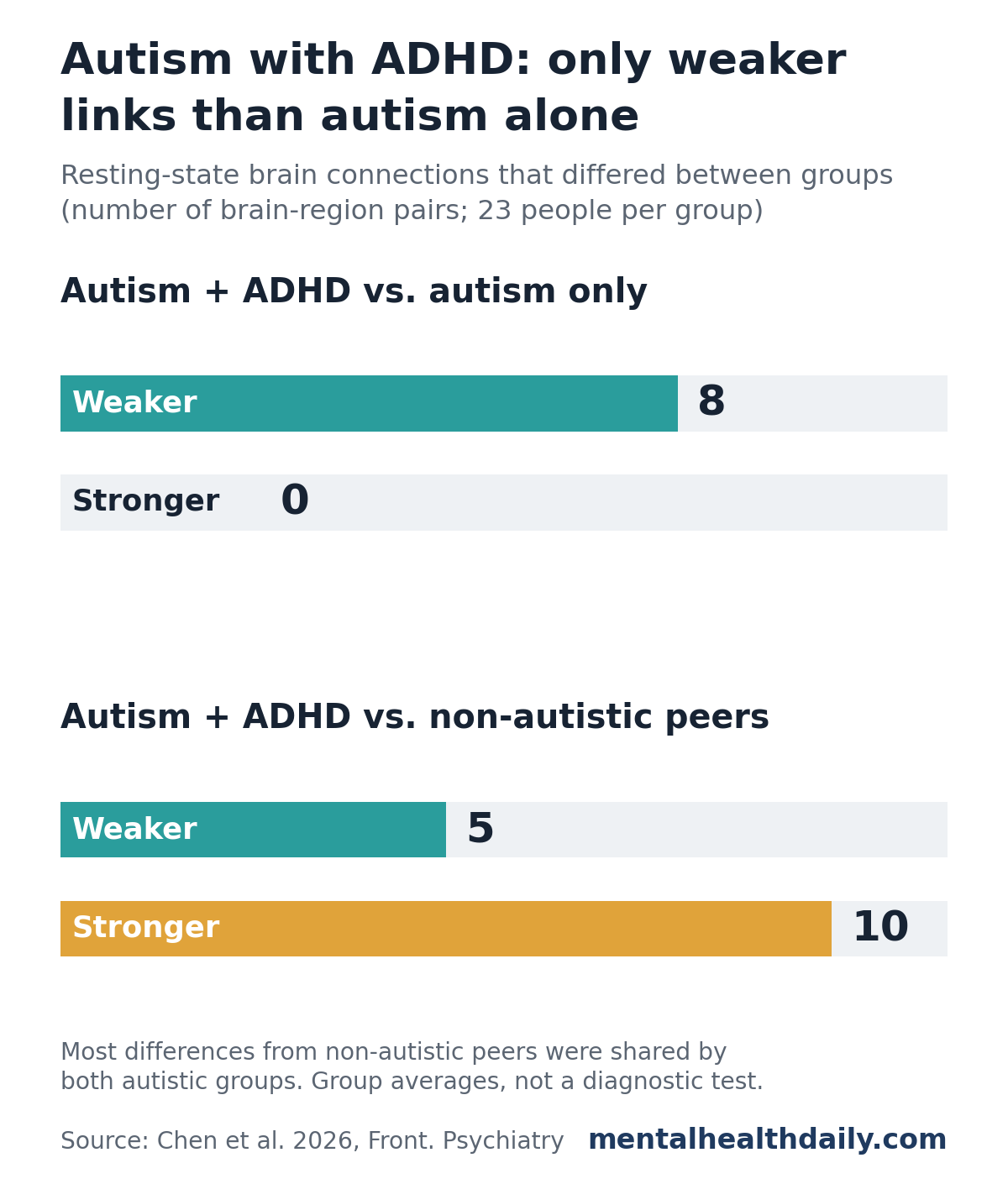
Compared with non-autistic peers, the autism-plus-ADHD group had a mixed picture: 10 stronger links and 5 weaker ones. Stronger links mostly ran from the hippocampus to the lower front of the brain, and from a default mode hub to executive regions.1
Shared Autism Patterns, Plus an ADHD-Linked Salience Difference
By checking each connection across all 3 groups, the researchers sorted the differences into types:
- Shared by both autistic groups: most hippocampus, default mode and executive network differences from non-autistic peers
- Specific to autism plus ADHD: lower connectivity of the anterior cingulate cortex, part of the salience network, with a frontal planning region, the thalamus and the posterior cingulate cortex
- Specific to autism alone: a few connections, such as the left hippocampus with deep structures, that were stronger only in the autism-only group
The anterior cingulate cortex helps monitor actions and hold back unwanted responses, so its weaker links fit the extra attention and impulse-control problems that come with ADHD.1
No connection showed a stepwise pattern, with autism plus ADHD furthest from non-autistic peers and autism alone in between. The researchers read this as autism plus ADHD being a distinct variant of autism rather than a more severe version of it.1
That fits a 2025 study of 282 children and teens, which found shared default mode differences in autism with and without ADHD, along with unique network patterns for each group that changed with age.5
2 Brain Connections Tracked Autism Symptoms Only Without ADHD
An exploratory analysis compared connectivity with autism symptom scores from a detailed parent interview. 2 links behaved differently depending on ADHD:1
- Hippocampus to anterior temporal lobe (a hub for word meaning and general knowledge): in autism alone, stronger connectivity went with milder verbal communication problems (r = −0.62). In autism plus ADHD, there was no clear link (r = 0.17).
- Posterior to anterior cingulate cortex: in autism alone, stronger connectivity went with milder repetitive behaviors (r = −0.48). In autism plus ADHD, the trend ran the opposite way (r = 0.42, not statistically significant).
Permutation testing, a check that reshuffles the data to see whether a result could arise by chance, supported both group differences. Still, each correlation rests on about 21 people, and some results lost significance after correction for multiple tests.1
Limits of This Small Autism-ADHD Imaging Study
This was a cross-sectional analysis of existing scans, so it describes group differences at one point in time. It cannot show that any connection causes symptoms, and it cannot tell an individual whether they have ADHD.
- Small groups: 23 per group, which the researchers note could miss real effects, including a stepwise pattern
- Lenient threshold: only 2 of the reported differences held at a stricter statistical cutoff
- No ADHD-only group: so the study cannot separate effects of ADHD itself from effects of having both conditions
- Rest only: differences may look different while people are doing a task
- Narrow sample: 2 sites of one older dataset, mostly male, average IQ, with medication use not reported
The researchers suggest support programs for autistic people with ADHD might pay more attention to memory, but memory was not tested here. That idea needs direct study, and the brain findings need replication in a larger, independent dataset such as ABIDE II.1
For families: if an autistic child also struggles with attention, impulsivity or hyperactivity, an ADHD evaluation is the useful step. Brain scans like these are research tools and are not used to diagnose either condition.
References
- Chen L, Riggs A, Luckenbach N. Overlapping and distinct intrinsic connectivity of hippocampal and triple networks in autistic individuals with and without a comorbid condition of ADHD. Frontiers in Psychiatry. 2026;17:1894578. doi:10.3389/fpsyt.2026.1894578
- Rong Y, Yang CJ, Jin Y, Wang Y. Prevalence of attention-deficit/hyperactivity disorder in individuals with autism spectrum disorder: a meta-analysis. Research in Autism Spectrum Disorders. 2021;83:101759. doi:10.1016/j.rasd.2021.101759
- Menon V. Large-scale brain networks and psychopathology: a unifying triple network model. Trends in Cognitive Sciences. 2011;15(10):483–506. doi:10.1016/j.tics.2011.08.003
- Di Martino A, Yan CG, Li Q, et al. The autism brain imaging data exchange: towards a large-scale evaluation of the intrinsic brain architecture in autism. Molecular Psychiatry. 2014;19(6):659–667. doi:10.1038/mp.2013.78
- Wang T, Xue Y, Mohamed ZA, Jia F. Developmental functional brain network abnormalities in autism spectrum disorder comorbid with attention deficit hyperactivity disorder. European Journal of Pediatrics. 2025;184:166. doi:10.1007/s00431-025-05989-x