hit counter

Cognitive Reserve in First-Episode Psychosis: Education PRS Adds 4.2%

Photoreal illustration of brain with strengthening neural networks suggesting reserve and protection against cognitive decline.

A 2026 analysis of 174 people with non-affective first-episode psychosis found that cognitive reserve was tied to 3 signals available near illness onset: age at onset, family history of psychosis, and polygenic liability for educational attainment. Adding the education polygenic score raised the model’s adjusted R² from 13.5% to 17.7%, a real but modest gain …

Read more

Catatonia Linked to Lower Left Paracingulate Sulcus Rate (28% vs 53%)

Photoreal illustration of a brain with the anterior cingulate cortex highlighted, representing transdiagnostic structural markers of catatonia.

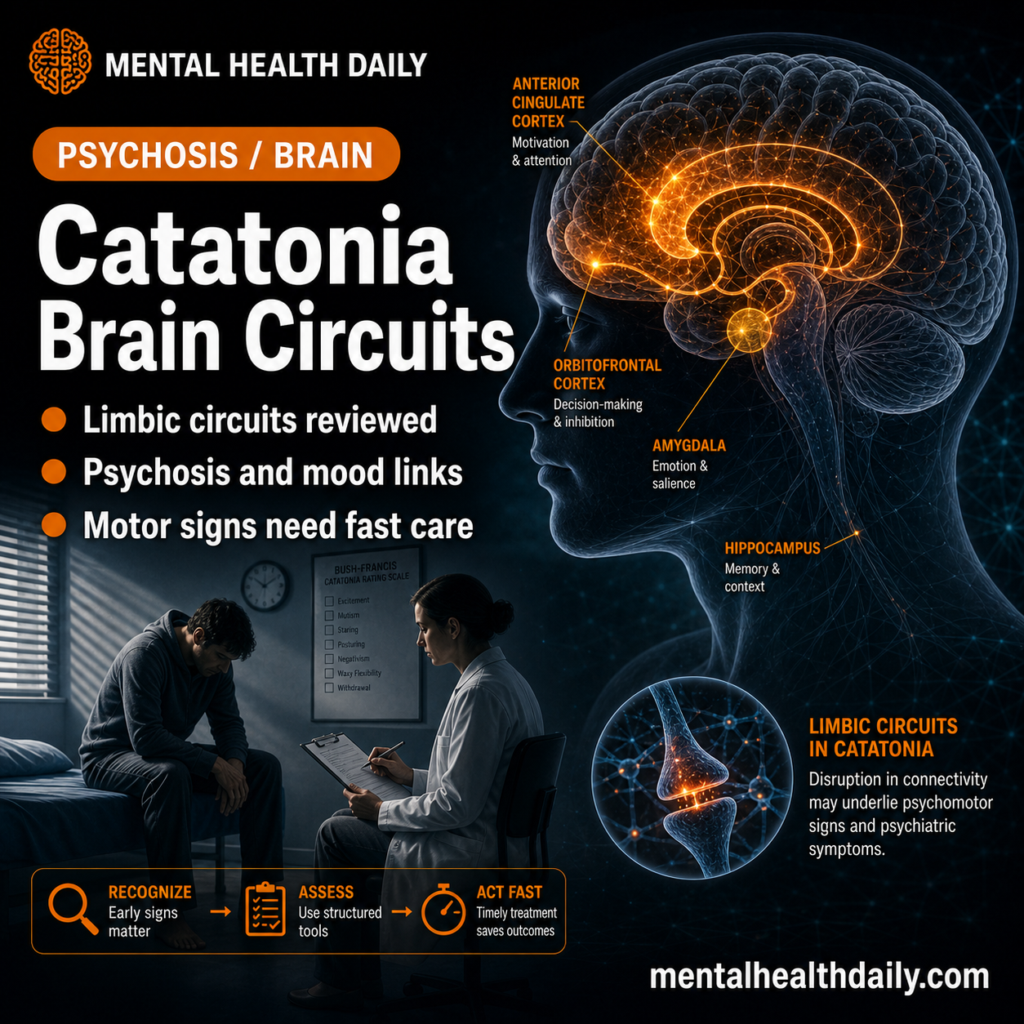
A 2026 hospital MRI study found that the left paracingulate sulcus was present in 31 of 109 catatonia patients (28%) vs. 171 of 323 psychiatric controls without catatonia (53%), a left-hemisphere group effect that survived adjustment for age, sex, scanner, brain volume, benzodiazepines, and antipsychotics.1 Research Highlights Left PCS signal: left paracingulate sulcus (PCS) presence …

Read more

Psychedelic Hallucinations May Reflect Wake-Time Memory Replay

Photoreal illustration of a brain shifting between perception and generative imagery under psychedelic influence.

A 2026 eLife computational study modeled classical psychedelics by increasing a network state variable from alpha = 0 to alpha = 1, shifting perception from bottom-up sensory inference toward top-down generative replay. The result is a useful but still unproven oneirogen model: hallucinations look less like random noise and more like wake-time replay of a …

Read more

Antipsychotic Shortages Caused Drug Switching: 95,968-Patient Claims Study (2026)

First-generation antipsychotic (FGA) shortages are not just pharmacy annoyances; they force medication changes in people who may have taken years to stabilize on a tolerable regimen. Research Highlights 95,968 patients: Tabah 2026 used Komodo claims data to study people with psychotic-spectrum diagnoses taking shortage-affected first-generation antipsychotics. Switching was not evenly distributed: molindone reached 100% switching, …

Read more

Schizophrenia Dementia Risk: Diabetes, Head Injury, Substance Use

Photoreal illustration of an aging brain with cardiovascular and lifestyle risk imagery, conveying preventable dementia drivers in schizophrenia.

Patients with schizophrenia have substantially elevated dementia risk compared to the general population — roughly 2-3 times the age-adjusted rate — but the specific drivers within the schizophrenia population have been less well characterized. A 2026 case-control study by Ho et al. used population-based data to identify which factors specifically elevate dementia risk among schizophrenia …

Read more

Machine Learning Predicts Clozapine Initiation in Schizophrenia

Photoreal illustration of an electronic health record dashboard with clinical text and a model output highlighted, representing ML prediction in psychiatry.

Clozapine is the only medication with proven efficacy for treatment-resistant schizophrenia, yet most eligible patients wait years before starting it. A 2026 paper by Perfalk and colleagues trains a machine-learning model on routine electronic health record data to flag candidates earlier.1 Research Highlights Clozapine is the only evidence-based treatment for treatment-resistant schizophrenia (TRS), but the …

Read more