About 9 in 10 children referred for ADHD or autism had elevated symptoms in at least 2 of 4 areas — ADHD, autism, defiance and learning problems — and the same overlap showed up in ordinary community children at lower rates, according to a 2026 Pennsylvania study based on mothers’ ratings.1
Research Highlights
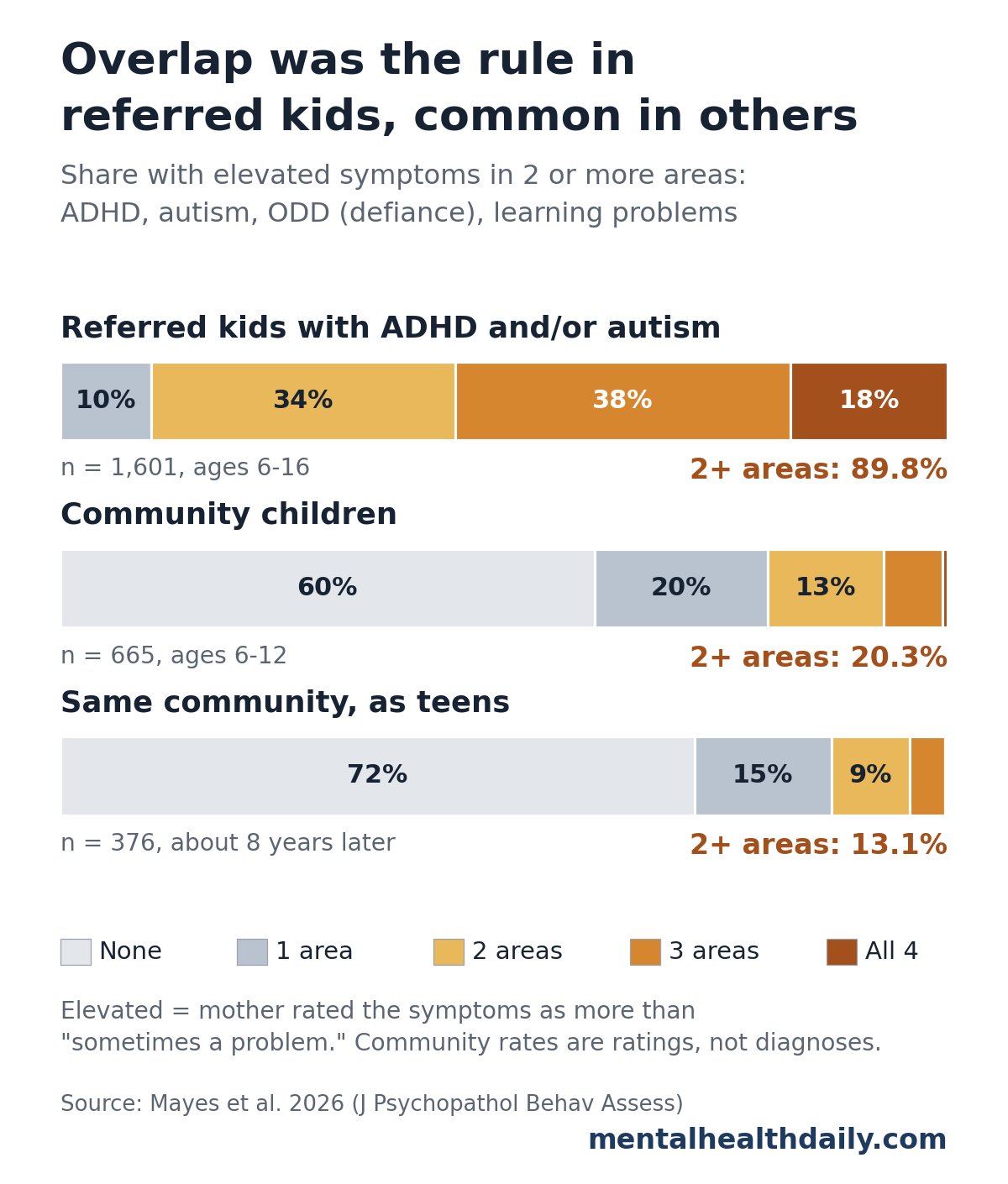
- Overlap was the norm in referred kids: of 1,601 children aged 6 to 16 diagnosed with ADHD and/or autism, 89.8% had elevated symptoms in 2 or more areas, and 17.7% had all 4. Only 10.2% had ADHD or autism alone.1
- Common in the community too: among 665 children from the general population, 20.3% had 2 or more elevated areas — about as many as the 19.5% with just 1. About 8 years later, 13.1% of the 376 re-checked teens had 2 or more.1
- Most autistic children also had ADHD and defiance symptoms: in the referred group, 80% of children with autism had combined-type ADHD, and 72% had elevated symptoms of oppositional defiant disorder (ODD).1
- Inattention went with learning problems: in all 3 samples, attention problems were the only symptom uniquely linked to academic difficulties, and the only one linked to lower reading and math test scores where tests were given.1
- Hyperactivity went with defiance: hyperactive and impulsive behavior was the symptom most strongly linked to ODD symptoms, with correlations of 0.53 to 0.62.1
How the Study Rated ADHD, Autism, Defiance and Learning Problems
Susan Mayes et al. at Penn State College of Medicine compared 2 groups of children rated with the same questionnaire. Mothers filled out the Pediatric Behavior Scale, rating each problem behavior over the past 2 months from 0 (almost never) to 3 (very often).1
- Referred sample: 1,601 children aged 6 to 16 (average age 8.9) seen at a psychiatry diagnostic clinic for behavior problems or possible autism or ADHD. A licensed psychologist diagnosed every child with ADHD, autism or both after parent interviews, parent and teacher rating scales, testing and observation. About 74% were boys and 92% were White.
- Community sample: 665 children aged 6 to 12 from a population-based study of sleep in central Pennsylvania, with 376 of them rated again an average of 8 years later (average age 16.4). These children were not clinically evaluated.
- IQ: all children had an IQ of 70 or higher, so the results do not cover children with intellectual disability.
The questionnaire covered 4 areas, each built from a handful of everyday behaviors:
- ADHD: inattention (short attention span, easily distracted, fails to finish things) and hyperactivity/impulsivity (restless, fidgety, acts without thinking, interrupts). Children with high scores on both had combined-type ADHD; those with mainly attention problems had inattentive-type ADHD.
- Autism: spends a lot of time alone, odd movements such as hand flapping, repeats the same actions or topics, upset by change.
- Oppositional defiant disorder: ODD is a pattern of irritable mood and defiant behavior toward adults. The scale asked about disobeying, arguing, being uncooperative, irritability, overreacting and temper tantrums.
- Academic impairment: difficulty learning even when trying hard, underachieving, low grades and trouble with reading, writing or math.
A score counted as elevated when the mother’s average rating in an area was more than “sometimes a problem.” In the referred group, ADHD and autism came from clinical diagnoses, while ODD and academic impairment came from mothers’ ratings. In the community groups, every area came from mothers’ ratings.1
89.8% of Referred Children Had Symptoms in 2 or More Areas
Among the 1,601 referred children, a single problem was the exception. Only 10.2% had ADHD or autism with no other elevated area.1
- 2 areas: 34.3%
- 3 areas: 37.8%
- All 4 areas: 17.7%
Specific pairings in the referred group were striking:1
- Autism with ADHD: 80% of children with autism had combined-type ADHD, and another 10% had inattentive-type ADHD.
- ADHD with autism: 47% of children with combined-type ADHD had autism, compared with 19% of those with inattentive-type ADHD.
- ODD: 73% of children with combined-type ADHD and 72% of children with autism had elevated ODD symptoms. Of children with ODD symptoms, 86% had combined-type ADHD.
- Learning problems: 99% of children with elevated academic impairment had ADHD of either type.
Defiance was highest with ADHD plus autism. Children with both combined-type ADHD and autism had the highest ODD scores, followed by combined-type ADHD alone. Both groups scored higher than children with autism alone, inattentive-type ADHD plus autism or inattentive-type ADHD alone.1
Learning problems were highest with ADHD alone. Mothers rated academic impairment higher for children with ADHD only (either type) than for any group that included autism.1
Community Children Showed the Same Overlap at Lower Rates
Referred children are selected for having problems, so heavy overlap there is partly expected. The community sample shows whether the pattern holds outside clinics.1
Among the 665 community children, 60.2% had no elevated area, 19.5% had 1 and 20.3% had 2 or more (13.1% with 2, 6.6% with 3 and 0.6% with all 4). Children with any elevated area were about as likely to have 2 or more as to have just 1.1
- Combined-type ADHD symptoms: about half of these children also had elevated academic impairment and ODD ratings.
- Inattentive-type symptoms: 40% also had elevated academic impairment.
- Academic impairment: 79% of children with elevated ratings also had ADHD symptoms.
- Autism symptoms: rare (under 3%), but 78% of those children also had combined-type ADHD symptoms.
The teen follow-up looked similar. Of the 376 youth re-rated about 8 years later, 71.5% had no elevated area, 15.4% had 1 and 13.1% had 2 or more. Among teens with combined-type ADHD symptoms, 56% had elevated ODD ratings and 56% had elevated academic impairment ratings.1
The researchers concluded that overlap is not just a product of who gets referred to clinics: it also appears in the wider population of children seen in schools and primary care.1
Inattention Was Linked to Learning Problems, Hyperactivity to Defiance
Because the problem areas overlapped so much, the team used correlations and regression models to see which symptoms were most closely linked to which problems. Two pairings stood out in all 3 samples.1
Inattention and learning problems: correlations between attention problems and academic impairment ratings were 0.38 in referred children and 0.67 in both community samples. In regression models, inattention was the only symptom uniquely linked to academic impairment. Hyperactivity, autism and ODD ratings added little once inattention was counted.1
Inattention and test scores: in the 2 samples that took standardized achievement tests (referred children and community children), inattention was also the only significant correlate of lower reading and math scores. That link was small in the referred group (R = 0.09 for reading and 0.14 for math) and somewhat larger in community children (0.24 and 0.28).1
Hyperactivity and defiance: hyperactive/impulsive ratings correlated with ODD ratings at 0.53 in referred children, 0.59 in community children and 0.62 in teens. Adding inattention, autism and academic ratings explained less than 4% more of the variation in ODD.1
This split fits a familiar pattern: learning problems are common in both ADHD types because both include attention problems, while defiance is more common in combined-type ADHD, which adds hyperactivity and impulsivity.1
Earlier Research on ADHD in Autism and Missed Diagnoses
The ADHD rate among referred autistic children (90% with either type) is higher than pooled estimates. A 2021 meta-analysis of 63 studies estimated that 38.5% of people with autism currently had ADHD, with rates varying by age, intellectual disability, recruitment setting and diagnostic criteria.2 Mayes et al. point out that many studies never assess every child for ADHD, which pushes prevalence estimates down.1
ADHD can delay an autism diagnosis. A 2019 Dutch study found that children and teens first diagnosed with ADHD received their autism diagnosis an average of 1.8 years later than autistic children without an earlier ADHD diagnosis.3
Missed ADHD in autism has a history. Until DSM-5 in 2013, the psychiatric manual did not allow ADHD to be diagnosed alongside autism, so many autistic children were never assessed or treated for it.1
ADHD and school outcomes: a 2020 systematic review of 176 long-term studies found that most achievement-test and academic-performance outcomes were worse in people with untreated ADHD than in peers without ADHD, and that treatment was associated with better outcomes.4
Limitations of This Mother-Report Study
- Ratings, not diagnoses: community children were never clinically evaluated, and ODD and academic impairment were based on mothers’ ratings in every group. The symptom comparisons analyzed only mothers’ ratings.
- Selected clinic sample: referred children came in because of behavior problems or possible ADHD or autism, which raises the rates of both.
- One region: both samples came from central Pennsylvania, and the referred sample was 92% White. Results need replication in more diverse groups.
- Associations only: the symptom links are correlations measured at the same time, so they do not show that inattention causes learning problems or that hyperactivity causes defiance.
- Other conditions left out: anxiety, depression and conduct problems were not analyzed, and children with IQ below 70 were excluded.
What This Means for Children Being Evaluated for ADHD or Autism
One diagnosis is often not the whole picture. The researchers recommend that when a child is evaluated for any of these 4 problems, clinicians check for the other 3 as well. Broad rating scales help, but they should be paired with autism-specific tools, since many broad scales do not cover autism.1
Learning problems are worth an attention check. Because most children with academic impairment in this study had ADHD symptoms, the researchers suggest considering ADHD in children referred for learning difficulties.1
Different symptoms, different targets. The researchers suggest that addressing inattention may help learning and addressing hyperactivity and impulsivity may ease defiant behavior. This study did not test treatments, so those ideas rest on the symptom links and on earlier treatment research.1
Parents who notice attention problems, defiance, social differences or school struggles in the same child can ask for an evaluation that looks at all of them together.
References
- Mayes SD, Villalongo Andino M, Mattison RE, Waschbusch DA. Co-occurring symptoms of ADHD, autism, oppositional defiant disorder, and academic impairment in referred and community children. Journal of Psychopathology and Behavioral Assessment. 2026;48:59. doi:10.1007/s10862-026-10317-0
- Rong Y, Yang CJ, Jin Y, Wang Y. Prevalence of attention-deficit/hyperactivity disorder in individuals with autism spectrum disorder: a meta-analysis. Research in Autism Spectrum Disorders. 2021;83:101759. doi:10.1016/j.rasd.2021.101759
- Kentrou V, de Veld DMJ, Mataw KJK, Begeer S. Delayed autism spectrum disorder recognition in children and adolescents previously diagnosed with attention-deficit/hyperactivity disorder. Autism. 2019;23(4):1065–1072. doi:10.1177/1362361318785171
- Arnold LE, Hodgkins P, Kahle J, Madhoo M, Kewley G. Long-term outcomes of ADHD: academic achievement and performance. Journal of Attention Disorders. 2020;24(1):73–85. doi:10.1177/1087054714566076