
Teens who have both ADHD and developmental coordination disorder (DCD) reported less resilience, less hope and a weaker sense that life is manageable and meaningful than typical teens, according to a 2026 study of 105 Israeli adolescents.1
Research Highlights
- Lower scores with both conditions: the 23 teens with ADHD plus DCD scored lower than 45 typical teens on resilience (p = 0.017), hope (p = 0.001) and sense of coherence (p = 0.007), with moderate-to-large gaps (Hedges’ g 0.72 to 0.87).1
- One diagnosis, smaller differences: the 37 teens with ADHD or DCD alone did not differ significantly from typical teens on these 3 totals, and they did not differ significantly from the teens with both conditions either.1
- The personal side of resilience stood out: on the personal part of the resilience scale, both diagnosed groups scored lower than typical teens.1
- Hope and sense of coherence went with resilience: together with diagnosis group, they accounted for 54.7% of the variation in resilience scores.1
- Small, one-time snapshot: the study was cross-sectional and relied on questionnaires, so it shows differences between groups, not causes.1
What DCD, Hope and Sense of Coherence Mean
Developmental coordination disorder (DCD), sometimes called dyspraxia, is a lasting difficulty learning and carrying out movement skills. Children with DCD tend to be clumsy, slow or inaccurate with tasks like handwriting, catching a ball or tying shoes, and it affects about 5% of children and teens.1
ADHD and DCD often show up together. Rates of overlap as high as 50% have been reported, so many teens live with both attention problems and motor problems at once.1
The study looked at 3 related inner resources that help young people cope:
- Resilience: the ability to recover and adapt after stress or setbacks.
- Hope: in psychology, the belief that you can find ways to reach your goals (“pathways”) and the drive to keep going toward them (“agency”).
- Sense of coherence: a general feeling that life is understandable, manageable and meaningful. People with a strong sense of coherence tend to handle stress better.
How the Israeli Study Grouped 105 Teens
Yael Rozman and Miri Tal-Saban, occupational therapy researchers at the Hebrew University of Jerusalem, recruited families through social media in 2023. Of 177 who responded, 105 teens aged 12 to 18 made it into the final analysis.1
Diagnoses were confirmed with more than a parent’s word:
- ADHD: a physician diagnosis reported by a parent, plus enough current symptoms on a standard parent rating scale.
- DCD: a prior diagnosis or a high score on a coordination questionnaire, plus a score below the 16th percentile on a hands-on movement test given by occupational therapists.
- Typical teens: no diagnosis, and scores below the cutoffs on the ADHD and coordination questionnaires.
That produced 3 groups: 37 teens with ADHD or DCD alone, 23 with both, and 45 typically developing teens. The researchers merged the ADHD-only and DCD-only teens into one group after finding no significant differences between them.1
Teens with diagnosed anxiety, depression or other psychiatric or medical conditions were left out. About 61% of teens in each diagnosed group took ADHD medication, and medication use was not linked to any of the 3 scores.1
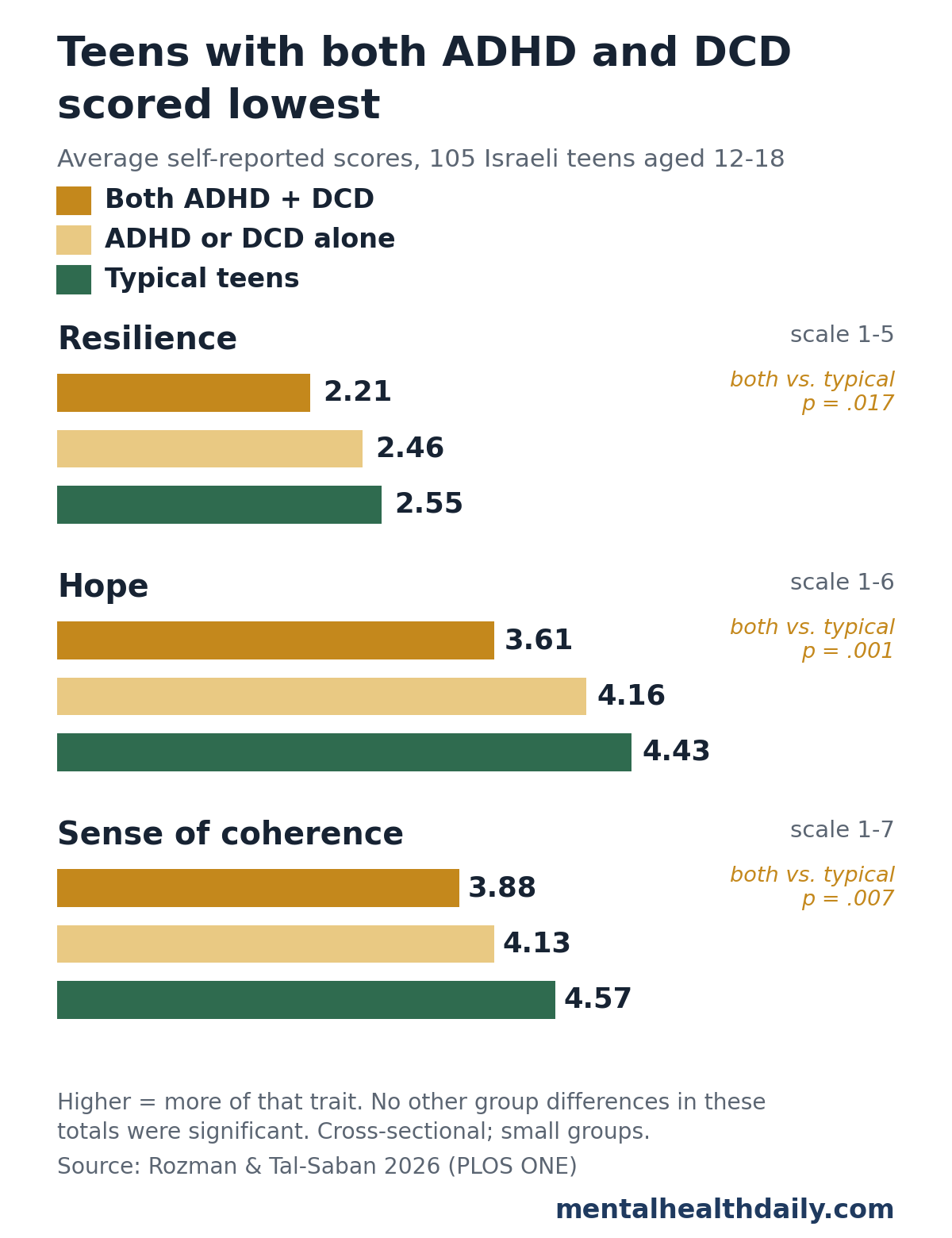
Teens With Both ADHD and DCD Scored Lowest on All 3 Measures
Each teen filled out 3 questionnaires: an 88-item resilience scale scored 1 to 5, a 6-item hope scale scored 1 to 6, and a 13-item sense of coherence scale scored 1 to 7. Higher scores mean more of each trait.1
On every measure, teens with both conditions had the lowest average, and their gap from typical teens was statistically significant:1
- Resilience: 2.21 vs. 2.55 in typical teens (g = 0.72, p = 0.017)
- Hope: 3.61 vs. 4.43 (g = 0.87, p = 0.001)
- Sense of coherence: 3.88 vs. 4.57 (g = 0.79, p = 0.007)
Effect size: Hedges’ g measures a gap between groups in standard-deviation units. Values from 0.72 to 0.87 mean the typical teens scored roughly three-quarters of a standard deviation higher, a moderate-to-large difference for questionnaire research.
Both parts of hope were lower in teens with both conditions. They scored lower than typical teens on agency, the drive to pursue goals (g = 0.87), and on pathways, the sense of knowing how to get there (g = 0.71).1
Teens With ADHD or DCD Alone Mostly Scored Like Typical Peers
The single-diagnosis group landed between the other 2 groups on all 3 measures. None of their total scores differed significantly from typical teens, which went against the researchers’ expectations and against some earlier studies of ADHD or DCD alone.1
The researchers had also predicted that teens with both conditions would score below teens with one. Their averages were lower, but those differences were not statistically significant. With only 23 and 37 teens in these groups, the study had limited power to detect gaps of that size.1
One exception: the resilience scale has 5 parts — self, family, peers, school and community. Only the “self” part, which covers self-confidence, emotional awareness, negative thinking, social skills and empathy, differed by group after correcting for multiple tests.1
- Both conditions vs. typical: 2.05 vs. 2.54 (g = 1.12, p < 0.001)
- One condition vs. typical: 2.30 vs. 2.54 (g = 0.58, p = 0.037)
Family, peer, school and community resilience did not differ between groups. The researchers suggest that similar home areas and regular schools across the groups may explain this.1
Hope and Sense of Coherence Tracked Closely With Resilience
Across all 105 teens, the 3 measures moved together. Resilience correlated with hope at r = 0.66 and with sense of coherence at r = 0.64, while hope and sense of coherence correlated at r = 0.55.1
In a step-by-step regression model, diagnosis group alone explained 7.3% of the variation in resilience. Adding hope and sense of coherence raised that to 54.7%, and diagnosis group was no longer a significant factor. Hope and sense of coherence each contributed about equally.1
These 3 traits overlap in meaning and were measured with the same kind of questionnaire at the same time, which pushes correlations up. The researchers describe the model as showing statistical associations, not that raising hope would raise resilience.1
Earlier Research on ADHD, DCD and Emotional Well-Being
Other studies have linked ADHD, and especially ADHD combined with DCD, to more emotional strain:
- Resilience in ADHD: a family study found that adolescents with ADHD had lower resilience than both their unaffected siblings and typical teens, even after accounting for anxiety and depression.2
- Depression and anxiety: a study of 244 children found that those with both DCD and ADHD were at particularly high risk of clinically significant depression and anxiety.3
- Peer problems: in a small study of 44 adolescents, those with both conditions reported more peer victimization and rated their school environment lower than typical teens and teens with DCD alone, although overall quality of life did not differ.4
- A distinct profile: a 2023 systematic review found that children with both conditions had worse motor skills than children with either one, and that their brain-network differences were not simply the sum of the 2 conditions.5
The Israeli result fits this picture: teens with both diagnoses look like the group most in need of attention to their emotional resources. It adds hope and sense of coherence to a literature that has focused mainly on distress and problems.
Limitations of This Small Study of Teens With ADHD and DCD
- Small, uneven groups: only 23 teens had both conditions, and the DCD-only subgroup was very small, which limits precision and the ability to detect differences between diagnosed groups.
- One-time snapshot: the cross-sectional design cannot show whether the conditions lower hope and resilience or whether other factors explain the gaps.
- Self-report only: all 3 outcomes were questionnaires filled out by the teens at the same time.
- Group checks were uneven: typical teens did not take the hands-on movement test, the test was used past its normal age range for 17- and 18-year-olds, and the therapists giving it knew which group each teen was in.
- Who took part: families volunteered through social media in Israel, and teens with diagnosed anxiety or depression were excluded, so the results may not apply to teens who also live with those conditions.
What This Means for Teens With ADHD and DCD
Check for both conditions. Because ADHD and DCD so often overlap, a teen with one may also have the other. The researchers note that many earlier studies of ADHD or DCD did not screen for the second condition, which could blur results.1
Ask about inner resources, not only symptoms. The researchers suggest that hope, sense of coherence and resilience be considered alongside attention and motor difficulties during assessment, as part of strengths-based support involving teens, families, teachers and clinicians.1
Treat this as an early finding. The study did not test any program to build hope or resilience. Larger studies that follow teens over time are needed to confirm which groups differ and why.
References
- Rozman Y, Tal-Saban M. Differences in resilience, hope, and sense of coherence among adolescents with ADHD/DCD, co-occurring ADHD and DCD, and typically developing adolescents. PLOS ONE. 2026;21(9):e0357815. doi:10.1371/journal.pone.0357815
- Regalla MAR, Segenreich D, Guilherme PR, Mattos P. Resilience levels among adolescents with ADHD using quantitative measures in a family-design study. Trends in Psychiatry and Psychotherapy. 2019;41(3):262–267. doi:10.1590/2237-6089-2018-0068
- Missiuna C, Cairney J, Pollock N, Campbell W, Russell DJ, Macdonald K, et al. Psychological distress in children with developmental coordination disorder and attention-deficit hyperactivity disorder. Research in Developmental Disabilities. 2014;35(5):1198–1207. doi:10.1016/j.ridd.2014.01.007
- Dewey D, Volkovinskaia A. Health-related quality of life and peer relationships in adolescents with developmental coordination disorder and attention-deficit-hyperactivity disorder. Developmental Medicine & Child Neurology. 2018;60(7):711–717. doi:10.1111/dmcn.13753
- Pranjić M, Rahman N, Kamenetskiy A, Mulligan K, Pihl S, Arnett AB. A systematic review of behavioral and neurobiological profiles associated with coexisting attention-deficit/hyperactivity disorder and developmental coordination disorder. Neuroscience & Biobehavioral Reviews. 2023;153:105389. doi:10.1016/j.neubiorev.2023.105389