hit counter

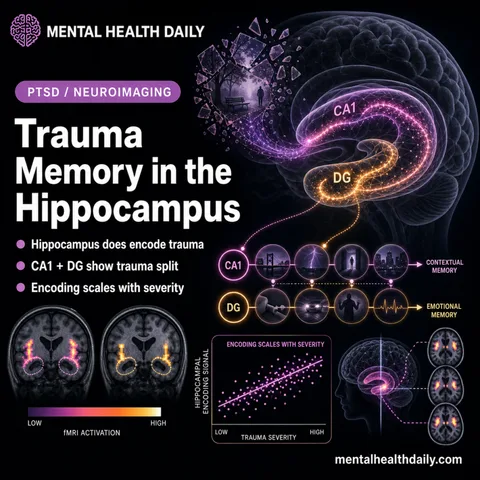
PTSD Trauma Memories Are Encoded in Hippocampal Semantic Maps

Photoreal illustration of the hippocampus with semantic encoding pathways highlighted, representing trauma memory processing in PTSD.

A 2026 fMRI study of 79 women with interpersonal-violence-related PTSD found that the hippocampus does encode the meaning of autobiographical trauma narratives, t(140) = 4.05, p < 0.001, even though average hippocampal encoding did not rise for trauma vs. neutral memories. Research Highlights Hippocampal semantic encoding was significant: Cisler et al. analyzed 3,928 narrative sentences …

Read more

fMRI Biotypes Predicted tDCS Anxiety Response in Older Adults

Photoreal illustration of a clinician fitting a tDCS device on an older adult, with brain network biotype overlays.

A 2026 BETA analysis of 199 older adults found that resting-state fMRI could separate 4 anxiety-related tDCS response patterns, but the result was narrower than “brain scan predicts treatment”: only the Robust tDCS Responder subtype showed a statistically reliable Active vs. Sham anxiety advantage across all participants.1 Research Highlights Only 1 subtype cleared the Active …

Read more

Lisdexamfetamine (Vyvanse) Changes Brain Connectivity & Activation to Treat Binge Eating Disorder (2023 Study)

Binge-eating disorder (BED), characterized by recurrent episodes of overeating without compensatory behaviors, is a significant global health concern. Lisdexamfetamine dimesylate (LDX), the only drug approved for moderate to severe BED, is showing promise not just in reducing episodes but also in altering brain function in ways previously not fully understood. Through a groundbreaking study, researchers …

Read more

Escitalopram (Lexapro) Normalizes Brain Connectivity in Major Depression (2024 Study)

Major Depressive Disorder (MDD) significantly alters the brain’s network connectivity, with disturbances in the default mode network (DMN), salience network (SN), and dorsal attention network (DAN). A new study reveals how escitalopram, a common antidepressant, can partially reverse these abnormalities, offering insights into the biological underpinnings of its therapeutic effects. This research deepens our understanding …

Read more

Effects of Coffee & Caffeine on Brain Connectivity in Habitual Drinkers (2023 Study)

Coffee, one of the world’s most consumed beverages, is often lauded for its ability to enhance alertness and cognitive performance. Recent studies utilizing advanced neuroimaging techniques like resting-state functional magnetic resonance imaging (fMRI) have begun to unravel the intricate ways in which coffee, and its key component caffeine, modulate brain activity. This exploration into the …

Read more

Alpha Brain Waves (8-10 Hz) & Default Mode Network Linked to Self-Control (Behavioral Inhibition) (2023 Study)

In recent scientific endeavors, researchers are probing into the complex web of interactions that define our brain’s functioning. Focusing on the subtle interplay between alpha wave activity, the Default Mode Network (DMN), and behavioral inhibition, these studies are uncovering new layers of understanding about how our brains operate during different states of activity and rest. …

Read more