hit counter

Intellectual Disability in Korean Children and Psychiatric Disorders (ADHD 42%, Depression 19%)

Photoreal illustration of a child interacting with cognitive and developmental motifs, representing intellectual disability and psychiatric comorbidity.

Children with intellectual disability are 3–4x more likely to have a comorbid psychiatric disorder than peers without ID. A 2026 nationwide Korean study by Joo and colleagues tracks how those rates changed across a decade.1 Research Highlights Korean children and adolescents (ages 2–18) with intellectual disability had ADHD comorbidity rise from 30.2% in 2012 to …

Read more

Maternal Health and Autism Risk: Most Links Are Genetic, Not Prenatal

Stylized illustration of a multi-generation family tree branching into cousin pairs, representing the 3-generation registry design used to separate inherited from in-utero genetic effects on autism risk.

For two decades, headlines have linked autism to maternal obesity, depression, anxiety, gestational diabetes, infection, autoimmune disease, and antidepressant use. The studies behind those headlines are well-replicated registry associations. A new design from the Aarhus University iPSYCH group offers the most careful answer yet to what they mean for an individual pregnancy. Most “maternal X …

Read more

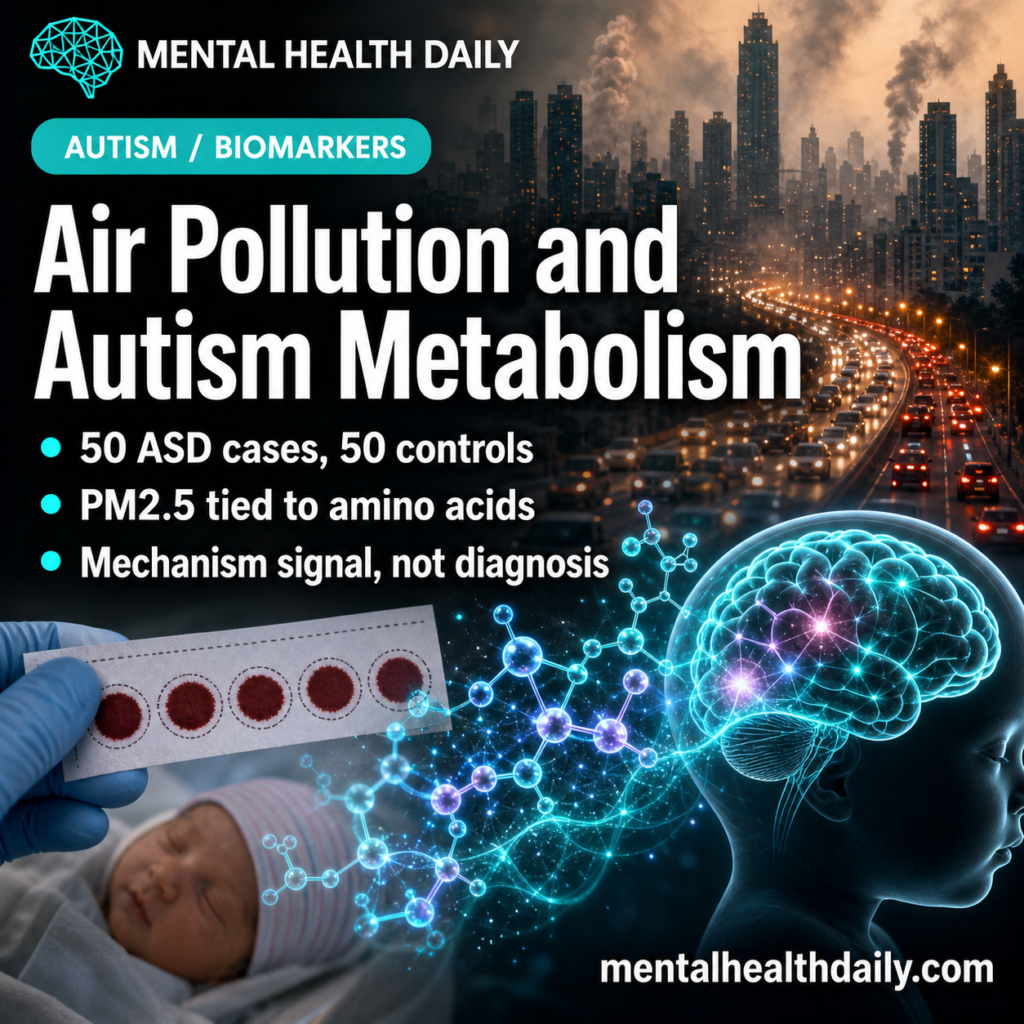
Air Pollution Increases Genetic Risk of Autism: Fine Particulate Matter (PM2.5) Most Problematic (2024 Study)

Air pollution is a global concern with far-reaching impacts on human health, including its potential role in the development of Autism Spectrum Disorder (ASD). Recent studies, including Mendelian randomization analyses, provide compelling evidence that particulate matter, specifically PM2.5, may increase the risk of ASD, offering new insights into the environmental factors contributing to the condition. …

Read more

ADHD Genetics Linked to Autism & Schizophrenia But Not Other Psychiatric Conditions (2024 Study)

Attention Deficit Hyperactivity Disorder (ADHD) is a complex neurodevelopmental condition that significantly impacts individuals’ lives. Recent advancements in genetic research, particularly Mendelian Randomization (MR) studies, have begun to unravel the intricate genetic associations between ADHD and other psychiatric disorders, offering new insights into their comorbidities. By leveraging data from genome-wide association studies (GWAS), this research …

Read more

Low Adiponectin Levels in Children with Autism Spectrum Disorder (ASD): Correlation with Symptom Severity (2024 Study)

In the intricate puzzle of autism spectrum disorders (ASD), emerging research highlights a fascinating piece: the role of adiponectin, an anti-inflammatory adipokine, in the development and severity of ASD in children. With the backdrop of increasing ASD prevalence and the quest for biomarkers for early identification, the exploration of adiponectin offers a promising avenue for …

Read more

Autism Genetics & Brain Cortex Surface Area (2024 Study)

Recent research has shed light on the complex relationship between Autism Spectrum Disorder (ASD) and alterations in the cortical surface area (SA) of the brain. By analyzing large-scale genetic data, scientists have begun to unravel the intricate genetic correlations and causal connections between these two factors. Highlights: Genetic Correlation Identified: The study found a nominal …

Read more

Autism Spectrum Disorder (ASD): Future Treatments with DNA, mRNA, Protein (CRISPR, ASOs, Drugs)

Autism Spectrum Disorder (ASD) represents a complex neurodevelopmental challenge with a strong genetic component. Recent advances in molecular biology have opened new avenues for potential therapeutic interventions, targeting the condition at the DNA, mRNA, and protein levels. Highlights: ASD is a genetically diverse condition, with many cases linked to loss-of-function mutations in specific genes. Innovative …

Read more