hit counter

Autism EEG Study Finds 2 Opposite Excitation-Inhibition Subtypes

Photoreal illustration of two opposing brain-network excitability profiles representing distinct autism neurosubtypes.

A 2026 medRxiv preprint did not find one simple autism excitation-inhibition signature. Bertelsen et al. found 2 EEG-derived E:I neurosubtypes in 286 autistic males: a 47% inhibition-dominant subtype with higher Hurst exponent and lower gamma, and a 53% excitation-dominant subtype with the opposite pattern.1 Research Highlights Two subtypes, opposite directions: in 286 autistic males ages …

Read more

Autism Gene-Expression Study Finds 3 Molecular Subtypes in 1,711 Samples

Photoreal illustration of brain with three highlighted gene-expression patterns showing distinct autism molecular subtypes.

A 2026 RNA-seq analysis of 1,711 autistic probands found 3 gene-expression clusters: 425 people with more severe restricted and repetitive behaviors than the other clusters, 282 with milder symptoms and better adaptive function than the other clusters, and 1,004 with stronger social-communication impairment than the other clusters.1 The supported claim is molecular stratification, not a …

Read more

Maternal Health and Autism Risk: Most Links Are Genetic, Not Prenatal

Stylized illustration of a multi-generation family tree branching into cousin pairs, representing the 3-generation registry design used to separate inherited from in-utero genetic effects on autism risk.

For two decades, headlines have linked autism to maternal obesity, depression, anxiety, gestational diabetes, infection, autoimmune disease, and antidepressant use. The studies behind those headlines are well-replicated registry associations. A new design from the Aarhus University iPSYCH group offers the most careful answer yet to what they mean for an individual pregnancy. Most “maternal X …

Read more

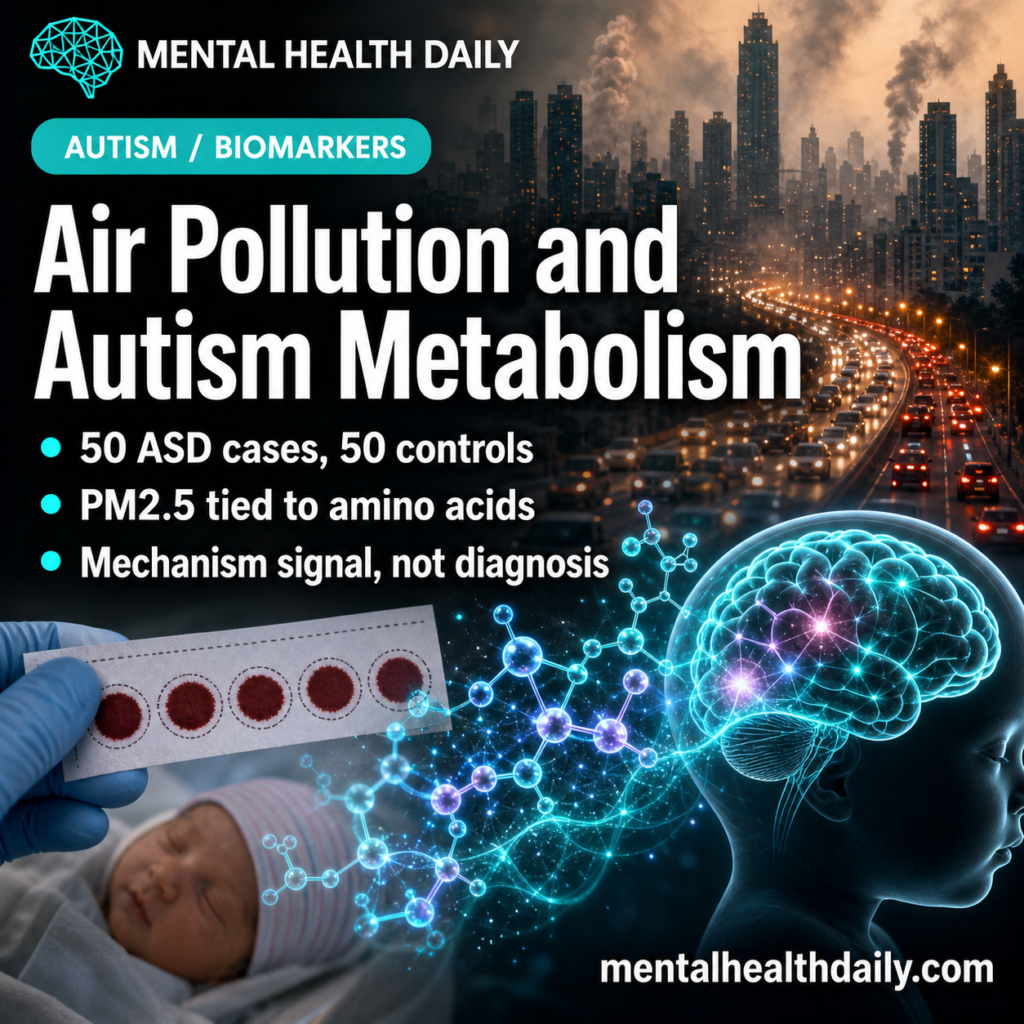
Air Pollution Increases Genetic Risk of Autism: Fine Particulate Matter (PM2.5) Most Problematic (2024 Study)

Air pollution is a global concern with far-reaching impacts on human health, including its potential role in the development of Autism Spectrum Disorder (ASD). Recent studies, including Mendelian randomization analyses, provide compelling evidence that particulate matter, specifically PM2.5, may increase the risk of ASD, offering new insights into the environmental factors contributing to the condition. …

Read more

ADHD Genetics Linked to Autism & Schizophrenia But Not Other Psychiatric Conditions (2024 Study)

Attention Deficit Hyperactivity Disorder (ADHD) is a complex neurodevelopmental condition that significantly impacts individuals’ lives. Recent advancements in genetic research, particularly Mendelian Randomization (MR) studies, have begun to unravel the intricate genetic associations between ADHD and other psychiatric disorders, offering new insights into their comorbidities. By leveraging data from genome-wide association studies (GWAS), this research …

Read more

Low Adiponectin Levels in Children with Autism Spectrum Disorder (ASD): Correlation with Symptom Severity (2024 Study)

In the intricate puzzle of autism spectrum disorders (ASD), emerging research highlights a fascinating piece: the role of adiponectin, an anti-inflammatory adipokine, in the development and severity of ASD in children. With the backdrop of increasing ASD prevalence and the quest for biomarkers for early identification, the exploration of adiponectin offers a promising avenue for …

Read more

Autism Genetics & Brain Cortex Surface Area (2024 Study)

Recent research has shed light on the complex relationship between Autism Spectrum Disorder (ASD) and alterations in the cortical surface area (SA) of the brain. By analyzing large-scale genetic data, scientists have begun to unravel the intricate genetic correlations and causal connections between these two factors. Highlights: Genetic Correlation Identified: The study found a nominal …

Read more