hit counter

Levetiracetam Range in Children: 2.82-24.37 mcg/mL TDM

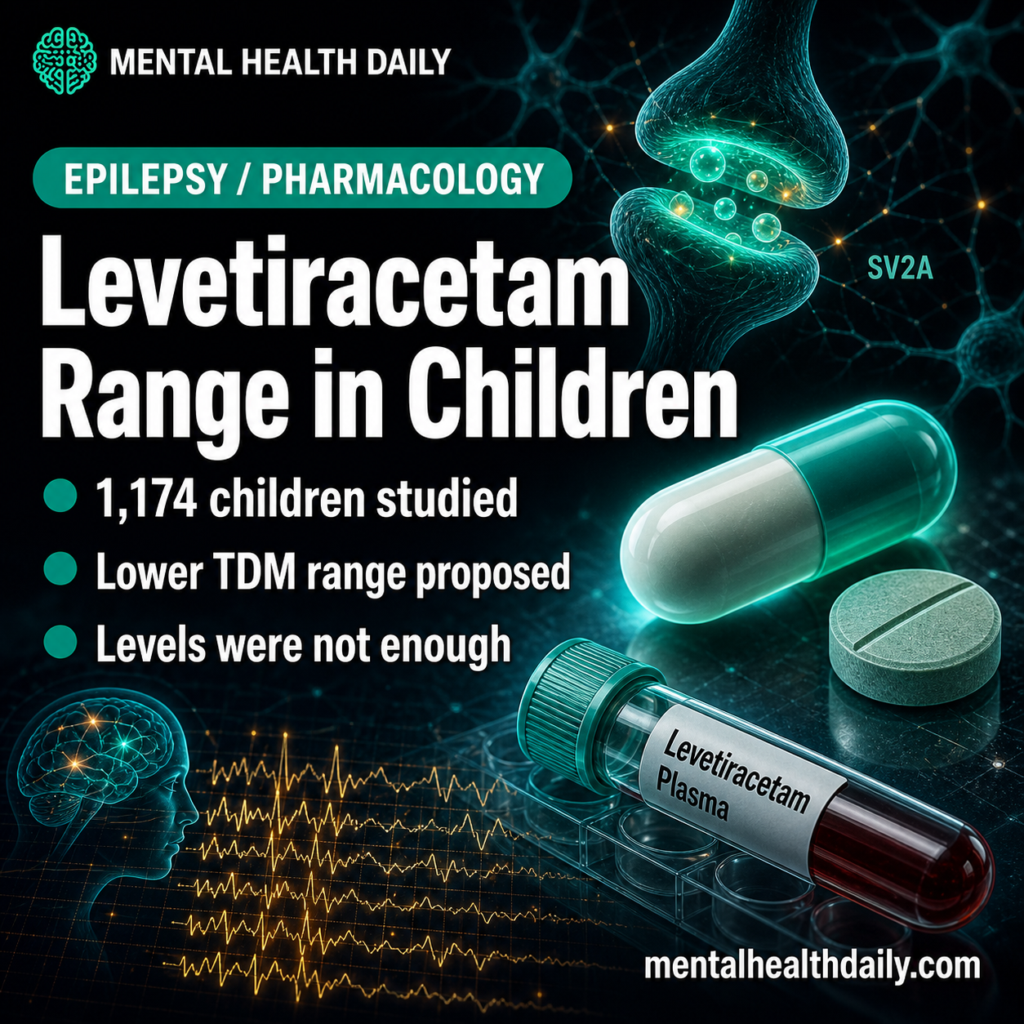
MHD featured image for levetiracetam therapeutic drug monitoring in children with epilepsy.

A 2026 real-world study involving 1,174 children with epilepsy proposed a levetiracetam therapeutic drug monitoring range of 2.82-24.37 mcg/mL, much lower than commonly cited adult-style ranges, but the same data also warned against treating a drug level as a stand-alone seizure-control predictor. Research Highlights Lower pediatric range: Sun et al. proposed an observational levetiracetam range …

Read more

Autoimmune Focal Epilepsy: Antibody Testing and Immunotherapy

MHD featured image for autoimmune drug-resistant focal epilepsy and immunotherapy.

A 2026 structured review of autoimmune drug-resistant focal epilepsy argues for a narrow but clinically important claim: immune mechanisms can make seizures refractory in selected patients, but the evidence supports targeted testing and immunotherapy triage rather than treating every medication-resistant seizure disorder as autoimmune. Research Highlights Autoimmune epilepsy is a subset: Kunecki et al. estimated …

Read more

Levetiracetam After Stroke: 9 Fewer Deaths in Older Adults

MHD featured image for levetiracetam continuation, post-stroke seizure prevention, and 90-day survival in older adults.

A 2026 Medicare target-trial emulation found continued levetiracetam after acute ischemic stroke was associated with 53 vs. 62 deaths per 1,000 over 90 days, a risk difference of −9 deaths per 1,000 favoring continuation. Research Highlights Survival signal: continued levetiracetam after an initial month of post-stroke use was linked to 53 deaths per 1,000 vs. …

Read more

Dynamic FDG-PET Signal Quality Beats Static PET in Focal Epilepsy

MHD featured image for dynamic FDG-PET signal quality in focal epilepsy neuroimaging.

A 2026 medRxiv study of 30 adults with drug-resistant focal epilepsy found that dynamic FDG-PET had higher model-adjusted signal quality than static PET in most brain regions, including >80% posterior probability of superiority in 29 of 36 regions. Research Highlights Dynamic PET beat static PET: interictal dynamic FDG-PET showed higher signal quality than static PET …

Read more

Closed-Loop Subgaleal ISP Reduced Epilepsy Seizure Incidence 80%

Editorial card showing subgaleal electrode strips, closed-loop seizure detection, and focused neurostimulation for therapy-resistant epilepsy.

A 2026 first-in-human medRxiv preprint reported that closed-loop subgaleal intersectional short-pulse stimulation shortened stimulated seizures by 52% on average and reduced seizure incidence by 80.9% after 48 hours in 5 high-frequency therapy-resistant epilepsy patients. The signal is promising because it combines responsive seizure detection with electrode strips placed under the scalp rather than electrodes implanted …

Read more

Resting EEG Supports Epilepsy More Than Functional Seizures

Photoreal illustration of EEG waveforms over a stylized brain, conveying network-based discrimination between two seizure-like disorders.

A 2026 diagnostic-accuracy preprint found that resting-state EEG network features separated non-lesional epilepsy from functional/dissociative seizures (FDS) at 67.5% balanced accuracy, but the signal was not symmetrical: sensitivity was 81.8% for epilepsy and only 53.3% for FDS.1 In plain clinical terms, the model looked more useful as an epilepsy-supporting marker than as a positive test …

Read more

VNS After Failed Epilepsy Surgery Reduced Seizures 76% at 36 Months

Photoreal illustration showing an implanted vagus nerve stimulator and brain pathways, representing neuromodulation for drug-resistant epilepsy.

A 2026 CORE-VNS registry analysis found that implanted vagus nerve stimulation still produced large 36-month seizure reductions after failed intracranial epilepsy surgery: median all-seizure reduction was 76.3% with prior surgery vs. 76.6% without prior surgery.1 Research Highlights Prior surgery did not blunt the main VNS signal: CORE-VNS reported 76.3% median all-seizure reduction at 36 months …

Read more