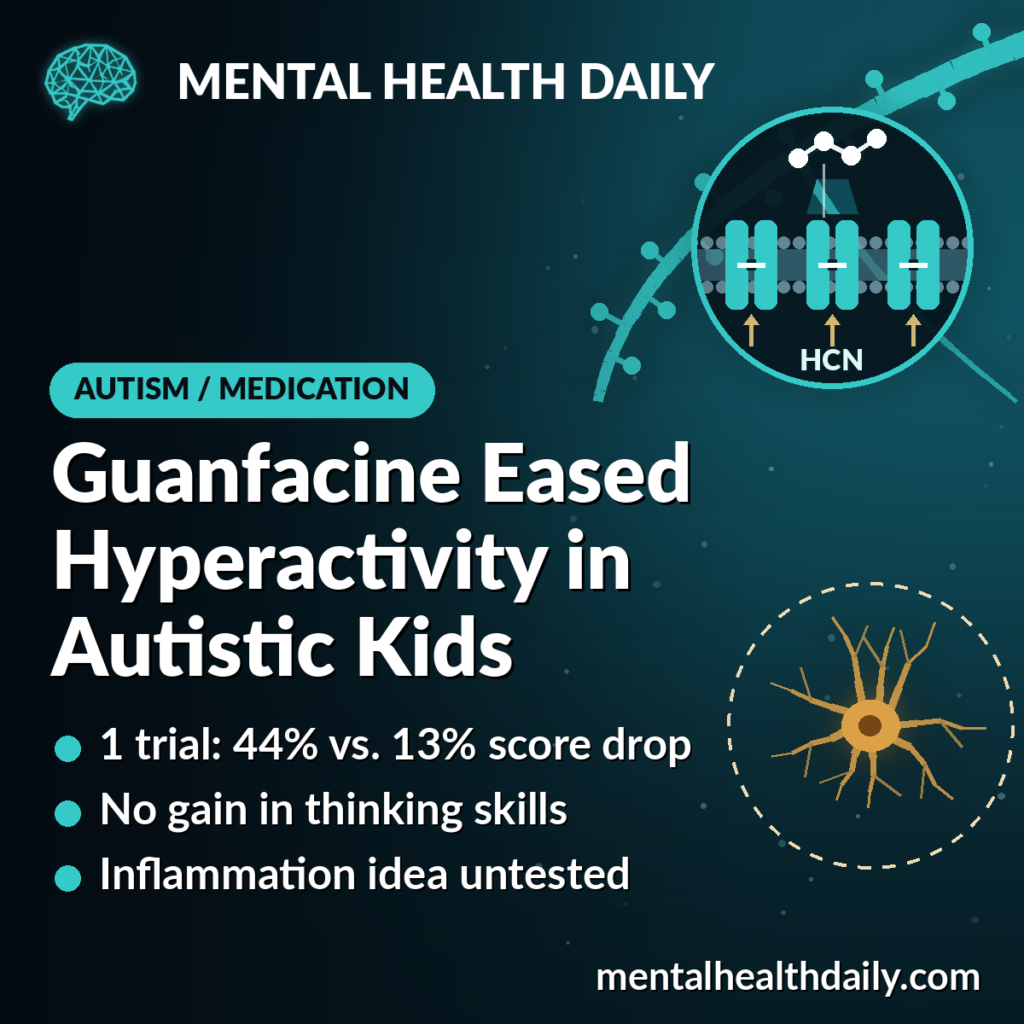
Guanfacine, a non-stimulant ADHD medication, reduced hyperactivity in autistic children in a placebo-controlled trial. A 2026 review argues it may also steady prefrontal brain signaling and calm the brain’s immune cells, but that immune effect has never been tested with guanfacine itself.1
Research Highlights
- Hyperactivity fell in the largest autism trial: in 62 autistic children, hyperactivity scores dropped 43.6% on extended-release guanfacine vs. 13.2% on placebo over 8 weeks, and 50% vs. 9.4% were rated much improved.2
- No gain in thinking skills: the same trial found no difference on a brief working memory and motor planning battery.2
- The brain-cell mechanism is well studied in animals: in monkeys and rats, guanfacine strengthens prefrontal firing by closing HCN channels, a type of ion channel that leaks signal out of neurons.3
- The anti-inflammatory idea is borrowed: it rests on norepinephrine, dexmedetomidine and other related drugs, and no trial has measured inflammation in autistic people taking guanfacine.1
- A narrative review, not new data: the authors call it a research framework, not evidence for prescribing guanfacine for autism.1
How the Review Says Guanfacine Could Act in Autism
Kazuhiko Yamamuro et al., researchers at Nara Medical University and Kumamoto University in Japan, published the review in Frontiers in Molecular Neuroscience in September 2026. It pulls together pharmacology, animal neuroscience, immunology and clinical studies; it reports no new experiment or patient data.1
Guanfacine was first developed as a blood pressure drug. Its extended-release form was approved for ADHD in children in 2009, and doctors already prescribe it off-label for hyperactivity and impulsivity in autism.1
It works by stimulating alpha-2A adrenergic receptors, one of the receptor types that respond to norepinephrine. When activated, these receptors lower cAMP (cyclic AMP, a chemical messenger inside cells). The review argues that this single step has 2 downstream effects:
- Neuron route. In the prefrontal cortex (the front of the brain that handles working memory, attention and self-control), lower cAMP closes HCN channels on the tiny spines where neurons receive input. Open HCN channels let incoming signals leak away; closing them helps networks of neurons keep firing while information is held in mind.
- Immune route. Microglia, the brain’s resident immune cells, add alpha-2A receptors when they become activated. The authors propose that guanfacine could act on these receptors to reduce inflammatory signals such as TNF-alpha, IL-1 beta and IL-6.
The link to autism comes from 2 lines of research. Brain imaging studies report atypical prefrontal connectivity in autism, and postmortem and blood studies report microglial activation and raised inflammatory cytokines in a subset of autistic people. A drug that touches both systems is the review’s central pitch.1
Guanfacine Reduced Hyperactivity in Autistic Children; Thinking Skills Unchanged
The clinical anchor is a trial from the Research Units on Pediatric Psychopharmacology (RUPP) Autism Network, the largest study of guanfacine in autistic children.2 Researchers at 5 US sites randomized 62 children with autism and moderate to severe hyperactivity to extended-release guanfacine or placebo for 8 weeks.2
- Participants: 53 boys and 9 girls, average age 8.5; 30 got guanfacine and 32 got placebo
- Hyperactivity: parent-rated scores on the Aberrant Behavior Checklist hyperactivity scale fell 43.6% with guanfacine vs. 13.2% with placebo (effect size 1.67, a very large difference)
- Overall response: 15 of 30 children on guanfacine (50%) were rated much or very much improved by clinicians, vs. 3 of 32 on placebo (9.4%)
- Thinking skills: no group difference on a brief battery of working memory and motor planning tests
- Dose: most children ended on 3 mg a day (range 1 to 4 mg)
A secondary analysis of the same children found that oppositional behavior fell 44% with guanfacine vs. 12% with placebo, and repetitive behavior fell 24% vs. under 1%. Anxiety and sleep did not differ between groups.4
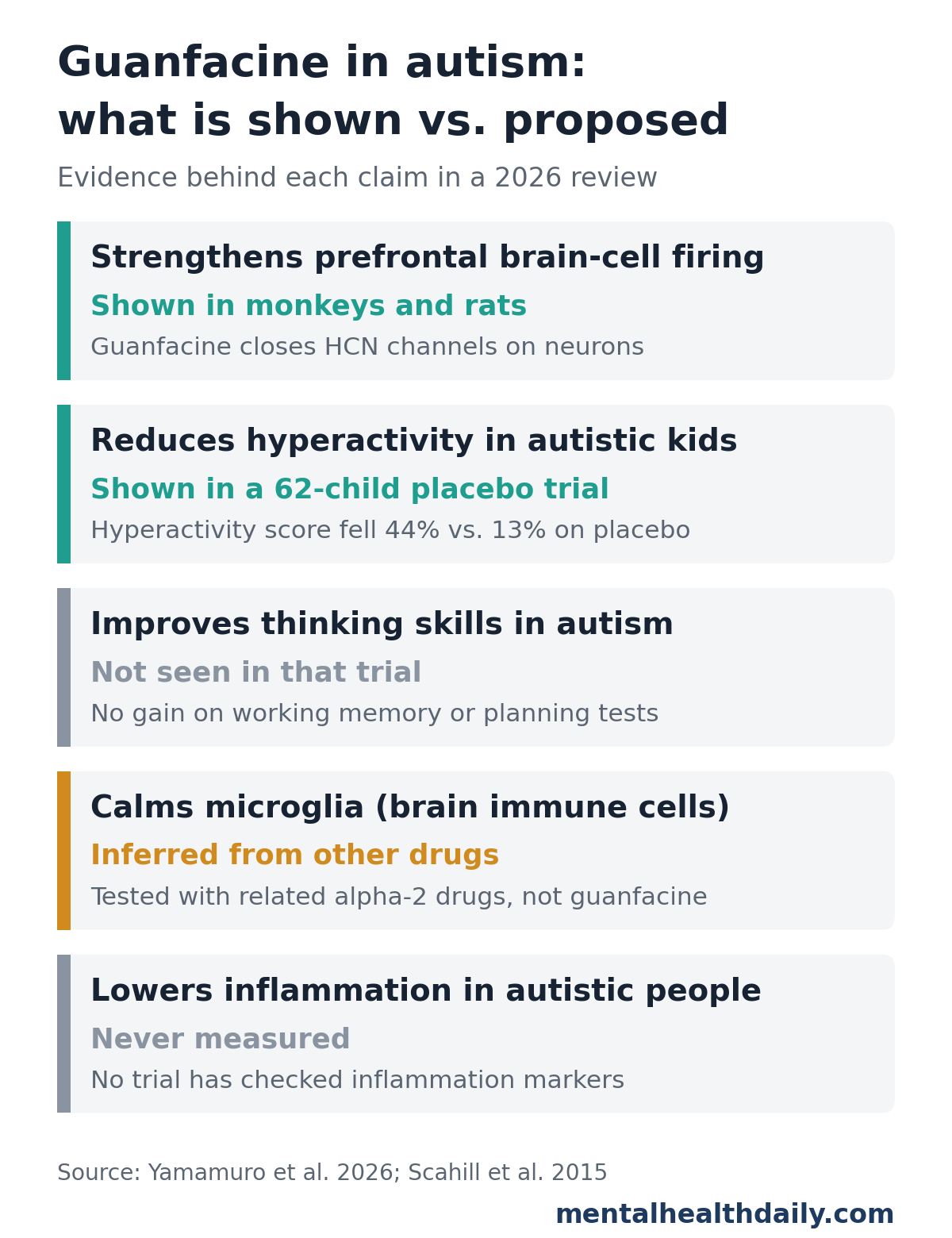
Behavior, not cognition. The review stresses that these are 2 reports from one trial, not independent replications, and that the benefits were behavioral. Calmer, less impulsive behavior is useful on its own, but it is a different outcome from better working memory or attention on testing.1
Side effects. Drowsiness, fatigue and decreased appetite were the most common. Blood pressure dipped during the first 4 weeks and returned close to baseline by week 8, while pulse stayed lower than at baseline.2
Real-world use looks similar. A 2025 retrospective study of 29 autistic children with ADHD at 3 clinics reported lower hyperactivity, irritability and repetitive movement scores on guanfacine. That study had no control group, and 3 children stopped because irritability got worse.5
HCN Channel Evidence Comes From Monkeys and Rats
The neuron route has the strongest support. In a 2007 study, Min Wang et al. applied guanfacine directly onto prefrontal neurons in monkeys doing a working memory task. Firing during the memory delay increased, and adding a cAMP-boosting compound reversed the effect. Blocking HCN channels mimicked guanfacine, and knocking down the HCN1 channel in rat prefrontal cortex improved working memory.3
Other animal work in the review points the same way:1
- Stress: daily guanfacine during 3 weeks of restraint stress prevented loss of dendritic spines (the contact points between neurons) in rodent prefrontal cortex and preserved working memory
- Aging: in aged monkeys, guanfacine improved working memory, and infusing a cAMP analog cancelled the benefit
- Selectivity: guanfacine is more selective for alpha-2A receptors than clonidine, and in aged monkeys it improved working memory with far less sedation and blood pressure lowering
The autism gap. No study has manipulated alpha-2A receptors or HCN channels in a genetic or environmental autism model and measured autism-related behavior. The review’s further proposal, that guanfacine rebalances excitation and inhibition in prefrontal circuits through fast-spiking interneurons, is labeled by the authors themselves as a testable hypothesis with no direct data yet.1
Guanfacine’s Anti-Inflammatory Effect Has Not Been Tested
Here the evidence thins out. The immune-cell studies the review leans on used other drugs in other settings:1
- Norepinephrine in cultured microglia: acting through alpha-2A receptors, it reduced microglial movement toward injury signals; guanfacine was not tested
- Dexmedetomidine: this ICU sedative, another alpha-2 drug, lowered TNF-alpha and IL-6 from inflamed macrophages in the lab, and in a trial of 86 intestinal-surgery patients it lowered IL-6, IL-8 and TNF-alpha
- Rodent stress studies with guanfacine: spines were protected, but microglia were not measured
The clinical reports are small and uncontrolled. In a pilot study of long COVID brain fog, 8 of 12 patients improved on guanfacine plus N-acetylcysteine (an antioxidant supplement), and 2 stopped because of low blood pressure or dizziness. Both drugs were given together and no inflammatory markers were checked, so neither the benefit nor any immune effect can be credited to guanfacine.1
The review also notes that HCN channels are present on microglia, where blocking them made the cells less reactive in lab dishes. That evidence comes from a handful of cell-culture studies and has not been connected to autism.1
Limitations of This Guanfacine and Autism Review
- Narrative, not systematic: the authors did not run a preregistered search and chose studies by relevance to their framework, so some contrary work may be missing.
- Thin autism data: the main trial had 62 children for 8 weeks, mostly boys of school age, and earlier autism studies were smaller. No study has looked at whether age or sex changes the response, and the animal work used almost only male animals.
- Core autism features untested: trials targeted ADHD-like symptoms, with little data on social communication, long-term effects or cognition.
- Borrowed immune evidence: dexmedetomidine during surgery is a different drug in a different setting from daily guanfacine in an autistic child.
- No validated biomarkers: the authors suggest selecting patients by cytokine levels or microglial imaging, but no such measure is validated for autism.
What This Means for Families Considering Guanfacine
For hyperactivity and impulsivity, guanfacine has reasonable evidence in school-age autistic children: one multisite placebo-controlled trial plus supportive real-world reports.25 Prescribers usually check blood pressure and pulse, especially in the first weeks, and the medication should not be stopped abruptly without medical advice.
For thinking skills, social communication or brain inflammation, there is no clinical evidence that guanfacine helps autistic people. The immune pathway is an interesting research idea built mostly on related drugs.
Guanfacine vs. clonidine. The review favors guanfacine for daytime hyperactivity because older clonidine trials in autism were smaller and sedation often limited the dose. Clonidine’s stronger sedative effect may suit sleep-onset problems instead. No trial has compared the 2 drugs directly in autism.1
What would settle the immune question: an adequately sized autism trial that measures inflammatory markers before and after guanfacine, alongside behavior and cognition.1
References
- Yamamuro K, Yamauchi T, Makinodan M. Guanfacine and HCN channels: bridging neuroinflammation and prefrontal cortex function in autism spectrum disorder. Frontiers in Molecular Neuroscience. 2026;19:1915506. doi:10.3389/fnmol.2026.1915506
- Scahill L, McCracken JT, King BH, et al. Extended-release guanfacine for hyperactivity in children with autism spectrum disorder. American Journal of Psychiatry. 2015;172:1197–1206. doi:10.1176/appi.ajp.2015.15010055
- Wang M, Ramos BP, Paspalas CD, et al. Alpha2A-adrenoceptors strengthen working memory networks by inhibiting cAMP-HCN channel signaling in prefrontal cortex. Cell. 2007;129(2):397–410. doi:10.1016/j.cell.2007.03.015
- Politte LC, Scahill L, Figueroa J, et al. A randomized, placebo-controlled trial of extended-release guanfacine in children with autism spectrum disorder and ADHD symptoms: an analysis of secondary outcome measures. Neuropsychopharmacology. 2018;43:1772–1778. doi:10.1038/s41386-018-0039-3
- Çobanoğlu Osmanlı C, Baykal S, Önal BS, et al. Comprehensive analysis of guanfacine treatment in autism spectrum disorder with comorbid attention deficit hyperactivity disorder. Scientific Reports. 2025;15:45310. doi:10.1038/s41598-025-29252-3