
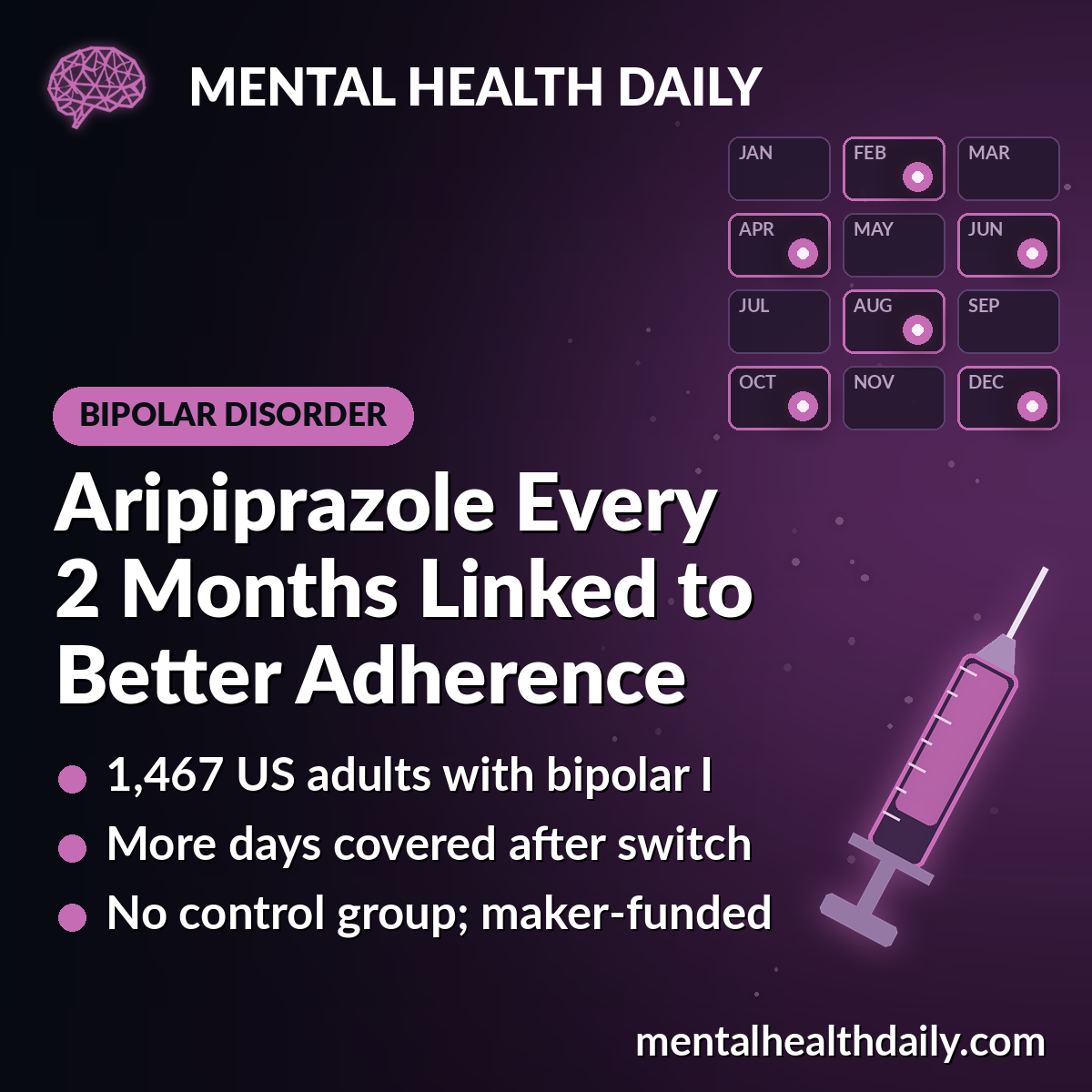
Adults with bipolar I disorder who switched to an aripiprazole injection given every 2 months had more days covered by medication over the next 6 months than in the 6 months before, according to a US insurance-claims study of 1,467 people.1 Hospital stays and medical costs fell too, but the study had no comparison group and was funded by the drug’s makers.
Research Highlights
- Switching from daily pills: in 371 people, the share of days covered by antipsychotic medication rose from 60% to 76% after the switch (P < 0.0001).1
- Switching from the monthly shot: in 1,096 people who had been on once-monthly aripiprazole, days covered rose from 56% to 81% (P < 0.0001).1
- Fewer hospital days in the pill-switch group: mean days in hospital fell from 2.04 to 1.02 per person, and the share with any hospital stay dropped from 26.4% to 14.3%.1
- Lower medical costs: mean total medical costs fell from $5,224.60 to $2,814.07 per patient per year in the pill-switch group and from $2,670.09 to $1,770.84 in the monthly-shot group.1
- Before-and-after design only: no control group, 6 months of follow-up, and funding plus authorship from Otsuka and Lundbeck, which market both aripiprazole injections.1
What Aripiprazole Every 2 Months Is and Who Was Studied
Long-acting injectable (LAI) antipsychotics are shots that release medication slowly from the muscle, so a person does not have to remember a daily pill. In bipolar I disorder, defined by at least 1 full manic episode, they are used as maintenance treatment to prevent new mood episodes.
Aripiprazole comes in 2 such forms in the US:
- Aripiprazole once-monthly (AOM, Abilify Maintena): a 400-mg shot every month. In a 52-week randomized withdrawal trial in 266 people with bipolar I, mood episodes returned in 26.5% of those kept on AOM vs 51.1% of those switched to placebo (hazard ratio 0.45), mainly through fewer manic episodes.3
- Aripiprazole 2-month ready-to-use (Ari 2MRTU, Abilify Asimtufii): a 960-mg or 720-mg shot every 56 days, approved in 2023. In a 32-week trial of 266 adults with schizophrenia or bipolar I, it produced blood levels of aripiprazole matching the monthly shot, with similar rates of side effects.2
The appeal of the 2-month version is the same drug exposure with half as many injections. Whether that translates into better real-world use is what the new claims study set out to check.
Nag et al. used a US claims database covering commercial insurance and Medicaid to find adults with bipolar disorder diagnosis codes who started Ari 2MRTU between April 2023 and September 2024.1 Each person’s 6 months after the first 2-month shot were compared with their own 6 months before it.
- Pill-switch group: 371 people who had filled a daily oral antipsychotic in the prior year (the study’s primary question).
- Monthly-shot group: 1,096 people who had been on AOM (an exploratory question).
- Who: mean age about 39; roughly 75% commercially insured and 25% on Medicaid; most treated by psychiatrists. Substance use disorders (58.8% and 45.7%) and anxiety disorders (55.5% and 45.9%) were common.
- Dose: 83.8% of 2-month shots were 960 mg and 16.2% were 720 mg.
Medication Coverage Rose After Switching to the 2-Month Aripiprazole Shot
Claims data cannot see whether someone swallows a pill, so adherence was estimated from pharmacy and injection records. The researchers used 2 standard measures:1
- Proportion of days covered (PDC): the share of days on which a person had medication available. For injections, each shot counted for the time until the next shot or the labeled interval, whichever was shorter.
- Medication possession ratio (MPR): days’ supply divided by days in the period. People with an MPR of at least 0.8 were counted as adherent.
Both groups improved on every measure, all with P < 0.0001:1
- Pill-switch group: PDC rose from 0.60 to 0.76; MPR from 0.67 to 0.85; adherent share from 41.2% to 72.0%.
- Monthly-shot group: PDC rose from 0.56 to 0.81; MPR from 0.62 to 0.89; adherent share from 51.2% to 79.0%.
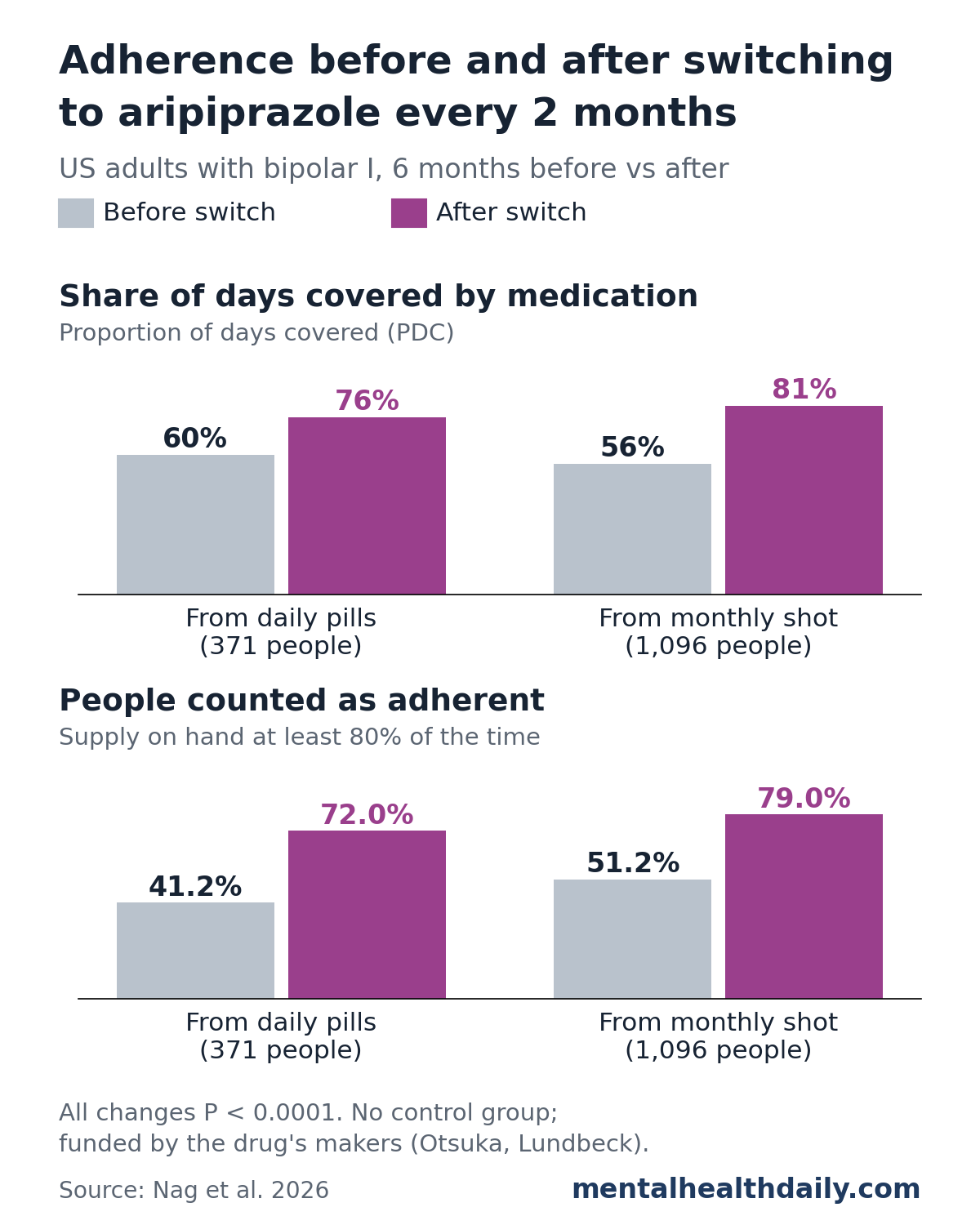
The monthly-shot result stands out. People already on an injection started with coverage as low as the pill group, which suggests late or missed monthly shots were common. The researchers note that poor adherence to AOM may itself have prompted some switches, so this group may not represent everyone on the monthly shot.1
After the switch, both groups landed at similar coverage, around 76% to 81% of days.
Hospital Stays, ER Visits, and Medical Costs After the Switch
The researchers also compared healthcare use and all-cause medical costs, meaning inpatient, outpatient, and emergency department (ED) spending in 2024 dollars. Costs were reported per patient per year from the 6-month observation windows. The paper did not report pharmacy spending on the medicines.1
Pill-switch group (371 people), 6 months before vs after:
- Hospital admissions: 0.64 vs 0.33 per person (P = 0.0073); any hospital stay 26.4% vs 14.3% (P = 0.0037).
- Days in hospital: 2.04 vs 1.02 per person (P = 0.0010); bipolar-related days 0.71 vs 0.27 (P = 0.0028).
- ED visits: any ED visit 36.4% vs 24.3% (P = 0.0110); bipolar-related ED visits 0.15 vs 0.06 per person (P = 0.0061).
- Outpatient care: any outpatient visit fell from 89.2% to 77.6% (P = 0.0027).
- Total medical costs: $5,224.60 vs $2,814.07 per patient per year (P = 0.0154), including $565.66 less inpatient spending (P = 0.0001), $581.93 less ED spending (P = 0.0387), and $1,262.94 less outpatient spending (no P value reported).
Monthly-shot group (1,096 people), 6 months before vs after:
- Hospital admissions: 0.21 vs 0.13 per person (P = 0.0097); bipolar-related admissions 0.08 vs 0.04 (P = 0.0160).
- Days in hospital: 0.71 vs 0.45 per person (P = 0.0246).
- Not significant: any hospital stay 10.2% vs 7.0% (P = 0.0597); any ED visit 20.0% vs 17.3% (P = 0.2609).
- Outpatient care went up: any outpatient visit rose from 69.9% to 80.3% (P = 0.0001), possibly from extra follow-up after starting a new formulation.
- Total medical costs: $2,670.09 vs $1,770.84 per patient per year (P = 0.0139), including $287.15 less ED spending (P = 0.0148).
Hospital use was much lower at baseline in the monthly-shot group than in the pill-switch group, so there was less room to fall.
Long-Acting Injectables vs Pills in Bipolar Disorder: What Earlier Studies Found
A 2026 meta-analysis pooled 17 observational studies comparing long-acting injectables with oral antipsychotics in bipolar disorder.4
- Cohort studies (which follow injection and pill users side by side): relapse or psychiatric hospitalization risk was 37% lower with injectables (relative risk 0.63).
- Mirror-image studies (which compare the same people before and after starting an injectable, like the 2026 claims study): risk was 54% lower (relative risk 0.46).
- Higher-quality studies only: the advantage was no longer significant in either design, and the certainty of evidence was rated low to very low.
The new claims results are consistent with that body of work. They also share its main weakness: in the meta-analysis, before-and-after studies showed a larger benefit than cohort studies, and the advantage faded in the best-quality studies.
Limitations of This Aripiprazole Claims Study
The adherence gains were large and consistent in both groups; the hospital and cost drops are associations, not proof that the switch caused them.
- Manufacturer-funded: Otsuka and Lundbeck paid for the study and were involved in its design, analysis, writing, and the decision to publish. Most authors work for the companies or consult for them.1
- No control group: nobody was followed who stayed on pills or on the monthly shot, so changes over time cannot be separated from the drug switch.
- Regression to the mean: if people were switched during a rough patch, hospital use would tend to fall afterward whatever the treatment. The researchers name this as a possible contributor.
- Who gets switched: prescribers may pick motivated patients, and extra attention after a switch can briefly boost adherence (a “honeymoon effect”).
- Adherence by claims: PDC and MPR were built for pills. The researchers say post-switch adherence may be inflated and that before-vs-after comparisons should be read cautiously.
- Short follow-up: 6 months cannot establish long-term relapse, rehospitalization, or treatment persistence.
- Simple statistics: unadjusted tests, no symptom data, and no account of other medicines such as mood stabilizers. The researchers describe the results as descriptive.
- Who is missing: Medicare patients and uninsured people were not included, and diagnosis codes for bipolar disorder also cover bipolar II and unspecified types.
What This Means for People With Bipolar I Disorder
- Fewer shots, similar drug levels: the 2-month aripiprazole shot gives the same aripiprazole exposure as the monthly one with about 6 injections a year instead of 12.2
- Better coverage in real-world use: in this study, people had medication available on more days after switching, whether they came from pills or the monthly shot.
- Hospital and cost savings need confirmation: a study with a comparison group and longer follow-up would show whether the drop in hospital use holds up.
- Talk it through: anyone who misses doses of a daily antipsychotic or monthly shot can ask their prescriber whether a longer-interval injection fits. Side effects such as weight gain and injection-site pain still apply.2
References
- Nag SS, Urganus A, Bell Lynum KS, et al. Real-world adherence, healthcare resource utilization, and costs following a transition to aripiprazole once every 2 months among patients diagnosed with bipolar I disorder in the United States. Frontiers in Psychiatry. 2026;17:1904737. doi:10.3389/fpsyt.2026.1904737
- Harlin M, Yildirim M, Such P, et al. A randomized, open-label, multiple-dose, parallel-arm, pivotal study to evaluate the safety, tolerability, and pharmacokinetics of aripiprazole 2-month long-acting injectable in adults with schizophrenia or bipolar I disorder. CNS Drugs. 2023;37:337–350. doi:10.1007/s40263-023-00996-8
- Calabrese JR, Sanchez R, Jin N, et al. Efficacy and safety of aripiprazole once-monthly in the maintenance treatment of bipolar I disorder: a double-blind, placebo-controlled, 52-week randomized withdrawal study. Journal of Clinical Psychiatry. 2017;78(3):324–331. doi:10.4088/JCP.16m11201
- Wagner E, Katyal S, Lee IO, et al. Effectiveness of long-acting injectable antipsychotics versus oral antipsychotics in people with bipolar disorder: a systematic review and meta-analysis of observational studies. Canadian Journal of Psychiatry. 2026;71:420–435. doi:10.1177/07067437251412576