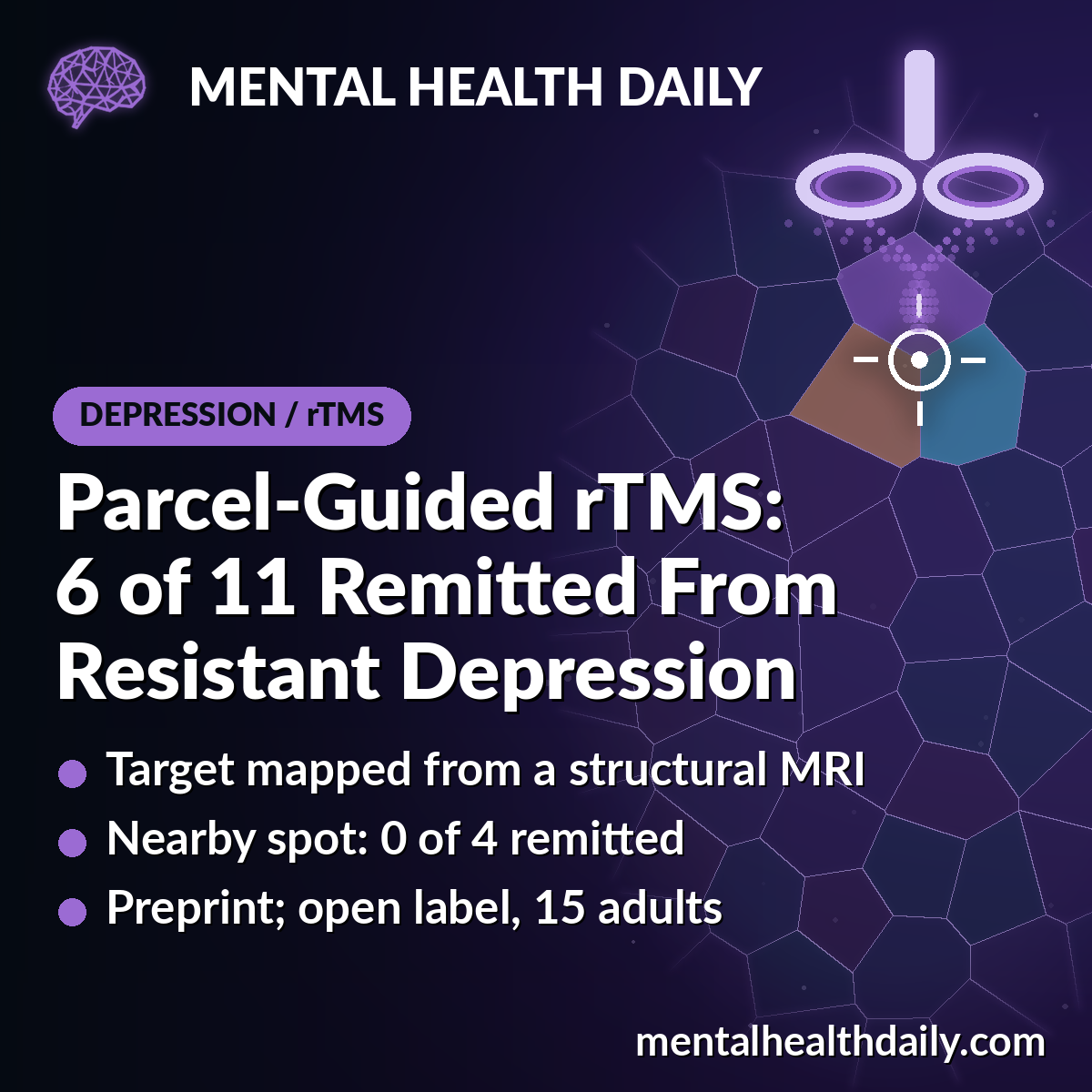
Researchers aimed repetitive transcranial magnetic stimulation (rTMS), which uses magnetic pulses to stimulate brain cells, at a spot chosen from each person’s own brain scan.
In a small Columbia University pilot, 6 of 11 adults with treatment-resistant depression ended with low depression scores that met the trial’s remission threshold.1
Research Highlights
- Symptoms improved at the main target: 11 people received treatment where a brain-map area called parcel 46 meets neighboring areas. Depression scores fell 57.8% on average. 8 of 11 (72.7%) had at least a 50% drop in scores, called a response; 6 of 11 (54.5%) met the trial’s low-symptom threshold for remission.1
- A nearby target did worse: 4 people treated at the middle of parcel 46 had a 38.2% average drop, 1 response, and no remissions.1
- Brain activity before treatment tracked remission: everyone who remitted had little correlation between activity in parcel 46 and the subgenual cingulate, a deeper brain region linked to mood. This measure tracks how closely the 2 regions’ activity rises and falls together.1
- No functional MRI needed for targeting: the target came from a structural brain scan alone, although the study used high-resolution research scans.1
- Early evidence: 15 people completed treatment. Everyone knew they were getting active treatment, there was no sham group for comparison, and the results have not been peer reviewed.
How Parcel-Guided rTMS Picks a Target From a Structural MRI
Repetitive transcranial magnetic stimulation (rTMS) uses a magnetic coil held against the scalp to send rapid pulses that make nerve cells in the cortex fire. For depression, the usual target is the left dorsolateral prefrontal cortex (DLPFC), a region near the left temple involved in planning and regulating emotion.
Repeated sessions are thought to work partly through the DLPFC’s links to deeper mood circuits, especially the subgenual anterior cingulate cortex (sgACC), a small area deep in the front of the brain that has been linked to depression.
In most clinics, the coil is placed by a scalp rule: 5.5 cm in front of the spot that makes the thumb twitch, or over the F3 position used in EEG.1 Neither rule looks at the person’s brain itself.
The connectivity clue. A 2012 analysis by Fox et al. found that TMS sites working best against depression were the ones most anti-correlated with the sgACC, meaning their activity at rest tended to go down when sgACC activity went up.2 Finding that spot in each patient usually takes a resting-state functional MRI and specialized analysis.
The parcel approach. The Columbia team used a different shortcut:
- Brain atlas: the Human Connectome Project’s multimodal parcellation divides each hemisphere of the cortex into 180 labeled areas, or parcels, based on structure, function, and connections.3
- Target: the group had earlier found that the DLPFC region most anti-correlated with the sgACC sits where parcel 46 meets 2 neighboring parcels (9-46d and a9-46v).14
- Personal map: each patient’s structural MRI was used to rebuild their cortical surface, the atlas labels were fitted onto it, and the junction was marked for the navigation system that guides the coil.1
Resting-state fMRI was collected before and after treatment, but only for analysis; it was not used to pick the target.1
6 of 11 Remitted When rTMS Hit the Parcel 46 Junction
The pilot (registered as NCT04956081) enrolled adults with moderate to severe major depression that had not improved after at least 2 adequate antidepressant trials, with a MADRS score of 20 or higher. MADRS, the Montgomery-Åsberg Depression Rating Scale, is a clinician-rated score from 0 to 60.1
- Sample: 16 people started and 15 completed; 12 of the 15 (80%) also had an anxiety disorder
- Treatment: standard 10-Hz rTMS, 27 sessions over 6 weeks
- Targets: 11 people were treated at the parcel 46 junction (3 of them positioned with custom 3D-printed headgear built from their brain map) and 4 at the middle of parcel 46
- Definitions: response meant at least a 50% drop in MADRS; remission meant a final MADRS of 10 or less
Both groups started with similar severity: average MADRS of 30.9 in the junction group and 33.3 in the midpoint group.1
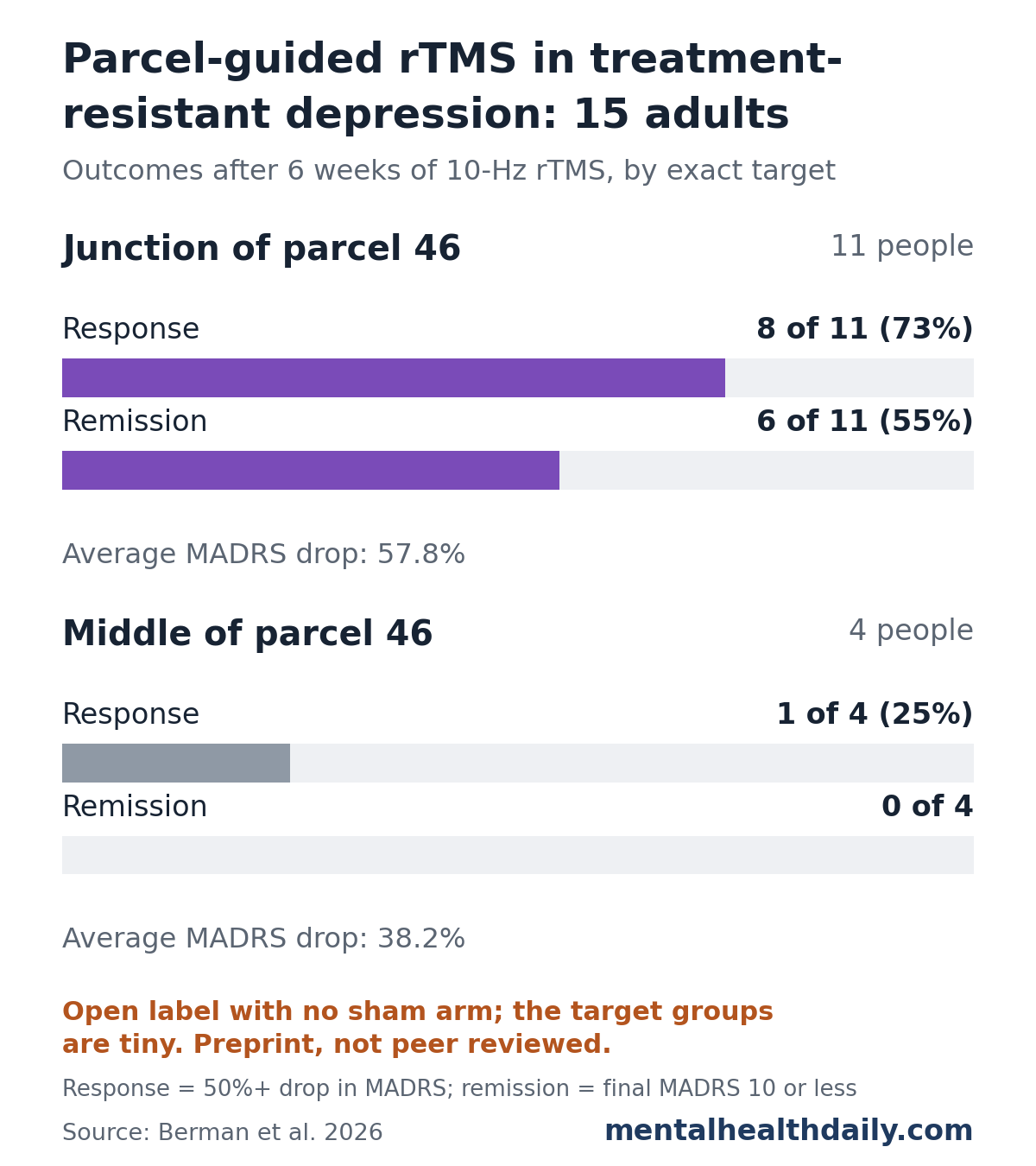
Junction group: MADRS scores fell 57.8% on average. 8 of 11 people (72.7%) responded and 6 of 11 (54.5%) reached remission.1
Midpoint group: scores fell 38.2% on average, 1 of 4 responded, and none remitted. The researchers read this as a sign that small shifts in coil position can change the clinical result.1
For a sense of scale, the researchers cite typical rates for standard scalp-targeted rTMS in treatment-resistant depression of about 40-50% response and 35% remission.1 A meta-analysis of sham-controlled trials in people who had failed 2 antidepressants found that standard rTMS significantly beat sham on both outcomes.5
Baseline Brain Connectivity Predicted Who Remitted
Functional connectivity measures how closely the activity of 2 brain regions rises and falls together while a person rests in the scanner. Before treatment, the strength of the link between parcel 46 and the sgACC significantly predicted who responded.1
- Who remitted: people with near-zero connectivity between the 2 regions at baseline; those with strong anti-correlation improved less
- Prediction accuracy: area under the ROC curve of 0.88 for response (1.0 means perfect sorting, 0.5 is chance), with 75% sensitivity and 100% specificity at the best cutoff; for remission, the AUC was 1.0
- After treatment: larger reductions in connectivity between the peak target region and the sgACC went with larger symptom improvements
This asks a different question from the 2012 work: Fox et al. compared stimulation sites, while this analysis compared people treated at similar sites.2 These sorting statistics come from 15 people, and the researchers say the predictor needs to be replicated in prospective studies and in existing treatment datasets before it can guide anyone’s care.1
How Parcel Targeting Compares With fMRI-Guided and Scalp-Based TMS
The same group reported an earlier parcel-guided pilot: in 2020, Moreno-Ortega et al. treated 10 people at parcel 46 who had not improved with conventional TMS: all 10 responded and half remitted.4
Stronger evidence for personalized targeting comes from trials that used functional MRI to find each person’s spot:
- Connectivity vs. scalp targeting: in a blinded randomized trial of accelerated TMS in 40 adults with treatment-resistant depression, connectivity-guided targeting reduced MADRS by a median of 24 points vs. 18 points with the scalp-based F3 method (P = .02), an effect size of 0.8.6
- Stanford neuromodulation therapy (SNT): an accelerated, fMRI-targeted protocol of several sessions a day. A 2026 sham-controlled trial in 48 participants found remission at 1 month in 50.0% with active treatment vs. 20.8% with sham.7
The parcel approach’s appeal is practical: it needs only a structural MRI, so it could work in settings where resting-state fMRI is not available. The researchers also suggest pairing it with accelerated schedules like SNT.1 This study did not compare parcel targeting directly with scalp or fMRI targeting.
Limits of This Small Open-Label Preprint
The response and remission rates are a strong early signal in favor of parcel-guided targeting, but the design cannot show how much of the improvement came from the targeting itself:
- No control group: there was no sham arm and no scalp-targeted comparison, and patients knew they were getting active treatment, so expectation and natural improvement could add to the numbers
- Very small groups: 11 and 4 people; no statistical test of the junction vs. midpoint difference was reported, and the paper does not describe how people were assigned to each target
- Short report: it is a brief research letter with limited statistical detail and no follow-up after the 6-week course
- Industry ties: 3 of the 7 authors are listed at Soterix Medical, which makes the CloudTMS system used in the study
- Not peer reviewed: the medRxiv banner states the preprint should not be used to guide clinical practice, and small details differ between the text and figure (for example, the number excluded at prescreening is 36 in the flow chart and 35 in its caption)
What It Means for People Considering TMS for Depression
- Standard rTMS already works for many people with treatment-resistant depression, and it is the approach backed by sham-controlled trials.5
- Precise targeting is a growing focus. A randomized trial now favors fMRI-based personalization over scalp rules, and this pilot suggests a structural-MRI shortcut might reach similar results.16
- Parcel-guided rTMS is still experimental. It needs a randomized, sham- or scalp-controlled trial before anyone can say it beats the usual approach.
References
- Berman J, Truong DQ, Murphy A, Mejia R, Valter YZ, Datta A, Javitt DC. Individualized, parcel-guided rTMS to the left dorsolateral prefrontal cortex for treatment resistant depression. medRxiv (preprint, not peer reviewed). Posted September 7, 2026. doi:10.64898/2026.09.03.26362155
- Fox MD, Buckner RL, White MP, Greicius MD, Pascual-Leone A. Efficacy of transcranial magnetic stimulation targets for depression is related to intrinsic functional connectivity with the subgenual cingulate. Biological Psychiatry. 2012;72(7):595–603. doi:10.1016/j.biopsych.2012.04.028
- Glasser MF, Coalson TS, Robinson EC, et al. A multi-modal parcellation of human cerebral cortex. Nature. 2016;536(7615):171–178. doi:10.1038/nature18933
- Moreno-Ortega M, Kangarlu A, Lee S, et al. Parcel-guided rTMS for depression. Translational Psychiatry. 2020;10(1):283. doi:10.1038/s41398-020-00970-8
- Vida RG, Sághy E, Bella R, et al. Efficacy of repetitive transcranial magnetic stimulation (rTMS) adjunctive therapy for major depressive disorder (MDD) after two antidepressant treatment failures: meta-analysis of randomized sham-controlled trials. BMC Psychiatry. 2023;23:545. doi:10.1186/s12888-023-05033-y
- Taylor JJ, Kare MR, Haj-Darwish D, et al. Connectivity- vs scalp-based targeting of accelerated transcranial magnetic stimulation for depression: a randomized clinical trial. JAMA Psychiatry. 2026;83(8):807–817. doi:10.1001/jamapsychiatry.2026.1100
- Kratter IH, Austelle CW, Lissemore JI, et al. Stanford neuromodulation therapy for treatment-resistant depression: a randomized controlled trial confirming efficacy, and an EEG study providing insight into mechanism of action and a potentially predictive biomarker of efficacy. World Psychiatry. 2026;25(1):105–116. doi:10.1002/wps.70032