
A new study reanalyzed a widely cited target-shooting experiment used to support the scarcity mindset theory. That theory says money shortages focus attention on immediate needs and make future costs easier to overlook.1
Giving players fewer or more shots changed their opportunities to score and borrow, explaining results previously attributed to narrowed attention. The findings do not settle how poverty affects thinking in everyday life.1
Research Highlights
- Better average scores did not demonstrate better focus: players given fewer shots earned more points per shot across the game. Comparing shots available to both groups did not confirm a shooting advantage.1
- More borrowing reflected more chances to borrow: players with fewer shots ran out sooner and faced costly borrowing far more often. Once borrowing was available, they were not more likely to take it than players with more shots.1
- Insurance choices did not show the predicted neglect: in a follow-up experiment involving 174 people, both groups had the same chances to buy insurance. Players with fewer shots were as likely to buy worthwhile insurance and less likely to buy bad-value insurance.1
- Everyday poverty was not studied: these were online game experiments. They also left untested the separate claim that financial worries use up mental capacity.1
What the Scarcity Mindset Theory Claims
Scarcity theory, popularized by Sendhil Mullainathan and Eldar Shafir in their book Scarcity, proposes that having too little money, time or food changes how people think and make decisions, regardless of personality. It makes 2 distinct claims.1
- A bandwidth tax. Worry about scarce resources uses up mental capacity. A 2013 study published in Science found that prompting financial worries lowered test scores in lower-income shoppers but not higher-income shoppers. Farmers also scored lower before harvest than afterward.4
- Attentional tunneling. Attention becomes concentrated on an immediate shortage. The proposed benefit is more careful use of scarce resources; the proposed cost is overlooking other important information, such as a loan’s interest rate or its future consequences.1
Fiona tho Pesch et al. tested the tunneling claim in their 2026 study. They reanalyzed a 2012 experiment by Shah et al. and data from Shah et al.’s 2019 repeat of that experiment. They also ran a new experiment to test whether the same interpretation held when both groups faced equal opportunities.1
According to tho Pesch et al., direct evidence for both parts of tunneling — better focus and neglect of other information — rested mainly on Shah et al.’s 2012 paper, “Some consequences of having too little.” That paper influenced books, press coverage and international poverty policy, including a World Bank report.12
The “Angry Blueberries” Game
Shah et al.’s 2012 paper included an experiment involving 68 online participants who played Angry Blueberries, a computer game in which they shot blueberries at targets. Each point improved their odds of winning a raffle. Each level began with 7 targets and awarded 3 bonus points for clearing all of them.1
Researchers assigned players different shot budgets. The labels “rich” and “poor” described those budgets, not participants’ actual incomes.1
- “Rich” players received 150 shots overall, with 15 available per level.
- “Poor” players received 30 shots overall, with 3 available per level.
- Borrowing: half the players could keep shooting after using up their shots for a level. Each extra shot automatically borrowed from future levels at 100% interest, costing 2 future shots.
Players with fewer shots spent longer aiming and earned more points per shot across the game. Shah et al. interpreted those results as evidence that scarcity improved focus.12
Among players allowed to borrow, the “poor” borrowed a larger share of their budget than the “rich”: 0.24 vs. 0.02. Borrowing also hurt their performance. Shah et al. interpreted this as evidence that focus on immediate needs caused players to overlook the interest cost.12
Game Rules, Not Focus, Explained the Accuracy Gap
Early shots had more targets available to hit. The first shot of a level earned 2.81 points on average, the third earned 1.80, and a “rich” player’s 15th shot earned just 0.69. Later shots were less profitable because the remaining targets were fewer.1
Without borrowing, “poor” players could take only the first 3 shots of each level. “Rich” players used about 5.7 shots per level, so their average included later shots with lower returns. The whole-game comparison therefore mixed differences in shooting performance with differences in which shots each group could take.1
Tho Pesch et al. compared only the first 3 shots of each level, which were available to both groups. The original data did not show clear evidence of a performance difference on those comparable shots.1
A p-value describes how surprising a result this large or larger would be under a model with no group difference. Smaller values give stronger evidence against that model; a p-value does not measure the probability that a finding is false.
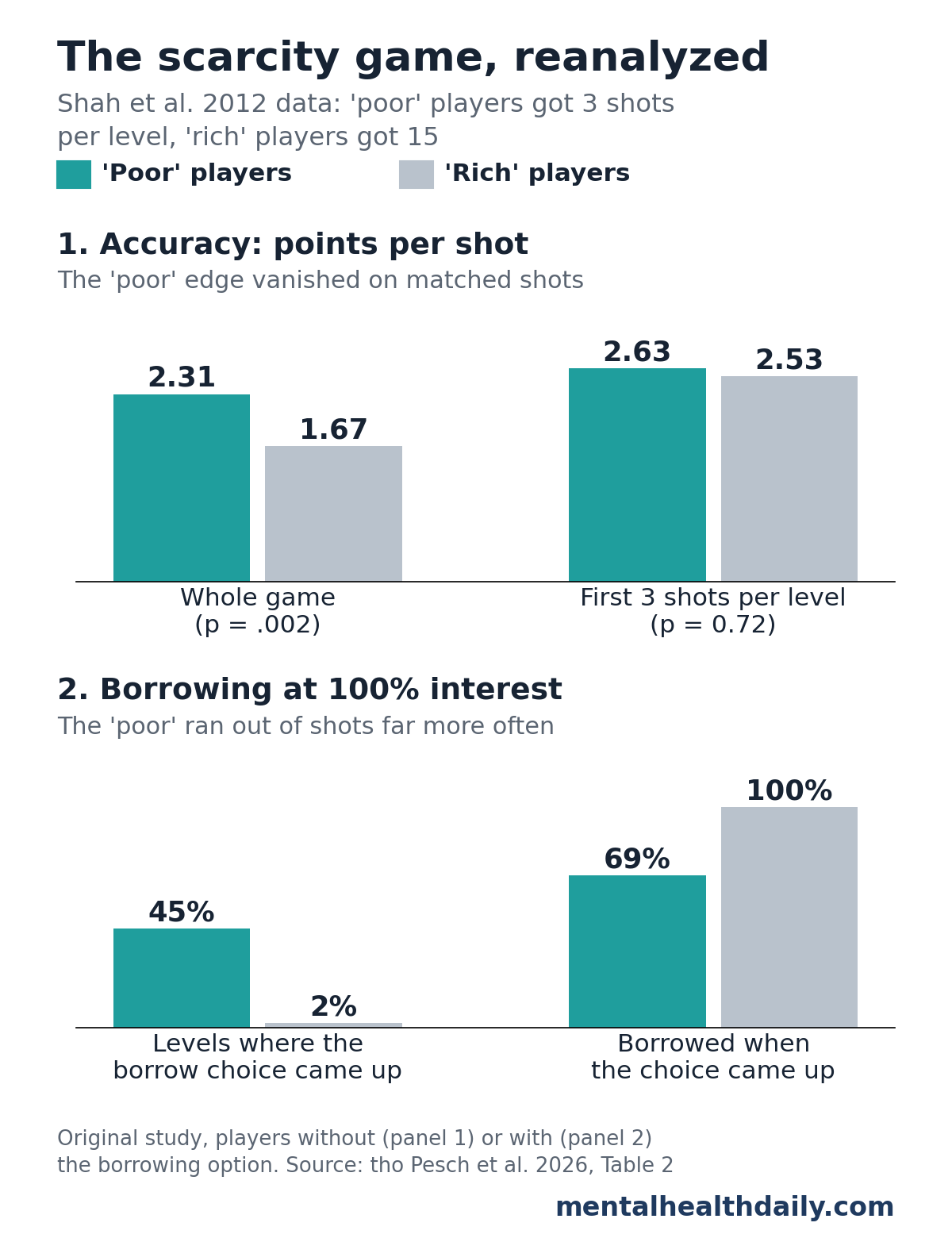
- Whole-game averages: “poor” players earned 2.31 vs. 1.67 points per shot for “rich” players (p = 0.002).
- Average across the first 3 shots of each level: 2.63 vs. 2.53 points per shot (p = 0.72).
- Each of those 3 shots considered separately: no statistically significant difference between groups.
The small 2012 sample could not establish that the groups performed equally well. Shah et al.’s 2019 repeat experiment, which included 974 players in the analysis, provided a larger dataset for the same comparison.13
An equivalence test checks whether a difference is small enough to fall within a predefined range. In the 2019 data, the matched-shot comparisons met the researchers’ criterion for no meaningful difference. This supports a stronger conclusion than simply finding a nonsignificant result in a small sample.1
Players with fewer shots did take longer to aim, but that extra time did not translate into better performance on comparable shots. Tho Pesch et al. noted that longer aiming could reflect hesitation or inattention as well as greater focus.1
Over-Borrowing Came From More Chances to Borrow
A player could borrow only after exhausting the shots available for a level while targets remained. With 3 shots per level, “poor” players faced that decision on 45% of levels. With 15 shots, “rich” players faced it on just 2%.1
When borrowing was available, “poor” players borrowed in 69% of cases and declined in 31%. “Rich” players borrowed every time they reached that decision. The difference in refusal rates was not statistically significant (p = 0.052).1
That comparison also involved a selected subset: only 40% of “rich” players ever reached a borrowing decision. Even with that limitation, the results did not show a greater tendency to borrow among “poor” players once borrowing opportunities were taken into account.1
Borrowing was costly for everyone. It affected players with fewer shots more because they encountered the decision far more often, rather than because they were more likely to borrow whenever it was available.1
Shah et al. also linked longer aiming to more borrowing among “poor” players. Their correlation, a measure of how closely two quantities vary together, was r = 0.43. That estimate came only from levels on which those players borrowed.1
Across all players who could borrow, the correlation was r = 0.03, close to zero. The aiming-borrowing relationship also failed to recur in Shah et al.’s 2019 data. It therefore did not provide reliable support for the claim that concentrating on aiming caused neglect of borrowing costs.1
Tho Pesch et al.’s reanalyses of Studies 4 and 5 in Shah et al.’s 2012 paper found the same pattern. A separate experiment in that paper, Study 1, had already failed to replicate in a 2018 project that repeated social science experiments from Nature and Science.136
A New Experiment Gave Both Groups the Same Chances
The unequal borrowing opportunities complicated the original comparison. Tho Pesch et al. addressed this by running a new version of Angry Blueberries involving 174 online participants: 91 assigned fewer shots and 83 assigned more shots. Both groups received an insurance offer on each of the first 10 levels.1
Instead of borrowing, players could spend current shots to insure extra points they would receive later. A simulated drought had a 50% chance of wiping out those points. The insurance cost them resources immediately, while any benefit would arrive later. This allowed researchers to test whether players with fewer resources overlooked future benefits when both groups received the same opportunities.1
Of the 10 offers, 8 provided benefits worth more on average than their cost. The remaining 2 were “scam” offers that cost more than their expected payout. The tunneling prediction was that players with fewer shots would focus on preserving shots now and miss worthwhile insurance for the future.1
- Good-value insurance: players with fewer shots bought 4.74 of the 8 offers on average, compared with 4.92 for players with more shots (p = 0.68). An equivalence test found the groups’ purchase rates sufficiently similar under the researchers’ predefined criterion.
- Scam insurance: players with fewer shots were significantly less likely to buy it (p = 0.005).
- Shooting patterns: players with fewer shots again aimed longer and earned more points per shot across the whole game. Comparing the first 3 shots of each level again found no meaningful performance difference.
The players with fewer resources did not miss more good-value offers. They were also better at avoiding the bad-value offers. Their purchasing behavior therefore did not support the predicted neglect of future benefits.1
What the Reanalysis Does and Does Not Overturn
Tho Pesch et al. reproduced the original scoring and borrowing patterns, and their follow-up experiment again found a whole-game scoring advantage. Reproducing those patterns did not establish attentional tunneling: shot limits and borrowing opportunities provided a simpler explanation for differences between groups.1
Tho Pesch et al. did not test the bandwidth-tax claim that financial worries consume mental capacity, investigated by Mani et al. in 2013. Their game analyses also cannot establish that poverty leaves thinking unaffected in everyday life.14
Results across the wider scarcity literature have been mixed. A 2021 audit that repeated 20 scarcity studies found substantial variation: some findings replicated strongly, while others did not.5
Tho Pesch et al. also identified a problem with defining tunneling. A test needs to specify which information a shortage is expected to draw attention toward and which information people are expected to overlook. Otherwise, better decisions can be labeled “focus” and worse decisions “neglect” after the results are known.1
The researchers emphasized structural constraints: limits on the options someone can choose from. The game made expensive borrowing available far more often to players with fewer shots.1
They suggested that unequal exposure to costly loans in real life could similarly shape borrowing behavior. That explanation centers on the choices people face, while leaving open how financial hardship might also affect attention.1
Limitations
- Artificial conditions. These online games used points and controlled rules. They could not capture the stakes and complexity of real financial hardship.
- Online samples. Participants were recruited through Amazon’s MTurk, an online recruitment platform. Data quality and platform-specific influences are concerns, and the original samples were not representative of the US population.
- A small original experiment. The 2012 game involved 68 participants and could not establish equivalent performance on comparable shots. That conclusion depended on the larger 2019 dataset and the new experiment.
- Changes to the research plan. For the new experiment, researchers preregistered their plan before collecting data, including a target of 200 participants. They analyzed 174 and reported budget limits. They also changed the planned statistical analysis to match the original researchers’ approach.
- Incomplete dropout information. The game software did not retain information on participants who quit, so systematic dropout could have affected any of the datasets.
- A specific claim. The research challenged evidence for tunneling from this game. Other proposed effects of scarcity, including the bandwidth tax, require their own tests.
References
- tho Pesch F, Langenhoff AF, Srinivasan M. Revisiting evidence for an attentional tunneling effect caused by scarcity. Nature Communications. 2026;17:10233. doi:10.1038/s41467-026-78074-y
- Shah AK, Mullainathan S, Shafir E. Some consequences of having too little. Science. 2012;338(6107):682–685. doi:10.1126/science.1222426
- Shah AK, Mullainathan S, Shafir E. An exercise in self-replication: replicating Shah, Mullainathan, and Shafir (2012). Journal of Economic Psychology. 2019;75:102127. doi:10.1016/j.joep.2018.12.001
- Mani A, Mullainathan S, Shafir E, Zhao J. Poverty impedes cognitive function. Science. 2013;341(6149):976–980. doi:10.1126/science.1238041
- O’Donnell M, Dev AS, Antonoplis S, et al. Empirical audit and review and an assessment of evidentiary value in research on the psychological consequences of scarcity. Proceedings of the National Academy of Sciences. 2021;118(44):e2103313118. doi:10.1073/pnas.2103313118
- Camerer CF, Dreber A, Holzmeister F, et al. Evaluating the replicability of social science experiments in Nature and Science between 2010 and 2015. Nature Human Behaviour. 2018;2:637–644. doi:10.1038/s41562-018-0399-z