Among Swedish memory-clinic patients without dementia, more stressful life events were linked to a spinal-fluid sign of Alzheimer’s amyloid buildup, but only in people with moderate-to-high insomnia symptoms, according to a 2026 study.1
Research Highlights
- Stress and insomnia worked together: in 103 patients with spinal-fluid tests, lifetime stressful events and insomnia symptoms interacted in relation to amyloid-beta 42 (interaction b = −0.032, p = 0.003). More events went with lower levels, a sign of more amyloid in the brain, only when insomnia was moderate to high.1
- Recent and long-lasting stress showed the same pattern: events in the past 5 years and chronic events, such as a close relative’s serious illness, each interacted with insomnia in the same direction.1
- No link for tau: stress and insomnia did not interact in relation to total tau or phosphorylated tau, the other 2 Alzheimer’s markers tested.1
- A one-time snapshot: stress, sleep and spinal fluid were measured at about the same time in 124 people with subjective cognitive impairment or mild cognitive impairment, so the study cannot show which came first.1
- Fits earlier sleep research: poor sleep has been linked to amyloid in cognitively normal adults, one night without sleep raised brain amyloid on PET scans, and insomnia has been linked to a higher risk of dementia.2–4
How the Swedish Study Measured Stress, Insomnia and Amyloid
Jasper Holleman et al. used baseline data from the Co-STAR (Cortisol and Stress in Alzheimer’s Disease) study at the Karolinska University Hospital memory clinic in Stockholm. Everyone was a first-time patient recruited between 2014 and 2017.1
Of 188 Co-STAR participants, the researchers excluded 41 with dementia, 1 with a missing diagnosis and 22 without sleep or stress data. That left 124 people, with an average age of 61.5 and 60% women:1
- 56 with subjective cognitive impairment (SCI): they noticed their own memory or thinking slipping but scored normally on cognitive tests.
- 68 with mild cognitive impairment (MCI): measurable decline on testing, but not enough to interfere with daily life the way dementia does.
Participants filled out questionnaires on sleep and stress:1
- Insomnia symptoms: 3 items from the Karolinska Sleep Questionnaire covering trouble falling asleep, waking repeatedly and waking too early over the past 3 months, scored 0 to 15. The average was 6.7.
- Stressful life events: a 16-item checklist of events across the whole lifespan, with the age at which each happened. The average person reported 4.4.
- Perceived stress: the 10-item Perceived Stress Scale, which asks how stressed and overwhelmed a person has felt in the past month.
The life-event count was also split by timing (within the past 5 years vs. earlier) and by type. Acute events were sudden and short, such as a close relative’s death; chronic events lasted a long time, such as a close relative’s serious illness.1
What the Spinal-Fluid Markers Mean
Routine lumbar punctures supplied cerebrospinal fluid (CSF), the clear fluid around the brain and spinal cord, for 103 of the 124 patients. The lab measured 3 standard Alzheimer’s markers:1
- Amyloid-beta 42 (Aβ42): a protein fragment that clumps into the plaques of Alzheimer’s disease. As it sticks in plaques, less of it reaches the spinal fluid, so lower CSF Aβ42 means more amyloid in the brain.
- Phosphorylated tau 181: a chemically altered form of tau that reflects tangle buildup inside nerve cells.
- Total tau: a broader marker of nerve-cell damage.
On average, the group sat on the normal side of common clinical cutoffs: Aβ42 was well above the threshold for abnormal, and both tau markers were well below it. The analysis looked at differences mostly below the level of clear Alzheimer’s pathology.1
All models were adjusted for age, sex, education, sleep-medication use and depressive symptoms.1
More Stressful Events Went With More Amyloid Only When Insomnia Was Worse
The researchers tested whether the link between stress and each marker changed with insomnia severity, a statistical interaction. For amyloid, it did.1
Total lifetime stressful events and insomnia interacted in relation to CSF Aβ42 (b = −0.032, 95% CI −0.053 to −0.011, p = 0.003). The more insomnia symptoms a person reported, the more each additional stressful event went with lower Aβ42.1
At the 2 ends of the comparison, the estimates moved in opposite directions:1
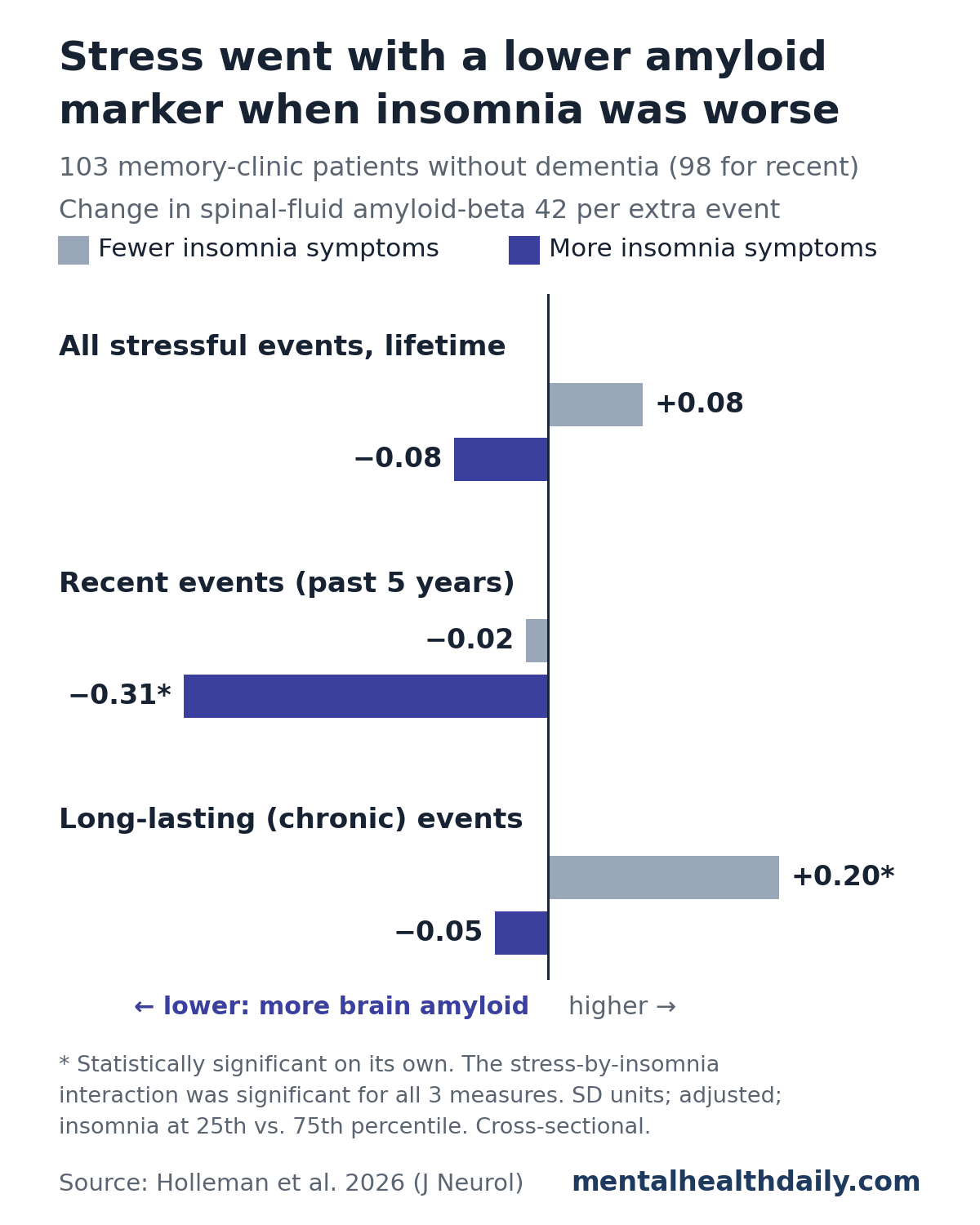
- Fewer insomnia symptoms (25th percentile): each extra lifetime event went with +0.08 standard deviations (SD) of Aβ42 (p = 0.168).
- More insomnia symptoms (75th percentile): each extra event went with −0.08 SD (p = 0.158).
Neither estimate was significant on its own. The finding is the difference between them: insomnia changed the direction of the stress-amyloid link.
Recent and Long-Lasting Stress Showed the Clearest Pattern
Recent events (past 5 years): among people with more insomnia symptoms, each recent event went with Aβ42 about 0.31 SD lower (p = 0.014). With fewer insomnia symptoms, the estimate was close to zero (−0.02, p = 0.898). The interaction was significant (p = 0.034, n = 98).1
Chronic events: with fewer insomnia symptoms, more long-lasting stress actually went with higher Aβ42 (+0.20 SD, p = 0.016). With more insomnia, the estimate turned slightly negative (−0.05, p = 0.531). This was the clearest interaction of all (p = 0.001).1
Non-recent events and acute events pointed the same way, but their linear interactions were not significant (p = 0.080 and 0.117).1
The Pattern Faded at the Highest Insomnia Scores
When the researchers allowed for a curved relationship, total lifetime, non-recent, acute and chronic events all showed the same shape:1
- Low insomnia: more events went with higher Aβ42.
- Average-to-high insomnia: more events went with lower Aβ42.
- Very high insomnia: the association disappeared.
Insomnia on its own was linked to higher CSF Aβ42 in this sample (b = 0.089, p = 0.002). The researchers note that poor sleep slows amyloid clearance, which may at first raise Aβ42 in spinal fluid; once amyloid starts clumping into plaques, levels fall. That two-stage process could help explain why the stress link flipped direction as insomnia rose.1
Current Stress Did Not Hold Up
Perceived stress over the past month also seemed to interact with insomnia at first (b = −0.008, p = 0.033). That result disappeared once the curved insomnia pattern was included (p = 0.545), so it reflected the shape of the insomnia-amyloid relationship rather than stress itself.1
The researchers suggest that life events capture long-term stress exposure better than a 1-month rating, which may be why only the life-event measures held up.1
No Stress-Insomnia Link for Tau
None of the 6 stress measures interacted with insomnia in relation to total tau or phosphorylated tau. For total lifetime events, the interaction p-values were 0.447 for total tau and 0.343 for phosphorylated tau.1
That fits a broader pattern. Insomnia symptoms were not related to tau in this sample, and earlier studies in cognitively healthy adults have generally linked poor sleep to amyloid but not tau. Amyloid builds up earlier in Alzheimer’s disease than tau does, so a sleep-related effect would likely show up there first. The researchers add that the study may have been too small to detect a weaker tau interaction.1
Current Stress Was Linked to Worse Insomnia
Separately, people who felt more stressed in the past month reported more insomnia symptoms (b = 0.066 points per Perceived Stress Scale point, p < 0.001).1
Lifetime stressful events showed a weak, nonsignificant link to insomnia that vanished entirely once depressive symptoms were included (b = −0.001, p = 0.983). The researchers suggest that past stress may raise depression risk, which in turn disrupts sleep.1
Why Stress and Poor Sleep Might Add Up
The study did not test mechanisms, but the researchers point to 2 pathways that could combine:1
- More amyloid made: in animal research, chronic stress and disrupted stress hormones (glucocorticoids such as cortisol) push the processing of amyloid precursor protein toward the pathway that produces amyloid-beta.
- Less amyloid cleared: during sleep, the glymphatic system, a network that flushes waste from the brain through fluid channels around blood vessels, becomes more active. Insomnia has been linked to poorer amyloid clearance.
Higher production plus slower clearance could leave more amyloid available to form plaques than either problem would alone. Inflammation is a third candidate: both chronic stress and sleep loss have been linked to inflammatory signals that encourage plaque formation.1
Earlier Studies Also Linked Poor Sleep to Amyloid
This is one of the first studies to examine stress and insomnia together in relation to Alzheimer’s markers, but the sleep side has a longer record:
- Sleep quality and CSF amyloid: in a 2013 study involving 142 cognitively normal adults aged 45 and older, the 32 with amyloid deposition (based on low CSF Aβ42) had worse sleep efficiency on wrist-worn activity monitors (80.4% vs. 83.7% of time in bed spent asleep, p = 0.04), with no difference in total sleep time.2
- One night without sleep: in 20 healthy adults aged 22 to 72, about 31 hours awake increased the amyloid-beta signal on PET brain scans by about 5% in the hippocampus and thalamus, regions affected early in Alzheimer’s disease.3
- Insomnia and later dementia: a 2016 meta-analysis of 5 population-based cohort studies linked insomnia to a higher risk of developing dementia (relative risk 1.53, 95% CI 1.07 to 2.18), though results varied a lot between studies.4
The 2024 Lancet Commission estimated that up to 45% of dementia cases could be prevented or delayed by addressing 14 modifiable risk factors.5 Sleep is not one of those 14, and the Swedish team describes disturbed sleep as a promising additional factor and chronic stress as another suspected one.1
Limitations of the Memory-Clinic Study
- Cross-sectional design: everything was measured at about the same time, so amyloid changes could be driving poor sleep and stress rather than the reverse. The researchers flag this as a particular concern in memory-clinic patients, who may already have more advanced pathology.
- Self-reported sleep and stress: insomnia came from 3 questionnaire items rather than a clinical diagnosis or sleep tracking, and life events were recalled years later.
- Small sample, many tests: 103 people had spinal-fluid data, and the team tested 6 stress measures against 3 markers. Sex-specific analyses were underpowered, though the direction was consistent in men and women.
- Markers, not disease: the study used spinal-fluid markers only, with no amyloid PET scans, cognitive outcomes or follow-up for dementia.
- Specific population: Swedish memory-clinic patients have more stress, sleep complaints and Alzheimer’s pathology than the general older population, so the results may not carry over.
What This Means for Stress, Sleep and Alzheimer’s Risk
Risk factors combine. The main message is that stress and sleep need to be studied together. Looking at either one alone, this study would have missed the amyloid pattern.1
No proof that treatment prevents Alzheimer’s. The study does not show that treating insomnia or reducing stress lowers amyloid or dementia risk. That would take long-term studies starting before memory problems appear, followed by intervention trials.
Both problems are worth addressing anyway. Ongoing insomnia and heavy stress affect mood, thinking and daily life on their own. Cognitive behavioral therapy for insomnia (CBT-I) is the usual first-line treatment, and persistent sleep trouble or memory concerns are worth raising with a doctor.
References
- Holleman J, Kåreholt I, Näsholm MS, Sørensen C, Hagman G, Aspö M, Kivipelto M, Solomon A, Sindi S. Insomnia symptoms and stress exposure interact in relation to Alzheimer’s disease biomarkers. Journal of Neurology. 2026;273:560. doi:10.1007/s00415-026-14102-7
- Ju YE, McLeland JS, Toedebusch CD, et al. Sleep quality and preclinical Alzheimer disease. JAMA Neurology. 2013;70(5):587–593. doi:10.1001/jamaneurol.2013.2334
- Shokri-Kojori E, Wang GJ, Wiers CE, et al. β-Amyloid accumulation in the human brain after one night of sleep deprivation. Proceedings of the National Academy of Sciences. 2018;115(17):4483–4488. doi:10.1073/pnas.1721694115
- de Almondes KM, Costa MV, Malloy-Diniz LF, Diniz BS. Insomnia and risk of dementia in older adults: systematic review and meta-analysis. Journal of Psychiatric Research. 2016;77:109–115. doi:10.1016/j.jpsychires.2016.02.021
- Livingston G, Huntley J, Liu KY, et al. Dementia prevention, intervention, and care: 2024 report of the Lancet standing Commission. The Lancet. 2024;404(10452):571–628. doi:10.1016/S0140-6736(24)01296-0