hit counter

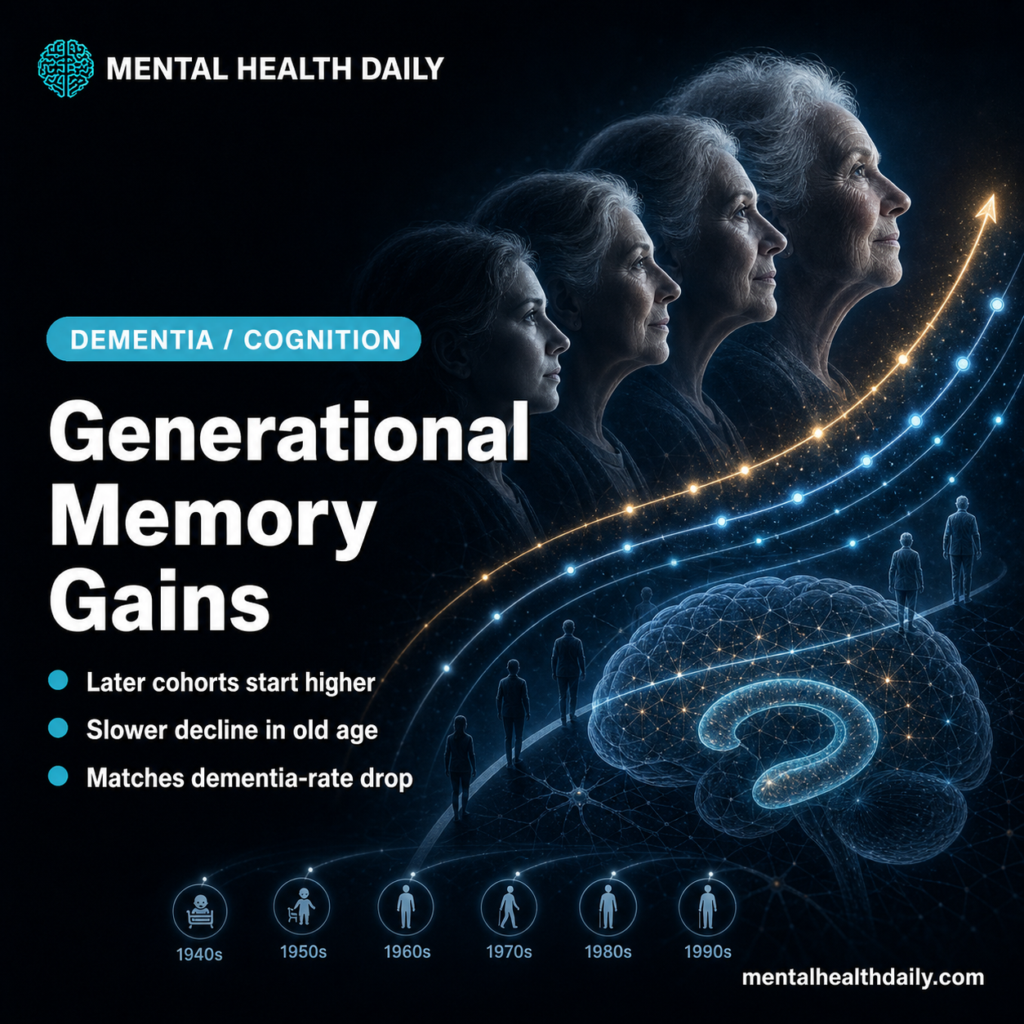
Falling Dementia Rates Linked to Generational Memory Gains

Photoreal illustration representing generational gains in memory across older adults, with imagery of overlapping age trajectories and hippocampal motifs.

Dementia rates in the US, UK, Netherlands, Sweden, France, and several other high-income countries have been falling for decades, despite population aging. The standard explanation — improved cardiovascular care, more education, and less smoking in later-born cohorts — is real but incomplete. Research Highlights Dementia incidence has been falling about 13% per decade in Western …

Read more

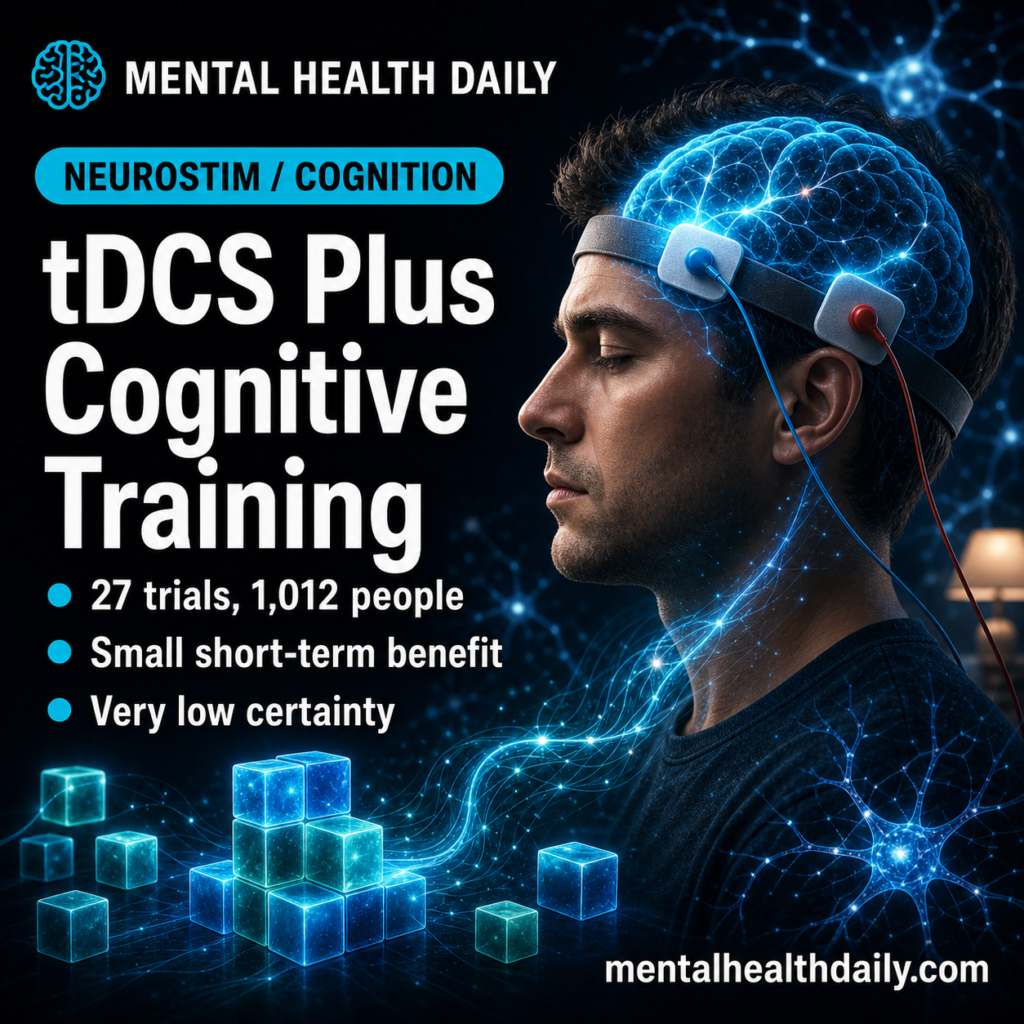
tDCS Plus Cognitive Training Improved Cognition Short-Term by SMD 0.36

MHD featured image for tDCS plus cognitive training in cognitive impairment.

A 2026 medRxiv meta-analysis of 27 trials found that transcranial direct current stimulation added to cognitive training improved global cognition immediately after treatment by SMD 0.36 compared with cognitive training alone.1 The signal was small, short-term, and rated very low certainty, so it is not evidence that tDCS is a durable cognitive-rehabilitation shortcut. Research Highlights …

Read more

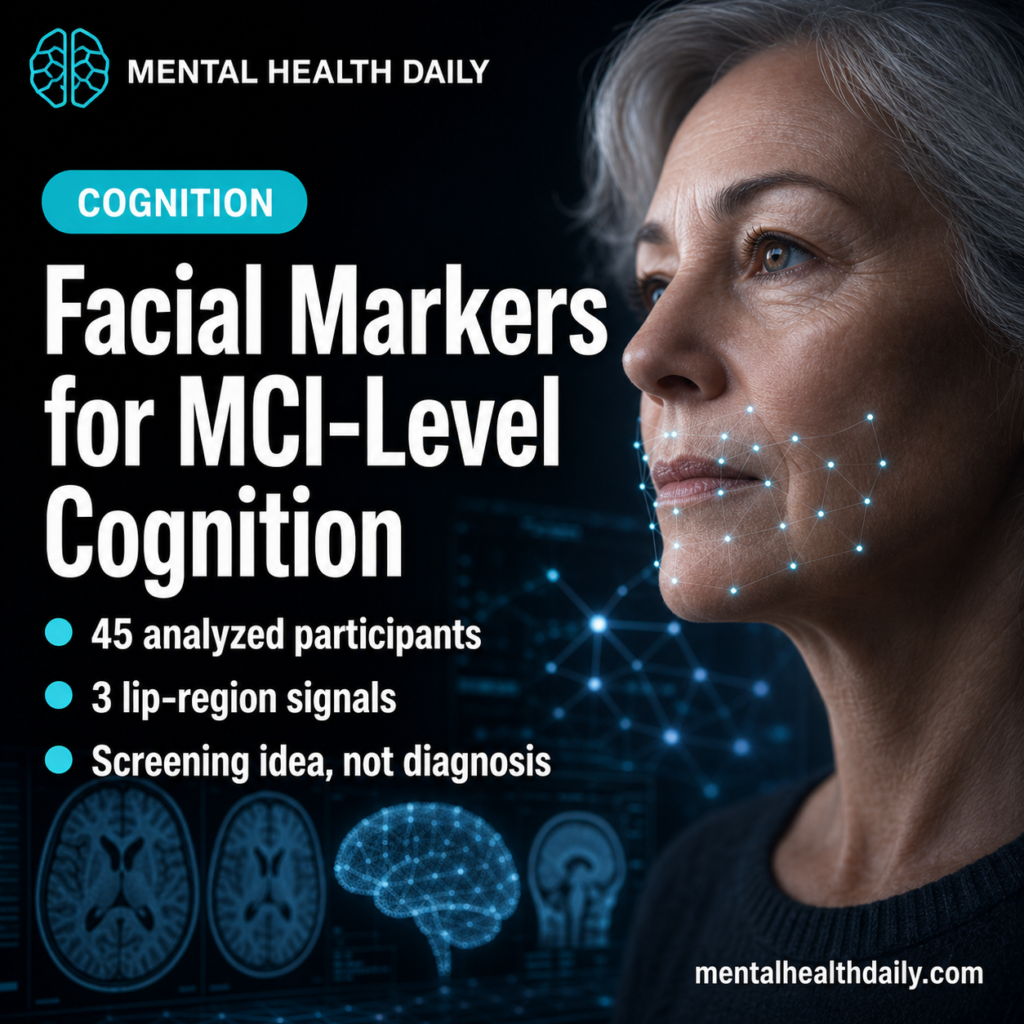
Facial Markers Differed in 31 Older Adults With MCI-Level MoCA Scores

MHD featured image for resting facial expression markers and MCI-level cognition.

A 2026 medRxiv preprint found that older adults with mild-cognitive-impairment-level MoCA-J scores showed distinct resting facial action-unit patterns: AU10 upper lip raiser, AU23 lip tightener, and AU28 lip suck differed after correction in 45 analyzable participants.1 The result supports facial-expression screening research, but it does not show that a face video can diagnose MCI or …

Read more

Pulse-Wave Harmonics Flag MCI During Cognitive Stress: 2.6-Point Gap

MHD featured image for pulse-wave harmonic coherence, cognitive stress, and mild cognitive impairment screening.

A 2026 community study of 101 older adults found that pulse-wave harmonics changed in a more organized way during a subtraction task in cognitively intact participants than in people with MoCA-defined mild cognitive impairment: amplitude-coherence scores averaged 9.00 vs. 6.40, a 2.60-point gap on a 0-10 scale. Research Highlights Cognitive stress exposed the signal: resting …

Read more

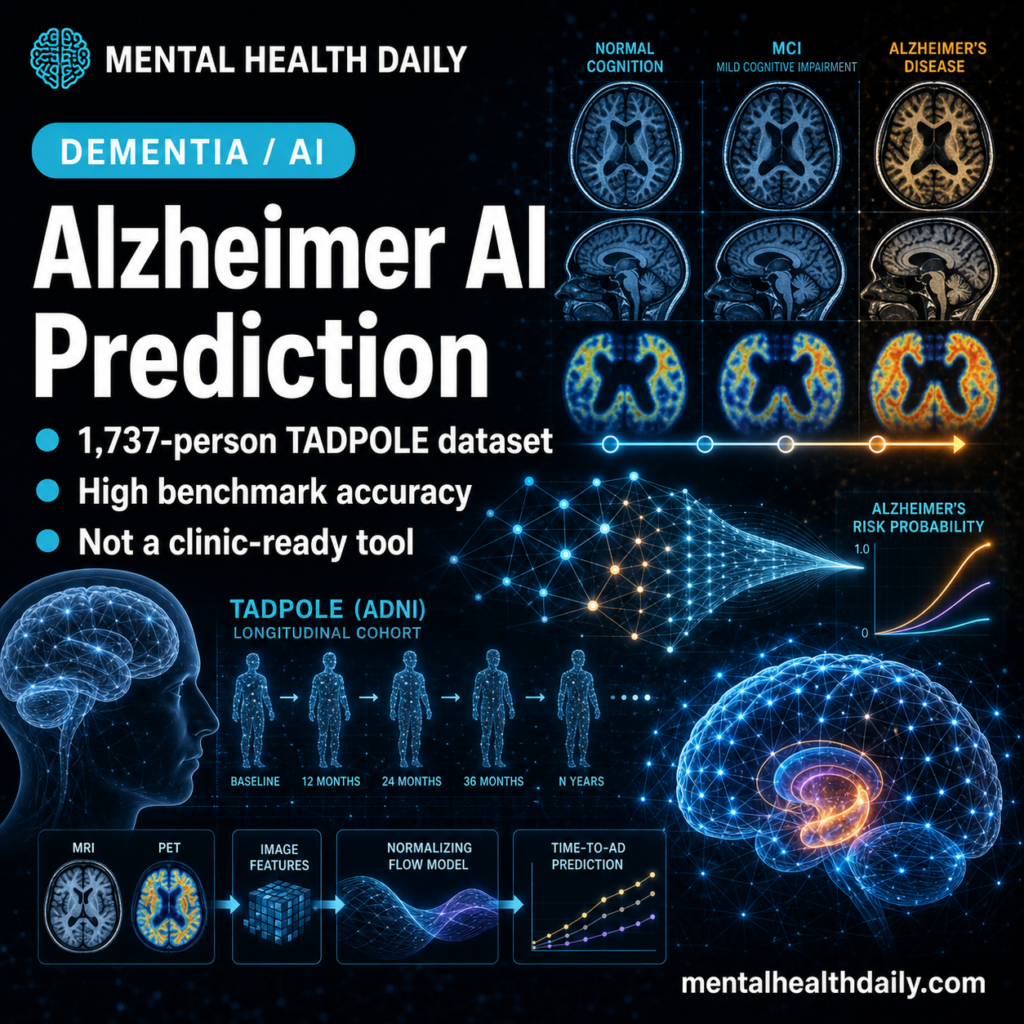
Alzheimer’s Progression AI Model Reaches 0.965 mAUC in TADPOLE Dataset

Editorial card showing Alzheimer progression prediction with longitudinal brain scans, model uncertainty, and TADPOLE cohort data.

A 2026 TADPOLE modeling study reported that a sequential neural process with normalizing flows predicted future Alzheimer diagnostic stage with mAUC 0.965 ± 0.006, ahead of the authors’ earlier sequential-neural-process model at 0.937 ± 0.014.1 The result is a strong benchmark signal for uncertainty-aware disease-progression AI, but it is still retrospective modeling evidence rather than …

Read more

REDDI MEG Classifier Separated 4 Neurodegenerative Diseases at 0.81

MHD featured image for REDDI MEG differential diagnosis research.

A 2026 medRxiv preprint found that REDDI, a resting-state magnetoencephalography machine-learning pipeline, separated mild cognitive impairment, multiple sclerosis, Parkinson’s disease, and amyotrophic lateral sclerosis with 0.81 ± 0.04 balanced accuracy across 5 folds.1 That is a meaningful jump over the prior 67.1% MEG benchmark, but it is still research-stage decision support rather than a clinical …

Read more

Alzheimer’s AI MRI Diagnosis: ANA-GNN Reaches 85.23% Accuracy in ADNI

MHD featured image for ANA-GNN Alzheimer's AI MRI diagnosis in the ADNI cohort.

A 2026 ADNI study reported 85.23% accuracy for ANA-GNN, a graph neural network that combined structural MRI regional features with clinical variables to classify cognitively normal controls, mild cognitive impairment, and Alzheimer’s disease.1 The result is useful, but the clinical-feature ablation dropped accuracy to 68.35%, so the model should be read as multimodal decision-support research, …

Read more