hit counter

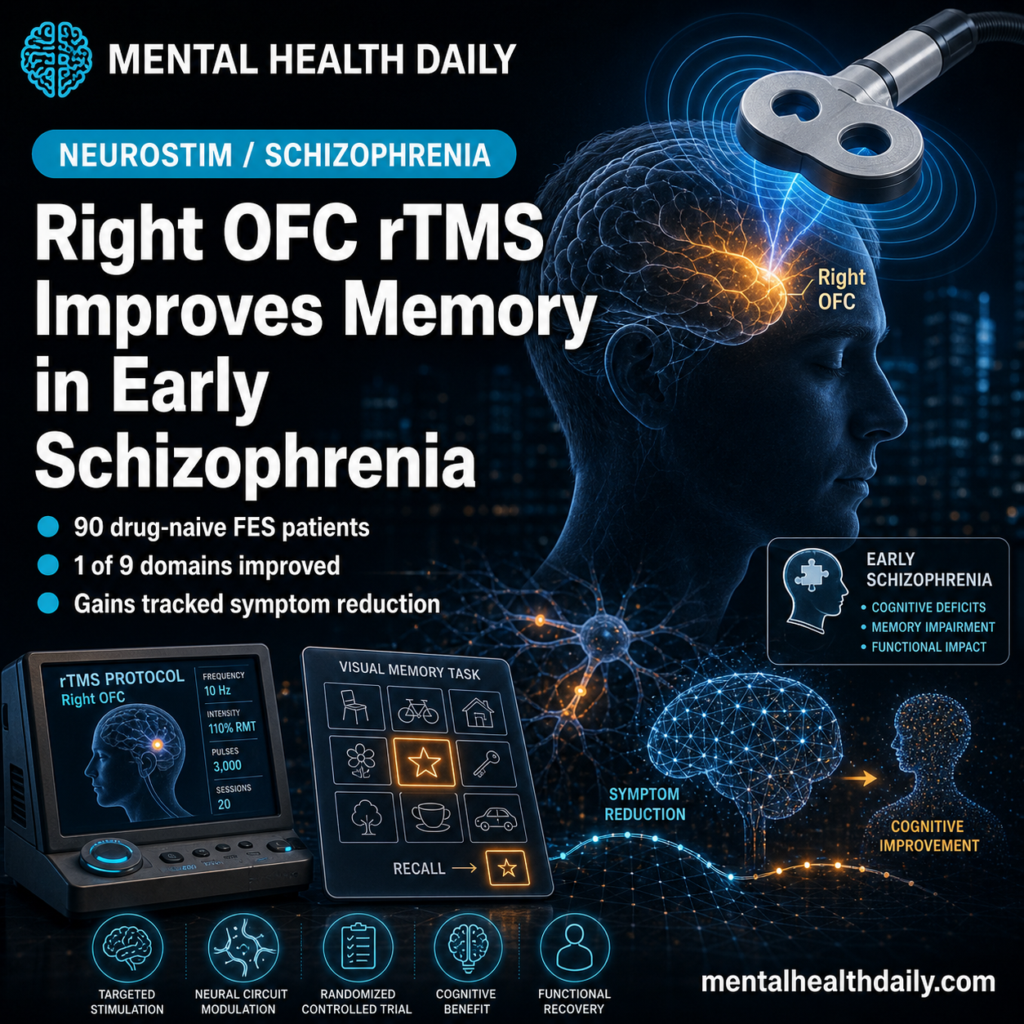
Right OFC rTMS Improves Memory in Early Schizophrenia

Editorial card showing a coronal brain section highlighting the right orbitofrontal cortex with a TMS coil, illustrating the first RCT of OFC stimulation in first-episode schizophrenia.

Cognitive impairment in first-episode schizophrenia (FES) is the symptom that does the most work blocking employment, relationships, and independent living — and the symptom current antipsychotics barely move. A 2026 RCT by Hu et al. in Psychological Medicine tested whether 20 sessions of low-frequency rTMS targeting the right orbitofrontal cortex (OFC) could improve cognition where …

Read more

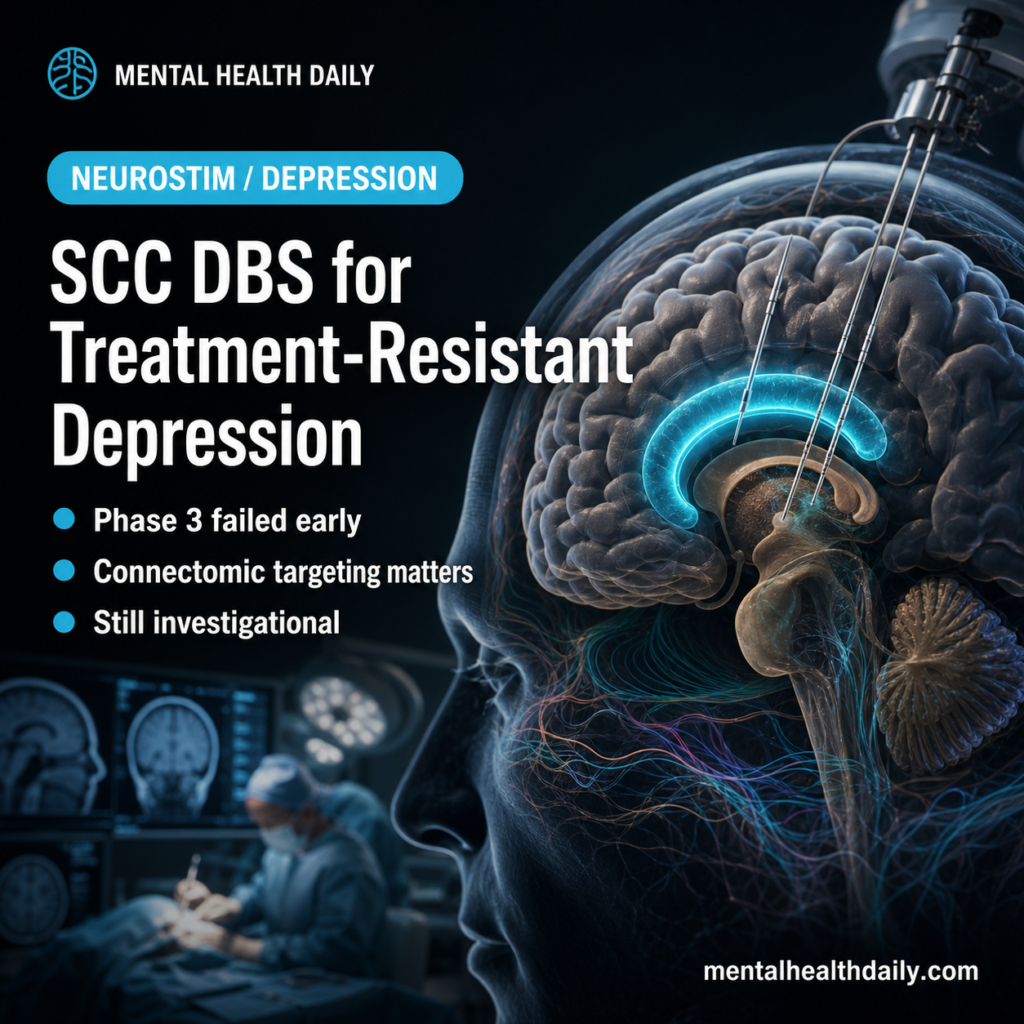
Subcallosal Cingulate DBS for Treatment-Resistant Depression

MHD featured image for Subcallosal Cingulate DBS for Treatment-Resistant Depression.

A 2026 systematic review of subcallosal cingulate (SCC) functional connectivity found 28 qualifying resting-state fMRI studies in depression: 21 rTMS/iTBS studies, 4 ECT studies, 3 focused-ultrasound studies, and 0 DBS or tDCS studies.1 That number is the useful correction: SCC DBS may still be biologically plausible, but the current fMRI connectivity literature mostly explains noninvasive …

Read more

Repetitive TMS for Alzheimer’s Disease Alters Brain Waves & Enhances Cognition (2024 Study)

Repetitive transcranial magnetic stimulation (rTMS) is making waves in the field of Alzheimer’s disease (AD) research, offering a glimmer of hope for enhancing cognitive functions in patients. By targeting specific brain regions, rTMS has shown promising results in modulating neural activity and improving cognitive scores. This innovative therapy, coupled with real-time monitoring through electroencephalography (EEG), …

Read more

Accelerated TMS for Depression: Is aTMS More Effective than Standard TMS? (2024 Review)

Depression, a common yet severe mood disorder, affects millions worldwide, posing significant challenges in both diagnosis and treatment. Recent advancements have led to the development of accelerated transcranial magnetic stimulation (aTMS), a novel approach aiming to offer rapid relief for individuals suffering from major depressive disorder (MDD). This revolutionary technique has shown promising results, potentially …

Read more

Stanford Accelerated Intelligent Neuromodulation Therapy (SAINT) for Rapid Treatment of Suicidal Depression (2023 Study)

Major depressive disorder (MDD) is a critical public health issue, particularly due to the high risk of suicide associated with it. Traditional treatments often take weeks to show effects and sometimes increase suicide risk in the early phases of therapy. However, a new approach, the Stanford Accelerated Intelligent Neuromodulation Therapy (SAINT), is showing promise in …

Read more

TMS For Anxiety Disorders (Transcranial Magnetic Stimulation)

TMS (Transcranial magnetic stimulation) is considered a non-invasive neurostimulation procedure aimed at normalizing brain activity among those with abnormal neurological function.  Individuals diagnosed with psychiatric conditions (e.g. depression) may turn to TMS for relief if standard first-line pharmacological options fail to ameliorate symptoms.  A TMS device works by using pulsed magnetic fields to generate low-grade electrical currents. …

Read more