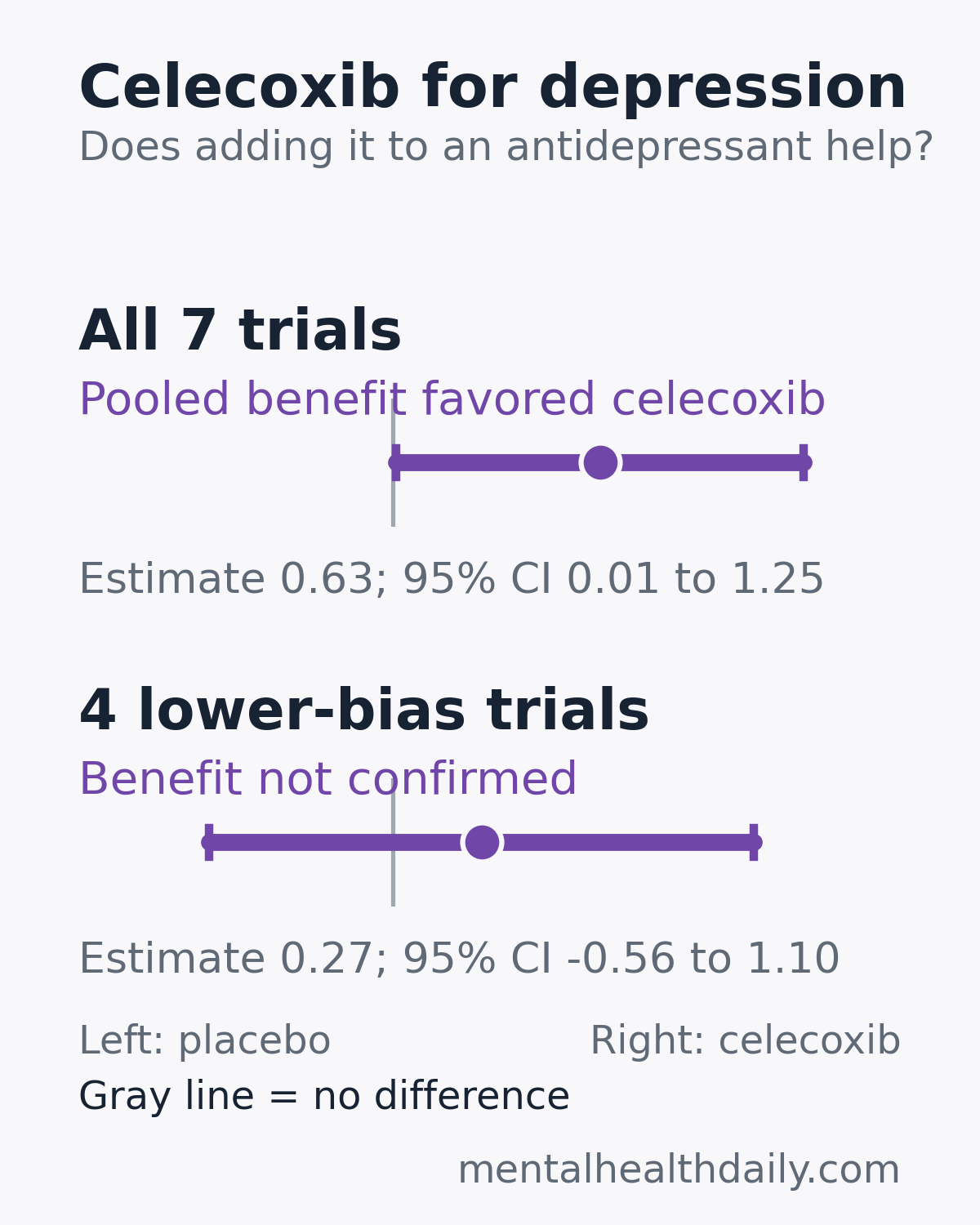
A 2026 review of 7 randomized trials involving 365 adults found that adding celecoxib to an antidepressant favored lower depression scores (standardized mean difference −0.63; 95% confidence interval −1.25 to −0.01). But when researchers removed 3 trials at high risk of bias, the apparent benefit shrank and was no longer statistically confirmed.1
Research Highlights
- A possible add-on effect: Across 7 trials, the pooled symptom-score difference favored celecoxib, but estimates differed greatly from trial to trial.1
- The quality check changed the answer: In 4 trials left after high-risk studies were excluded, the estimate was −0.27 (95% confidence interval −1.10 to 0.56), which does not confirm a benefit.1
- Later results conflict: A 119-person trial in a mostly treatment-resistant group and a 43-person inpatient trial found no clear added benefit; a 60-person trial using escitalopram reported improvement.2, 3, 4
- Safety remains part of the decision: Trial dropout comparisons were too imprecise to establish tolerability, and celecoxib carries cardiovascular, gastrointestinal, and other drug-interaction risks.1
Celecoxib is a prescription anti-inflammatory drug that blocks cyclooxygenase-2 (COX-2), an enzyme involved in making inflammatory signaling molecules. Researchers have tested whether dampening that pathway adds to antidepressant treatment in major depressive disorder, a condition involving persistent depressed mood or loss of interest with meaningful effects on daily life.
The trials tested celecoxib alongside an antidepressant, not as a replacement for one.1
Seven Trials Produced a Fragile Depression Benefit
Srisurapanont et al. pooled 7 double-blind trials comparing an antidepressant plus celecoxib with the same antidepressant plus placebo.1
- Participants: 183 assigned to celecoxib and 182 to placebo.
- Regimen: Most trials used 400 mg/day for 6 weeks; 1 used 200 mg/day for 8 weeks.
The review’s main result was a standardized mean difference (SMD) of −0.63. An SMD puts symptom scales measured in different trials onto one common scale; here, a negative number favors celecoxib. Its 95% confidence interval, −1.25 to −0.01, barely excluded no difference.1
The estimate points toward benefit, but its wide interval does not tell an individual patient how much improvement to expect.
Trial results varied: I² was 81.3%, meaning much of their variation exceeded what chance alone would typically explain. Four trials reported a significant celecoxib advantage; 3 did not.
The 95% prediction interval for another similar trial ran from −2.23 to 0.97. It spans a strong benefit, no benefit, and a result favoring placebo.1
The quality check weakened the result: 3 trials were rated at high risk of bias, particularly because outcome data were missing. After excluding them, the estimate moved toward no effect: SMD −0.27 across 4 trials, with a 95% confidence interval from −1.10 to 0.56.1
The point estimate still leans toward celecoxib; the remaining data do not establish that it works better than placebo.
Why Earlier Celecoxib Studies Looked More Convincing
Early positive trials were small. A 40-person trial pairing celecoxib with reboxetine reported greater depression improvement than reboxetine plus placebo, but 55% of participants did not complete the 6-week assessment. Missing results on that scale make the favorable estimate less secure.1, 5
Later trials tested the same add-on question in different clinical settings:
- Vortioxetine: In the largest trial, 119 people were enrolled and 76% had not responded to earlier treatment. Adding celecoxib produced no confirmed advantage.2
- Sertraline: A 43-person inpatient trial found no significant improvement in response or remission with celecoxib.3
- Escitalopram: A 60-person trial reported lower depression ratings with celecoxib at weeks 4 and 8.4
These are not interchangeable patients or antidepressants. The 2026 review cannot tell whether drug pairing, depression history, or chance explains why some trials favored celecoxib while others did not. A 2023 meta-analysis had estimated a larger benefit (SMD −0.85); the newer review incorporated later negative evidence and put more weight on variation and study quality.1, 6
Inflammation Has Not Identified a Reliable Responder Group
C-reactive protein (CRP) is a blood marker of inflammation. If celecoxib helps mainly when inflammation is elevated, CRP might eventually help select patients. That appealing idea has not been confirmed in these trials.
The 119-person trial tested whether baseline CRP separated people who benefited from celecoxib from those who did not. It found no clear treatment-by-CRP interaction: measured inflammation did not reliably predict an added antidepressant effect.2
One exploratory treatment-resistance subgroup pattern in the 2026 review came from a single trial. It is too narrow to guide patient selection.1
Depression can involve inflammatory processes, but a plausible mechanism is not the same as a validated treatment rule. Routine CRP testing to decide on celecoxib for depression would run ahead of the evidence.
Short Trials Cannot Settle the Safety Tradeoff
Only 5 trials involving 265 people contributed to the review’s dropout analyses. Neither comparison settled whether the add-on is easy to tolerate:1
- Any-cause dropout: risk ratio 0.77 (95% confidence interval 0.14 to 4.07).
- Dropout due to adverse effects: risk ratio 0.83 (95% confidence interval 0.19 to 3.64).
Both intervals span substantially fewer and substantially more dropouts with celecoxib.
Longer-term risks matter because the depression trials mostly lasted 6 weeks. The US prescribing label warns about serious cardiovascular events, gastrointestinal bleeding or ulcers, and kidney risks.
Bleeding risk can also rise when celecoxib is used with selective serotonin reuptake inhibitors or serotonin-norepinephrine reuptake inhibitors, 2 common antidepressant classes.
A short, underpowered dropout comparison cannot cancel those established drug warnings. Anyone considering celecoxib for a separate pain or inflammatory condition needs an ordinary medication review, especially when taking an antidepressant; the depression evidence alone does not justify routine add-on prescribing.
What the Celecoxib Evidence Supports Now
The overall estimate favors celecoxib, so a modest add-on effect remains possible. Better-quality evidence has not confirmed its size or even its presence, and the review rated confidence in the efficacy result very low.1
For someone already taking an antidepressant, celecoxib remains a research lead rather than a tested routine add-on. The trials have not shown a repeatable depression benefit strong enough to offset its known risks for routine use.
A larger trial with better follow-up could clarify whether a subgroup benefits. It would need to define that subgroup before enrollment and measure both depression symptoms and clinically meaningful harms over a longer period.
References
- Celecoxib adjunct to antidepressants for major depressive disorder: Systematic review and meta-analysis. Srisurapanont M, et al. Brain Behav Immun Health. 2026;55:101277. doi:10.1016/j.bbih.2026.101277
- No evidence for clinical efficacy of adjunctive celecoxib with vortioxetine in the treatment of depression: A 6-week double-blind placebo controlled randomized trial. Baune BT, et al. Eur Neuropsychopharmacol. 2021;53:34-46. doi:10.1016/j.euroneuro.2021.07.092
- Efficacy of Sertraline Plus Placebo or Add-On Celecoxib in Major Depressive Disorder: Macrophage Migration Inhibitory Factor as a Promising Biomarker for Remission After Sertraline — Results From a Randomized Controlled Clinical Trial. Simon MS, et al. Front Psychiatry. 2021;12:615261. doi:10.3389/fpsyt.2021.615261
- The efficacy and safety of adding celecoxib to escitalopram for improving symptoms of major depressive disorder. Sakhvidi MN, et al. Int J Psychiatry Med. 2024;59(5):511-520. doi:10.1177/00912174231210567
- The cyclooxygenase-2 inhibitor celecoxib has therapeutic effects in major depression: Results of a double-blind, randomized, placebo controlled, add-on pilot study to reboxetine. Müller N, et al. Mol Psychiatry. 2006. doi:10.1038/sj.mp.4001805
- Celecoxib for Mood Disorders: A Systematic Review and Meta-Analysis of Randomized Controlled Trials. Gedek A, et al. J Clin Med. 2023;12(10):3497. doi:10.3390/jcm12103497