Overactive, misdirected attention may be the common thread that keeps persistent postural-perceptual dizziness (PPPD) going, according to a 2026 narrative review. Yang et al. argue it can explain dizziness from busy visual scenes and dizziness while simply sitting or standing still.1
Research Highlights
- Attention as the link: the review pulled together brain imaging, balance, perception and clinical studies and proposed that attention sets how much weight the brain gives to visual, inner-ear, body and balance signals.1
- More than a visual problem: PPPD comes in at least 4 symptom patterns. In one questionnaire study, about two-thirds of patients had a main pattern, and dizziness from their own movement was the most common.1
- People feel more sway than they have: in a lab study the review cites, PPPD patients overestimated their own body sway compared with the sway actually measured.1
- Spread-out brain changes, no single damaged spot: imaging studies point to altered communication among attention, salience, vestibular, visual and movement networks.1
- Treatments fit the idea but do not prove it: a meta-analysis of 6 randomized trials found that adding cognitive behavioral therapy to usual care improved dizziness handicap scores.3
What PPPD Is and Who Gets It
Persistent postural-perceptual dizziness (PPPD) is a chronic functional dizziness disorder. “Functional” means the problem lies in how the nervous system processes balance and motion, not in visible structural damage.
The Bárány Society, the international body that classifies vestibular (inner-ear and balance) disorders, defined PPPD in 2017. Its criteria require:2
- Symptoms: dizziness, unsteadiness or non-spinning vertigo on most days for 3 months or more
- Triggers: worse with upright posture, active or passive motion, and moving or complex visual scenes
- Precipitating condition: symptoms began after a vestibular disorder, another medical or neurological illness, or psychological distress that caused dizziness, unsteadiness or balance problems.
- Impact: significant distress or trouble functioning
- Exclusion: not better explained by another disorder
The 2017 definition pulled together 4 older diagnoses: phobic postural vertigo, chronic subjective dizziness, space-motion discomfort and visual vertigo. PPPD is now listed in the WHO’s ICD-11 as a functional neuro-otologic disorder.1
It is common. Studies cited in the review put PPPD at about 15–20% of dizziness cases in specialist referral clinics and up to 40% in dedicated vestibular centers. It mostly affects adults aged 30 to 50, and women about 4 times as often as men.1
PPPD often starts after an acute balance problem such as benign paroxysmal positional vertigo (BPPV), vestibular neuritis or vestibular migraine. It can also follow a medical illness, psychological distress or a period of feeling unstable with no clear ear problem at all.1
Routine balance tests and brain scans are often normal. That mismatch between how disabling the symptoms feel and what standard tests show has made PPPD hard to explain.1
How Attention Could Keep the Brain on High Alert
After a sudden balance problem, people naturally switch into a protective mode. They watch their footing, lean on vision, stiffen their trunk and legs, and notice every bit of motion around them.1
Most people drop these strategies within days to weeks as the inner ear recovers and the brain recalibrates. In PPPD, this high-alert mode seems to stay switched on. Yang et al. describe this as the failure of readaptation model, and note that it describes what happens without explaining how the brain keeps it going.1
The review links 2 mechanisms that researchers have proposed to fill that gap:
- Multisensory reweighting gets stuck. Healthy balance blends inner-ear, visual and body-position signals, shifting weight toward whichever is most reliable in the moment. In PPPD, that weighting seems to lose flexibility, often leaning too hard on vision.
- Prediction errors get amplified. The brain constantly predicts the sensations its own movements should cause and mostly ignores what it expected. Only surprises, called prediction errors, get flagged. In PPPD, tiny normal signals from breathing, heartbeat or ordinary sway seem to get flagged as threats to balance.
Attention is the proposed bridge between the two. In predictive-processing theory, attention helps decide how reliable, or “precise,” a signal is treated as being. Pay too much attention to a signal and the brain trusts it too much, so minor sensations can override the stable prediction that the body is fine.1
Lab evidence fits this picture. In one study the review cites, PPPD patients overestimated their own sway compared with their objectively measured sway. In another, they had lower thresholds for detecting inner-ear stimulation, higher thresholds for detecting visual motion, and reported feeling motion on sham trials with no motion at all.1
PPPD Is Not Only a Visual Problem: 4 Symptom Patterns
Many people with PPPD feel worse in supermarkets, traffic, patterned spaces or while scrolling a screen. But visual sensitivity is not universal, and the review argues that treating PPPD as purely a visual disorder misses important groups of patients.1
Questionnaires have mapped this variety. The Niigata PPPD Questionnaire scores symptoms across upright posture or walking, movement, and visual stimulation. The 8-item Athens-Lubeck Questionnaire goes further and separates 4 patterns:1
- Visual intolerance: dizziness from busy or moving visual scenes
- Quiet standing or sitting intolerance: dizziness with no overt body motion
- Passive motion intolerance: dizziness when being moved
- Active motion intolerance: dizziness when walking or moving the head
In the prospective study that developed the Athens-Lubeck tool, about two-thirds of patients had one predominant pattern, and active motion intolerance was the most common.1
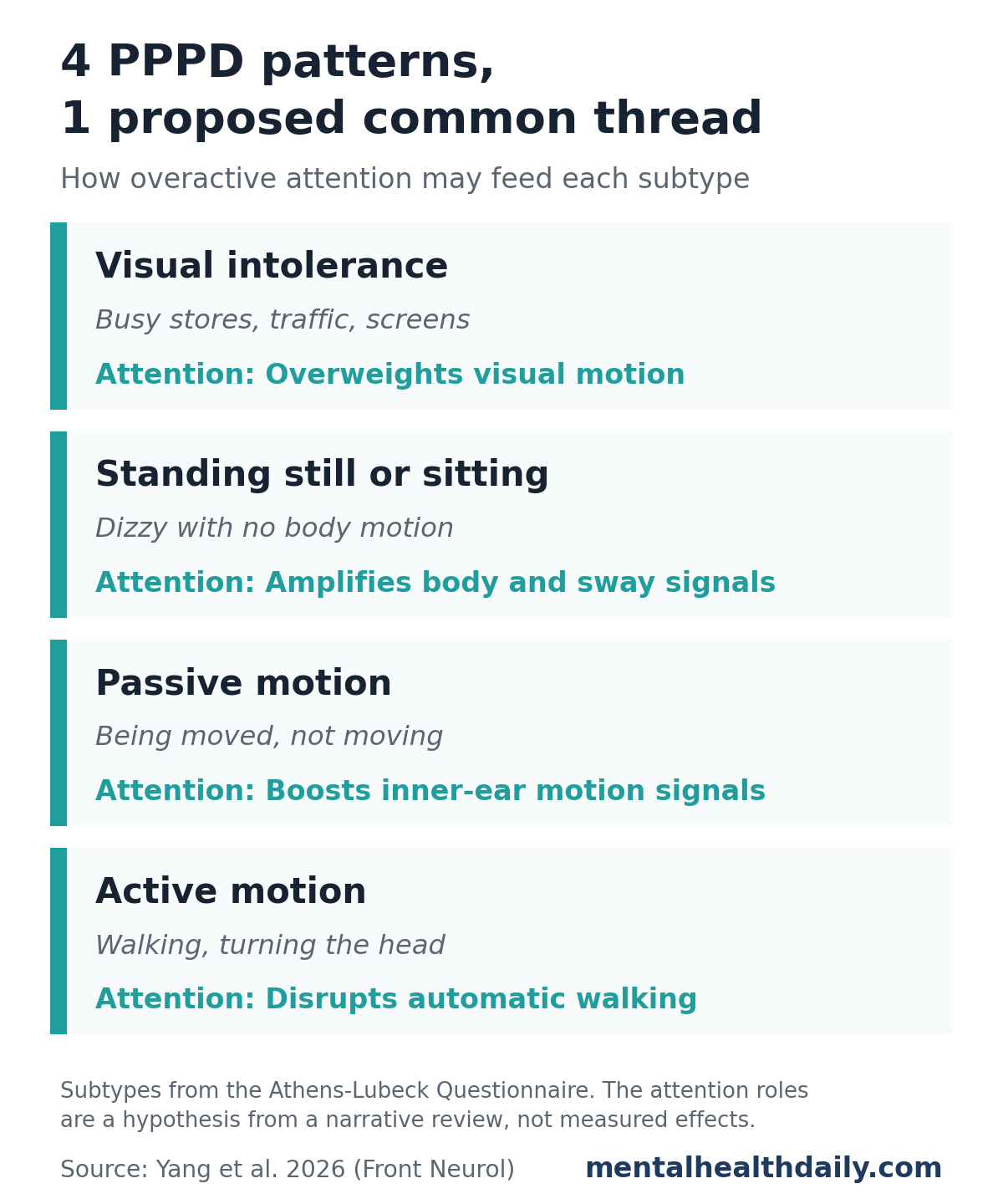
The review proposes a role for attention in all 4 patterns. Where vision dominates, attention makes visual motion feel too trustworthy. For people who get dizzy sitting still, it amplifies internal body and posture signals.
With passive motion, attention heightens inner-ear motion signals, and with active motion, it interferes with walking and head movement that should run on autopilot.1
Brain Scans in PPPD Show Spread-Out Changes, Not One Damaged Spot
Imaging studies in PPPD have found differences across several brain regions. Each one plays a different part in balance and attention:1
- Dorsolateral prefrontal cortex (DLPFC): top-down control of attention
- Anterior cingulate cortex (ACC): detecting conflict and deciding what is important
- Posterior insula and parietal operculum: processing inner-ear and internal body signals
- Temporoparietal junction and vestibular cortex: sensing self-motion
- Precuneus: spatial and self-referential processing
- Visual cortex, cerebellum and sensorimotor cortex: visual motion and fine-tuning posture
Findings include lower gray matter volume in the DLPFC, ACC and cerebellum, reduced cortical folding in vestibular regions, and weaker communication within the default mode network, a set of regions active during rest and inward-focused thought.1
Network studies also found stronger coupling between movement and visual networks, and less efficient information flow through the precuneus. Yang et al. read this as distributed reorganization, and they are explicit that these scans do not show attention is the primary problem.1
Balance Becomes Effortful Instead of Automatic
Healthy people stand and walk without thinking about it. Several studies, mostly in phobic postural vertigo (an older diagnosis now folded into PPPD), suggest that balance in these patients becomes something they consciously manage:1
- Stiff stance: more body sway in the 3.5–8 Hz range, a sign of co-contracting muscles rather than actually losing balance
- Cautious walking: slower gait that changed with attention demands and with eyes closed
- Narrower gaze: less side-to-side eye and head scanning while walking through complex scenes
Dual tasks cut both ways. A light mental task may steady some patients by pulling attention away from monitoring their balance, while a heavier task can make balance worse once mental resources run out. The review’s illustration of this curve is a concept sketch, not measured data.1
Balance vigilance describes the clinical side: constant monitoring of posture and any sense of instability. The review describes a self-reinforcing loop in which watching for instability makes small sensations feel bigger, which seems to confirm the threat and draws even more attention.1
Anxiety and threat-focused attention are common in PPPD. The review is clear, though, that PPPD is not simply anxiety: the attention bias becomes linked to balance and motion cues, and can sustain dizziness even after the inner ear has recovered.1
What Treatment Research Says About Attention in PPPD
The review describes the 2 main PPPD treatments as working partly through attention:
- Cognitive behavioral therapy (CBT): a structured talk therapy that targets catastrophic interpretations of symptoms, avoidance, safety behaviors and constant self-monitoring.
- Vestibular rehabilitation therapy (VRT): guided exercises that use gradual exposure to motion, gaze stabilization and balance practice to help the brain reweight senses and restore automatic movement.
Zang et al. pooled 6 randomized trials and found that adding CBT to conventional treatment (VRT, an SSRI antidepressant, or both) improved scores on the Dizziness Handicap Inventory, a standard questionnaire on how much dizziness disrupts daily life. The average improvement was 8.17 points greater than conventional treatment alone (95% CI, 6.09 to 10.26).3
That meta-analysis also found lower anxiety and depression scores with added CBT, and called for more randomized trials.3
Proposed next steps: Yang et al. suggest testing treatments matched to each symptom pattern, plus attention bias modification, graded virtual-reality exposure to visual motion, and brain stimulation of the DLPFC. The review presents these as ideas to evaluate in trials, not established treatments.1
Limitations of This PPPD Attention Review
This is a narrative review: Yang et al. selected and interpreted studies without a systematic search, quality scoring or pooled statistics. They call their model hypothesis-generating. Specific limits:1
- Not a proven cause: the review proposes attention as an organizing process and states that attention alone is not a sufficient cause of PPPD.
- Mixed diagnoses: much of the balance and gait evidence comes from phobic postural vertigo and other predecessor syndromes, not PPPD as defined in 2017.
- Associations only: imaging and lab findings show differences between patients and controls, not that attention produces them.
- Untested treatment matching: the idea that each symptom pattern needs a different treatment emphasis has not been tested in trials.
To test the model, Yang et al. propose sorting patients by symptom pattern, designing dual-task studies that separate light and heavy mental load, and tracking attention in real time with event-related potentials (brain-wave responses measured by EEG).1
What This Means for People With Chronic Dizziness
PPPD symptoms are real. The model describes a brain that stays stuck in a protective, high-alert mode, which is different from saying symptoms are imagined or “just anxiety.”
It also helps explain why someone can feel dizzy sitting on a couch, or long after an inner-ear problem has settled. And it fits with how CBT and vestibular rehabilitation are thought to work, since both retrain how attention and balance interact.1,3
Anyone with dizziness lasting 3 months or more should get a full medical and vestibular evaluation, since other conditions need to be ruled out before a PPPD diagnosis.2
References
- Yang S, Liu X-C, Chen J. Attentional dysfunction in persistent postural-perceptual dizziness: a narrative review of mechanistic evidence. Frontiers in Neurology. 2026;17:1938453. doi:10.3389/fneur.2026.1938453
- Staab JP, Eckhardt-Henn A, Horii A, Jacob R, Strupp M, Brandt T, Bronstein A. Diagnostic criteria for persistent postural-perceptual dizziness (PPPD): consensus document of the committee for the Classification of Vestibular Disorders of the Bárány Society. Journal of Vestibular Research. 2017;27(4):191–208. doi:10.3233/VES-170622
- Zang J, Zheng M, Chu H, Yang X. Additional cognitive behavior therapy for persistent postural-perceptual dizziness: a meta-analysis. Brazilian Journal of Otorhinolaryngology. 2024;90(3):101393. doi:10.1016/j.bjorl.2024.101393