hit counter

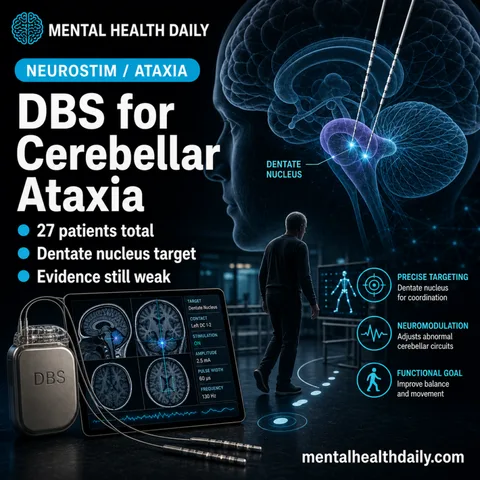
DBS for Cerebellar Ataxia: 27 Patients, Weak Evidence

MHD featured image for deep brain stimulation, the dentate nucleus, and cerebellar ataxia.

A 2026 systematic review found 15 clinical reports of deep brain stimulation for cerebellar ataxia, covering only 27 human patients across heterogeneous targets, causes, and outcome measures. Research Highlights The human evidence base was tiny: the review found 27 patients across 15 clinical studies, including 10 case reports, 4 case series, and 1 randomized trial. …

Read more

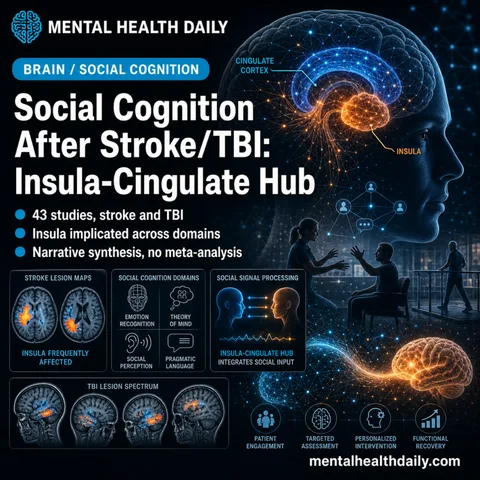
Social Cognition After Stroke/TBI: Insula-Cingulate Hub

Editorial card showing a stylized brain with the insula, cingulate, middle frontal gyrus, and corpus callosum highlighted, representing the convergent neural substrates of social cognition after acquired brain injury.

A 2026 PRISMA systematic review by Cavallo et al. in Cognitive, Affective, & Behavioral Neuroscience aggregates 43 neuroimaging studies of social cognition in adults with stroke or traumatic brain injury and finds the same handful of regions implicated again and again: the insula, cingulate cortex, middle frontal gyrus, and corpus callosum.1 Research Highlights Stroke/TBI social-cognition …

Read more

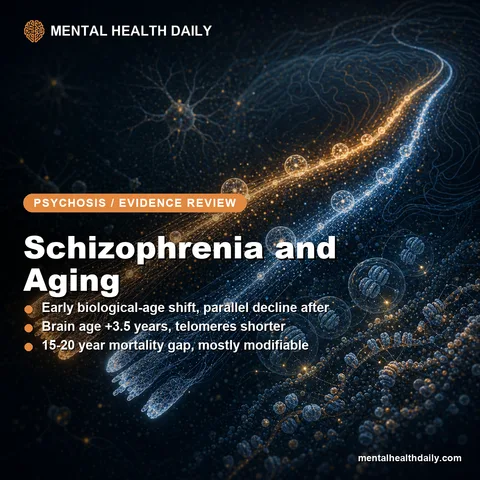
Schizophrenia and Aging: Advanced, Not Accelerated

Two parallel timelines representing chronological vs. biological age in schizophrenia: an early offset at first episode, then parallel trajectories afterward — illustrating advanced rather than accelerated aging.

“Schizophrenia ages you faster” is the headline that gets repeated whenever a new biomarker study lands. The 2026 Fernandez-Egea, Garcia-Rizo and Kirkpatrick review — covering 170 studies across mortality, brain imaging, telomeres, epigenetic clocks, and metabolic markers — pushes back on that framing.2 The aging signal is genuine. “Accelerated” is the part that overshoots for …

Read more

tDCS for Fibromyalgia: Efficacy of Transcranial Direct Current Stimulation (2024 Review)

A recent systematic review and meta-analysis aimed to update the understanding of the efficacy and safety of transcranial direct current stimulation (tDCS) for treating fibromyalgia (FM), focusing on its effects on analgesia, antidepressant outcomes, and the reduction of FM’s impact. Highlights: Efficacy of tDCS: The analysis revealed that tDCS is effective in reducing pain intensity, …

Read more

Valerian Root for Insomnia & Sleep: Is It Actually Effective? (2023 Review)

Valerian, a herb long cherished for its sedative properties, stands at the crossroads of traditional medicine and modern scientific inquiry. Despite its widespread use across cultures for promoting sleep and alleviating insomnia, the scientific community remains divided over its efficacy. Highlights: Historical Significance: Valerian has been used since the times of ancient Greece and Rome …

Read more

Psilocybin for Depression: Optimal Dosages for Antidepressant Effects (2023 Review)

Recent research has provided compelling evidence on the therapeutic potential of psilocybin, a naturally occurring psychedelic, in treating depression. A systematic review and dose-response meta-analysis shed light on the optimal dosage of psilocybin for depression, revealing variations in effectiveness based on patient subgroups and associated risks. Highlights: Psilocybin showed significant antidepressant effects, with optimal dosages …

Read more