
Drug use and internet fraud often fed each other, according to 22 young adults in addiction treatment in southwestern Nigeria who took part in focus groups for a 2026 study. They also described both as driven by peer pressure, lack of jobs and mixed community approval, and as carrying real costs in guilt and distress.1
Research Highlights
- A 2-way link in many accounts: across 4 focus groups, participants described drugs giving confidence, energy to stay awake and a way to cope during fraud, and fraud money paying for more drugs.1
- Often separate, too: many participants knew people who committed fraud without using drugs, or used drugs without any fraud involvement.1
- Peers came up most: belonging to a group and seeing friends’ visible wealth was the most consistently cited reason for both behaviors, alongside unemployment and pressure to provide for family.1
- Mixed signals at home and in the community: participants described some parents and community members ignoring, tolerating or even supporting fraud once money arrived.1
- Hidden mental health costs: guilt, depression, anxiety, aggression and trouble sleeping came up despite the money.1
- Small, specific sample: the study captured experiences of people already in treatment at 1 hospital, so it cannot say how common these patterns are.1
Who Took Part in the Nigerian Focus Groups
Lateef Oluwole et al. recruited patients from a unit at a teaching hospital in southwestern Nigeria that treats mental and behavioral disorders caused by psychoactive substance use. Psychoactive substances are drugs that change mood, thinking or alertness, such as alcohol, cannabis and opioids like tramadol and codeine.1
- Participants: 22 single adults aged 19 to 47 (average about 25), mostly men; 17 had a college or university education and 5 had a secondary-school education.
- Fraud connection: each had either been involved in internet fraud or had close friends who were, as disclosed earlier to their clinical team. No one was included based on rumor alone.
- Format: 4 group discussions of about 60 to 90 minutes, held in English and grouped by age and gender, with 1 group made up mainly of women.
- Analysis: 2 researchers independently coded the first 2 transcripts, then the full team agreed on a framework applied to all transcripts, identifying 8 themes using thematic analysis — a standard qualitative method that groups what people say into recurring patterns.
The fraud in question is known in Nigeria as “Yahoo Yahoo”: online scams, such as romance and advance-fee schemes, that use digital tools and manipulation to trick victims into sending money. To protect participants, the discussions steered away from details of specific scams.1
How Participants Said Drugs and Internet Fraud Fed Each Other
Participants named cannabis, tramadol, codeine, alcohol and a synthetic cannabinoid sold locally as “Colorado.” They described 3 overlapping reasons for using them:1
- Recreation: getting high for enjoyment.
- Emotional coping: using drugs “to forget problems,” including money stress and family conflict.
- Performance during fraud: drugs to stay awake while committing fraud, or to feel confident enough to talk to victims online.
Money flowed the other way as well. Proceeds from fraud often paid for continued drug use, which the researchers described as bidirectional reinforcement: each behavior helping to sustain the other.1
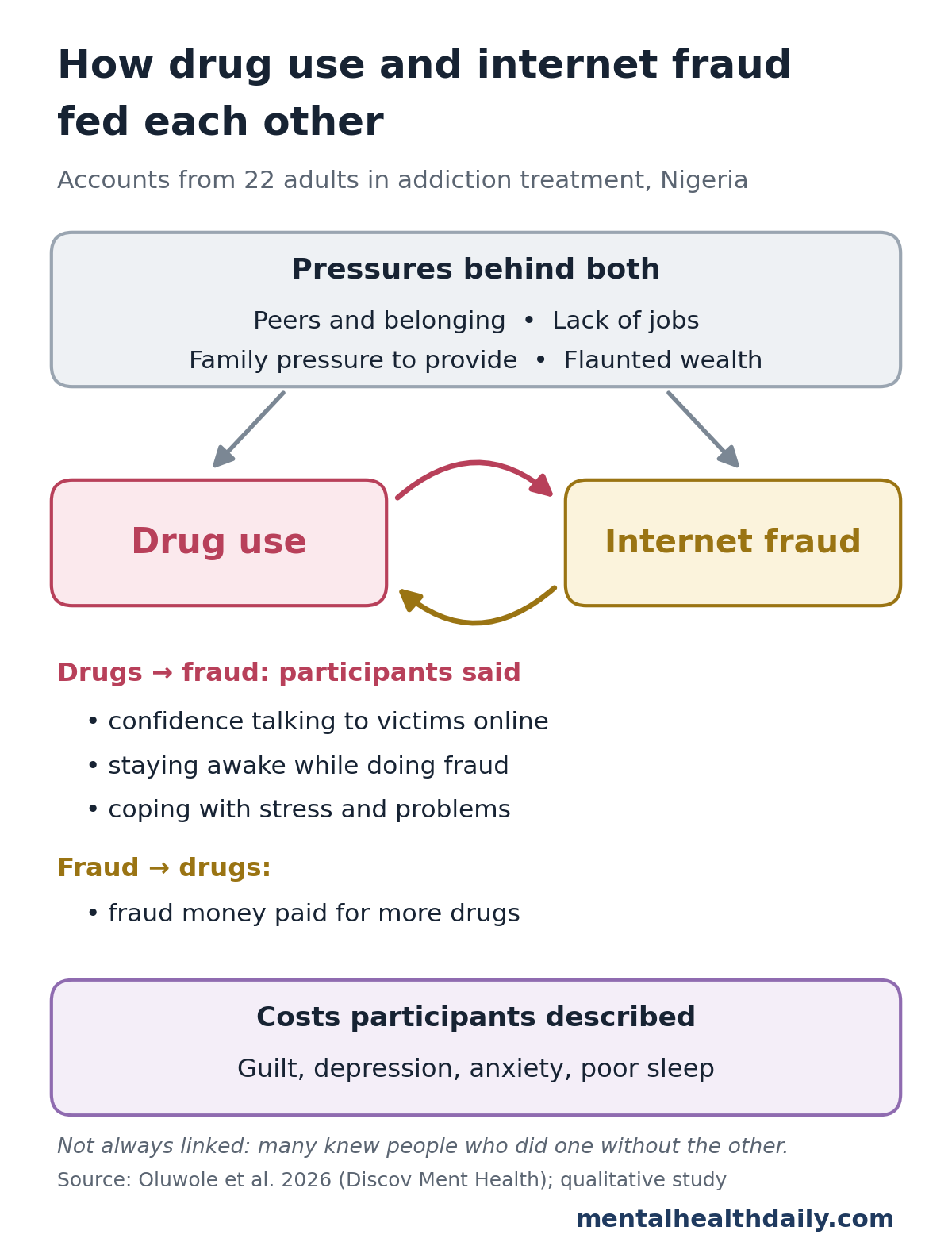
The link was not universal. Many participants knew people who committed fraud without drugs or used drugs without fraud. As one put it: “Not everyone doing fraud uses drugs… some are even scared of it.”1
The researchers concluded that the relationship ranges from a direct functional link to complete independence and resists a simple cause-and-effect story.1
Peer Pressure and Lack of Jobs Drove Both Drug Use and Fraud
Peers and belonging: peer influence was the most consistently cited reason for both behaviors across all 4 groups. Young people joined in to fit in, avoid being left out, or match friends’ success. “If your guy is doing Yahoo and you see him driving Benz, you go want join too,” one participant said.1
Economic hardship: participants described a gap between society’s expectations of financial success and the lack of legitimate ways to reach it. Some saw failed routes through education and hard work as a justification for fraud.1
Pressure on men to provide: men were described as more directly involved in both fraud and drug use, partly because of expectations to support their families, especially as a first son. Women were described as involved more indirectly, often through romantic partners or friends.1
Social media display: participants said young people look up to people online who flaunt fraud money, which spreads the appeal beyond their immediate circle of friends.1
Families and Communities Sent Mixed Messages About Internet Fraud
Participants described fraud becoming normal in some communities. “Now Yahoo is like normal job… even parents sometimes support it,” one said. Others drew a moral line between fraud and armed robbery, describing it as “not stealing with a gun.”1
Family responses fell into 3 patterns:1
- Unknowing enablement: parents who did not know at first but stayed quiet once money started coming in.
- Active complicity: parents who supported or prayed for their children’s success at fraud.
- Spiritual fortification: parents taking their children to traditional healers to ritually “fortify” them for fraud.
At the same time, participants criticized harsh, authoritarian parenting, which they said pushed young people toward secrecy and rebellion. Some churches were described as refusing people involved in fraud, while others welcomed their donations.1
The researchers argue that this mix of condemnation and celebration may influence young people more than clear approval or clear rejection would, because it leaves room to justify the choice.1
Guilt, Depression and Poor Sleep Despite the Money
Even with the social acceptance, participants consistently described psychological distress among people involved in fraud:1
- Guilt and remorse, including intrusive thoughts about victims
- Depression and anxiety, especially when schemes failed
- Anger and aggression, including violence toward partners
- Sleep problems and difficulty forming trusting relationships
“Sometimes it’s hard to sleep, even after making money. The guilt is real,” one participant said. The researchers suggest that this conflict between outside rewards and inner distress complicates the image of fraudsters as simply immoral, and that drug use may partly serve as self-medication for it.1
Other Research on Drug Use and Internet Fraud in Nigeria
Substance use is common in the region. A 2024 meta-analysis of 22 studies with 43,145 participants across West Africa estimated pooled prevalence rates of 44% for alcohol, 30% for tramadol, 11% for codeine and 6% for cannabis. Rates varied widely between studies, and peer influence and socioeconomic conditions were among the factors linked to use.2
Fraud research describes similar social drivers. Interviews with 12 young men involved in internet fraud in Nigeria found that peers introduced them to it and that communities and families gave tacit support. Some framed fraud as a kind of payback from Westerners for historical wrongs.3
Interviews with 40 frontline officers of Nigeria’s Economic and Financial Crimes Commission described the culture around fraud as built on masculinity and material wealth, consistent with the provider pressure participants described in the 2026 study.4
Neither of those fraud studies focused on drug use, which is the gap the 2026 study set out to explore.1
Limitations of This Qualitative Study
Focus groups are good for mapping how people explain their experiences, but they cannot measure how often something happens or prove what causes what.
- Treatment-seeking sample: everyone was already in treatment for a substance use disorder, so the accounts may emphasize harms and drug-fraud overlap more than a community sample would.
- 1 hospital, 1 region: results come from a single facility in southwestern Nigeria.
- Second-hand accounts: many participants knew fraud through friends rather than direct involvement, and many quotes describe what “they” do.
- Sensitive topic: people may understate illegal activity or give socially acceptable answers in a group.
- Minor reporting inconsistencies: the paper’s participant table does not fully match its text on age range and the gender split.
The findings describe one group’s experiences and do not describe Nigerian young people as a whole.
What Participants and Researchers Suggested
Participants offered their own ideas for prevention:1
- Jobs and skills training: “If there are jobs or skills training, many won’t do Yahoo or drugs.”
- Parenting programs: “Teach parents how to train children with love, not cane.”
- Recreational and vocational programs to give young people meaningful alternatives
- Mental health support and mentorship
- Faith-based and moral guidance
For clinicians: the researchers recommend that addiction assessments ask about peer networks, money pressures, trauma and cultural influences, not only symptoms. They suggest that treatment address guilt and moral conflict alongside drug use, and that group therapy could turn peer influence into support.1
These ideas come from the interviews and have not been tested in trials.
References
- Oluwole LO, Obadeji A, Ajiboye AS, Atofarati MA. Psychosocial and cultural dynamics shaping substance use and internet fraud among Nigerian youths. Discover Mental Health. 2026;6:178. doi:10.1007/s44192-026-00476-7
- Emmanuel GO, Akinsolu FT, Abodunrin OR, Ezechi OC. Prevalence and patterns of substance use in West Africa: a systematic review and meta-analysis. PLOS Global Public Health. 2024;4(12):e0004019. doi:10.1371/journal.pgph.0004019
- Orjiakor CT, Ndiwe CG, Anwanabasi P, Onyekachi BN. How do internet fraudsters think? A qualitative examination of pro-criminal attitudes and cognitions among internet fraudsters in Nigeria. Journal of Forensic Psychiatry & Psychology. 2022;33(3):428–444. doi:10.1080/14789949.2022.2051583
- Lazarus S, Okolorie GU. The bifurcation of the Nigerian cybercriminals: narratives of the Economic and Financial Crimes Commission (EFCC) agents. Telematics and Informatics. 2019;40:14–26. doi:10.1016/j.tele.2019.04.009