
Medical and nursing students who worried more than usual about being replaced by AI reported less enthusiasm for studying at their next diary entry, according to a 10-day diary study of 751 students in China. That drop in enthusiasm was then linked to more anxiety at the following entry.1
Research Highlights
- AI worry came before lower study enthusiasm: on days when a student’s AI replacement worry ran higher than their own usual level, they reported more cynicism toward studying at the next diary (standardized β = 0.068).1
- Cynicism came before anxiety: higher cynicism was in turn linked to higher anxiety at the following diary (β = 0.067). Both steps held up when the weekend gap was handled differently.1
- The full chain was not confirmed: the combined AI-worry-to-anxiety effect running through cynicism had a credible interval that included zero, so the study did not establish that cynicism carries AI worry into anxiety.1
- Exhaustion was not part of the pattern: AI worry was not linked to next-day tiredness about studying.1
- Large sample, uneven diaries: 751 students turned in 4,625 diaries, 61.6% of the 7,510 planned.1
What AI Replacement Anxiety Means for Future Doctors and Nurses
AI replacement anxiety is worry that artificial intelligence, robots or algorithms will make your skills, work or future job less valuable or unnecessary. For students training in medicine and nursing, AI-assisted diagnosis, automated documentation and decision-support tools make that worry concrete.1
Most earlier research measured this worry once, in a single survey. Haoqian Li et al. wanted to know whether it rises and falls from day to day, and whether those swings line up with changes in academic burnout — a state of study-related depletion and disengagement — and with day-to-day anxiety.1
The researchers split burnout into 3 parts, since they can behave differently:
- Exhaustion: feeling drained before facing the day’s studies.
- Cynicism: pulling away from studying, measured as “Today, my enthusiasm for studying decreased.”
- Academic inefficacy: feeling ineffective as a learner, measured here with a narrower item, “Today, I did not learn anything interesting in my studies.”
How the 10-Day AI Anxiety Diary Worked
- Who: 751 undergraduate medicine and nursing students at one university in northern China, aged 17 to 27 (average about 20); 70.7% were women.
- When: 10 weekday evenings over 2 consecutive weeks in May and June 2025. A reminder went out between 7 and 9 p.m., and each survey closed at midnight.
- AI worry item: “I worry that what I learned today and what I did today may be replaced by AI in the future,” rated 1 to 5.
- State anxiety: 2 items, “I felt anxious today” and “I felt worried today.” State anxiety means anxiety felt in the moment or that day, as opposed to a lasting anxious temperament.
- Quality checks: diaries finished in a minute or less, or with a failed attention check, were dropped.
The analysis used dynamic structural equation modeling (DSEM), a statistical method for repeated diaries. It compares each student with their own average, then asks whether a higher-than-usual score on one day comes before a change in another score at the next diary. That within-person design separates out stable differences between students, such as one person simply being more anxious than another.1
On average, students rated their AI worry at 2.69 out of 5. About 29% of the variation in that worry came from day-to-day swings within the same student; the rest reflected stable differences between students.1
AI Worry Was Followed by Lower Study Enthusiasm, Then More Anxiety
A credible interval is the Bayesian version of a confidence interval: the range where the true value most plausibly lies. When it excludes zero, the link is treated as supported.
Of 3 burnout parts tested in the AI-worry-to-anxiety direction, only cynicism showed both links:1
- Step 1: a higher-than-usual AI worry score was linked to more cynicism at the next diary (β = 0.068, 95% credible interval 0.016 to 0.119).
- Step 2: more cynicism was linked to more anxiety at the diary after that (β = 0.067, 95% credible interval 0.019 to 0.112).
- Direct link: AI worry was not linked to anxiety 2 diaries later when the 2 steps were set aside (β = −0.011).
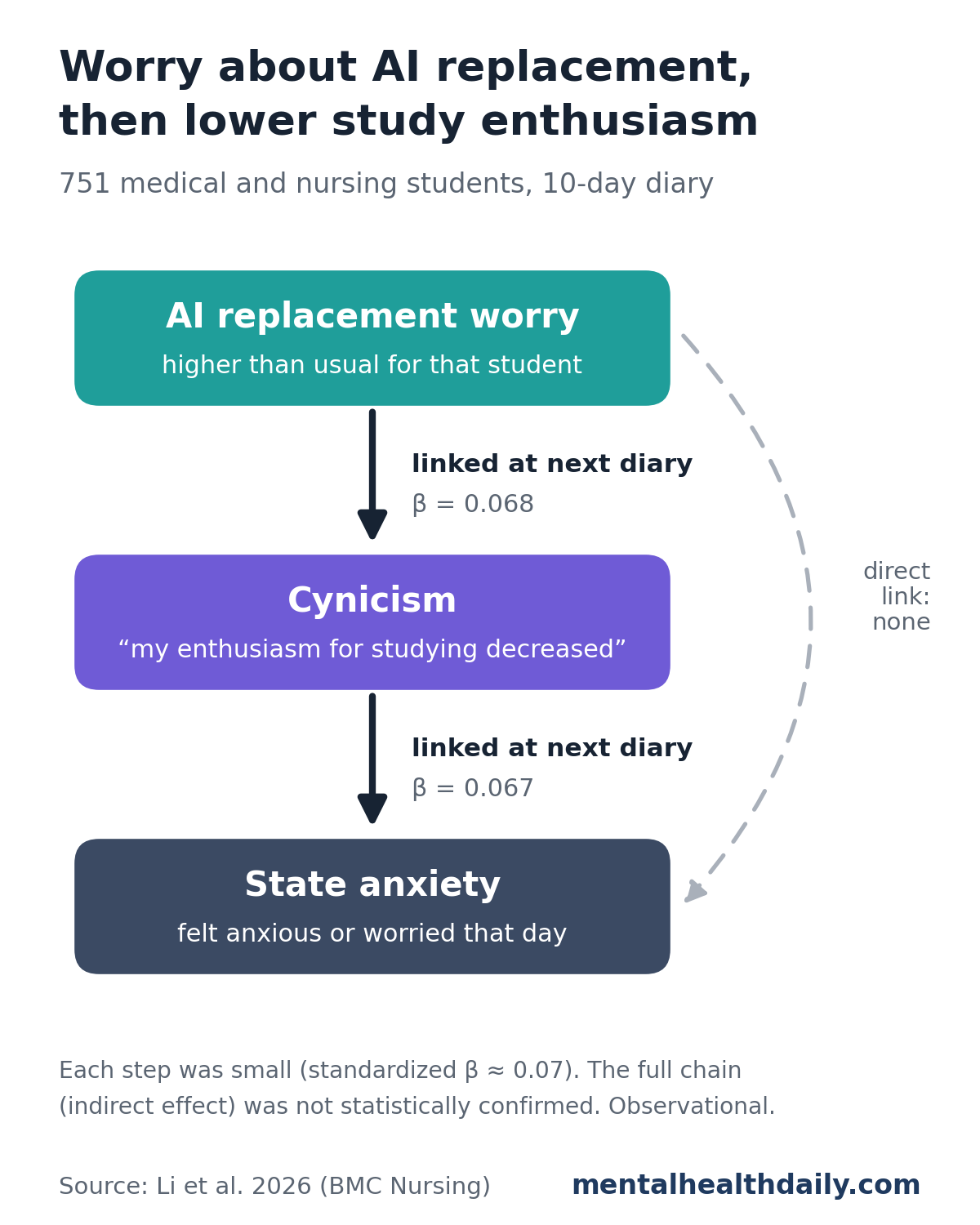
Effect size: standardized coefficients near 0.07 are small. Within the same student, the daily correlation between AI worry and cynicism was 0.16, and between AI worry and anxiety it was 0.12.1
Robustness: the diary skipped weekends, so the Friday-to-Monday gap was longer than the others. When the researchers coded the days by actual calendar spacing, both cynicism steps stayed supported (β = 0.075 and 0.056). They also held in a stricter sample of 695 students with at least 3 valid diaries.1
Other burnout parts: AI worry was not linked to next-day exhaustion or to the “didn’t learn anything interesting” item. That second item was still linked to later anxiety (β = 0.126), but nothing connected it back to AI worry.1
Why the Full AI-to-Anxiety Chain Was Not Confirmed
Two supported steps do not automatically add up to a supported chain. The researchers also estimated the indirect effect — how much of AI worry’s link to later anxiety actually runs through cynicism. For all 6 models, that estimate’s credible interval included zero.1
In plain terms, the data show the right order of events, but they cannot say with confidence that cynicism is the route by which AI worry becomes anxiety. The indirect effect multiplies 2 small, uncertain numbers and varies from student to student, so it is much harder to pin down than either step alone.
The researchers describe the result as linked steps in time, not proof of a mediating pathway or a cause.1
Anxious Days Were Followed by Feeling Lessons Were Uninteresting
The team also tested the reverse direction: does a more anxious day come before burnout signs and then more AI worry?1
- Consistent link: a more anxious day was followed by a higher score on “I did not learn anything interesting today” (β = 0.111). Anxiety was also followed by more exhaustion (β = 0.065) and more cynicism (β = 0.098).
- Shaky return link: the “nothing interesting” item was linked to later AI worry in the main model (β = 0.060), but that link sat at the edge in the stricter sample and disappeared when the weekend gap was coded by calendar days.
The researchers read the first finding as anxious days coloring how students judge the next day’s learning, rather than evidence that anxiety lowers competence. The item could also reflect boredom or low interest.1
Earlier Studies on AI Anxiety and Burnout in Medical and Nursing Students
Earlier single-survey studies show that AI worry is common among future clinicians and can shape career choices:
- AI anxiety in medical students: in a 2024 survey of 542 medical students, AI anxiety was high and readiness for AI moderate; students who felt more ready for AI reported less anxiety about it.2
- Radiology career choice: in a survey of 463 US medical students, 21.4% ranked radiology first when AI was not considered, compared with 17.7% when they factored in AI, suggesting AI deterred about 1 in 6 potential radiology applicants.3
Burnout is also common in this group. A 2024 meta-analysis of 34 studies and 9,554 nursing students estimated academic burnout prevalence at 35%, with the highest rate (58%) in Asia.4
The 2026 diary study adds a day-level view: within the same student, a spike in AI worry was followed by a dip in study enthusiasm.
Limitations of This 10-Day AI Anxiety Diary Study
- Observational design: the order of events does not prove cause. Exams, workload, poor sleep or a news story about AI could drive several of these feelings on slightly different timescales.
- One-item measures: AI worry and each burnout part were measured with a single question, and anxiety with 2. These are narrow snapshots, not full validated scales.
- Missing diaries: 38.4% of planned diary days were missing. If students skipped diaries on their worst days, the results may reflect calmer days.
- Short time series: students averaged about 6 diaries, and only 560 provided a complete 3-day run.
- One setting: one university in northern China, mostly women, and the data did not record whether each student studied medicine or nursing, so the 2 groups could not be compared.
What This Means for Medical and Nursing Students Worried About AI
Study enthusiasm is an early sign to watch. In this sample, AI worry showed up first as pulling back from studying, not as exhaustion. Motivation that sags after a day of worrying about AI replacing clinicians fits the pattern this study tracked.1
Effects were small and day-to-day. The study measured brief fluctuations across 2 weeks, not lasting burnout or clinical anxiety disorders.
Schools could pair AI training with career meaning. The researchers suggest that responses to AI worry in health education may work better when they address professional meaning, competence support and how humans and AI work together, alongside technical AI skills. That idea has not yet been tested in a trial.1
References
- Li H, Zhang Z, Yang B, Liu C, Sun J, Zhou J, Cao X. Daily temporal associations among AI replacement anxiety, state anxiety, and academic burnout indicators in medicine and nursing students: a 10-day diary study. BMC Nursing. 2026;25:875. doi:10.1186/s12912-026-05275-7
- Güven GÖ, Yilmaz Ş, Inceğlu F. Determining medical students’ anxiety and readiness levels about artificial intelligence. Heliyon. 2024;10(4):e25894. doi:10.1016/j.heliyon.2024.e25894
- Reeder K, Lee H. Impact of artificial intelligence on US medical students’ choice of radiology. Clinical Imaging. 2022;81:67–71. doi:10.1016/j.clinimag.2021.09.018
- Hernández-Mariano JÁ, Hurtado-Salgado E, Velázquez-Núñez MDC, Cupul-Uicab LA. Prevalence of academic burnout among nursing students: a systematic review and meta-analysis. Journal of Nursing Education. 2024;63(8):533–539. doi:10.3928/01484834-20240502-04