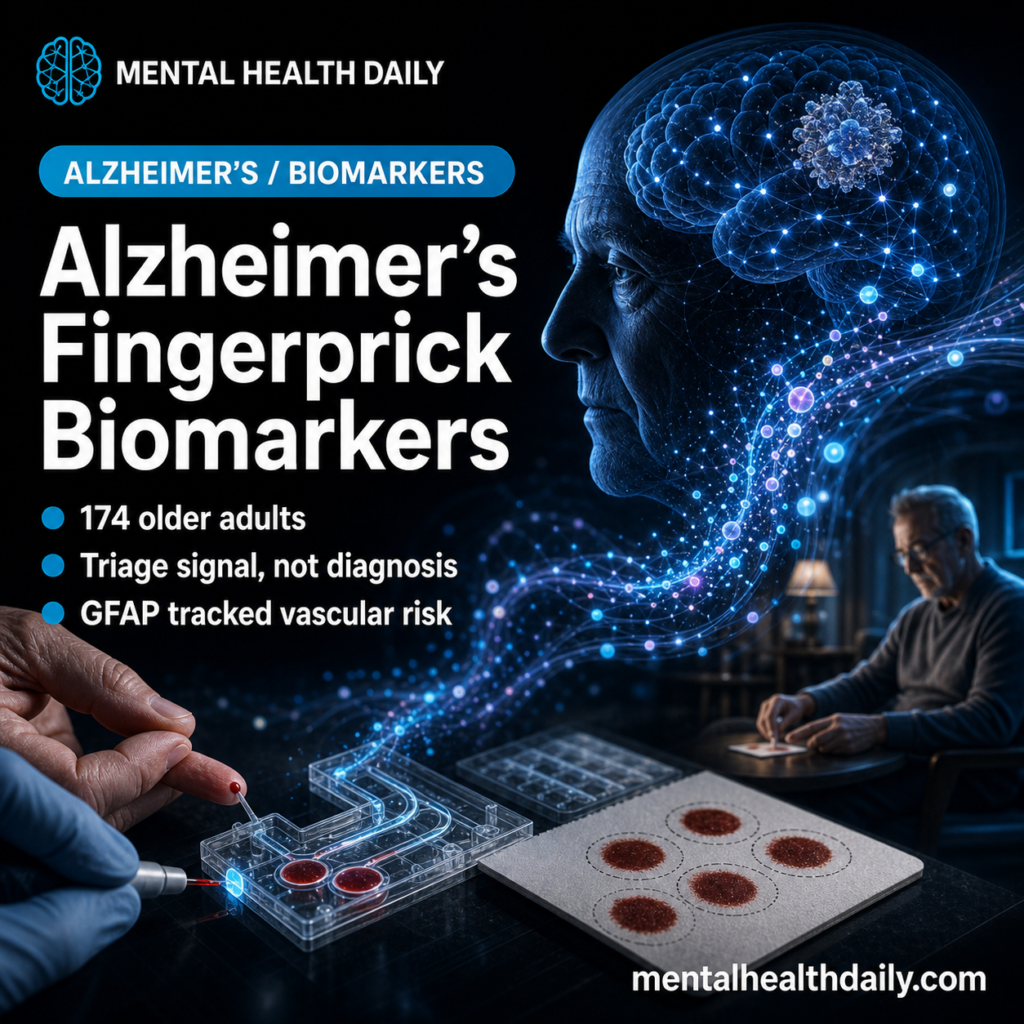
A 2026 PROTECT study involving 174 older adults found that self-administered fingerprick p-tau217 correlated with episodic memory (r = 0.299, p < 0.001) and GFAP correlated with working memory (r = 0.183, p = 0.034), supporting remote Alzheimer's risk triage rather than a stand-alone dementia diagnosis.
Research Highlights
- Fingerprick sampling reached 77% completion: 174 of 226 recruited PROTECT participants returned valid remote blood-test kits, showing the workflow can work outside a clinic.1
- p-tau217 tracked memory and function: capillary p-tau217 correlated with episodic memory (r = 0.299), attention (r = 0.197), executive function (r = 0.191), IADL (r = 0.293), and IQCODE (r = 0.244).
- GFAP added a different signal: capillary GFAP correlated with working memory (r = 0.183), executive function (r = 0.182), and IADL (r = 0.230), and the researchers linked it more closely to vascular risk.
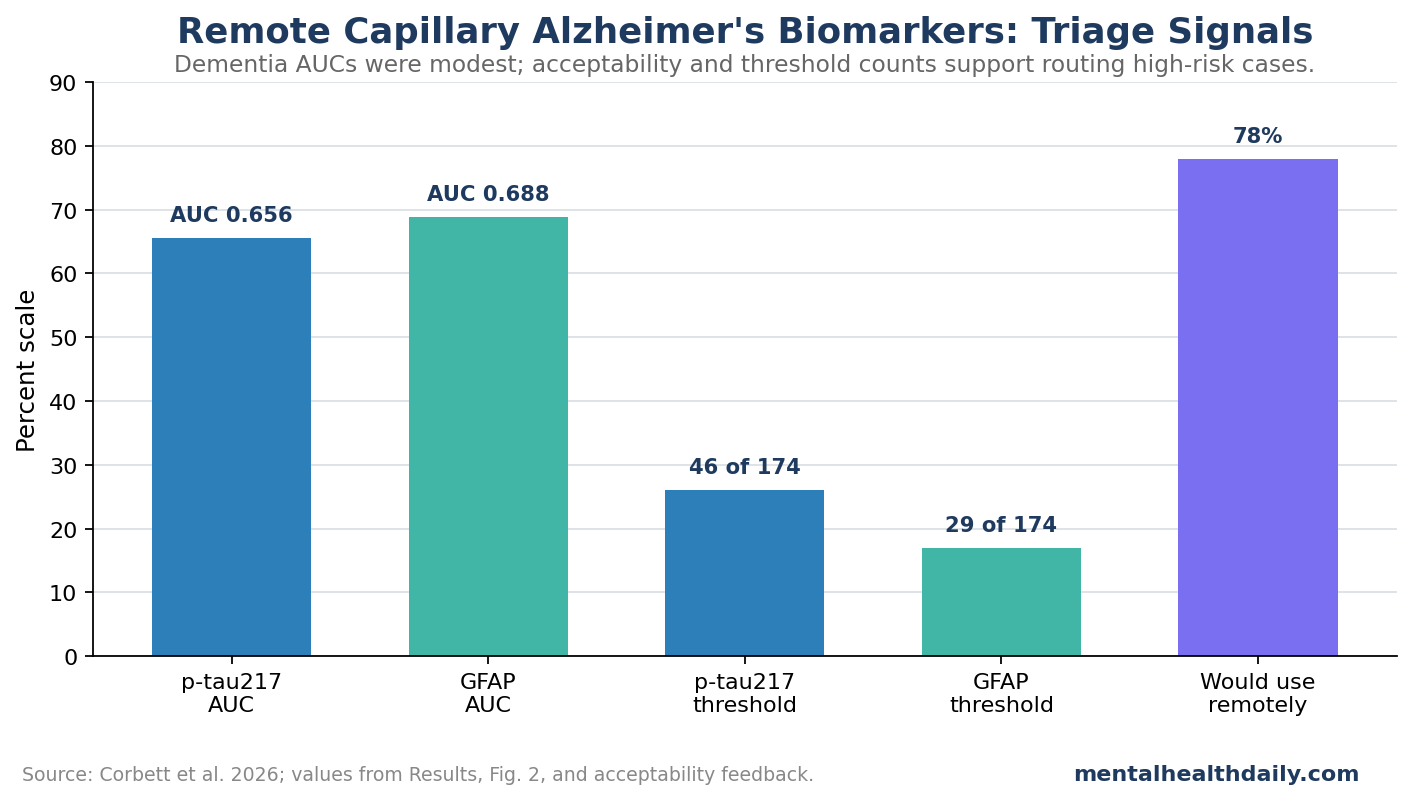
- Dementia AUCs were modest: p-tau217 had AUC 0.656 and GFAP had AUC 0.688 for dementia status, which is useful for routing risk but not enough for stand-alone diagnosis.
- Remote use looked acceptable: 80% completed the test without help and 78% said they would use remote testing as part of routine care.
p-tau217 is phosphorylated tau at amino acid 217, a blood marker that rises when Alzheimer's-type tau and amyloid biology are present. GFAP means glial fibrillary acidic protein, a marker of astrocyte activation that can reflect neuroinflammation, vascular injury, or Alzheimer-related glial response.
Those markers are already stronger in venous blood than many older dementia-screening tools. Corbett et al. tested a narrower operational question: whether older adults could collect capillary blood at home and still produce biomarker values that aligned with cognition, function, venous blood, and user feedback.
Remote Capillary Sampling Is a Triage Tool, Not a Diagnosis
The study recruited 226 people from the UK PROTECT research program and analyzed the 174 participants who completed the blood-test kits. The final group included 146 people with normal cognition and 28 people with dementia, with mean age 66.03 years and 54% female sex.
The workflow was intentionally low-friction:
- Collection: participants used an unsupervised fingerprick kit at home.
- Return: dried blood spots were mailed back for processing.
- Assay: p-tau217 and GFAP were measured with immunoassays on the Simoa platform.
- Comparison: 40 participants also had venous blood samples.
The practical advantage is reach. Venous blood testing still requires a clinic or phlebotomy pathway, while capillary sampling can be paired with computerized cognitive testing, mailed kits, and remote trial-screening workflows.
p-tau217 Looked More Alzheimer-Specific Than GFAP
Capillary p-tau217 showed its strongest cognitive association with episodic memory, the memory system most visibly affected early in typical Alzheimer's disease. It also correlated with attention, executive function, and both functional measures.
GFAP showed a broader but less Alzheimer-specific pattern. It correlated with working memory, executive function, and instrumental activities of daily living, but not with the IQCODE functional informant measure. The researchers also reported a relationship between GFAP positivity and heart disease, making vascular and inflammatory interpretation more plausible.
That split fits adjacent biomarker work. Palmqvist et al. showed plasma p-tau217 can discriminate Alzheimer's disease from other neurodegenerative disorders,2 while Ashton et al. reported strong diagnostic accuracy for a plasma p-tau217 immunoassay against Alzheimer pathology.3 GFAP can be clinically useful, but it is a less direct Alzheimer label because astrocyte activation can come from several injury pathways.
85% Specificity Thresholds Identified Higher-Risk Subgroups
Corbett et al. used prespecified 85% specificity thresholds of 0.016 pg/ml for capillary p-tau217 and 12.45 pg/ml for capillary GFAP. Those thresholds identified 46 participants (26%) with elevated p-tau217 and 29 participants (17%) with elevated GFAP.
People above those thresholds performed worse on several cognitive or functional measures. For p-tau217, memory difference had Cohen's d = 0.548 (p = 0.020), IADL d = 0.542 (p = 0.017), and IQCODE d = 0.657 (p = 0.001). For GFAP, IADL difference was larger at d = 0.754 (p = 0.004), while executive function was d = 0.541 (p = 0.016).
The same thresholds were recognizable in venous plasma. Plasma p-tau217 discriminated the capillary p-tau217 threshold group with AUC 0.785, and plasma GFAP discriminated the capillary GFAP threshold group with AUC 0.895. A remote kit only becomes clinically useful when it maps onto established blood chemistry rather than producing a separate artifact.
Capillary Blood Testing Needs Cognitive Context
The paper's strongest clinical idea was a combined triage profile: p-tau217 above the 85% specificity threshold plus memory performance low enough to meet age-associated cognitive-decline criteria. That combination can identify people who should move toward formal dementia evaluation faster than a symptom questionnaire alone.
AUC values explain the boundary. Capillary p-tau217 AUC 0.656 and GFAP AUC 0.688 separated dementia vs. non-dementia status better than chance, but those values are not diagnostic-grade. A normal result also cannot rule out non-Alzheimer causes of cognitive decline, early pathology below threshold, or future conversion.
Clinical role: remote p-tau217 and GFAP can sort risk, reduce screen failures for trials, and direct scarce specialist appointments toward people with higher biological signal. They should not tell a person at home that they have Alzheimer's disease.
The distinction between risk sorting and diagnosis is not semantic. AUC 0.656 means many dementia and non-dementia cases still overlap on capillary p-tau217. GFAP is even less disease-specific because astrocyte activation can rise with vascular injury, inflammation, neurodegeneration, and mixed pathology.
The useful version of the test is therefore a referral aid: combine the blood result with memory performance, daily-function reports, medication review, depression screening, sensory assessment, and vascular-risk history before deciding who needs confirmatory imaging, cerebrospinal-fluid testing, or specialist evaluation.
Remote Screening Still Needs a Confirmatory Pathway
Capillary biomarkers become useful only when the next step is planned. A remote positive result should not leave the patient with a label and no route forward; it should trigger a defined sequence of cognitive testing, medical review, and confirmatory assessment when appropriate.
A workable pathway would separate 3 jobs:
- Rule-in triage: high p-tau217 plus memory impairment can prioritize memory-clinic referral or trial-screening evaluation.
- Mixed-risk sorting: elevated GFAP with vascular risk can push clinicians to look harder at stroke risk, white-matter disease, sleep apnea, diabetes, hypertension, and inflammatory contributors.
- Reassurance with follow-up: low biomarker levels plus normal cognitive testing can support watchful follow-up rather than immediate specialist escalation.
Access effect: remote testing also changes who gets reached. Many people with early cognitive impairment never enter specialist pathways when travel, rural access, clinic capacity, or trial-screening burden gets in the way.
A mailed capillary kit can lower that barrier, but lowering the barrier increases responsibility to avoid overdiagnosis.
Boundary condition: p-tau217 is closest to Alzheimer biology, while GFAP may identify broader neuroinflammatory or vascular risk. A triage algorithm that treats both markers as interchangeable "Alzheimer positive" would flatten the most useful distinction in the paper.
Trial Recruitment May Benefit Before Routine Screening Does
Clinical trials may be the most immediate early use case. Alzheimer prevention and early-intervention trials often screen large numbers of people to find a smaller group with the right biomarker profile. Fingerprick p-tau217 could reduce expensive screen failures by identifying people more likely to have confirmatory amyloid or tau evidence.
Routine population screening is a harder claim. Screening programs need evidence that testing improves outcomes, reduces harms, and does not create avoidable anxiety or unnecessary procedures. A cross-sectional correlation study cannot answer that full implementation question.
Practical threshold: the evidence is strong enough to justify more validation of remote triage, especially in trial recruitment and specialist-referral enrichment. It is not strong enough to market home fingerprick testing as a direct-to-consumer Alzheimer's diagnosis.
The equity argument is strongest when the test expands access to follow-up rather than replacing it. A mailed kit can reach people who live far from memory clinics, but the result still needs interpretation by a clinician who can ask about medications, alcohol use, sleep, depression, sensory impairment, vascular risk, education, and day-to-day function.
False-positive management: a person with elevated GFAP and vascular disease may need aggressive vascular-risk management more than an Alzheimer label. A person with elevated p-tau217 and declining memory may need confirmatory Alzheimer workup. Keeping those routes separate is what makes the biomarker pair clinically useful.
Longitudinal follow-up is the missing link. The most useful future outcome is not whether a capillary marker correlates with memory on the same date; it is whether the marker predicts conversion, faster decline, or treatment-trial eligibility over several years. That is the evidence needed before remote screening can move from triage research into routine primary-care pathways.
Implementation also needs a plan for low-signal results. A low capillary biomarker result should not dismiss a caregiver's report of worsening memory, medication errors, falls, hallucinations, or financial mistakes.
It should narrow the immediate Alzheimer-biomarker probability while keeping the broader differential diagnosis open. That is especially important in primary care, where depression, sleep apnea, anticholinergic drugs, alcohol exposure, hearing loss, and cerebrovascular disease can all look like early dementia to families.
Questions About Fingerprick Alzheimer's Blood Tests
Could this replace a memory-clinic assessment?
No. The PROTECT data support triage. Diagnosis still needs clinical history, cognitive testing, functional assessment, and often confirmatory biomarker or imaging evidence.
Why include GFAP if p-tau217 is more Alzheimer-specific?
GFAP may flag vascular or inflammatory risk that p-tau217 misses. In a clinic trying to identify progressive cognitive impairment from multiple causes, that broader signal can be useful.
What would make this ready for routine screening?
Longitudinal validation. A useful screening pathway needs to show that remote biomarker-plus-cognition profiles predict future diagnosis, functional decline, or trial eligibility better than current referral pathways.
References
- Alzheimer's Disease Blood Biomarkers Measured Through Remote Capillary Sampling Correlate with Cognition in Older Adults. Corbett A et al. Nature Communications. 2026;17:3699. doi:10.1038/s41467-026-71448-2
- Discriminative Accuracy of Plasma Phospho-tau217 for Alzheimer Disease vs. Other Neurodegenerative Disorders. Palmqvist S et al. JAMA. 2020;324(8):772-781. doi:10.1001/jama.2020.12134
- Diagnostic Accuracy of a Plasma Phosphorylated Tau 217 Immunoassay for Alzheimer Disease Pathology. Ashton NJ et al. JAMA Neurology. 2024;81(3):255-263. doi:10.1001/jamaneurol.2023.5319
- Alzheimer's Disease Diagnosis and Management: Perspectives from Around the World. Cummings J et al. Journal of Alzheimer's Disease. 2022;90(2):549-561. doi:10.3233/jad-220401