Smelling dark chocolate for 30 seconds before each set helped fasted, resistance-trained men complete more leg-extension reps, according to a small 2026 crossover trial. A milk chocolate scent helped too, though less.1
Research Highlights
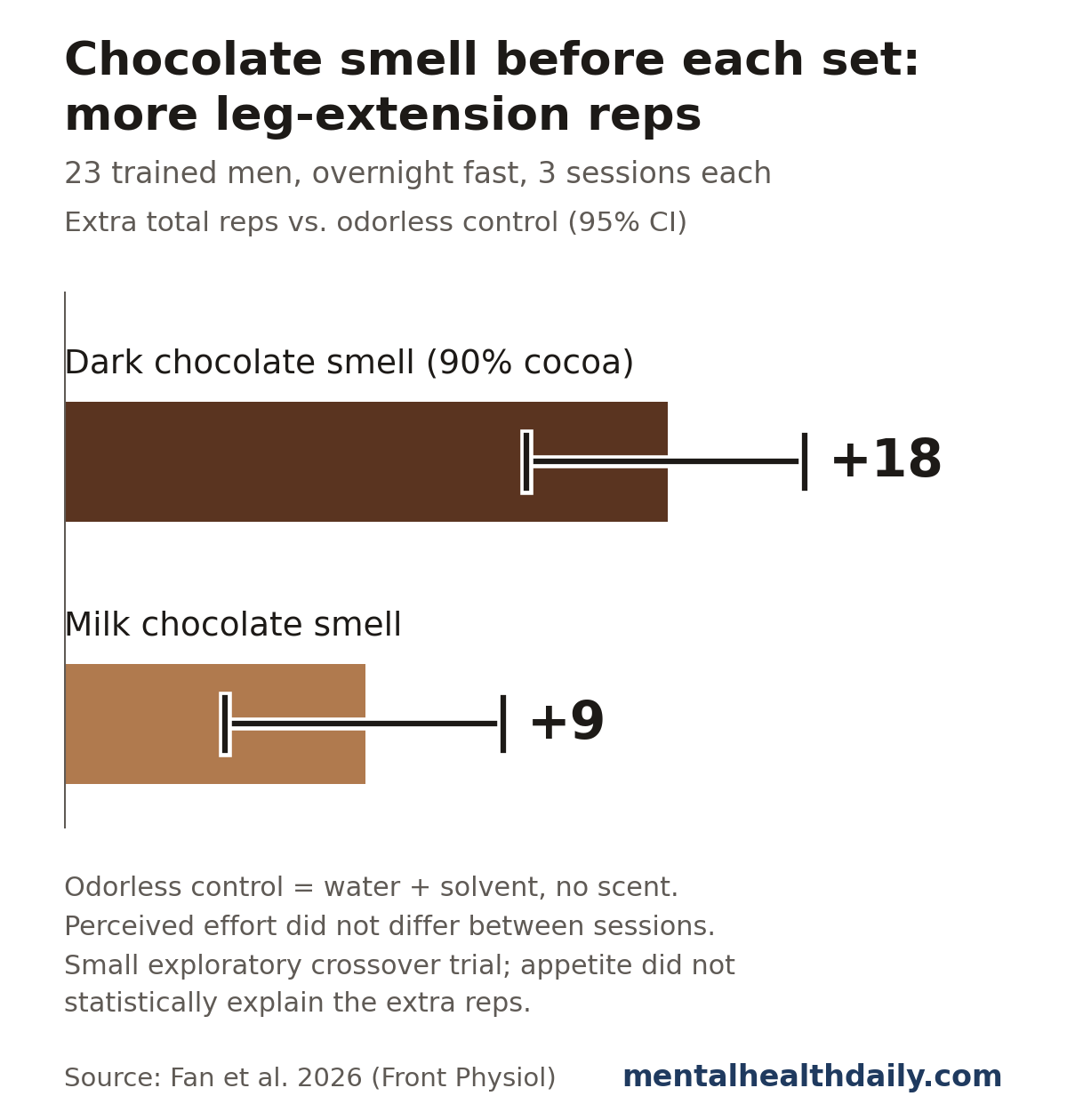
- More reps with chocolate smell: after an overnight fast, 23 trained men completed 18 more total leg-extension reps with a 90% dark chocolate scent (95% CI 13.8 to 22.1) and 9 more with a milk chocolate scent (95% CI 4.8 to 13.1) than with an odorless control.1
- Same effort rating: perceived exertion climbed set by set in every session but did not differ between the 3 scents.1
- Dark chocolate smell curbed hunger: before exercise, it lowered hunger and desire to eat and raised fullness compared with the odorless control. The milk chocolate scent mostly made the session more pleasant.1
- Appetite did not explain the gain: despite the paper’s title, its own mediation tests did not show that lower hunger, greater fullness or pleasantness accounted for the extra reps.1
- Early evidence: the researchers called the study exploratory. It tested one exercise in young men only, and the odorless control was easy to recognize.1
How the Chocolate Smell and Leg-Extension Trial Worked
Xiaohan Fan et al. at the University of Malaya in Kuala Lumpur recruited 23 healthy men, average age 23, who had lifted weights at least twice a week for at least 2 years. All of them usually ate breakfast, so arriving after an overnight fast of about 10 hours was a real departure from routine.1
Each man came in for 3 test sessions at least 4 days apart, one per scent, in an order set by a randomization schedule. Each scent was a freshly mixed liquid in an identical glass jar:1
- Dark chocolate: 90% cocoa chocolate melted with a little water
- Milk chocolate: a smaller amount of the same dark chocolate blended with whole milk, labeled “60% milk chocolate”
- Odorless control: distilled water
All 3 contained a small amount of propylene glycol, a solvent used to even out how quickly each liquid gave off its scent. Neither the participants nor the staff counting reps were told which jar was which.1
Smelling routine: the jar was held 2 to 3 cm below the nose for 30 seconds of paced breathing (3 seconds in, 3 seconds out). This happened 4 times in the 15 minutes before exercise and again before every set.1
Workout: sets of 10 leg extensions at 80% of each man’s 10-rep maximum (the heaviest weight he could lift 10 times), with 3.5 minutes of rest, repeated until he could no longer finish a set. Total reps was the main outcome.1
Between scent exposures, the men rated hunger, fullness, desire to eat and how pleasant the smell was on 100-mm visual analog scales (a line from “not at all” to “extremely”). After each set they rated effort on the Borg CR10 scale, a 0-to-10 rating of perceived exertion.1
Dark Chocolate Smell Added 18 Reps; Milk Chocolate Added 9
Scent made a clear difference to total reps. Compared with the odorless control, the men completed:1
- 18 more reps with dark chocolate (95% CI 13.8 to 22.1, p < 0.001)
- 9 more reps with milk chocolate (95% CI 4.8 to 13.1, p < 0.001)
Dark chocolate also beat milk chocolate by 9 reps. It added about 1 more set than either the control or the milk chocolate session, while milk chocolate and control finished a similar number of sets.1
Effort ratings: perceived exertion rose with each set in all 3 sessions, but the scent made no clear difference (p ≥ 0.31). In other words, the men did more work without rating each set as harder.1
Effort was only rated after each set, though. The study did not measure motivation, mood or muscle fatigue, so it cannot say how the men felt more broadly during the extra reps.1
The 2 Chocolate Scents Changed Hunger and Pleasure Differently
Dark chocolate: in the 15 minutes before exercise, it lowered hunger, desire to eat and how much the men thought they could eat, and raised fullness, compared with both the control and the milk chocolate scent. Its pleasantness rating was no different from the odorless control.1
Milk chocolate: it did not reduce hunger. It slightly raised desire to eat and was rated a little more pleasant than the control, by 3.1 mm on the 100-mm scale.1
Hunger ratings during exercise followed a similar pattern, lowest with dark chocolate. Those ratings were taken right after hard sets, and exercise itself can blunt appetite, so the researchers treated the before-exercise ratings as the clearer evidence of a scent effect.1
Did Lower Hunger Explain the Extra Reps?
The paper’s title says chocolate odor improved performance “through appetite suppression,” but its own analysis did not confirm that.1
A mediation analysis tests whether an effect runs through a middle step: here, whether a scent changed appetite and the change in appetite then produced more reps. The researchers tested 3 possible routes:1
- Dark chocolate through lower hunger: the scent clearly lowered hunger, but the indirect effect on reps (about 2 reps) was not statistically significant (95% CI −1.25 to 5.73, p = 0.208).
- Dark chocolate through greater fullness: an indirect effect of under 1 rep, not significant (p = 0.317).
- Milk chocolate through pleasantness: an indirect effect of about 1 rep, not significant (p = 0.424).
So most of the gain went unexplained by the appetite and pleasantness ratings. The researchers concluded that these analyses did not establish hunger, fullness or pleasantness as the mechanism.1
Within-person link: a separate correlation analysis did find that, for the same man, sessions with lower hunger before exercise went with more reps (r = −0.47), and sessions with greater fullness went with more reps (r = 0.38). Pleasantness had no link to reps (r = 0.01). This fits an appetite story, but a correlation cannot show which came first.1
Earlier Studies on Hunger, Smell and Lifting Performance
Smelling dark chocolate and appetite: a 2010 study in 12 young women found that smelling 85% cocoa chocolate raised feelings of satiety and linked that response to ghrelin, a hormone involved in hunger. Only 6 women were randomized to the smelling condition, so that result is very preliminary too.2
The lifting side comes mostly from the same University of Malaya research group and its UK collaborators:
- Skipping breakfast: in 16 resistance-trained men, skipping breakfast cut total back squat reps from 68 to 58 and bench press reps from 40 to 38, compared with eating breakfast.3
- Less hunger, same carbs: when 16 trained men ate a thick semisolid meal instead of a thin liquid one, they felt less hungry and completed about 10% more back squat reps (57 vs. 51), with no difference in bench press.4
Not every study finds that fasting hurts lifting. A Brazilian trial in trained young men found that 12 or 16 hours of overnight fasting raised hunger but did not change strength, jump height, or reps on the back squat and leg press.5
Expectations: a systematic review of 32 studies with 1,513 participants found that placebo and nocebo (expecting harm) effects on sports performance were small to moderate, with a pooled effect size of d = 0.38. That bears directly on the chocolate trial, because its control jar had no smell at all.6
Limitations of This Chocolate Smell Exercise Study
- Easy-to-spot control: in a blinding check, the men’s guesses about the 2 chocolate jars were close to chance, but they readily identified the odorless jar. Knowing they had the “nothing” condition may have lowered effort, so part of the gap over control could reflect expectations rather than the scent itself.
- Mechanism unconfirmed: mediation tests did not support the appetite explanation, and no hormones, heart-rate measures or brain activity were recorded.
- Narrow sample: 23 young, lean, resistance-trained men; no women, older adults or beginners.
- One exercise, one state: a single-joint leg extension after an overnight fast. Results may differ for squats, bench press, endurance work or training after a meal.
- Imprecise dose: scents were sniffed from jars rather than delivered by an olfactometer (a device that controls odor concentration), so the amount reaching the nose varied.
- Registration: the trial was preregistered on the Open Science Framework, but its clinical trial registry entry was filed after the fact.
Should You Smell Chocolate Before a Fasted Workout?
The idea requires no snack or calories: just 30 seconds of smelling before each set. If you train fasted and hunger gets in the way, a whiff of dark chocolate between sets is a reasonable experiment.
Keep expectations modest. This is one small, exploratory trial in one exercise, and the comparison was against no scent at all rather than a neutral, non-food smell. A trial with an odor-matched control, more lifts and women included would show whether the effect holds up and whether it really runs through appetite.1
References
- Fan X, Deng H, Ng JY, Ab Aziz AAH, Naharudin MN. Chocolate odor enhances resistance exercise performance through appetite suppression in the fasted state: an exploratory study. Frontiers in Physiology. 2026;17:1834757. doi:10.3389/fphys.2026.1834757
- Massolt ET, van Haard PM, Rehfeld JF, Posthuma EF, van der Veer E, Schweitzer DH. Appetite suppression through smelling of dark chocolate correlates with changes in ghrelin in young women. Regulatory Peptides. 2010;161(1–3):81–86. doi:10.1016/j.regpep.2010.01.005
- Bin Naharudin MN, Yusof A, Shaw H, Stockton M, Clayton DJ, James LJ. Breakfast omission reduces subsequent resistance exercise performance. Journal of Strength and Conditioning Research. 2019;33(7):1766–1772. doi:10.1519/JSC.0000000000003054
- Naharudin MN, Yusof A, Clayton DJ, James LJ. Starving your performance? Reduced preexercise hunger increases resistance exercise performance. International Journal of Sports Physiology and Performance. 2022;17(3):458–464. doi:10.1123/ijspp.2021-0166
- Drummond MDM, Soares PSG, Savoi LA, Silva RAD. Fasting reduces satiety and increases hunger but does not affect the performance in resistance training. Biology of Sport. 2024;41(2):57–65. doi:10.5114/biolsport.2024.131814
- Hurst P, Schipof-Godart L, Szabo A, Raglin J, Hettinga F, Roelands B, et al. The placebo and nocebo effect on sports performance: a systematic review. European Journal of Sport Science. 2020;20(3):279–292. doi:10.1080/17461391.2019.1655098