Sleep difficulties and tiredness were among the main symptoms linking depression and PTSD in a 2026 survey of 6,240 Chinese firefighters. Women reported somewhat higher scores for both conditions than men, although average scores were low.1
Research Highlights
- Three main bridges: a questionnaire item on thoughts of death or self-harm, sleep difficulties and feeling tired did the most to connect depression symptoms with PTSD symptoms.1
- Tiredness and poor sleep were tightly linked: the strongest single connection between the 2 conditions ran between feeling tired (depression) and sleep difficulties (PTSD).1
- Women scored higher: average depression scores were 3.87 in women vs. 2.54 in men, and average PTSD scores were 23.96 vs. 21.29. Both averages sit in the low range of each scale.1
- Different bridges by sex, but not a proven difference: trouble concentrating stood out in women and slowed or restless movement in men, yet formal tests found no significant difference between the male and female symptom networks.1
- One-time survey: the results show which symptoms tend to occur together, not which ones cause the others.1
How Researchers Mapped Depression and PTSD Symptoms in 6,240 Firefighters
Firefighters are repeatedly exposed to fires, crashes, injuries and death, and depression and post-traumatic stress disorder (PTSD) often show up together in this work. Yidi Wang et al. at Xi’an Jiaotong University and the Air Force Medical University in Xi’an wanted to know which specific symptoms hold that overlap together, and whether the pattern differs between men and women.1
- Sample: 6,240 firefighters with complete questionnaires (5,357 men and 883 women), out of 8,471 recruited; average age about 29
- When: March to May 2023, completed online in supervised group sessions
- Depression: the 9-item Patient Health Questionnaire (PHQ-9), scored 0 to 27
- PTSD: the 17-item PTSD Checklist-Civilian Version (PCL-C), scored 17 to 85
Both questionnaires are screening tools. They measure how much each symptom bothered someone recently; they do not diagnose depression or PTSD.
What Symptom Networks and Bridge Symptoms Mean
A symptom network treats each questionnaire item, such as low mood, nightmares or poor concentration, as a point. Lines connect symptoms that tend to rise and fall together across people, after accounting for every other symptom in the model.
The idea behind this approach is that mental health conditions may be held together partly by symptoms feeding each other, such as poor sleep leading to fatigue, and fatigue to low mood.
Bridge symptoms are the points with the most connections across the boundary between 2 conditions. In this study, a bridge symptom was one from the depression questionnaire that was closely linked to PTSD items, or the reverse. Researchers use a score called bridge strength to rank them.2
In computer simulations, switching off high-ranking bridge symptoms reduced the spread of symptoms from one condition to another, which is why bridges are proposed as possible treatment targets. Real-world testing of that idea is still limited.2
Sleep Difficulties and Fatigue Linked Depression and PTSD in Firefighters
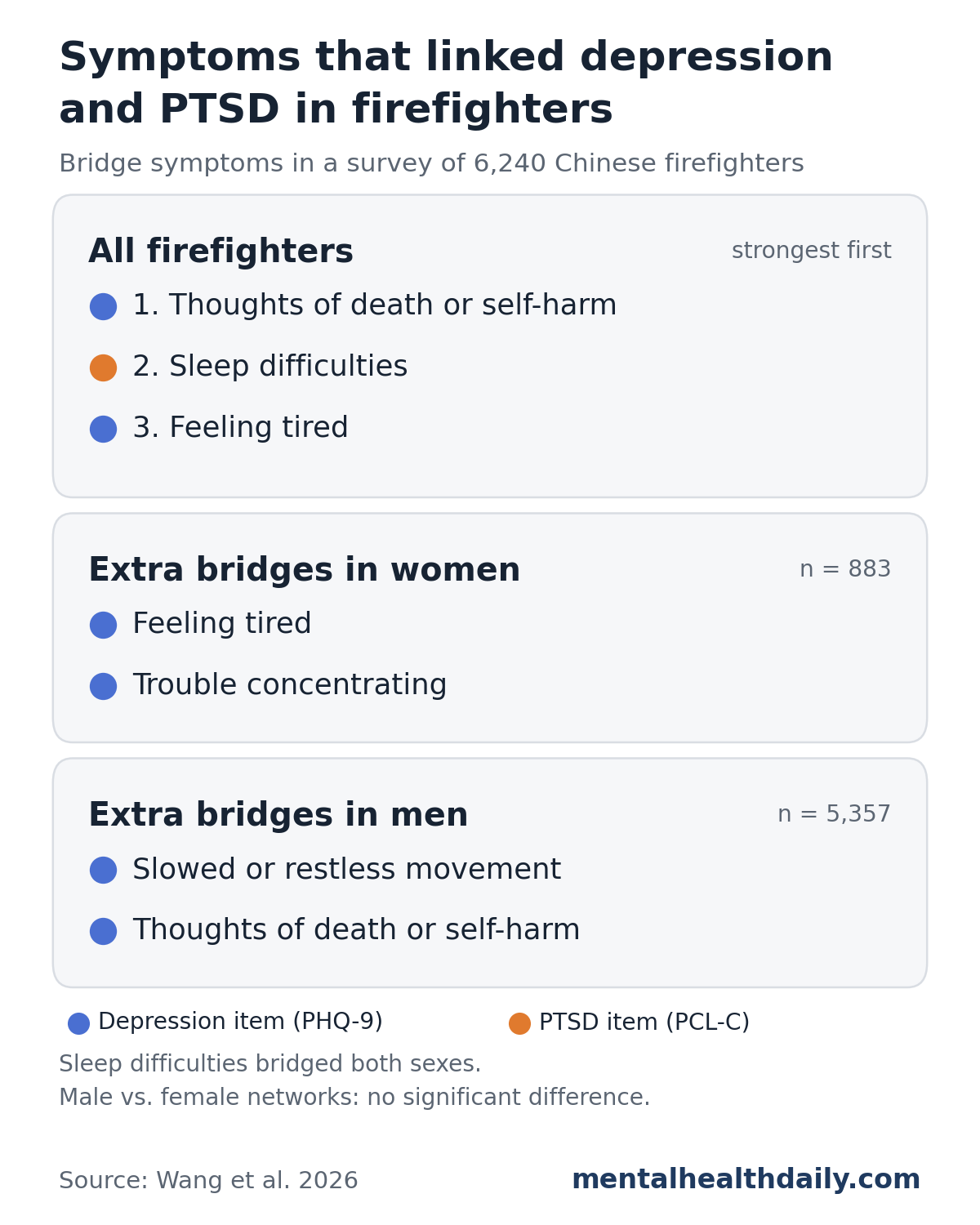
Across all 6,240 firefighters, 3 symptoms had the highest bridge strength:1
- Thoughts of death or self-harm: the last PHQ-9 item, which asks how often someone has thought they would be better off dead or of hurting themselves.
- Sleep difficulties: the PTSD checklist item on trouble falling or staying asleep.
- Feeling tired: the PHQ-9 item on tiredness or low energy.
Feeling tired and sleep difficulties also formed the single strongest connection between the depression and PTSD questionnaires. Poor sleep and daytime tiredness naturally travel together, so this connection fits everyday experience.1
Avoidance was the busiest hub overall: trying to push away thoughts of a traumatic event was the most connected symptom in the whole network, followed by avoiding reminders and difficulty concentrating.1
Sleep in PTSD: a 2008 review concluded that disturbed sleep is a core part of PTSD that can help bring it on and keep it going, rather than a side effect that clears up once other symptoms improve.3 That fits sleep showing up as a bridge here, although a one-time survey cannot show which came first.
How Thoughts of Death or Self-Harm Fit Into the Firefighter Network
The PHQ-9 item on thoughts of death or self-harm had the highest bridge strength in the full sample. The researchers cautioned against reading this as a driver of other symptoms. Because such thoughts are less common and more severe, they suggested it more likely reflects a buildup of depression and PTSD symptoms than a starting point.1
The study did not report how many firefighters endorsed this item, and a questionnaire item is not a measure of suicide risk on its own. Still, it is a reminder that screening programs for firefighters should ask directly and have a clear path to support when someone answers yes.
If you or someone you know is struggling, help is available. In the United States, call or text 988 to reach the 988 Suicide & Crisis Lifeline. Elsewhere, contact local emergency services or a local crisis line.
Female Firefighters Reported Higher Depression and PTSD Scores
Women scored higher than men on both questionnaires, and both differences were statistically significant:1
- Depression (PHQ-9): 3.87 in women vs. 2.54 in men
- PTSD (PCL-C): 23.96 in women vs. 21.29 in men
Low scores overall: on the PHQ-9, a score of 5 marks mild depression and 10 marks moderate depression.4 Both group averages fall below 5. PTSD averages sit only 4 to 7 points above the checklist’s minimum possible score of 17, which is the score of someone reporting no symptoms at all.
Most firefighters in this survey, then, reported few symptoms. The network shows how symptoms cluster across the whole workforce, including people with mild complaints, rather than in firefighters with diagnosed depression or PTSD.
Bridge Symptoms Looked Different in Men and Women
Sleep difficulties served as a bridge in both sexes. Beyond that, the researchers described distinct bridges for each group:1
- Women: feeling tired and trouble concentrating, which the researchers grouped as inward emotional and thinking problems.
- Men: slowed or restless movement and the item on thoughts of death or self-harm, which they grouped as outward, functional and crisis-type symptoms.
Formal comparison found no significant difference. A Network Comparison Test, which checks whether 2 networks differ by more than chance, found no significant sex difference in overall structure (p = 0.979), overall connection strength (p = 0.220) or any individual connection.1
The researchers call the sex-specific bridges tentative. The female group was much smaller (883 vs. 5,357), which makes small or moderate differences harder to detect, so the patterns are worth testing again rather than acting on.1
Earlier Firefighter Network Study Found Different Bridges
A 2023 network study of 1,768 Chinese firefighters found a different set of bridges between PTSD and depression: emotional numbness, being on high alert, sad mood, and guilt or self-blame. Life feeling empty was the most central symptom, followed by fatigue and loss of interest.5
Fatigue appears prominently in both studies. The other differences likely reflect different questionnaires, sample sizes and analysis choices, and they show that bridge rankings can shift from one sample to the next.
Limitations of This Firefighter Symptom Network Study
- One-time survey: the network shows which symptoms occur together, not cause and effect or how symptoms change over time.
- Mostly low symptom levels: results describe a general firefighter workforce, not people with diagnosed depression or PTSD.
- Uneven group sizes: far fewer women limited the power to detect differences between the male and female networks.
- No trauma details: the type, frequency and timing of traumatic calls were not recorded.
- Setting: Chinese firefighters surveyed in 2023, shortly after the COVID-19 pandemic; workplace culture and pandemic stress may shape results.
- Self-report questionnaires: no clinical interviews were used.
What This Means for Firefighter Mental Health
Sleep and fatigue deserve attention. In this survey, poor sleep and tiredness sat right where depression and PTSD symptoms meet. Firefighters who notice ongoing trouble sleeping along with exhaustion or low mood have good reason to raise it with a doctor or a peer-support or employee assistance program.
Screening can look at both conditions together. Because the symptoms overlap, a check for one condition is a natural moment to ask about the other, including the sleep and self-harm questions.
Sex-specific programs need more evidence. The researchers suggest that gender-informed support may help, but they say these network patterns are not strong enough to guide targeted treatment until other studies confirm them.1
References
- Wang Y, Ni X, Li M, Zhang J, Ma Z, Gai Y, Wu Z, Fan J, Liu B, Song L, Yang Q. Gender-Specific Network Structures of Depression and PTSD Symptoms in Chinese Firefighters. Psychology Research and Behavior Management. 2026;19:590750. doi:10.2147/PRBM.S590750
- Jones PJ, Ma R, McNally RJ. Bridge centrality: a network approach to understanding comorbidity. Multivariate Behavioral Research. 2021;56(2):353–367. doi:10.1080/00273171.2019.1614898
- Spoormaker VI, Montgomery P. Disturbed sleep in post-traumatic stress disorder: secondary symptom or core feature? Sleep Medicine Reviews. 2008;12(3):169–184. doi:10.1016/j.smrv.2007.08.008
- Kroenke K, Spitzer RL, Williams JBW. The PHQ-9: validity of a brief depression severity measure. Journal of General Internal Medicine. 2001;16(9):606–613. doi:10.1046/j.1525-1497.2001.016009606.x
- Cheng P, Wang L, Zhou Y, Ma W, Zhao G, Zhang L, Li W. Post-traumatic stress disorder and depressive symptoms among firefighters: a network analysis. Frontiers in Public Health. 2023;11:1096771. doi:10.3389/fpubh.2023.1096771