hit counter

Alzheimer’s Fingerprick Blood Biomarkers: p-tau217 and GFAP Track Cognition

MHD featured image for Alzheimer’s disease fingerprick blood biomarkers p-tau217 and GFAP.

A 2026 PROTECT study involving 174 older adults found that self-administered fingerprick p-tau217 correlated with episodic memory (r = 0.299, p < 0.001) and GFAP correlated with working memory (r = 0.183, p = 0.034), supporting remote Alzheimer's risk triage rather than a stand-alone dementia diagnosis. Research Highlights Fingerprick sampling reached 77% completion: 174 of …

Read more

Epilepsy and Alzheimer’s Blood Biomarkers in Older Adults

MHD featured image for epilepsy, Alzheimer’s blood biomarkers, and AT(N) profiles in older adults.

A preprint in 84 older adults with epilepsy found that abnormal Alzheimer's-related blood biomarkers were common, but the biomarker categories did not line up neatly with cognitive impairment. Research Highlights Only 32.1% had normal biomarkers: 27 of 84 older adults with epilepsy were A−T−N− using blood-based amyloid, tau, and neurodegeneration markers.1 AD-continuum profiles were common: …

Read more

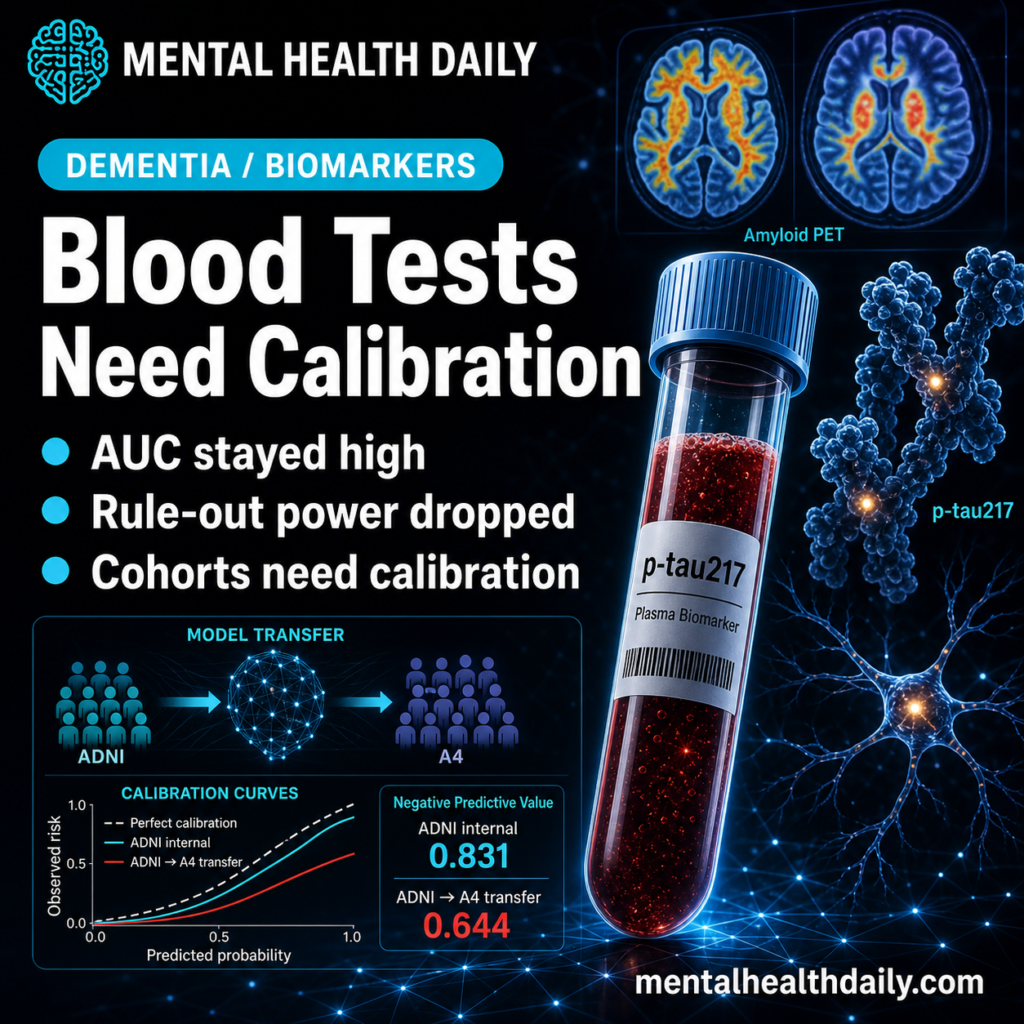
Alzheimer’s Blood Biomarker Models Lose Rule-Out Power Across Cohorts

Editorial card showing Alzheimer's blood biomarker model transfer across cohorts with PET scan and blood assay imagery.

A 2026 ADNI/A4 validation study found that Alzheimer’s plasma-biomarker machine-learning models still ranked amyloid PET status well across cohorts, but the practical rule-out number moved hard: negative predictive value fell from 0.831 inside ADNI to 0.644 when the ADNI-trained model was applied to A4.1 Research Highlights 1,707-person ADNI/A4 test: researchers trained amyloid PET prediction models …

Read more

Plasma p-tau217 Blood Test Predicts Alzheimer’s Risk 1.5x Stronger in APOE-e4

Photoreal illustration representing a blood biomarker test for Alzheimer's disease with imagery of blood vials, neurons, and APOE genetic motifs.

Until recently, Alzheimer’s pathology could only be confirmed in living patients via PET imaging or lumbar puncture. Plasma p-tau217 changed that calculus — but how to interpret a positive result depends substantially on APOE genotype.1 Research Highlights Plasma p-tau217 is a blood biomarker that rises years before Alzheimer’s symptoms. The 2024 Alzheimer’s Association revised criteria …

Read more