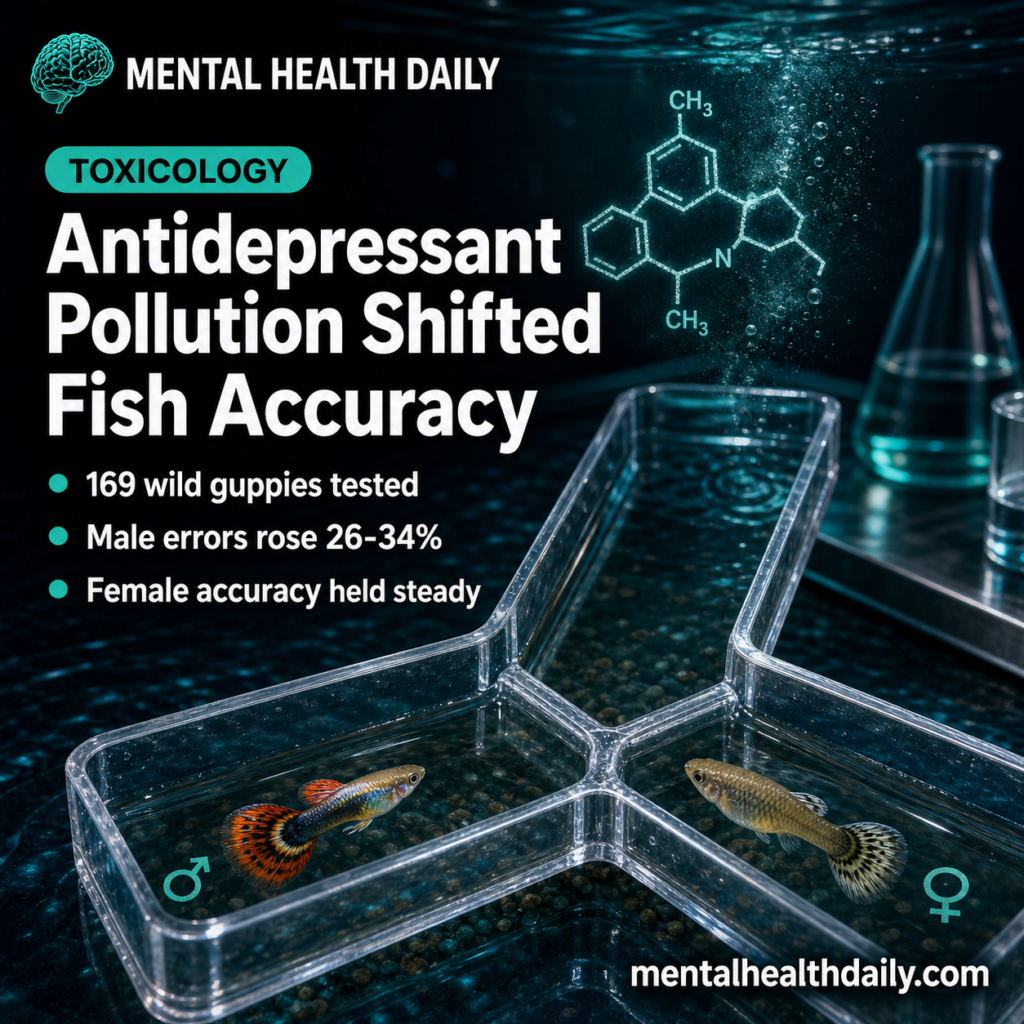
A 2026 Environmental Science & Technology experiment found that wild guppies still reduced maze solve times with practice after 11-day exposure to environmentally motivated amitriptyline concentrations, but exposed males made 26.35% to 34.21% more navigation errors than control males.1 The result is a sex-specific accuracy signal, not a blanket claim that antidepressant pollution erased learning.
Research Highlights
- Male accuracy worsened: Low- and high-exposed males made 26.35% and 34.21% more maze errors than control males, while female accuracy was not strongly affected.1
- Learning speed stayed intact: Across all groups, solve time improved by 6.88 seconds per trial, from 119.07 seconds in trial 1 to 38.37 seconds in trial 12.1
- The exposure was measured: Low and high treatment tanks averaged 52.47 ng/L and 496.44 ng/L amitriptyline; control tanks had no detected amitriptyline.1
- The behavioral dataset was large: Researchers analyzed 169 wild-caught guppies and 1,938 maze trials after excluding misstarts and exposure losses.1
- Human inference is limited: This 2026 aquatic toxicology study says something about environmental exposure in fish, not prescribed amitriptyline effects in patients.
Amitriptyline is a tricyclic antidepressant that affects serotonin and norepinephrine signaling and also has anticholinergic properties. In medicine, it is prescribed for depression, neuropathic pain, migraine prevention, and other conditions. In waterways, it becomes a neuroactive pollutant: a brain-active compound reaching organisms that were never supposed to receive it.
Spatial learning means using environmental cues to navigate. For small fish, that can affect food finding, shelter use, mate access, and predator avoidance. A maze assay is a simplified test of a cognitive system with ecological value.
169 Wild Guppies Completed 1,938 Maze Trials
Manera et al. collected wild adult guppies and exposed them for 11 days to freshwater control, low amitriptyline, or high amitriptyline conditions. The nominal concentrations were 0, 30, and 300 ng/L. Measured concentrations were 52.47 ng/L in the low group and 496.44 ng/L in the high group, with no amitriptyline detected in control tanks.1
After exclusions, the behavioral analysis included 169 fish: 86 females and 83 males. Each fish was tested across 12 maze trials over 4 days, producing 1,938 analyzable trials. The maze required fish to use spatial memory to find a food reward, while the final trial removed the food reward to reduce the chance that fish were simply following scent.
Design strength: repeated trials let the researchers separate 2 questions that are often blurred together: whether fish got faster at solving the maze, and whether they made fewer wrong-arm entries while doing it.
Solve Times Improved Across All Exposure Groups
Guppies showed clear learning by solve time. Across treatment groups, fish solved the maze 6.88 seconds faster with each successive trial, 95% credible interval −7.90 to −5.88. Model-estimated solve time fell from 119.07 seconds in the first trial to 38.37 seconds in the final trial.1
The researchers did not find strong evidence that amitriptyline changed solve-time learning rate or absolute solve time. That detail prevents an overclaim. The fish still learned the route in the broad speed sense.
Calibration: if the headline says “amitriptyline impaired learning,” the next sentence needs to say what kind of learning. The impairment appeared in male navigation accuracy, not in the basic ability to reduce solve time with practice.
Male Navigation Errors Rose 26% to 34%
Error counts told the sharper story. Control males became more accurate than control females later in training, with fewer wrong-arm entries from trial 8 onward. Amitriptyline exposure erased that male advantage.
Low-exposed males made 0.42 more errors than control males on average, and high-exposed males made 0.55 more errors. Expressed as percentages, low- and high-exposed males made 26.35% and 34.21% more errors than control males, respectively.1
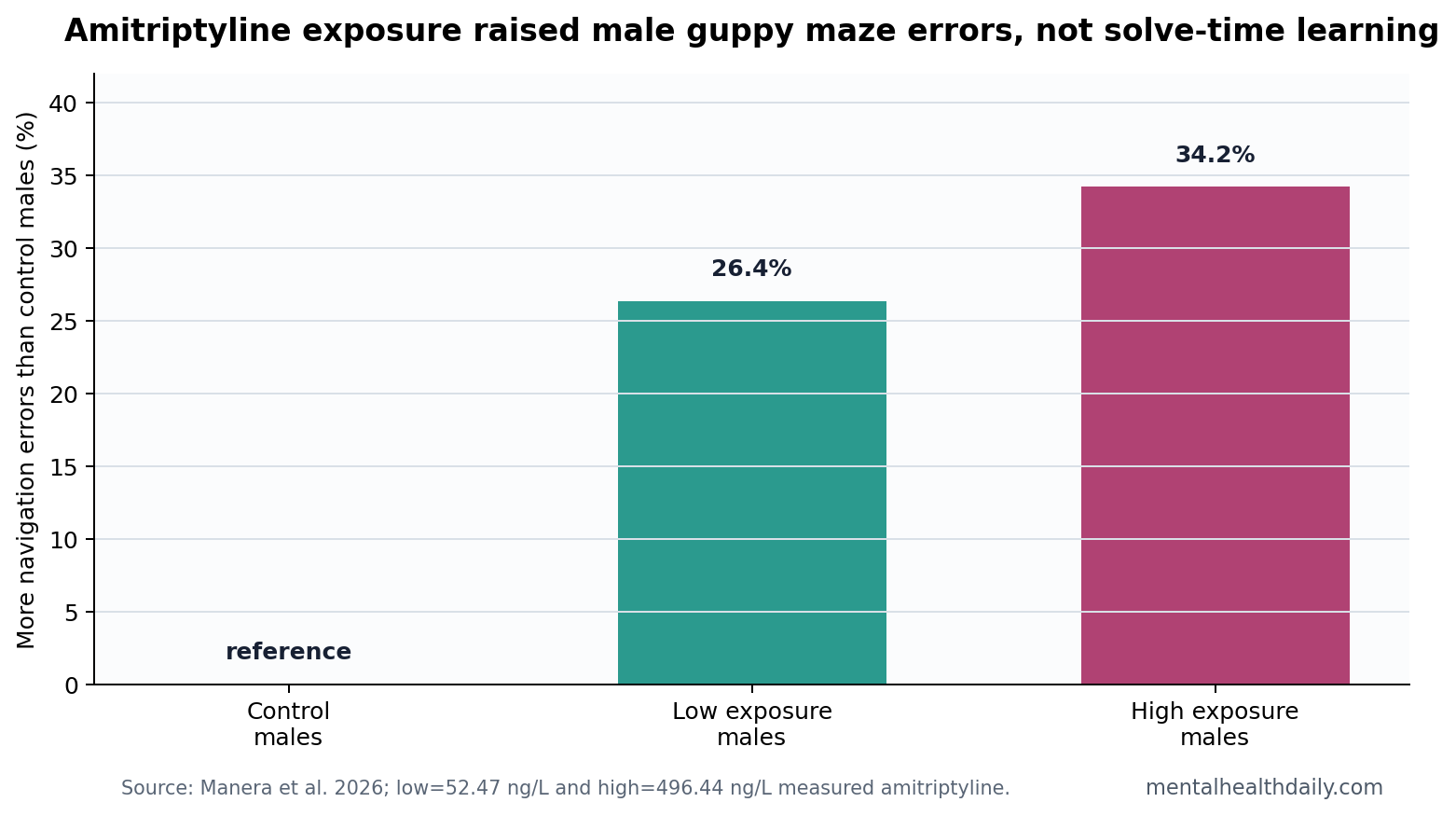
Female accuracy did not show the same exposure effect. Under high exposure, males initially performed worse than females, reversing the control-sex pattern. That is why the study is best read as sex-specific cognitive vulnerability rather than general neurotoxicity across all fish.
Neuroactive Pollution Can Change Behavior Without Killing Fish
David et al. previously showed that fish exposed to wastewater effluent can accumulate mixtures of neuroactive pharmaceuticals and show altered brain neurotransmitter levels.2 That kind of evidence is important because ecological risk can occur below obvious mortality. A fish does not have to die for pollution to change navigation, foraging, boldness, or social behavior.
Polverino et al. reported sex-specific effects of psychoactive pollution on fish behavioral individuality and plasticity.3 Manera et al. extend that logic into spatial accuracy: the cognitive phenotype was not evenly distributed across male and female fish.
Population implication: if a pollutant selectively weakens the sex that normally has an advantage in a task, the ecological effect can be larger than a simple average effect suggests. A group mean can hide which animals lose the trait that mattered most.
Why Accuracy and Speed Split in This Study
Maze solve time and wrong-arm entries are related but not identical. A fish can move through the maze more quickly with practice while still making poor decisions at branch points. That is exactly why the Manera experiment measured both outcomes instead of relying on solve time alone.
Speed outcome: repeated exposure to the maze improved route completion across groups. That supports basic learning and habituation to the task environment.
Accuracy outcome: exposed males made more incorrect arm entries, especially later in training when control males normally showed the advantage. That pattern suggests a navigation-quality problem rather than a global failure to participate or a sedation-like slowing effect.
For environmental toxicology, this distinction matters. A pollutant that leaves speed intact but increases decision errors could still affect survival if the ecological task requires choosing the right refuge, food patch, or escape route under time pressure.
The sex-specific result also changes how risk should be summarized. If male control fish normally gain an accuracy advantage with repeated trials, then losing that advantage is not a small statistical footnote. It means exposure removed the group difference that emerged under normal conditions.
Mechanism caution: amitriptyline affects several neurotransmitter systems, and the study did not isolate which receptor or pathway drove the male-specific error increase. Serotonin, norepinephrine, acetylcholine, stress responsiveness, activity pattern, and motivation could all interact with spatial learning. The behavioral result is clear enough to justify concern, but the pathway remains open.
Field relevance depends on more than one compound. Real waterways contain mixtures: antidepressants, stimulants, pain medications, hormones, pesticides, metals, and nutrients can arrive together. A single-compound amitriptyline experiment is cleaner mechanistically, while real exposure is messier and may involve additive, buffering, or interaction effects.
Policy-facing read: the study supports measuring behavior at concentrations that actually occur in water, not waiting for lethal effects. Sublethal cognitive changes can matter when navigation accuracy affects feeding, mating, or escape.
The repeated-trial design also matters for regulation. A single open-field swim test might detect activity changes but miss learning accuracy. If neuroactive pollution mainly changes decision quality, environmental testing needs tasks that force animals to choose, remember, and update behavior across time.
Public-health boundary: the finding should not be used to stigmatize antidepressant treatment. The relevant failure point is wastewater and environmental exposure control, not whether a patient should take a prescribed medication.
Why Fish Spatial Cognition Belongs in a Mental-Health Site
This is not a human antidepressant warning. The paper belongs in a brain-and-behavior context because it tests what happens when a human neuroactive drug becomes an environmental exposure for another vertebrate. Yang et al. showed that fish telencephalon can carry population codes for spatial representation, reinforcing that fish navigation is a real neural computation, not a reflexive tank artifact.4
Evidence-strength note: this was an aquatic toxicology experiment, not a clinical study. It can support concern that environmentally relevant amitriptyline exposure altered male guppy spatial accuracy after 11 days. It cannot support claims about human cognition during prescribed amitriptyline treatment.
Sex-specific effects need follow-up. The male accuracy signal could reflect sex differences in baseline navigation strategy, stress physiology, metabolism, or sensitivity to serotonergic and noradrenergic disruption. The study identifies a vulnerable pattern; it does not show whether female guppies are protected, whether males are uniquely sensitive, or whether the effect changes across reproductive context.
That uncertainty is exactly why sex-stratified behavioral reporting matters in pollution studies. Pooling males and females could have made the navigation-accuracy signal look smaller or disappear.
Questions About Amitriptyline Pollution and Fish Cognition
Did amitriptyline stop the fish from learning?
No. Solve times improved across all groups. The impairment was more specific: exposed males made more wrong-arm entries, meaning accuracy was worse even while speed improved.
Were the concentrations realistic?
The low measured concentration, 52.47 ng/L, falls within the broad range reported for surface waters. The high measured concentration, 496.44 ng/L, is closer to treated wastewater discharge scenarios and represents a heavier exposure.
Does this say anything about people taking amitriptyline?
No. Prescribed drug exposure in humans is intentional, dosed, monitored, and metabolized in a different organism. This study is about unintended exposure in wildlife.
References
- Manera J, et al. Neuroactive pollution disrupts cognition: sex-specific effects of amitriptyline on spatial learning in wild guppies. Environmental Science & Technology. 2026;60:10640-10650. doi:10.1021/acs.est.6c00552
- David A, Lange A, Tyler CR, Hill EM. Concentrating mixtures of neuroactive pharmaceuticals and altered neurotransmitter levels in the brain of fish exposed to a wastewater effluent. Science of the Total Environment. 2018;621:782-790. doi:10.1016/j.scitotenv.2017.10.096
- Polverino G, Aich U, Brand JA, et al. Sex-specific effects of psychoactive pollution on behavioral individuality and plasticity in fish. Behavioral Ecology. 2023;34:969-978. doi:10.1093/beheco/arad064
- Yang C, Mammen L, Kim B, et al. A population code for spatial representation in the zebrafish telencephalon. Nature. 2024;634:397-406. doi:10.1038/s41586-024-07867-2