People on hemodialysis in Japan who received a small card summing up their own life story described it as a keepsake, a way to be heard and a source of courage to keep going, according to a 2026 interview study of 21 patients.1
Research Highlights
- A one-page life story: researchers with dialysis nursing experience interviewed each patient at the bedside during dialysis, then made a folded card with a summary of what mattered to them, a picture of something they cherished and a short message from a nurse who cared for them.1
- 3 themes from 315 interview codes: patients described the card as turning their story into a lasting keepsake, as a way to get their thoughts across, and as a source of courage to live.1
- A voice in care and at home: some patients used the card to tell staff their wishes about treatment and to show family what they had been going through.1
- No outcome measures: the study had no control group and did not measure depression, anxiety or quality of life, so it shows how patients experienced the cards, not whether the cards improved mental health.1
- A real need: about 23% of people on dialysis meet interview criteria for depression, and 39% screen positive on questionnaires.2
Why People on Hemodialysis Need Emotional Support
Hemodialysis is a treatment for kidney failure in which a machine filters the blood outside the body, doing the cleaning job the kidneys can no longer do. Most patients go to a clinic several times a week for sessions lasting hours, and once the kidneys have failed, treatment usually continues for life unless they get a transplant.
Japan had 343,508 people on chronic dialysis at the end of 2023, and about 97% of them were on hemodialysis. Michiyo Oka et al. at Gunma University describe that lifelong dependence on a machine as a heavy psychological load that can bring helplessness, depression and fear.1
Depression is common in this group. A 2013 meta-analysis of 216 studies and 55,982 people with chronic kidney disease found:2
- 22.8% of people on dialysis had depression when assessed by clinical interview
- 39.3% of people on dialysis had elevated depressive symptoms on self-report questionnaires
Treatment evidence is thinner than the need. A 2019 Cochrane review of 33 trials with 2,056 dialysis patients concluded that cognitive behavioral therapy (CBT), exercise and relaxation techniques probably reduce depressive symptoms, while counseling may help slightly. Few trials tested each approach, and evidence for the others was weak.3
What a Life Story Card Is
The card grew out of life story books, personal albums of photos and written memories used in dementia care to help staff and families see the person behind the diagnosis. A 2017 review of the dementia research found mostly positive effects on patients, relatives and staff, but only 5 studies, too few to draw firm conclusions.5
Life story books take a lot of time to compile, which makes them hard to fit into a busy dialysis unit. Oka et al. condensed the idea into a Life Story Card: a single card meant to capture what a patient values most, quickly enough that nurses could realistically make one.1
How each card was made:
- Bedside interview: during a dialysis session, an interviewer with dialysis nursing experience asked questions such as “How did you feel about starting dialysis?” and “What is important to you in your life?” These talks usually took 60 to 90 minutes.
- Draft: researchers pulled out what the person valued and their most meaningful experiences, focusing on feelings rather than only events.
- Design: the summary went on a sheet of thick paper about 30 by 20 cm (roughly 12 by 8 inches), folded in half, with a photo or illustration of an object meaningful to the patient.
- Nurse’s note: a nurse from the kidney center who regularly cared for the patient added a 1- or 2-line personal message.
- Patient approval: each person checked the draft, corrected names and details, removed anything they wanted, and had the final say. The finished card was handed over and read aloud.
One example: a man who loved vegetable gardening got a card illustrated with a smiling figure holding his harvest.1
How the Dialysis Study Was Done
Researchers invited 22 people receiving hemodialysis at one hospital in Gunma Prefecture; 1 declined because of family opposition. All 21 who joined completed the study.1
- Participants: 13 men and 8 women, average age about 67, on dialysis for an average of about 7 years
- Causes of kidney failure: unknown cause in 13, diabetic kidney disease in 5, and 1 each with IgA nephropathy, acute kidney injury and chronic glomerulonephritis
- Follow-up interviews: after reading their cards, participants had 1 or 2 in-depth interviews of 50 to 90 minutes about their impressions and feelings
The team analyzed the transcripts with reflexive thematic analysis, a qualitative method in which researchers code what people say, group related codes and refine them into themes that capture shared meaning. The interviewers were not involved in the patients’ day-to-day care.1
3 Things Patients Said Their Life Story Cards Meant
Analysis produced 315 codes, which the researchers grouped into 7 subthemes and 3 themes.1
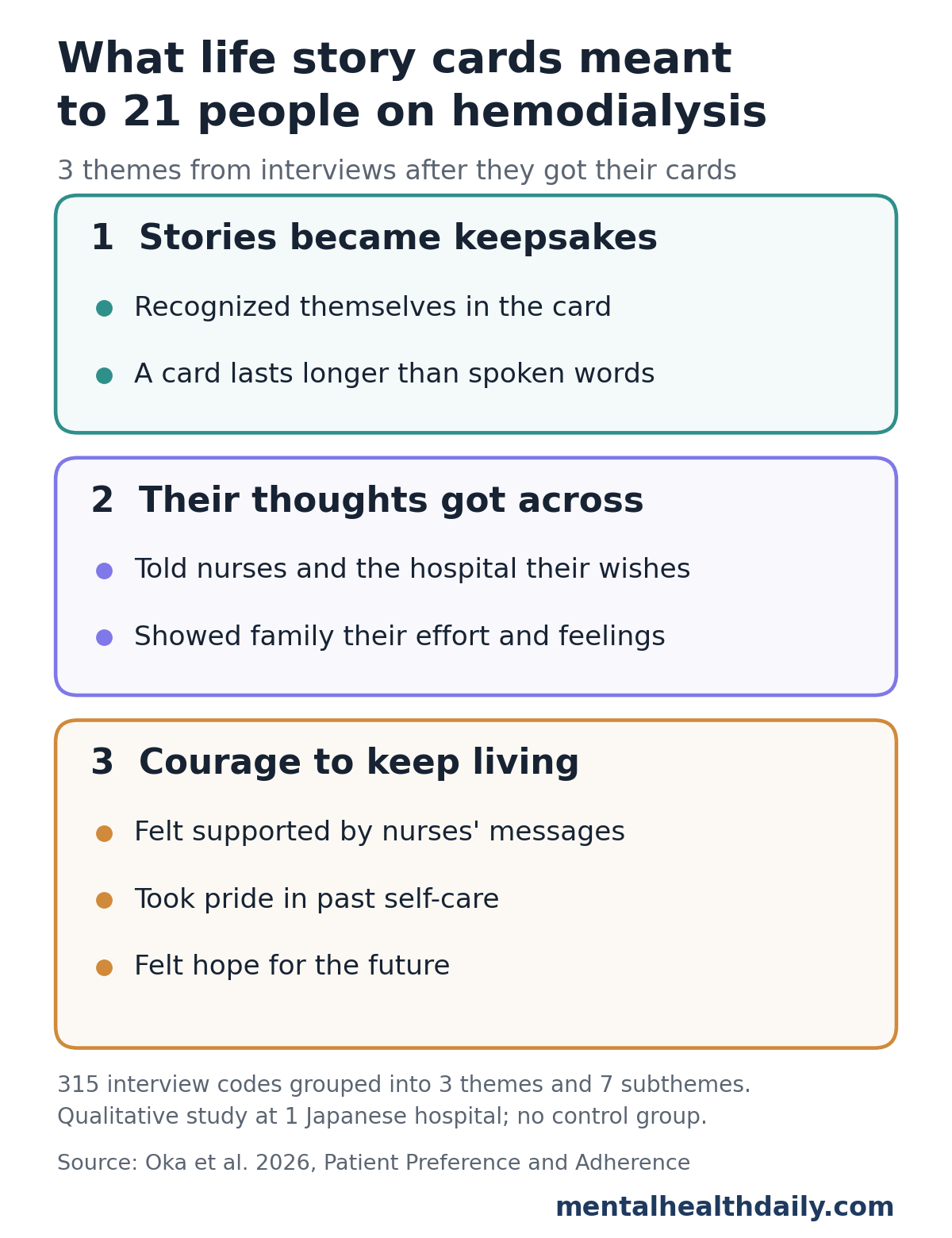
1. Their stories became keepsakes. Patients liked seeing themselves in the card, whether through a favorite color or a picture of something they loved. The gardener said the vegetable picture “feels special to me.”1
Another man, who had learned to cook to manage his weight after starting dialysis, explained why a card beats conversation alone: what is in your mind at the time “usually goes away,” but an object on display lets you remember. Several patients said they kept their cards and looked at them from time to time.1
2. Their thoughts got across. Some patients used the card to say things they had struggled to put into words. One man had long wanted to tell the hospital his wishes about hospitalization and dialysis but found it hard.
The card, he said, became a helpful tool for conveying them, and he was grateful staff took them seriously.1
He also showed the card to his wife and daughter, telling them it held what he had been thinking about them all along. The cook’s wife showed his card to family, including grandchildren, who praised him for doing his best.1
3. They gained courage to live. This theme had 3 parts:1
- Feeling supported: the nurses’ messages showed patients that staff were on their side. “Even when I feel down, the card encourages me,” one man said.
- Recognizing past effort: talking about past diet control, exercise and other self-care let patients feel satisfied with themselves. One man admitted he felt embarrassed, since he rarely got compliments, but was happy to talk about it.
- Hope for the future: patients said looking at the card made them want to keep doing their best, and that talking about themselves helped them think in a more positive direction.
How Life Story Cards Compare With Reminiscence Therapy and Dignity Therapy
The card is a brief form of reminiscence, structured remembering of one’s past, often guided by a therapist or nurse. The more intensive version, life review, asks people to look back across their whole life and make sense of it.
Those approaches have a solid trial record outside kidney care. A 2024 meta-analysis of 195 randomized controlled trials found that reminiscence interventions produced moderate improvements in depressive symptoms and small-to-moderate improvements in anxiety.4
Effects were similar in people with physical illness, people with cognitive impairment and general community samples. Life review for people who already had elevated symptoms tended to work best.4
The closest tested approach in dialysis is dignity therapy, a guided interview about a person’s life, values and wishes that is turned into a written document they can keep or share. In a 2026 randomized trial of 92 hemodialysis patients in China, adding culturally adapted dignity therapy to routine psychological care significantly reduced dignity-related distress compared with routine care alone.6
Where the card fits: dignity therapy in that trial was delivered by staff who had completed a month of special training. Oka et al. see the Life Story Card as something regular dialysis nurses could make without that training, though it still takes a long conversation.1
According to the researchers, no earlier studies had tested life story or reminiscence interventions designed specifically for people with kidney failure.1
Limitations of This Life Story Card Study
This was a small qualitative study, designed to understand patients’ experiences rather than test whether the cards work:
- No comparison group or symptom scales: nobody received usual care for comparison, and depression, anxiety and quality of life were not measured.
- One hospital, 21 people: all participants came from a single Japanese facility, and some were invited directly by hospital administrators, which may have made it harder to say no.
- Pressure to be grateful: the cards came from nurses, and the people who made them also ran the follow-up interviews, so patients may have wanted to come across as appreciative “good patients.”
- Cultural context: long relationships with dialysis staff and a reluctance to voice feelings in Japanese care may have shaped how patients responded.
- One point in time: patients were interviewed once (twice if they asked for revisions) soon after getting the card, so it is unknown whether any lift lasted.
The researchers call for standardized procedures and randomized trials with longer follow-up to test whether the cards bring measurable psychological benefits.1
What This Means for Dialysis Care
Being heard was part of what patients valued. Along with the card itself, they valued the chance to talk about themselves and the sign that their nurses cared. The researchers note that time with doctors in dialysis care is often limited, and that nurses setting aside time to listen may help patients voice their needs.1
A low-tech option worth testing. A life story card costs little more than paper and time, patients in this study responded warmly, and broader reminiscence research shows real effects on depressive symptoms. Whether the card itself eases depression in dialysis patients still needs a proper trial.1,4
Help exists for depression on dialysis. Persistent low mood, loss of interest or hopelessness during dialysis is worth raising with the care team. CBT, exercise and relaxation training have the strongest evidence so far in this group.3
References
- Oka M, Joboshi H, Takahashi S, Matsumoto M, Imai Y, Sato Y. The Meaning of Life Story Card for People Undergoing Hemodialysis. Patient Preference and Adherence. 2026;20:614365. doi:10.2147/PPA.S614365
- Palmer S, Vecchio M, Craig JC, et al. Prevalence of depression in chronic kidney disease: systematic review and meta-analysis of observational studies. Kidney International. 2013;84(1):179–191. doi:10.1038/ki.2013.77
- Natale P, Palmer SC, Ruospo M, Saglimbene VM, Rabindranath KS, Strippoli GFM. Psychosocial interventions for preventing and treating depression in dialysis patients. Cochrane Database of Systematic Reviews. 2019;(12):CD004542. doi:10.1002/14651858.CD004542.pub3
- Pinquart M. Effects of reminiscence interventions on depression and anxiety: a meta-analysis of randomized controlled trials. Aging & Mental Health. 2024;28(5):717–724. doi:10.1080/13607863.2024.2320133
- Grøndahl VA, Persenius M, Bååth C, Helgesen AK. The use of life stories and its influence on persons with dementia, their relatives and staff – a systematic mixed studies review. BMC Nursing. 2017;16:28. doi:10.1186/s12912-017-0223-5
- Chen Y, Huang R, Zhou T, et al. Effects of dignity therapy on psychological and behavioral outcomes in patients with end-stage renal disease undergoing hemodialysis: a randomized controlled trial. International Journal of Nursing Studies. 2026;178:105397. doi:10.1016/j.ijnurstu.2026.105397