hit counter

Amitriptyline Water Pollution Impaired Male Guppy Spatial Accuracy
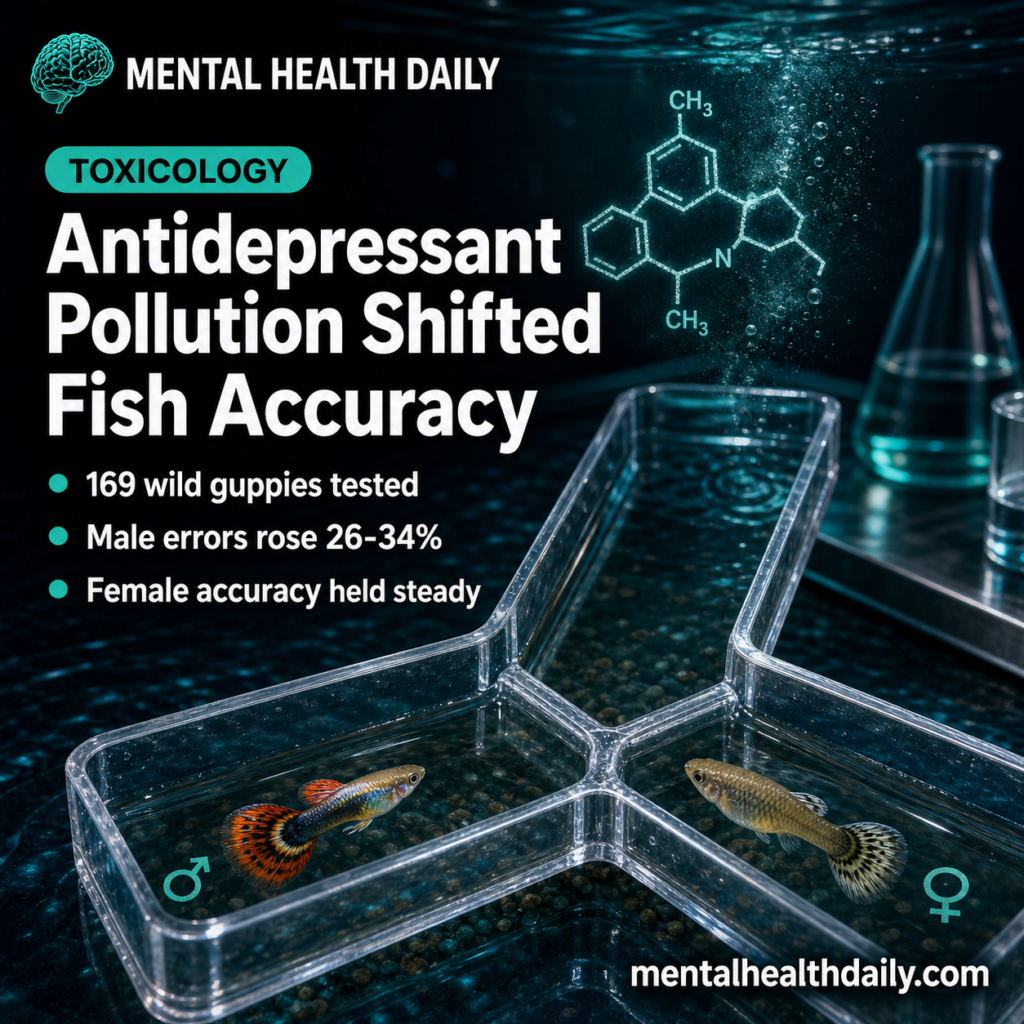
MHD featured image for amitriptyline water pollution and guppy spatial cognition.

A 2026 Environmental Science & Technology experiment found that wild guppies still reduced maze solve times with practice after 11-day exposure to environmentally motivated amitriptyline concentrations, but exposed males made 26.35% to 34.21% more navigation errors than control males.1 The result is a sex-specific accuracy signal, not a blanket claim that antidepressant pollution erased learning. …

Read more

Amitriptyline For Migraines: An Effective Prophylactic Agent

Amitriptyline (brand name “Elavil”) is a medication that was initially approved by the FDA in 1961 for the treatment of major depressive disorder.  Due to its three-ring chemical structure, it is formally classified as a tricyclic antidepressant (TCA).  Though not formally approved in the United States to treat conditions other than major depression, Amitriptyline is …

Read more

How Long Does Amitriptyline Stay In Your System?

Amitriptyline (brand name “Elavil”) is a drug derived from the chemical dibenzocycloheptadiene that was discovered and approved in the early 1960s for the treatment of major depression.  It is formally classified as a tricyclic antidepressant (TCA) and functions principally via inhibiting the presynaptic reuptake of norepinephrine and serotonin.  This effect of dual presynaptic reuptake inhibition …

Read more

Amitriptyline & Weight Gain: The Reason 50% Discontinue Treatment

Amitriptyline (Elavil) is the most popular TCA (tricyclic antidepressant) medication on the market. It is primarily utilized for the treatment of depression, and in other cases, migraine headaches and anxiety disorders. The drug functions primarily by inhibiting the reuptake of the serotonin transporter, which increases extracellular levels of the neurotransmitter serotonin. Although serotonin is primarily …

Read more

Tricyclic Antidepressants List (TCAs)

Tricyclic Antidepressants (TCAs) were developed in the 1950s as a way to treat depression with chemical compounds. These drugs are known for their specific chemical structure consisting of three rings of atoms, hence being referred to as “tri”-cyclic. Tricyclics were developed after researchers began exploring derivatives of the first typical antipsychotic medication Thorazine. Experimentation with derivatives …

Read more