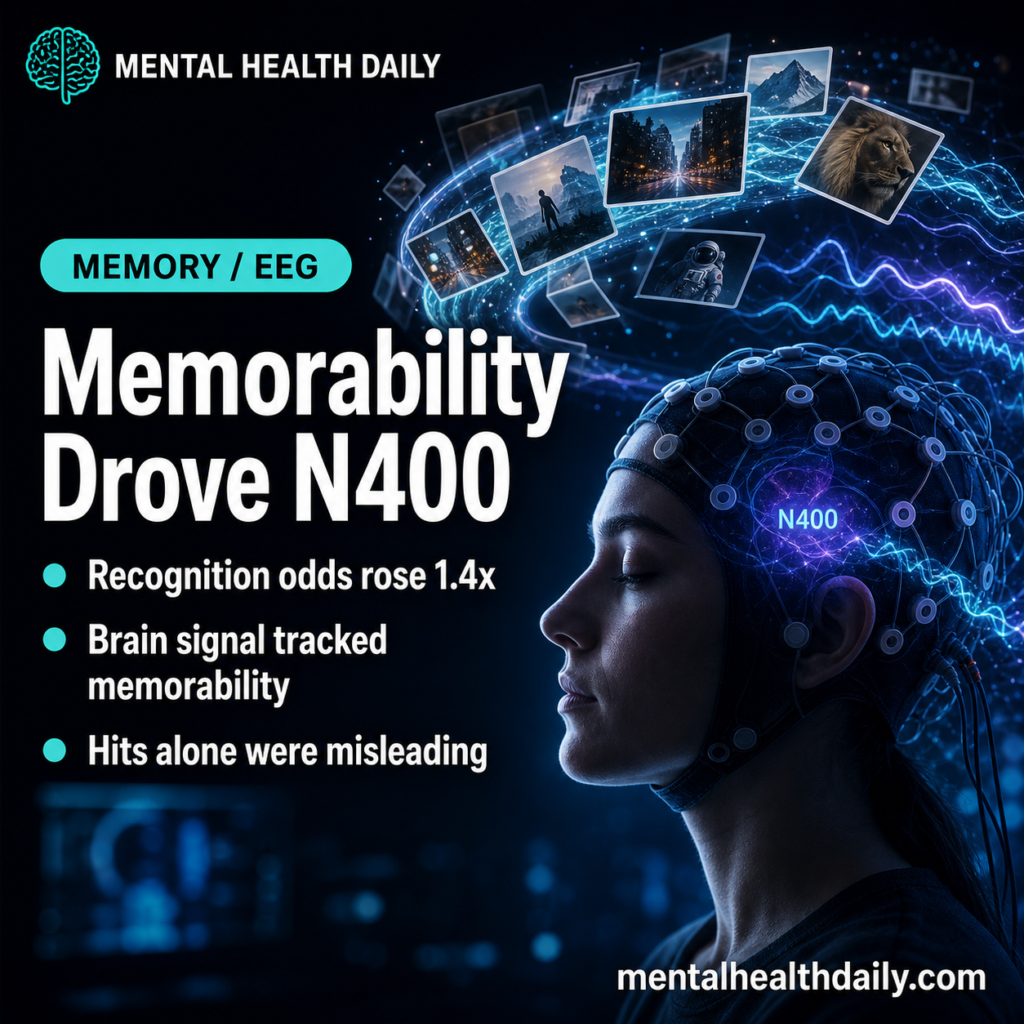
A 2026 EEG study found that image memorability predicted recognition strongly, z = 9.17, p < 0.001, and the N400 encoding signal tracked memorability after later recognition success was included in the same model.1 The result weakens the common shortcut that every hit-vs-miss brain signal is purely an encoding-success signal.
Research Highlights
- Memorability predicted recognition: Normed image memorability predicted later recognition, z = 9.17, p < 0.001, with about 1.4x higher recognition odds per 0.1 memorability increase.1
- N400 tracked the image: In the joint model, N400 was predicted by memorability, t = 5.66, p < 0.001, while recognition success was not significant.1
- Recognition dropped out: The N400 recognition term was only t = 0.26, p = 0.794, after memorability was included.1
- LPC showed the same direction: LPC tracked memorability, t = 4.95, p < 0.001, but not recognition, t = 1.03, p = 0.301.1
- Scope is task-specific: A 2026 image-recognition EEG study does not show that memorability explains every memory failure.
Image memorability is the stable tendency of some pictures to be remembered by many people, even when viewers differ. A memorable image can be remembered later because the item itself is easier to remember, alongside the viewer’s encoding effort.
Event-related potentials are EEG voltage changes time-locked to a stimulus. The N400 is a negative-going signal often linked to semantic processing, expectancy, and meaning integration, while the LPC is a later positive component often tied to memory and evaluative processing.
Recognition Hits Can Smuggle in Item Memorability
Subsequent-memory designs compare items later remembered with items later forgotten. That can be powerful, but it has a hidden problem: later remembered pictures may not be random. They may be the pictures that people tend to remember anyway.
Deng et al. addressed that problem by using normed continuous memorability scores. Higher memorability predicted recognition with z = 9.17, p < 0.001, and a 0.1 increase in memorability raised recognition odds by about 1.4.1
The 1.4x odds figure is the behavioral anchor. It shows that the stimulus itself carried enough memory advantage to shape later hit rates. Once that is true, an EEG contrast between hits and misses can mix 2 ingredients: the participant’s encoding state and the image’s built-in memorability.
Subsequent-memory effect means a brain difference measured during encoding that separates items later remembered from items later forgotten. The classic interpretation is viewer-centered: the brain was in a better encoding state for the later-remembered items. Deng et al. showed why that interpretation needs an item-centered control.
N400 Was a Memorability Signal After Adjustment
When memorability and recognition were modeled together, N400 was predicted by memorability, t = 5.66, p < 0.001. Recognition success was not significant, t = 0.26, p = 0.794. LPC followed the same broad pattern: memorability was significant, while recognition was not.1
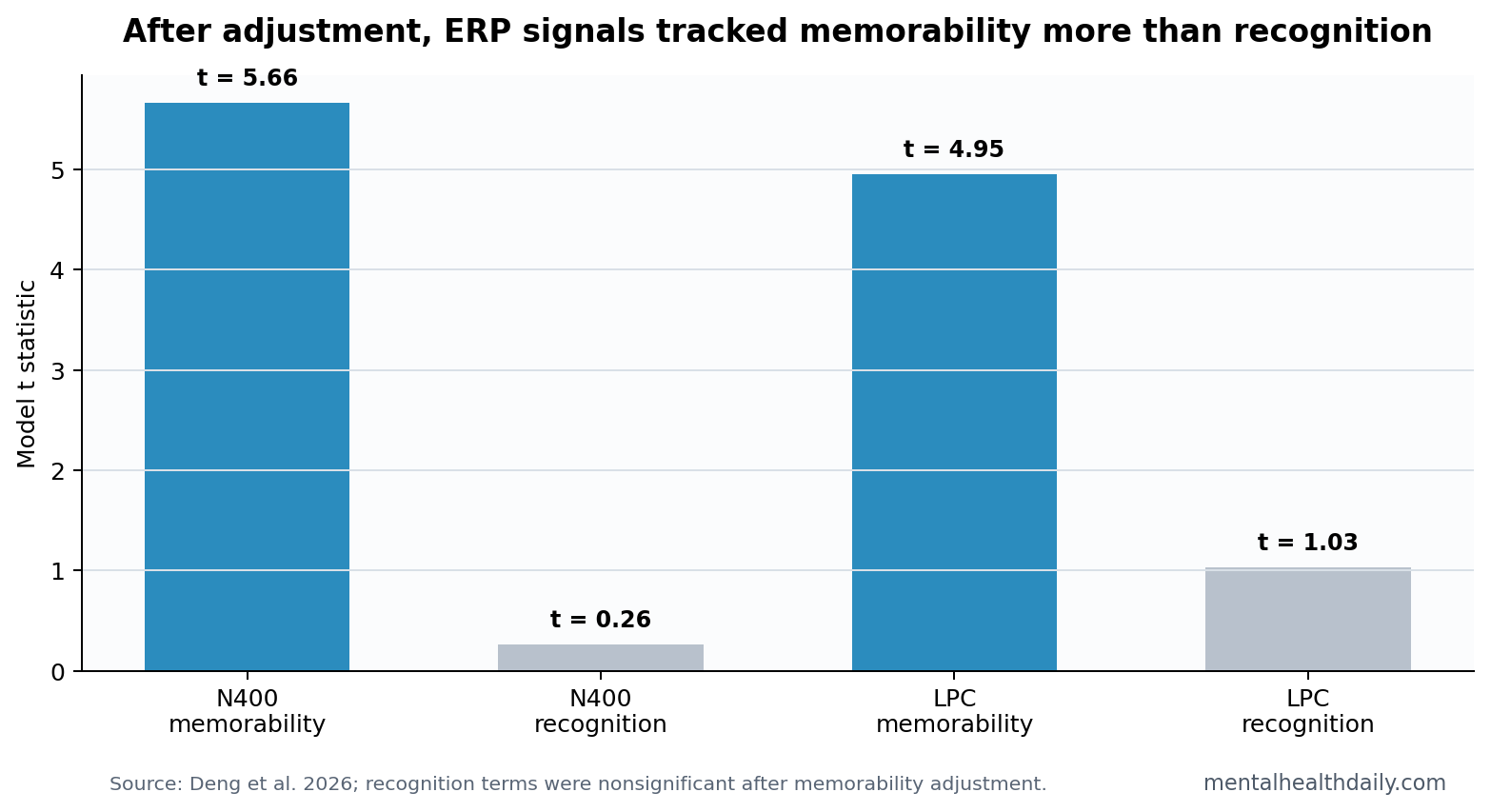
Interpretive consequence: a brain signal during encoding can partly reflect what kind of item was shown, alongside how successfully the participant encoded it. Subsequent-memory effects stay useful when item-level controls are built into the model.
The N400 result is especially useful because N400 is often treated as a meaning-processing signal. Highly memorable images may be easier to label, richer in semantic associations, more visually distinctive, or more congruent with stored knowledge. Any of those properties could reduce N400 negativity during encoding without requiring later recognition success to be the causal driver.
LPC followed the same broad direction. That reduces the chance that the finding is a narrow artifact of 1 time window. The late positive complex often appears in memory and evaluative processing, so the memorability-linked LPC signal suggests that memorable images may carry broader encoding-stage processing advantages.
Older Memorability Work Makes the Result Plausible
Image-memorability research has shown that memorability is a stable stimulus property across observers. Some images are consistently remembered across people.2 ERP memory research also has a long history of separating neural signals at encoding from later recognition outcomes.3
The Deng study connects those literatures. If a later hit is partly driven by the item, then an EEG contrast between hits and misses can overstate the viewer-side encoding explanation.
For experimental design, the fix is straightforward: include item memorability as a predictor, match stimuli across conditions, or use mixed-effects models that account for item-level variance. That does not make the experiment less cognitive. It makes the memory claim more specific.
What the study can support: in image-recognition EEG work, stable stimulus memorability can explain N400 and LPC differences that might otherwise be attributed to later recognition success.
What the study cannot support: image memorability does not explain all memory performance. Verbal learning, emotional memory, autobiographical recall, working memory, sleep-dependent consolidation, and clinical memory impairment involve other mechanisms.
Memory Research Should Model People and Items Together
Psychology often focuses on participant variables: attention, strategy, arousal, fatigue, depression, age, medication, and sleep. Stimulus variables can be just as important. Some words are more concrete, some faces are more distinctive, some scenes are more meaningful, and some images are simply more memorable.
The cleaner model includes both sides. A participant can encode well or poorly, and an item can be easy or hard to remember. When both are modeled together, the researcher can ask which part of the neural signal belongs to the person and which part belongs to the stimulus.
That distinction is relevant beyond laboratory images. Educational materials, safety warnings, medication instructions, and therapy handouts all depend on stimulus design. If a visual is naturally memorable, it may be retained better regardless of the viewer’s effort. If it is visually flat or semantically thin, even attentive viewers may forget it.
The result also matters for neuroimaging and EEG claims about learning. A study can accidentally attribute a brain signal to attention, motivation, or encoding quality when the stimulus set quietly carried the difference. Images with faces, unusual objects, emotional content, or strong scene structure may produce different ERPs because they are richer stimuli.
Design implication: memory experiments should report how items were selected, whether memorability norms were used, and whether item identity entered the statistical model. That is especially important when the conclusion depends on a small hit-vs-miss difference.
The clinical analogy is modest but useful. People with memory concerns often notice that some events or images stick while routine details vanish. That pattern does not prove a disorder or rule one out. It shows that memory performance is always a combination of person, context, and stimulus properties.
For readers, the practical lesson is about interpretation. A brain response during encoding should be read as a mixed signal unless the design separates item memorability from later recognition. Deng et al. supplied that separation and found that memorability carried the N400 and LPC effects more strongly than recognition success.
The result also explains why replications can disagree. If 2 studies use different image sets, the later remembered vs. forgotten contrast may change because the stimulus pool changed. A stronger design either reuses normed stimuli, balances memorability across conditions, or treats item identity as a source of variance instead of background noise.
For cognitive neuroscience, that is a useful constraint. Neural encoding studies are strongest when they model the brain, the person, and the stimulus together. Leaving out any 1 of those 3 pieces can make a clean-looking memory signal less specific than it appears.
The same logic applies to digital learning and health communication. A visual reminder, warning label, or therapy worksheet may succeed because it is designed to be memorable, not because the viewer tried harder. Better stimulus design can therefore reduce the burden placed on attention alone.
Deng et al. did not turn memory into a property of pictures only. They showed that item-level properties can be strong enough to reshape the neural interpretation. That is the calibration: remembered items are partly about the person and partly about what was shown.
Clinical translation should stay modest. N400 shifts in a recognition experiment do not diagnose memory impairment, but they do sharpen how cognitive tests should be built. If a test uses unusually memorable pictures in one condition and forgettable pictures in another, the apparent patient difference can partly reflect stimulus imbalance rather than cognition alone.
Statistical adjustment is the central contribution. Memorable images were remembered more often, and the stronger claim came from putting memorability and recognition into the same model. N400 effects followed memorability after recognition success was considered. That is why the result changes interpretation rather than restating common sense.
Questions About Image Memorability and N400
Does this mean people do not control what they remember?
No. Attention, strategy, sleep, emotion, and learning still matter. The study shows that item properties can contribute to later recognition and encoding ERPs.
Was the N400 really a memory signal?
In this analysis, N400 behaved more like a memorability-linked item signal than a pure later-recognition signal after both predictors entered the model.
Does this apply to clinical memory problems?
Only indirectly. The study used an image-recognition task, not a dementia, traumatic brain injury, or depression-memory cohort.
References
- Deng W, et al. ERP effects at encoding: image memorability and recognition success. Cognitive, Affective, & Behavioral Neuroscience. 2026. doi:10.3758/s13415-026-01427-z
- Isola P, et al. What makes a photograph memorable? Psychological Science. 2014. doi:10.1109/tpami.2013.200
- Paller KA, Kutas M, Mayes AR. Neural correlates of encoding in an incidental learning paradigm. Psychophysiology. 1990. doi:10.1111/j.1469-8986.1990.tb01966.x
- Kutas M, Federmeier KD. Review of meaning-related N400 event-related potential research. Annual Review of Psychology. 2011. doi:10.1146/annurev.psych.093008.131123