hit counter

Cholinergic Modulators Improved Schizophrenia Negative Symptoms

MHD featured image for cholinergic modulators in schizophrenia.

A 30-trial meta-analysis found that cholinergic modulators improved schizophrenia negative symptoms, SMD −0.42, while the overall total PANSS/BPRS effect was not statistically significant.1 The clearest signal came from muscarinic agonists, which makes acetylcholine biology promising but not uniformly positive across every cholinergic drug class. Research Highlights Negative symptoms improved: Cholinergic modulators reduced PANSS-N/SANS negative symptom …

Read more

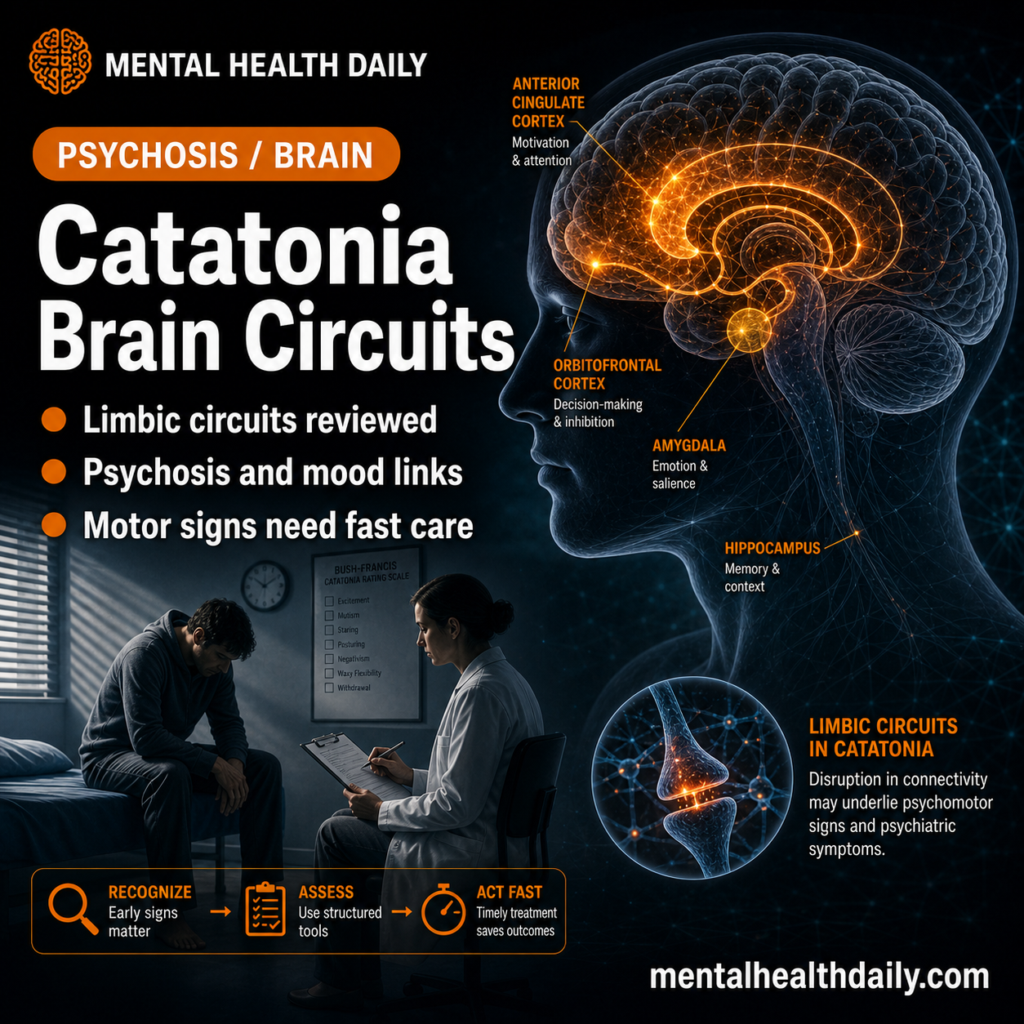
Catatonia Brain Circuits: Limbic System Review

MHD featured image for catatonia, limbic-system brain circuits, and psychomotor shutdown.

A 2026 systematic review argues that catatonia should be read as a limbic-cortical circuit syndrome, with motor shutdown tied to brain systems for threat, salience, motivation, and emotional regulation. Research Highlights 20 studies met criteria: the 2026 review screened 1,792 records, assessed 54 full texts, and included 20 articles: 13 observational studies and 7 case …

Read more

Antipsychotic Dose Was Not Linked to MoCA in Schizophrenia

A 2026 cross-sectional schizophrenia study found no meaningful association between antipsychotic dose and Montreal Cognitive Assessment (MoCA) performance in young, clinically stable outpatients. Cognitive scores related more strongly to symptom burden, illness duration, education, and age at diagnosis than to daily or 1-year cumulative antipsychotic exposure.1 Research Highlights Daily dose was not linked to MoCA: …

Read more

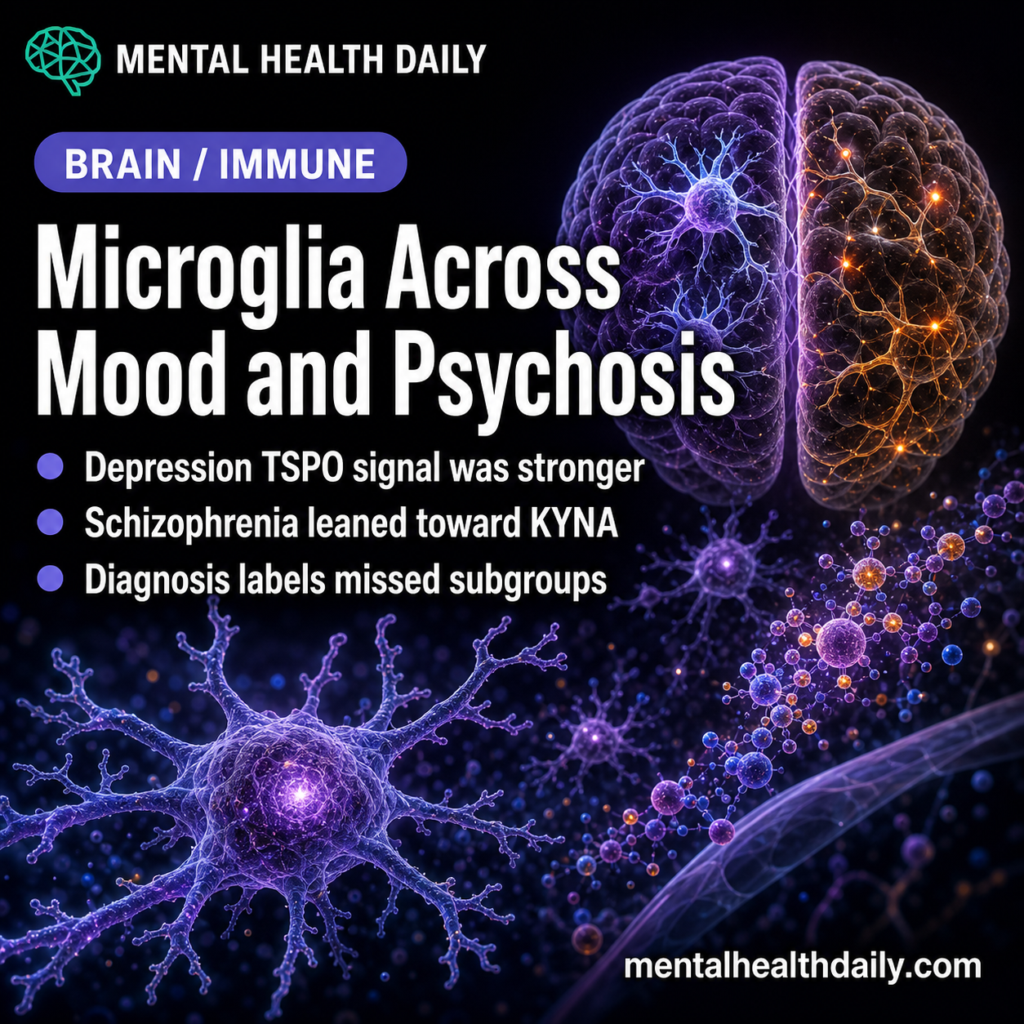
Depression vs. Schizophrenia: Microglial TSPO and KYNA Signals

MHD featured image for microglial and kynurenine pathway patterns across depression, bipolar disorder, and schizophrenia.

A 2026 systematic review found that microglia-related immune signals do not line up cleanly with psychiatric diagnosis labels: major depression showed frontolimbic TSPO-PET increases, while schizophrenia showed elevated kynurenic acid in cerebrospinal fluid.1 The strongest interpretation is that immune-brain markers may sort subgroups better than DSM categories do. Research Highlights Depression had the clearest TSPO-PET …

Read more

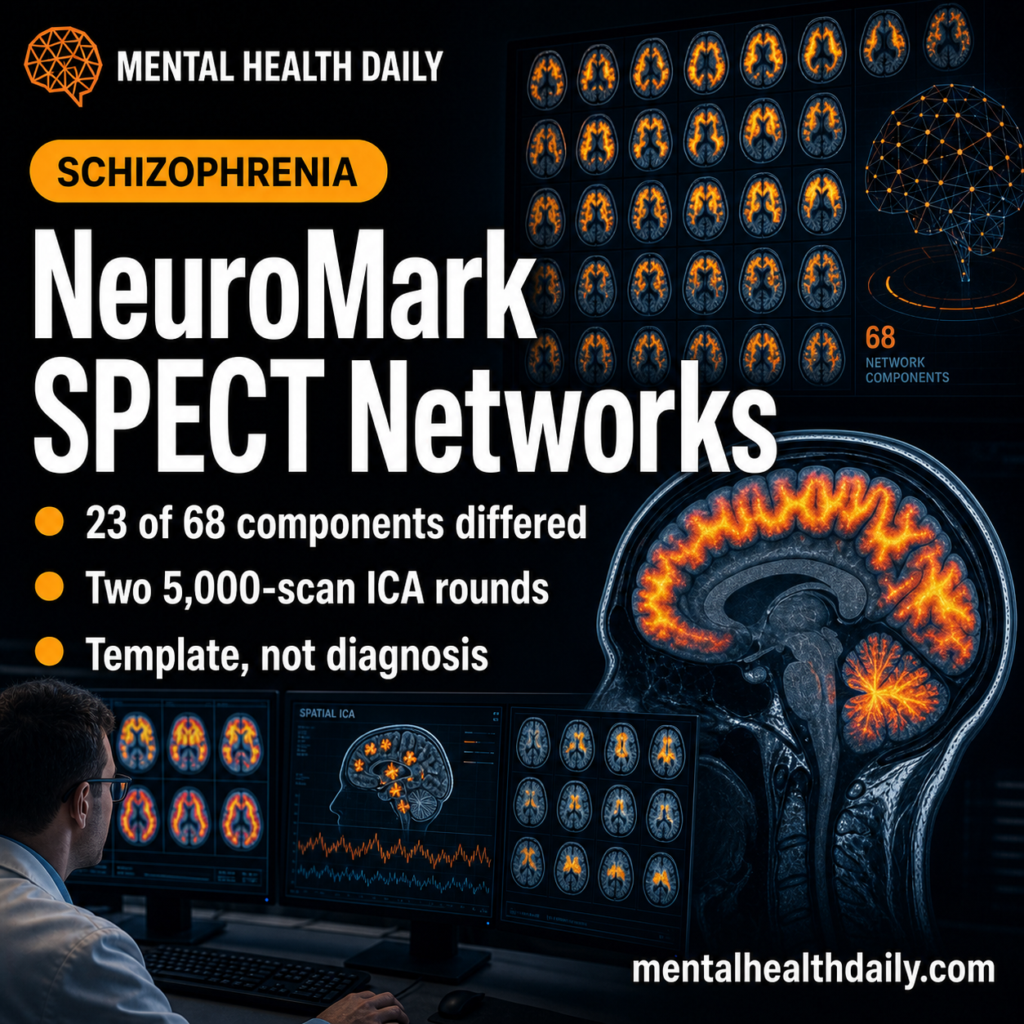
NeuroMark SPECT Found 23 Schizophrenia Perfusion Network Changes

MHD featured image for NeuroMark SPECT schizophrenia perfusion-network research.

A 2026 medRxiv preprint built a reusable NeuroMark SPECT template from 2 large independent component analysis rounds, then applied it to 137 schizophrenia patients and 76 controls; after false-discovery-rate correction, 23 of 68 perfusion components differed between groups.1 Those data support infrastructure for comparing SPECT perfusion networks across datasets, with standalone schizophrenia diagnosis left outside …

Read more

Neonatal Brain MRI Shows Gyri Are Connectivity Hubs by 38-44 Weeks

MHD featured image for neonatal MRI, cortical gyri, sulci, and early brain connectivity.

A 2026 developing Human Connectome Project analysis of 438 full-term neonates found that the newborn cortex already had an adult-like folding hierarchy: gyri connected most strongly to other gyri, sulci connected most weakly to other sulci, and structure-function coupling shifted near 41 to 42 weeks postmenstrual age.1 Research Highlights Gyri were already high-connectivity hubs: across …

Read more

Ethiopia Somali Region Stigma Delayed Mental Health Care

MHD featured image for mental health stigma and care-seeking in Ethiopia's Somali Region.

A 2026 qualitative study from Ethiopia’s Somali Regional State found a harsh care-seeking pattern: mental illness was often recognized only when it looked like visible “madness,” was commonly explained through spiritual causes, and carried stigma severe enough to delay biomedical care.1 Research Highlights 16 interviews shaped the analysis: Warfa et al. interviewed health workers, service …

Read more