Adults with inborn errors of immunity, also called primary immunodeficiency, who cut back social contact to avoid infections reported more depression and anxiety symptoms. A 2026 German clinic study of 143 patients also found that about 1 in 4 people with significant symptoms had never been diagnosed.1
Research Highlights
- Isolation went with higher symptom scores: the more often patients isolated over infection worries, the higher their depression (Spearman ρ = 0.52) and anxiety (ρ = 0.48) scores, both p < 0.001.1
- Permanent isolators scored highest: people who isolated permanently had a median depression score of 13.5 and anxiety score of 11, compared with 3 and 3 among those who never isolated.1
- Isolation was common: 56% of patients said they had isolated themselves because of infection concerns, 11% of all respondents permanently.1
- Symptoms were often missed: 28% had at least moderate depression symptoms and 23% at least moderate anxiety symptoms; 26% of those with significant symptoms had no psychiatric diagnosis or treatment.1
- The link faded after adjustment: once pain, fatigue, sleep problems and psychiatric history were in the model, isolation no longer predicted symptoms on its own (p = 0.236).1
What Are Inborn Errors of Immunity?
Inborn errors of immunity (IEI), long known as primary immunodeficiencies, are genetic conditions in which part of the immune system does not work properly. People with IEI catch infections more easily, and those infections can be more severe, more persistent or caused by germs that rarely trouble other people.1
Many IEI also bring autoimmune disease and chronic inflammation, because the same faulty immune machinery can turn on the body. Treatment ranges from preventive antibiotics and regular immunoglobulin (antibody) infusions to bone marrow transplants in severe cases.1
The most common form in adults is common variable immunodeficiency (CVID), in which the body makes too few working antibodies. CVID accounted for 67% of patients in the German study.1
How the Hannover Study Measured Isolation and Mood
Luca Wolff et al. invited every adult with IEI seen at the immunology outpatient clinic of Hannover Medical School between July 2024 and February 2025. Of 150 people recruited, 143 were included in the analysis.1
- Patients: 88 women and 55 men, average age 45 (range 21 to 85)
- Depression: the PHQ-9, a 9-question screening tool scored 0 to 27; 10 or more signals at least moderate symptoms and possible major depression
- Anxiety: the GAD-7, a 7-question screening tool scored 0 to 21, with the same cutoff of 10
- Isolation: whether patients had isolated themselves because of infection concerns, and how often (never, occasionally or permanently)
- Other factors: 0-to-10 ratings of pain, fatigue and quality of life, sleep problems, and existing psychiatric diagnoses from the chart and patient report
Both questionnaires are screening tools: a high score flags likely depression or anxiety but is not a diagnosis.
Self-Isolation Was Linked to Higher Depression and Anxiety Scores
Of the 140 patients who answered the isolation question, 79 (56%) said they had isolated because of infection worries: 63 occasionally and 16 permanently. The other 61 never had.1
Symptom scores rose step by step with isolation. The correlation between isolation frequency and PHQ-9 score was ρ = 0.52, and with GAD-7 score ρ = 0.48 (both p < 0.001), moderate-to-strong links by usual standards. All 3 groups differed significantly from one another.1
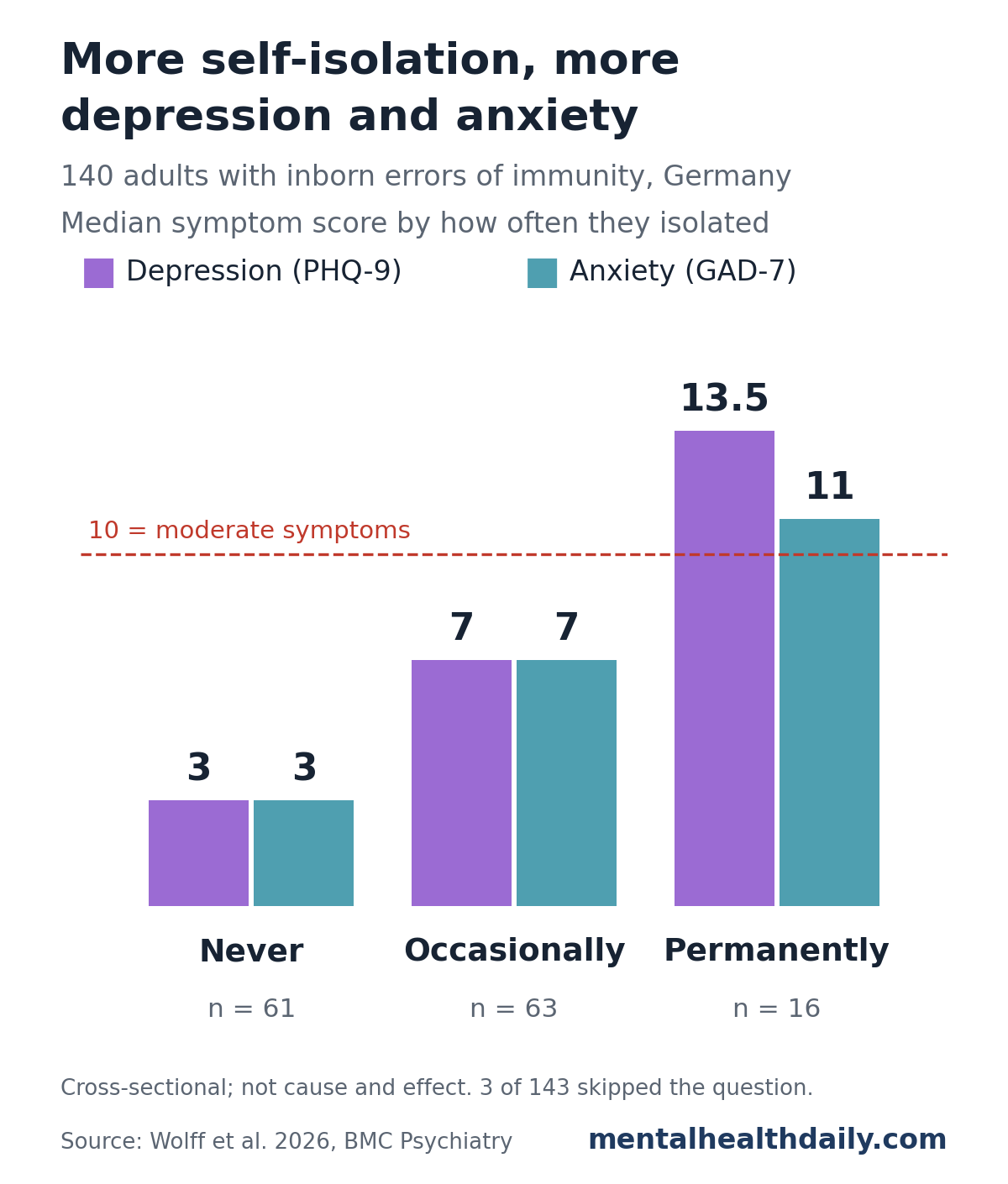
Permanent isolators: a median PHQ-9 of 13.5 sits in the moderate depression range, and a median GAD-7 of 11 in the moderate anxiety range. Patients who never isolated had medians of 3 on both, which is below the threshold for even mild symptoms.1
Who isolated: isolation was more common in patients who felt their infections were poorly controlled and in those with a psychiatric diagnosis before the study. Isolators also reported more pain and fatigue and worse quality of life. Men and women isolated at similar rates.1
Isolation Was Not an Independent Predictor After Adjustment
The researchers then put several factors into one regression model to see which ones predicted symptom scores on their own. For depression, 4 stood out:1
- Fatigue: the strongest single factor; fatigue alone accounted for about half of the variation in PHQ-9 scores
- Sleep problems
- An existing psychiatric diagnosis
- Pain
The same 4 factors predicted anxiety scores. With them in the model, self-isolation no longer added a significant independent link for either depression or anxiety (both p = 0.236), and a simpler model selected by a statistical fit criterion dropped it entirely.1
One sentence in the paper describes isolation as an independent predictor of depression, but the reported regression results show it was not statistically significant once the other factors were included.
What this suggests: isolation, pain, fatigue, poor sleep and low mood tend to come as a package. Isolation may be one part of a broader burden of illness rather than a separate cause. Fatigue also overlaps with depression scoring, since the PHQ-9 itself asks about tiredness and low energy.1
Depression and Anxiety Symptoms Were Common and Often Undiagnosed
Across all 143 patients, the median score was 5 on both questionnaires, the threshold for mild symptoms. Many scored higher:1
- Depression (PHQ-9): 57% had at least mild symptoms, 28% at least moderate, 13% moderately severe or worse
- Anxiety (GAD-7): 53% had at least mild symptoms, 23% at least moderate, 11% severe
About a third of patients (34%) already had a psychiatric diagnosis, mostly depression. Yet 11 of the 40 patients with PHQ-9 scores of 10 or more, and 8 of the 33 with GAD-7 scores of 10 or more, had no known psychiatric condition. Overall, 26% of those with significant symptoms had received neither a diagnosis nor treatment.1
Patients’ and physicians’ views of infection risk often differed. They agreed on whether infections were well controlled 79% of the time, but agreement beyond chance was low (Cohen’s κ = 0.1). Patients who felt poorly protected had higher depression and anxiety scores, while the doctors’ assessment was not linked to distress.1
Other Primary Immunodeficiency Studies Found High Distress and Loneliness
The Hannover results are consistent with other clinic studies of adults with IEI:
- Poland: among 105 adults, 36% had anxiety symptoms on the Hospital Anxiety and Depression Scale, and 13% had severe anxiety. Poor sleep, more frequent pain, younger age and no fixed income went with higher anxiety.2
- Turkey: among 104 adults, average scores pointed to a risk of depression, and loneliness levels were high. Loneliness and difficulty with social adjustment were linked to more anxiety and depression.3
In the general population, social isolation also predicts later depression. In a UK Biobank study of 339,051 adults followed for a median of 12.5 years, people who were socially isolated at the start had a 14% higher risk of developing depression (hazard ratio 1.14), and lonely people a 77% higher risk.4
For people with IEI, isolation is often a deliberate health decision rather than circumstance. That makes the trade-off between infection risk and the mental cost of withdrawal a real clinical question.
Limitations of This Immunodeficiency and Mental Health Study
- Cross-sectional design: isolation and symptoms were measured once, at the same time. Depression and anxiety could drive people to withdraw just as easily as isolation could worsen mood.
- Screening scores, not diagnoses: PHQ-9 and GAD-7 results show symptom levels, not confirmed psychiatric disorders.
- No comparison group: the study had no healthy controls, so it cannot say how much more these patients isolate than other people.
- Small permanent-isolation group: only 16 people isolated permanently.
- Missing context: income, education, employment, living situation and social support were not measured, and actual infection risk was not objectively assessed.
- Post-pandemic timing: data were collected in 2024 and 2025, so some isolation may reflect habits left over from COVID-19 rather than IEI itself.
- One center: most patients had CVID, so results may not apply to rarer or more severe forms of IEI.
Screening for Depression and Anxiety in Primary Immunodeficiency Care
Routine screening: the researchers recommend standard PHQ-9 and GAD-7 screening at diagnosis and follow-up visits, as is already common in other chronic illnesses. In this clinic, about a quarter of patients with significant symptoms had not been recognized before the questionnaires.1
Talking about isolation: they also suggest that doctors discuss each patient’s actual infection risk and help weigh the benefits of limiting contact against the costs of long-term isolation. Current IEI guidelines focus mostly on medical ways to prevent infection.1
For patients: if you have an immune disorder and have pulled back from people for a long time, or if fatigue, pain, poor sleep or low mood are building up, raise it with your immunology team or family doctor. Depression and anxiety are treatable, and your care team can help you judge how much caution your own infection risk calls for.
References
- Wolff LJ, Witte T, Kahl KG, Meinecke A, Ahrenstorf G, Sogkas G, Hillmer S, Thiele T. Frequency of depression and anxiety in patients with inborn errors of immunity: a cross-sectional study. BMC Psychiatry. 2026;26:721. doi:10.1186/s12888-026-08654-1
- Grochowalska K, Ziętkiewicz M, Nowicka-Sauer K, Topolski M, Więsik-Szewczyk E, Matyja-Bednarczyk A, et al. Anxiety in Polish adult patients with inborn errors of immunity: a cross-sectional study. Frontiers in Psychiatry. 2024;15:1293935. doi:10.3389/fpsyt.2024.1293935
- Gumusburun R, Altay S, Cengiz H, Hakverdioglu Yont G, Kuman Tuncel O, Ardeniz O. Psychosocial evaluation of adults with primary immunodeficiency. Journal of Clinical Immunology. 2024. doi:10.1007/s10875-024-01671-3
- Wan L, Zhao Z, Liu B, Zhu J, Jia C, Wang X. Association between loneliness, social isolation and incident depression: a prospective study based on UK Biobank. General Hospital Psychiatry. 2025;96:171–177. doi:10.1016/j.genhosppsych.2025.07.007