Financial burden was the carer problem that most lowered quality of life when 771 Australian adults weighed caregiving situations against years of life. Their choices built the first scoring system for COCOON, a new quality-of-life measure for people caring for someone with dementia.1
Research Highlights
- Money strain counted most: “always” feeling a financial burden took 0.34 off a scale where 1 is the best possible carer situation, the largest loss of any problem. Financial burden accounted for 21.5% of the overall weight.1
- Physical health came next: physical health problems carried 15.4% of the weight, followed by loneliness (14.3%) and feeling unsupported (14.1%).1
- Every problem counted: all 7 parts of the measure carried at least 10% of the weight, so no part of caregiving was treated as trivial.1
- The worst situation scored below zero: a carer who always faced all 7 problems scored −0.70, which the scoring system treats as worse than being dead.1
- Carers agreed on money: respondents who were carers themselves also gave financial burden the most weight.1
What a Value Set Is and Why Dementia Carers Need One
Health funders often compare treatments in quality-adjusted life-years (QALYs). A QALY multiplies years of life by a quality score called a utility, where 1 means full quality of life and 0 means dead. One year at a utility of 0.5 counts as half a QALY.
A questionnaire alone does not give utilities. It needs a value set: a scoring formula that says how much each answer lowers the score, based on what the general public thinks each situation is worth. Without one, a carer’s answers cannot be turned into QALYs.1
This gap has real effects on funding decisions. Dementia treatments and services often change the lives of unpaid family carers as well as patients, but economic evaluations usually count only the patient.
- Alzheimer’s cost studies: a review of 63 cost-utility analyses of Alzheimer’s and dementia interventions found that 70% included some carer effects, mostly unpaid care time. Only 12 counted effects on carers’ health. In 28 of 33 paired cost-effectiveness comparisons from 19 studies (about 85%), including carer effects made the intervention look more cost-effective or kept it cost saving.4
- Expert guidance: an international task force on family and carer “spillover” effects reported in 2024 that leaving them out is still common, and that methods vary widely when they are included.5
Common measures such as the EQ-5D often miss what caregiving takes from people, and carer-specific tools such as the CarerQol are not scored on the 0-to-1 scale that QALYs need.1,2
The COCOON measure (incorporating Carer Outcomes in COst-effectiveness analyses Of dementia iNterventions) was built to fill that gap. Its developers cut 60 candidate questions to 7, using interviews and surveys with dementia carers and an advisory group.2
How 771 Australian Adults Valued Caregiving Situations
Each COCOON item asks how often a carer has a problem, from “never” through “once in a while,” “sometimes” and “often” to “always”:1
- You feel emotionally exhausted
- You feel a sense of loss and grief
- You feel a loss of freedom
- You feel lonely
- You have problems with your physical health
- You feel unsupported
- You experience financial burden
Lidia Engel et al. at Monash and Deakin universities used a discrete choice experiment with duration. In each task, respondents saw 2 caregiving situations, each with a set number of years to live in it (1, 4, 7 or 10) before dying, and picked the one they preferred.1
Each person answered 10 of these choices. How often people gave up years of life to avoid a problem shows how much that problem is worth on the 0-to-1 scale. The tasks did not mention dementia, so respondents judged the caregiving problems themselves.1
Sample: 1,087 adults from an online panel completed the survey in April and May 2024, and 771 passed the quality checks. The largest group excluded, 262 people, chose a situation with every problem at its worst and only 1 year of life over one with no problems and 10 years.1
The final group matched Australia closely on age, sex, state and education. Their average age was 49, and 38% described themselves as informal carers.1
Financial Burden Was the Costliest Carer Problem
The finished value set gives a deduction for each level of each problem. At the “always” level, the deductions were:1
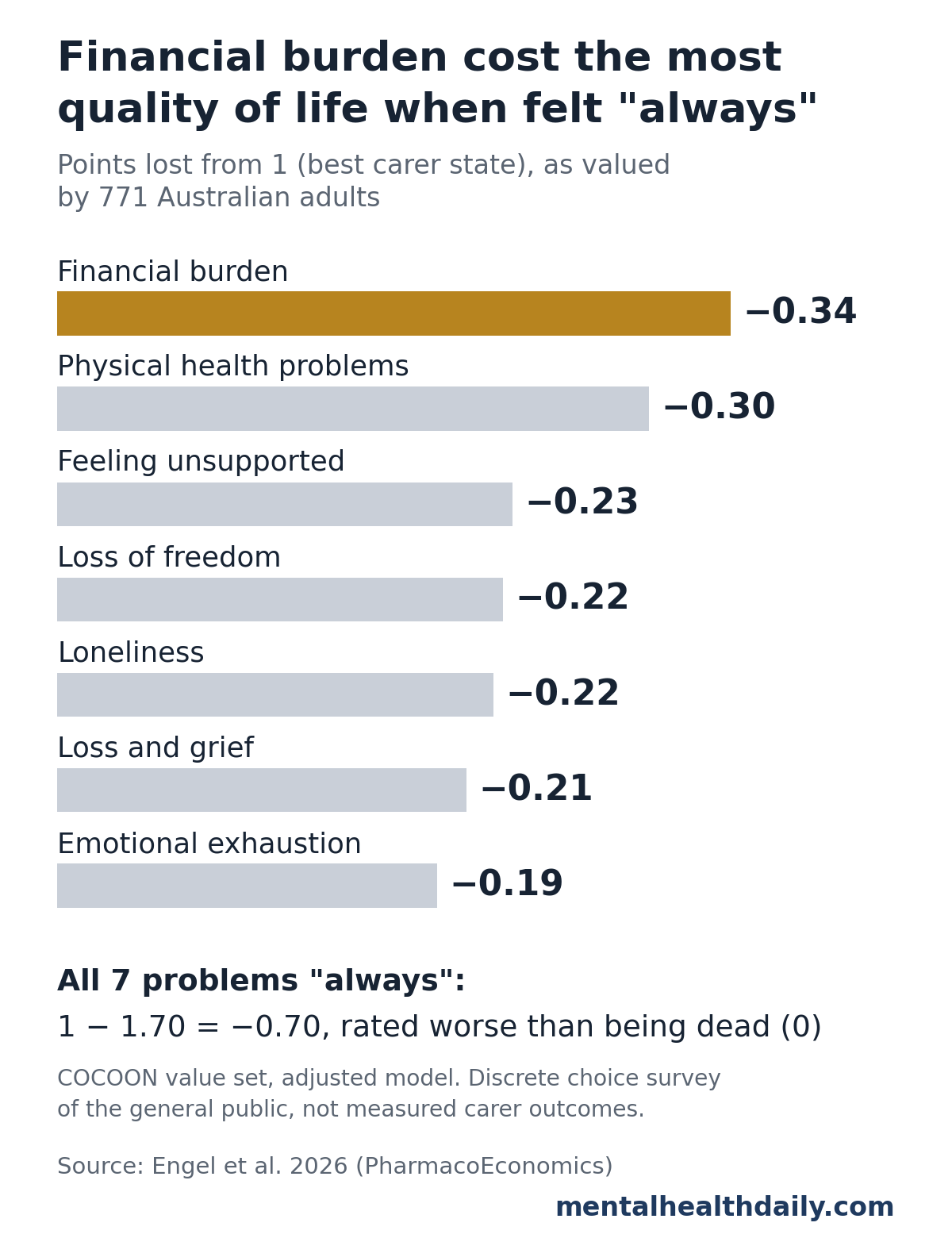
- Financial burden: 0.34
- Physical health problems: 0.30
- Feeling unsupported: 0.23
- Loss of freedom: 0.22
- Loneliness: 0.22
- Loss and grief: 0.21
- Emotional exhaustion: 0.19
Below the top 2, the problems were close together. The researchers’ importance measure, which looks at each problem’s whole range of levels, put loneliness (14.3%) just ahead of support (14.1%), with loss and grief lowest at 10.2%.1
Money was a surprise: the researchers called the size of the financial burden effect “unanticipated.” The drop was steep once money problems became frequent: “often” already cost 0.21, versus 0.05 for “sometimes.”1
Smoothing the results: in the first statistical model, a few milder levels came out slightly better than the levels below them, such as “once in a while” lonely scoring higher than “never.” A scoring formula cannot reward a worse answer, so the team merged those neighboring levels. The merged model kept the same overall pattern.1
Why a Carer Situation Can Score Below Zero
A carer’s score is 1 minus the deductions for each answer. Someone who sometimes feels emotionally exhausted, once in a while feels grief, often feels a loss of freedom and always feels lonely, with no other problems, scores 0.57.1
When every problem is at “always,” the deductions add up to 1.70, so the score is −0.70. On the QALY scale, a negative value means people’s choices treated more years in that situation as worse than fewer years. In other words, the situation was valued as worse than being dead.1
Value sets for other quality-of-life measures also include states below zero. The negative score marks how severe the worst caregiving situations look to the public; it is a valuation, not a statement about any real carer’s life.
Real carers scored much higher: applied to the 296 respondents who were carers, the value set gave an average of 0.66. Individual scores still spanned the full range, from −0.70 to 1.1
Carers and Non-Carers Both Gave Money the Most Weight
The general public, not carers, normally sets these values, because public money pays for the services being compared. That raises a fair question: do non-carers misjudge what caregiving is like?
Breakdowns by carer status and income showed only small differences:1
- Carers: financial burden still came first (20%, vs. 23% among non-carers). Carers gave somewhat more weight to grief, physical health and support.
- Lower-income respondents: financial burden carried 25% of the weight, vs. 19% for higher-income respondents.
- Full sample: rerunning the analysis with all 1,087 respondents again put financial burden first and grief last.
The researchers suggest grief ranked lowest because it is hard to imagine without living through it. Many dementia carers grieve long before their relative dies.1
Another carer measure ranked things differently: Australian values for the CarerQol, another carer quality-of-life measure, put physical and mental health problems at the top, with financial problems third. Physical health problems were the strongest factor in all 5 countries in that study.1,3
Limitations of the COCOON Value Set Study
- Hypothetical choices: respondents rated imagined situations, not their own lives. Most said the tasks were not very hard and that they used all the information, but 10% to 15% found parts of them very difficult.
- Many exclusions: 316 of 1,087 respondents were dropped for low-quality answers, a common problem with online panels.
- Who answered: people with limited internet access, less education or culturally and linguistically diverse backgrounds were likely under-represented.
- Broad carer label: 38% called themselves carers, vs. about 12% of Australians, and half of them gave fewer than 10 hours of care a week.
- No dementia framing: the tasks did not mention dementia, and values might differ if they had. Whether COCOON fits carers of people with other conditions is untested.
- Financial support not described: the survey did not explain Australia’s carer payments, which may have shaped how bad financial strain sounded.
- Australia only: other countries will need their own translations and value sets.
Health economists also still debate whether a QALY gained by a carer should count the same as one gained by a patient.1
What the COCOON Value Set Means for Dementia Care Funding
Carer benefits can now be counted: with this value set, a trial of a dementia drug, respite program or carer support service can report how much it changed carers’ quality of life in QALYs, on the same scale funders already use.1
A program that helps both the person with dementia and the carer would get credit for both.1
Money support deserves attention: because financial strain carries the largest weight, services that ease carers’ costs or lost income would show up strongly in COCOON scores. Physical health, loneliness and support each add meaningful weight too.1
For carers themselves, the findings line up with a common experience: the practical strain of caregiving, including money and health, weighs heavily alongside the emotional toll. Dementia Australia and similar organizations can point carers to financial supports and respite services.
References
- Engel L, Mihalopoulos C, McCaffrey N, Thai T. Developing an Australian value set for the COCOON carer quality-of-life measure for use in economic evaluations. PharmacoEconomics. 2026. doi:10.1007/s40273-026-01670-9
- Engel L, Dow B, Muldowney A, et al. Developing a quality-of-life measure for carers of people with dementia for use in economic evaluations: results from the COCOON project. PharmacoEconomics. 2026. doi:10.1007/s40273-026-01657-6
- Hoefman RJ, van Exel J, Brouwer WBF. Measuring care-related quality of life of caregivers for use in economic evaluations: CarerQol tariffs for Australia, Germany, Sweden, UK, and US. PharmacoEconomics. 2017;35(4):469–478. doi:10.1007/s40273-016-0477-x
- Lin PJ, D’Cruz B, Leech AA, et al. Family and caregiver spillover effects in cost-utility analyses of Alzheimer’s disease interventions. PharmacoEconomics. 2019;37(4):597–608. doi:10.1007/s40273-019-00788-3
- Henry E, Al-Janabi H, Brouwer W, et al. Recommendations for emerging good practice and future research in relation to family and caregiver health spillovers in health economic evaluations: a report of the SHEER Task Force. PharmacoEconomics. 2024;42(3):343–362. doi:10.1007/s40273-023-01321-3