High-school students in Vietnam who slept worse reported slightly lower grades, according to a 2026 survey of 541 students in Grades 10 and 11. Shorter sleep carried most of that link, which shrank once fatigue and motivation were taken into account.1
Research Highlights
- A small link between sleep and grades: worse sleep scores went with lower self-reported grades (canonical correlation r = 0.20, permutation p = 0.011). The combined sleep and grade scores shared about 4% of their variation.1
- Short sleep did most of the work: of 7 sleep measures, sleep duration, daytime dysfunction and sleep-medication use carried the link, and it showed up in grade point average (GPA) rather than in students’ own rating of how they were doing.1
- Fatigue and motivation explained part of it: with both added to the analysis, the correlation fell to 0.15 and was no longer statistically significant (p = 0.167).1
- Grade level changed the pattern: short sleep was linked to lower GPA in Grade 11 but not Grade 10, while daytime dysfunction was linked to lower GPA in Grade 10 but not Grade 11.1
- Consistent with earlier research: a meta-analysis of children and teens found small but reliable links between sleep quality, sleep duration, sleepiness and school performance.2
How the Vietnam Study Measured Teen Sleep and Grades
Trang Le et al. surveyed students at 4 high schools: 2 in urban Hanoi and 2 in rural Hung Yen province. Of 750 students approached, 639 took part with parental consent, and 541 had complete answers for the analysis. Grade 12 was left out because students that year are busy with college entrance exams.1
- Sleep: a Vietnamese version of the Pittsburgh Sleep Quality Index (PSQI)
- Grades: self-reported GPA overall and in math, literature and a foreign language, plus a 4-point self-rating from unsatisfactory to excellent
- Possible explanations: the Chalder Fatigue Scale and the Academic Motivation Scale (motivation from inside the student and from parents and teachers)
The PSQI is a widely used questionnaire about the past month of sleep. It scores 7 components from 0 (no problem) to 3 (severe problem):
- Subjective sleep quality: how well the person thinks they slept
- Sleep latency: how long it takes to fall asleep
- Sleep duration: how many hours of actual sleep
- Sleep efficiency: the share of time in bed spent asleep
- Sleep disturbance: waking for the bathroom, breathing trouble and similar disruptions
- Sleep medication use: prescription or over-the-counter
- Daytime dysfunction: trouble staying awake and low enthusiasm for getting things done
Sleep problems were common. 68% of students usually took more than 15 minutes to fall asleep, 59% reported some daytime dysfunction, about half had at least some shortfall in sleep duration, and 8% reported using sleep medication.1
To relate all 7 sleep scores to both grade measures at once, the researchers used canonical correlation analysis. It finds the weighted mix of sleep scores and the weighted mix of grade scores that line up most closely, then reports how strongly those 2 mixes correlate. The weights show which individual scores drive the link.
Shorter Sleep Was Most Closely Linked to Lower GPA
The first canonical correlation was r = 0.20. Because the data were not normally distributed, the team confirmed it with a permutation test (reshuffling the data 9,999 times), which gave p = 0.0108. A second, weaker pattern (r = 0.11) was not significant, so a single dimension linked sleep and school performance.1
Effect size: an r of 0.20 is small. The sleep and grade composites shared about 4% of their variation, so the other 96% came from everything else that shapes a teenager’s grades.1
Using a cutoff of 0.40 for a meaningful weight, 3 sleep components stood out:
- Sleep duration (0.68): students who reported less sleep reported lower grades.
- Sleep medication use (0.50): more use went with lower grades.
- Daytime dysfunction (0.47): more daytime sleepiness and low drive went with lower grades.
Time to fall asleep, sleep efficiency, nighttime disturbances and overall sleep-quality ratings all had weights below the cutoff. On the grades side, self-reported GPA carried the link (weight −0.74), while students’ own rating of their performance fell below the cutoff.1
Sleep medication: fewer than 10% of students used it. The researchers suggest that students with the most severe sleep problems were the most likely to take something, so this result may reflect worse sleep rather than a direct effect of the medication. It needs confirmation in a larger group of users.1
Fatigue and Motivation Explained Part of the Sleep-Grades Link
The researchers then added fatigue and motivation to the analysis, one at a time and then together. Each one alone shrank the correlation a little but left it significant. With both included, it fell by 25%, to 0.15, and was no longer significant.1
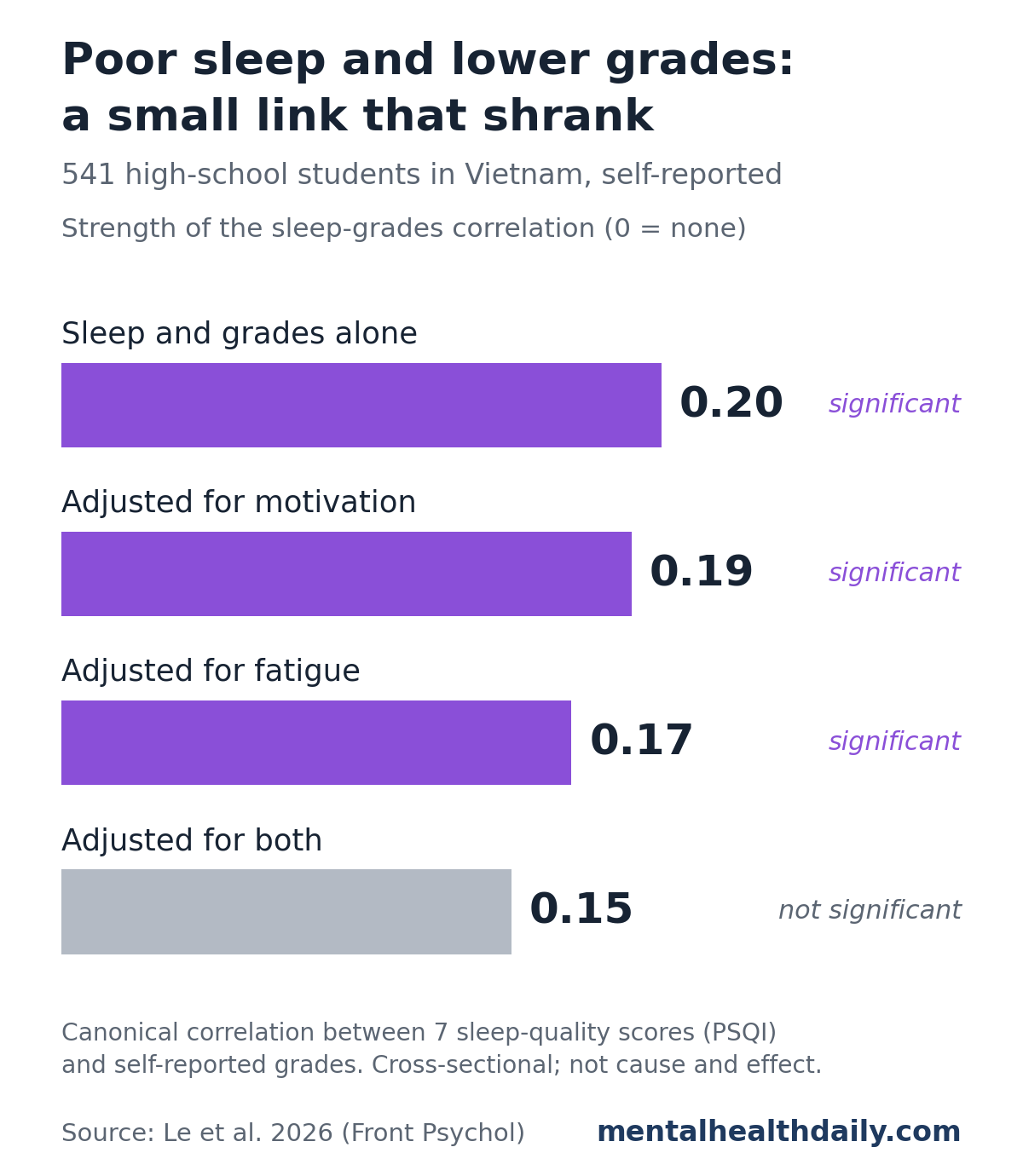
This pattern fits a plausible chain: short or poor sleep leaves students tired and less driven, and tired, unmotivated students study and perform less well. A one-time survey cannot confirm the order of those steps, and the researchers describe fatigue and motivation as possible statistical explanations that need long-term follow-up.1
Short Sleep Mattered in Grade 11, Daytime Tiredness in Grade 10
The team also tested whether the link differed by gender or grade. Gender made no difference. Grade did:1
- Grade 10: daytime dysfunction was linked to lower GPA (β = −0.24, p = 0.0007), but sleep duration was not.
- Grade 11: shorter sleep was linked to lower GPA (β = −0.21, p = 0.0003), but daytime dysfunction was not.
In Vietnam, Grade 10 is mostly about adjusting to high school, while Grade 11 brings heavy preparation for college applications and exams. The researchers suggest that Grade 11 students may push through tiredness to keep studying, while short sleep still weakens memory and focus in ways determination cannot fully offset. That explanation is untested.1
Earlier Research Also Links Teen Sleep to School Performance
The Vietnam result is consistent with a larger body of work. A 2010 meta-analysis pooled studies of children and adolescents and found that all 3 sleep measures were related to school performance, each modestly:2
- Sleepiness: r = −0.133
- Sleep quality: r = 0.096
- Sleep duration: r = 0.069
The Vietnam figure of 0.20 is somewhat higher, partly because canonical correlation combines several sleep scores into the best-fitting mix rather than testing one measure at a time.
Other studies point the same way:
- Sweden: among 15- to 17-year-olds, insomnia was linked to higher odds of failing a school course (odds ratio 1.47).3
- Long-term studies: a 2023 systematic review of 25 longitudinal studies found that poor sleep quality and sleep disturbances predicted later drops in school engagement and performance, and that school stress, burnout and early start times in turn worsened sleep over time.4
That 2-way relationship is why a single survey like this one cannot say whether poor sleep lowers grades, poor grades disrupt sleep, or both.
Limitations of This Vietnamese Sleep and Grades Survey
- Cross-sectional design: sleep and grades were measured at the same time, so the study shows a link, not cause and effect.
- Self-reported grades: GPA came from students, not school records. Students’ own performance ratings did not carry the link, which argues somewhat against a simple negative-reporting bias.
- Missing context: school and classroom were not recorded, so clustering could not be accounted for, and family income and other socioeconomic factors were not measured.
- Questionnaire, not diagnosis: the PSQI measures sleep quality and insomnia symptoms; it does not diagnose insomnia disorder.
- One country, 2 grades: results come from 4 schools in northern Vietnam, where academic achievement is strongly emphasized.
What This Means for Teen Sleep and School
Sleep duration is the target to watch. Of all the sleep problems measured, getting too little sleep had the clearest link to lower grades, especially in the higher-pressure Grade 11 year. The researchers suggest testing sleep extension therapy, a behavioral approach that gradually lengthens time in bed to increase total sleep, in trials with school outcomes.1
Expect a small payoff on grades. Even if sleep does affect grades directly, the link here was small, and ability, prior achievement and other factors matter much more. The researchers argue that small effects can still add up over several school years when the factor is changeable.1
Tiredness and motivation are worth noticing. A teen who is short on sleep and also worn out or unmotivated fits the pattern this study described. Persistent trouble falling or staying asleep, or daytime sleepiness that interferes with school, is worth raising with a doctor.
References
- Le T, Weiss B, Phuong DTL, Linh HT, Tung NX. Relations between sleep quality and academic performance among Vietnamese high-school students. Frontiers in Psychology. 2026;17:1848504. doi:10.3389/fpsyg.2026.1848504
- Dewald JF, Meijer AM, Oort FJ, Kerkhof GA, Bögels SM. The influence of sleep quality, sleep duration and sleepiness on school performance in children and adolescents: a meta-analytic review. Sleep Medicine Reviews. 2010;14(3):179–189. doi:10.1016/j.smrv.2009.10.004
- Hedin G, Norell-Clarke A, Hagell P, Tønnesen H, Westergren A, Garmy P. Insomnia in relation to academic performance, self-reported health, physical activity, and substance use among adolescents. International Journal of Environmental Research and Public Health. 2020;17(17):6433. doi:10.3390/ijerph17176433
- Bacaro V, Carpentier L, Crocetti E. Sleep well, study well: a systematic review of longitudinal studies on the interplay between sleep and school experience in adolescence. International Journal of Environmental Research and Public Health. 2023;20(6):4829. doi:10.3390/ijerph20064829