Chinese college freshmen from homes with stricter parenting and more family conflict sensed more anxiety in their parents about their education, according to a 2026 survey of 646 students. Higher resilience was linked to sensing less of it, and strict parenting showed the strongest link of all.1
Research Highlights
- Family conflict and resilience pulled in opposite directions: more conflict at home went with higher scores for perceived parental educational anxiety (β = 0.136), and higher resilience went with lower scores (β = −0.138), after accounting for each other and for family background.1
- Strict parenting had the strongest link: authoritarian parenting carried the largest coefficient in the final model (β = 0.274). Students who described their parents that way had a median score of 52.5 out of 80, compared with 37.5 for students with democratic parents.1
- Family closeness dropped out: contrary to the researchers’ prediction, family cohesion was no longer significant once conflict, parenting style and resilience were in the model.1
- A new 16-item questionnaire held up well: it gave consistent answers within a sitting (Cronbach’s α = 0.922) and over 6 weeks (ICC = 0.825).1
- Typical scores were moderate: the median was 40 on a 16–80 scale, or 2.5 per item on a scale from 1 (never) to 5 (always).1
What Parental Educational Anxiety Means for Students
Parental educational anxiety is the ongoing worry, tension and sense of urgency parents feel about how their child is doing in school and where that schooling will lead. In China, intense competition for school places and jobs has made it common enough that the government’s 2021 “Double Reduction” policy aimed partly at easing it.1
Most research on this worry asks parents to rate themselves. Children, though, react to what they see and hear, and their view of a parent’s mood often differs from the parent’s own report.1
Laiju Du et al. at the Army Medical University in Chongqing set out to measure the child’s side: how much educational anxiety students perceived in their parents while growing up.
How the Perceived Parental School Anxiety Questionnaire Works
The researchers started with a 16-item questionnaire written for parents and rewrote each item from the child’s point of view, so “I feel anxious” became “My parents feel anxious.” Students rated each item from 1 (never) to 5 (always), for a total of 16 to 80.1
The items cover 3 kinds of parental worry:
- Academic performance: anxiety about grades and test results (9 items)
- Competitive environment: anxiety about how the child stacks up against other students (4 items)
- Educational efficacy: parents’ doubts about whether they are guiding their child’s education well (3 items)
Freshmen were chosen because they had just finished 12 years of school, so they could look back over the whole stretch. All participants were first-year students at 2 universities in Chongqing who reported no current or past mental disorder, substance abuse or serious physical illness.1
Testing the questionnaire
The researchers tested the rewritten questionnaire in 2 separate groups of freshmen:
- 232 students: the answers sorted into the same 3 groups as the parent version, which together explained 63% of the variation in responses.
- 287 students: the 3-part structure fit acceptably after one adjustment for 2 similarly worded items. Scores were consistent across items (α = 0.922), and 156 students who retook it 6 weeks later gave similar answers (ICC = 0.825, where 1 is perfect agreement).
- Men and women: the questionnaire worked the same way for both, so their scores can be compared directly.
Scores also lined up with related measures. Students who sensed more parental school anxiety rated their own general anxiety higher (r = 0.291) and described their parents as more rejecting, more overprotective and less warm.1
Strict Parenting and Family Conflict Linked to Higher Scores
A third group of 646 freshmen filled out the questionnaire alongside measures of family life and resilience. Their median score was 40, with the middle half falling between 32 and 49.1
Several groups scored higher than others:
- Parenting style: authoritarian 52.5, indulgent 42, democratic 37.5, permissive 33
- Who oversaw schoolwork: mother 42, both parents 42, father 40, neither 34
- Family situation: divorced parents 44 vs. 38; only children 42 vs. 38
- Gender: men 42 vs. women 37
Parents’ education level and family income made no difference.1
The final model
To sort out which factors mattered independently, the researchers used hierarchical regression, a method that adds groups of factors in steps and checks how much each step explains. Background details came first, then family factors, then resilience.1
The results are shown as standardized coefficients (β), which put every factor on the same scale. A bigger number means a stronger link, and a minus sign means the factor went with lower scores.
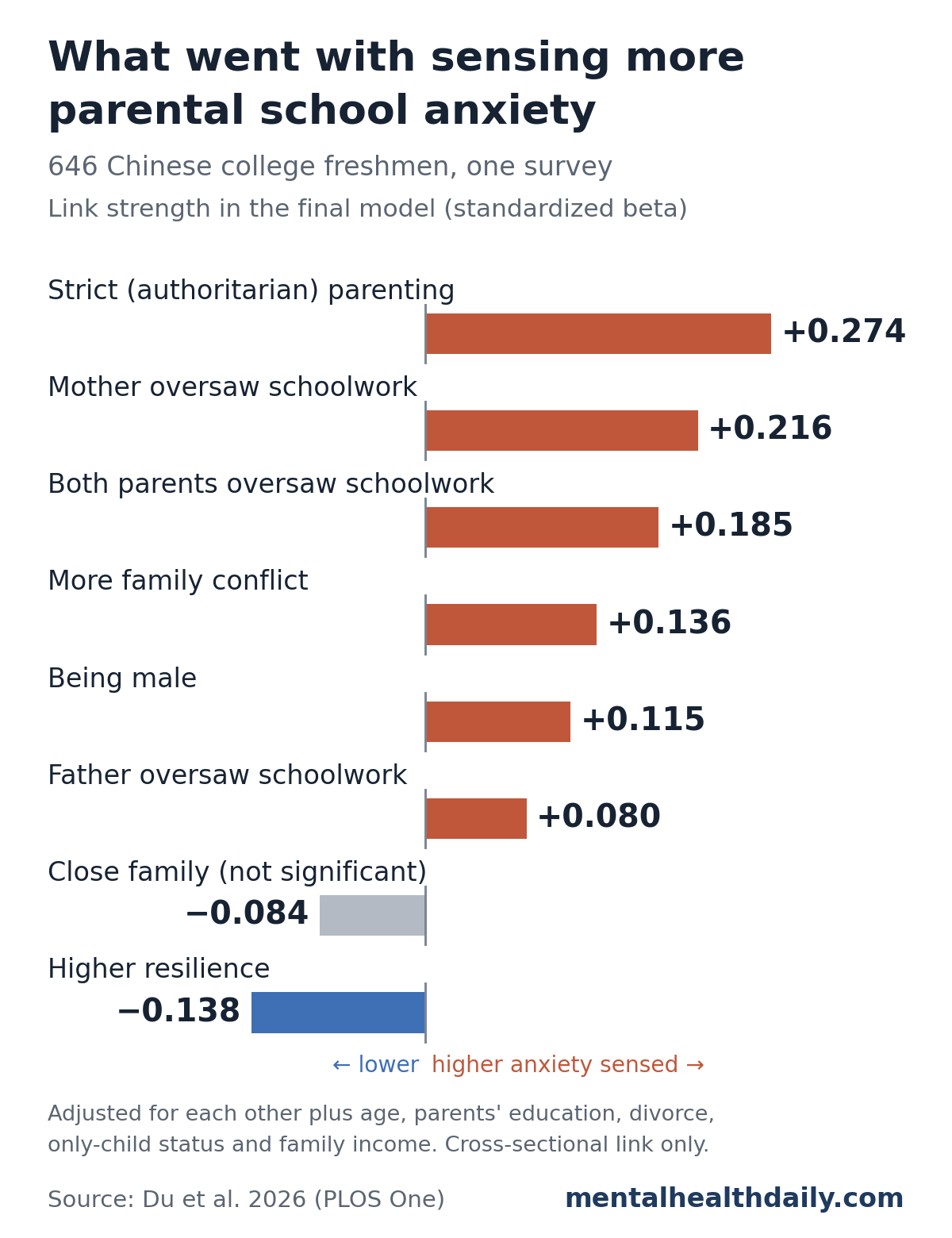
Family factors did most of the explaining. Together the model accounted for 24% of the differences between students. Family factors added 20.1 percentage points of that, background details 2.6 and resilience 1.5.1
Family conflict here means how often family members argue and express anger, measured with the Family Environment Scale. It stayed linked to higher scores even after parenting style and resilience were counted.
Resilience, measured with the Connor-Davidson Resilience Scale, is a person’s capacity to cope with stress and recover from setbacks. Students who scored higher on it sensed less educational anxiety in their parents.
Family Closeness Did Not Hold Up in the Final Model
The researchers predicted that close, supportive families, which the scale calls family cohesion, would go with lower scores. On its own, cohesion did (r = −0.242). But once conflict, parenting style and resilience were in the model, its link shrank to β = −0.084 and was no longer significant.1
The researchers suggest cohesion overlaps with stronger factors such as conflict and authoritarian parenting. In practice, how much a family argues and how strictly parents run things seem to say more about a student’s sense of parental school anxiety than how close the family feels.
Why Conflict and Resilience Could Shape What Students Sense
The researchers offer 2 explanations for the family conflict link:1
- Parents feel more anxious: conflict at home raises parents’ own stress, which can spill into how they handle schoolwork.
- Children watch more closely: conflict leaves children feeling less secure, so they stay alert to signs of a parent’s worry.
The second idea comes from emotional security theory, which holds that children exposed to frequent family conflict become more watchful for threat. Research built on that theory links inter-parental and parent–child conflict with children’s emotional, behavioral, social and school problems.2
For resilience, the researchers point to reappraisal: resilient students may read a parent’s pressure as concern for their future rather than as a threat. That is an interpretation, and this survey did not test it.1
Parents’ School Anxiety Is Linked to Children’s Mental Health
Other Chinese studies have connected parental educational anxiety with how children fare:
- Learning anxiety: in a stratified sample of 3,298, parents’ education anxiety correlated with children’s learning anxiety (r = 0.301), with rejecting and overprotective parenting linked to more of it and warm parenting to less.3
- Problem behaviors: among 1,131 adolescents and their parents, parental educational anxiety was weakly but significantly linked to teen problem behaviors, partly through more psychological control and a worse parent–child relationship.4
- Depression: in 1,979 parent–teen pairs, parental educational anxiety was linked to teen depressive symptoms (β = 0.304), and the link was weaker in teens with higher resilience.5
That last finding fits with the 2026 survey’s resilience result from a different angle. The depression and problem-behavior studies were cross-sectional, so they show links, not cause and effect.
The new questionnaire adds the child’s own view to this research. Students’ median item score of 2.50 was lower than averages reported by parents in earlier studies, which hints that children may sense less anxiety than parents feel. The researchers did not survey parents, so that gap is a rough comparison, not a tested result.1
Limitations of This Chinese Freshman Survey
- One-time survey: everything was measured at once, so the study cannot show whether family conflict raises perceived anxiety, anxious parents create conflict, or both.
- Looking back: students rated their parents over 12 years of school, and current mood or the current parent–child relationship may color those memories.
- Healthy, uneven sample: students with mental health conditions were excluded, recruitment was by convenience at 2 universities in one city, and 64% of the main sample was male.
- No parent reports: parents were not surveyed, so the study cannot compare what students sensed with what parents actually felt.
- Single questions: parenting style and who oversaw schoolwork were each measured with one question.
- Much left unexplained: the final model accounted for 24% of the differences between students.
What This Means for Families
The home climate shows through. Students who grew up with frequent arguments or rigid, demanding parenting were the ones most likely to describe their parents as anxious about school. Lower-conflict homes and a less authoritarian style are reasonable goals on their own merits.
Resilience went with sensing less pressure. Whether building a student’s resilience would change how they read their parents’ worry has not been tested.
The questionnaire is a research tool. It gives researchers a reliable way to measure the student’s side of parental school anxiety in Chinese freshmen. Its value for screening or for other countries still needs testing.
References
- Du L, Dai Z, Sun X, Liu M, Dai Q. Revision of the perceived parental-educational-anxiety scale and its application among Chinese college freshmen. PLOS One. 2026;21(9):e0358097. doi:10.1371/journal.pone.0358097
- Cummings EM, Schatz JN. Family conflict, emotional security, and child development: translating research findings into a prevention program for community families. Clinical Child and Family Psychology Review. 2012;15(1):14–27. doi:10.1007/s10567-012-0112-0
- Yin X, Zhang H, Chen M. The influence of parents’ education anxiety on children’s learning anxiety: the mediating role of parenting style and the moderating effect of extracurricular tutoring. Frontiers in Psychology. 2024;15:1380363. doi:10.3389/fpsyg.2024.1380363
- Lu F, Wen M, Niu W, Wu X, Zhang C. Parental educational anxiety and adolescent problem behaviors: serial mediation of psychological control and parent-child relationship with gender differences. Acta Psychologica. 2025;259:105348. doi:10.1016/j.actpsy.2025.105348
- Lu Y, Zhao H, Zhu X, et al. How parental educational anxiety fuels adolescent depression: the mediating chain of moral disengagement and negative coping, and the buffering role of psychological resilience. BMC Psychology. 2025;13:1370. doi:10.1186/s40359-025-03718-5