
Mice that only watched another mouse being attacked developed anxiety- and depression-like behavior, but milder and narrower changes than mice that were attacked themselves, according to a 2026 study in male mice.1
Research Highlights
- Both kinds of stress caused social avoidance: after 14 days, attacked mice and witness mice both spent less time near a strange mouse than unstressed controls (both p < 0.001), but attacked mice avoided it more than witnesses did (p = 0.0026).1
- Shared anxiety and despair signs: both groups spent less time in the open arms of a raised maze, waited longer to eat in a new space, and stayed still longer when hung by the tail.1
- Loss of pleasure only after attacks: attacked mice showed less preference for sugar water than controls (p = 0.0379), while witnesses showed no change at all (p = 0.9909).1
- Different brain chemistry: only 11 of 59 altered hippocampal proteins (18.6%) were shared, and the 2 forms of stress shifted inflammation, neurotransmitters and brain energy markers in different ways.1
- Not a simple substitute: the researchers concluded that witnessed defeat is a distinct, milder stressor rather than a stand-in for direct defeat in mouse models of anxiety and depression.1
How Direct and Witnessed Social Defeat Work in Mice
Chronic social defeat stress is one of the most widely used ways to model depression in mice. A smaller C57BL/6 mouse is put in the home cage of a larger, aggressive CD-1 mouse, which attacks it.
After the brief fight, the two live on either side of a clear, perforated divider, so the threat stays in view.2
Repeated over days, this produces a lasting set of changes, most clearly a tendency to avoid other mice.2
Vicarious defeat stress removes the physical attack. A witness mouse sits behind the divider and sees, hears and smells another mouse being defeated, then spends the rest of the day facing the aggressor.
Warren et al. introduced this version in 2013 and found that witness mice also developed depression- and anxiety-like behavior, along with higher levels of the stress hormone corticosterone.3
The witness model became popular for 2 reasons:
- It isolates psychological stress. Any effect cannot come from bites or wounds.4
- It works in more animals. Standard defeat relies on male-on-male territorial aggression, so it is hard to use in females. Iñiguez et al. later showed that female witness mice developed social withdrawal, lower sugar-water preference and more immobility.5
Witnessing violence can be traumatic for people too, which is part of why the model appeals to researchers who study depression and post-traumatic stress.
Whether the 2 mouse models can be swapped for each other is less settled, so Sun et al. compared them side by side across 7 behavior tests and a wide range of hippocampal measures.
How Sun et al. Compared Attacked and Witness Mice
Xin-Ran Sun et al., at the Chinese Academy of Medical Sciences in Beijing, randomly split 68 young adult male C57BL/6N mice into 4 groups of 17.1
- Controls: no stress
- Attacked group: 10 minutes a day of direct attack by a different screened CD-1 aggressor, then 24 hours of sensory contact through the divider
- Witness group: watched the same 10-minute attack on another mouse, then lived across the divider from the aggressor
- Intruder group: the mice that were attacked in front of the witnesses; they were not analyzed
After 14 days, 10 to 12 mice per analyzed group went through 7 behavior tests. Researchers then measured hippocampal proteins, synapse markers, energy and oxidative stress markers, neurotransmitters and inflammation genes. The hippocampus is a brain region involved in memory and emotion that also helps switch off the body’s stress-hormone response.1
Witness Mice Showed Fewer Anxiety and Depression-Like Changes
Both groups developed a core set of stress behaviors compared with controls:1
- Social avoidance: less time near a caged strange mouse (both p < 0.001)
- Anxiety in a raised maze: less time on the exposed open arms (witnesses p = 0.0246; attacked p = 0.0001)
- Hesitation to eat: after a day without food, both groups took longer to start eating in a new, open arena (witnesses p = 0.0138; attacked p = 0.0110)
- Behavioral despair: more time motionless when suspended by the tail (witnesses p = 0.0092; attacked p = 0.0001)
Attacked mice went further. They avoided the strange mouse more than witnesses did (p = 0.0026), and they also showed anxiety in 2 tests where witnesses looked normal: a light/dark box and the center of an open field.1
Anhedonia, the loss of interest in pleasurable things, gave the clearest split. Mice usually prefer sugar water to plain water. Attacked mice lost some of that preference (p = 0.0379 vs. controls), while witnesses were indistinguishable from controls (p = 0.9909) and kept a higher preference than attacked mice (p = 0.0466).1
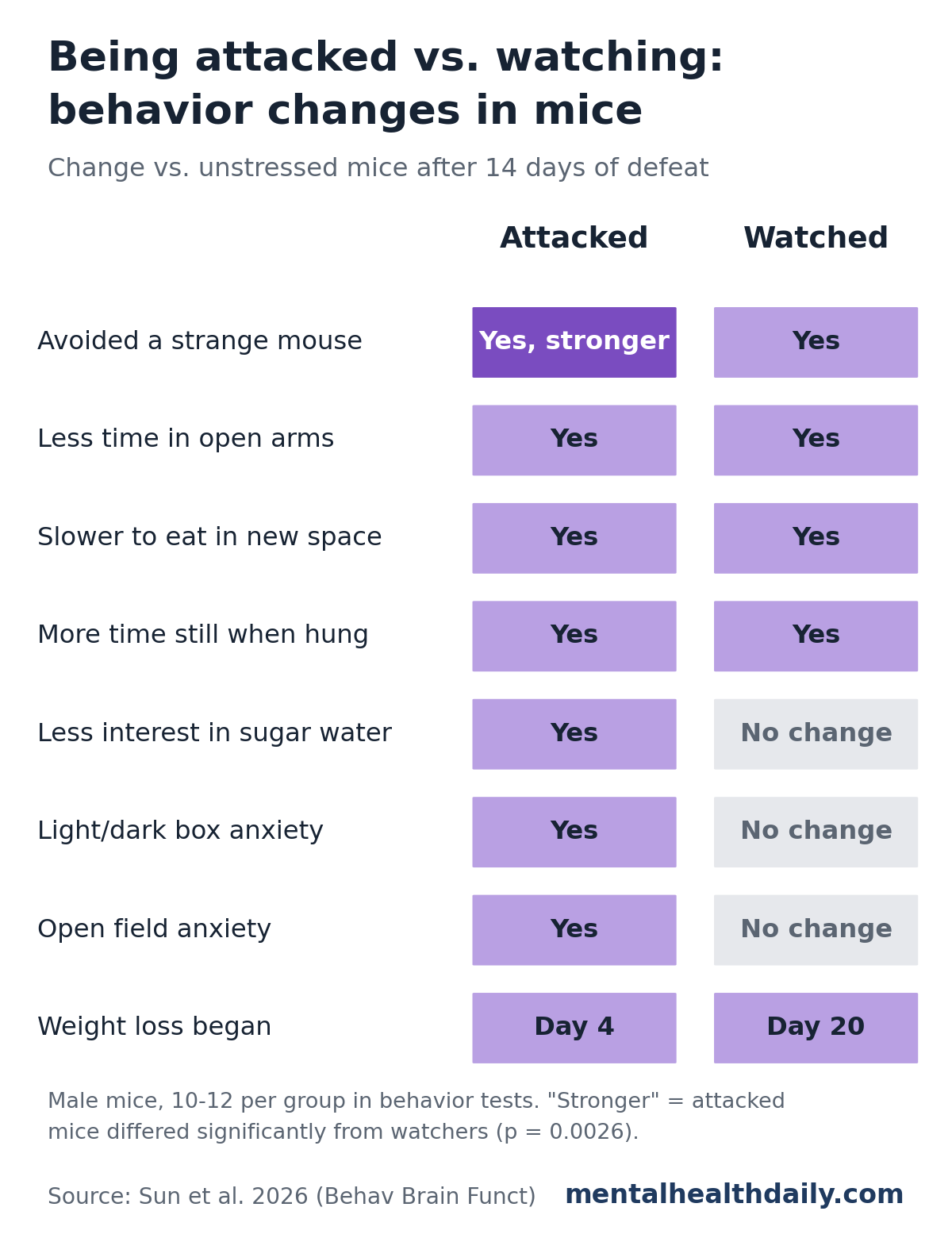
Body weight and spleen: attacked mice began losing weight on day 4, witnesses not until day 20, even though food intake did not differ. Both groups had enlarged spleens, a sign of immune activation, with no significant difference between them (p = 0.1119).1
Only 18.6% of Hippocampal Protein Changes Overlapped
Using label-free proteomics, a mass-spectrometry method that measures the levels of hundreds of proteins at once, the team analyzed 953 hippocampal proteins in 4 mice per group. Compared with controls, attacked mice had 38 altered proteins and witnesses had 32. Just 11 were shared, or 18.6% of the 59 distinct proteins.1
The altered proteins pointed in different directions:
- Attacked mice: energy production, mitochondria, protein folding and immune pathways
- Witness mice: synaptic signaling, receptor trafficking and communication between neurons
Inflammation, Neurotransmitters and Brain Energy Shifted Differently
Follow-up measurements found some changes common to both models and some that split along the type of stress.1
Shared changes:
- Lower hippocampal ATP, the cell’s main energy currency, and weaker antioxidant defenses in the hippocampus and blood
- Less PSD95, a scaffold protein that holds receptors in place at synapses, in all 3 hippocampal subregions measured (with a larger drop in attacked mice in the dentate gyrus, p = 0.0301)
- More alpha-synuclein, a protein involved in releasing neurotransmitters, in 2 subregions
- Lower dopamine and norepinephrine
- Higher activity of 3 inflammation genes (IL-1β, TNF-α and IL-6)
Changes seen only after attacks:
- Lower serotonin and glutamate
- Higher iNOS, an enzyme linked to inflammatory damage, plus lower activity of 2 anti-inflammatory genes (TGF-β and IL-10)
- A shift in the kynurenine pathway, the route that breaks down the serotonin building block tryptophan, toward 2 potentially neurotoxic products (3-HK and quinolinic acid) and away from protective kynurenic acid
Changes seen only after witnessing:
- Lower GABA, the brain’s main calming neurotransmitter (p = 0.0282)
- Higher lactate in the hippocampus and blood, where attacked mice trended lower
- Higher anti-inflammatory IL-10 (p = 0.0079), the opposite of the drop in attacked mice
In short, attacked mice showed a stronger inflammatory and kynurenine response, while witnesses showed lower inhibitory GABA signaling and a rise in anti-inflammatory IL-10.1
Earlier Studies Also Found Witnessed Defeat Is Not Identical
The new findings are consistent with a 2020 study by Nakatake et al., which also concluded that witnessed and physical defeat are not the same.
In that study, both groups became less social and more immobile in a swim test, but the split ran the other way on 2 measures: only witnesses lost sugar-water preference, and only attacked mice lost open-arm time.6
Nakatake et al. used deliberately milder aggressors, which may explain part of the difference. Together, the 2 studies suggest that which symptoms a witness mouse develops depends on lab details such as how hard the aggressor attacks.6
What This Mouse Study Means for Depression and PTSD Research
Witnessing someone else being harmed is a recognized route to trauma in people, so a mouse model of it is useful. These results support using witnessed defeat to study purely psychological stress, but not as a drop-in replacement for direct defeat.
For labs, the choice should follow the question:
- Direct defeat produces a broader, stronger syndrome, including loss of pleasure and strong inflammation.
- Witnessed defeat models stress without injury and points more toward synaptic and GABA changes.
The study does not test treatments, and mouse behavior tests are stand-ins for human symptoms rather than diagnoses.
Limitations of This Mouse Social Defeat Comparison
- Male mice only: one main reason for the witness model is to study females, who were not included.
- Small molecular samples: proteomics used 4 mice per group and other lab assays 5 to 12, across many comparisons.
- No resilience split: defeat studies often separate susceptible and resilient mice; group averages here may blend the two.
- One brain region and one time point: only the hippocampus was measured, shortly after the 14-day stress period and behavior testing.
- Protocol-dependent results: the Nakatake study suggests that details such as aggressor strength may change which behaviors appear.
References
- Sun XR, Chen YX, Zhang XJL, Jiang N, Liu XM, Chang Q, Pan RL. Vicarious defeat stress (VDS) is not a simple substitute for chronic social defeat stress (CSDS): a comparative study on behavioral and molecular mechanisms in both stress-induced anxiety- and depression-like behaviors. Behavioral and Brain Functions. 2026;22:41. doi:10.1186/s12993-026-00360-y
- Golden SA, Covington HE, Berton O, Russo SJ. A standardized protocol for repeated social defeat stress in mice. Nature Protocols. 2011;6(8):1183–1191. doi:10.1038/nprot.2011.361
- Warren BL, Vialou VF, Iñiguez SD, Alcantara LF, Wright KN, Feng J, et al. Neurobiological sequelae of witnessing stressful events in adult mice. Biological Psychiatry. 2013;73(1):7–14. doi:10.1016/j.biopsych.2012.06.006
- Sial OK, Warren BL, Alcantara LF, Parise EM, Bolaños-Guzmán CA. Vicarious social defeat stress: bridging the gap between physical and emotional stress. Journal of Neuroscience Methods. 2016;258:94–103. doi:10.1016/j.jneumeth.2015.10.012
- Iñiguez SD, Flores-Ramirez FJ, Riggs LM, et al. Vicarious social defeat stress induces depression-related outcomes in female mice. Biological Psychiatry. 2018;83(1):9–17. doi:10.1016/j.biopsych.2017.07.014
- Nakatake Y, Furuie H, Yamada M, Kuniishi H, Ukezono M, Yoshizawa K, Yamada M. The effects of emotional stress are not identical to those of physical stress in mouse model of social defeat stress. Neuroscience Research. 2020;158:56–63. doi:10.1016/j.neures.2019.10.008