hit counter

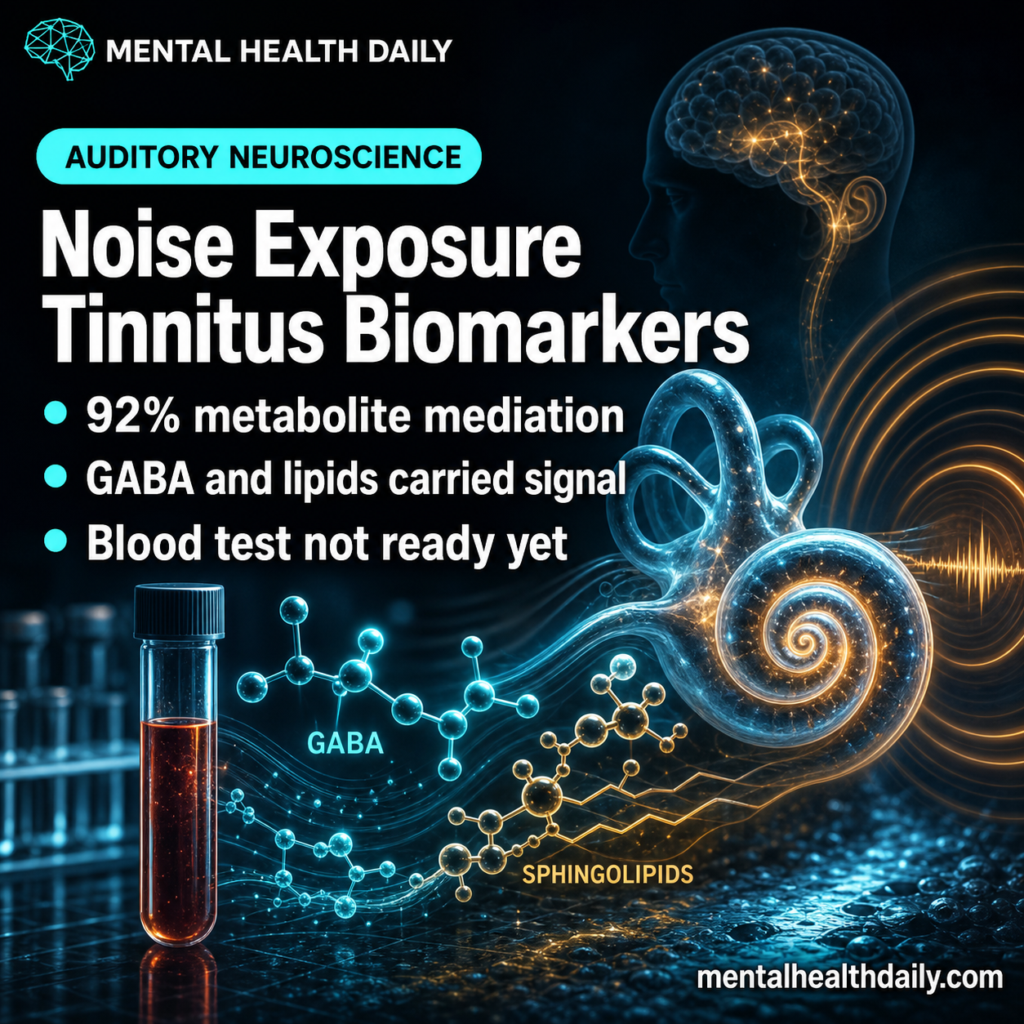
Noise Exposure Tinnitus Biomarkers: 92% Metabolite Mediation

MHD featured image for noise exposure, tinnitus biomarkers, GABA, and sphingolipid metabolism.

A 2026 serum multiomics study linked occupational noise exposure to tinnitus severity mostly through metabolism: 10 metabolites, including GABA, fumaric acid, and steroid hormone precursors, statistically mediated 92% of the exposure-tinnitus association.1 The result is not a clinical blood test yet, but it pushes tinnitus biology beyond the ear-only frame toward a metabolism-immunity model that …

Read more

Autism EEG Study Finds 2 Opposite Excitation-Inhibition Subtypes

Photoreal illustration of two opposing brain-network excitability profiles representing distinct autism neurosubtypes.

A 2026 medRxiv preprint did not find one simple autism excitation-inhibition signature. Bertelsen et al. found 2 EEG-derived E:I neurosubtypes in 286 autistic males: a 47% inhibition-dominant subtype with higher Hurst exponent and lower gamma, and a 53% excitation-dominant subtype with the opposite pattern.1 Research Highlights Two subtypes, opposite directions: in 286 autistic males ages …

Read more

Zuranolone for Depression: Rapid Efficacy & Safety in Clinical Trials (2023 Review)

Zuranolone, a novel antidepressant, shows promise in treating depression, as evidenced by a recent meta-analysis. A new study investigated zuranolone’s efficacy and safety, focusing on short-term rapid antidepressant effects. Highlights: Zuranolone Effectiveness: Demonstrated significant improvement in depression severity scores compared to placebo, with notable effects by day 15. Treatment-Emergent Adverse Events (TEAEs): Increased incidence in …

Read more

Allopregnanolone Agonists for Depression: Brexanolone & Zuranolone in Focus (2023)

Allopregnanolone agonists represent a promising new class of medications for treating depressive disorders. Evidence suggests that allopregnanolone agonists exhibit rapid-onset of antidepressant action – particularly in women with postpartum depression (PPD). Key facts: Allopregnanolone is a neurosteroid that acts as a positive allosteric modulator of GABAA receptors and is decreased in depressive disorders. The allopregnanolone …

Read more

Gabapentin For Opiate Withdrawal

Gabapentin is rumored to have been synthesized by chemists in the 1970s in attempt to develop an antispasmodic agent.  After its synthesis, rights to gabapentin were acquired by Parke-Davis (a subsidiary of Pfizer) whereafter it underwent clinical trials that evaluated its safety and anticonvulsant efficacy in the treatment of seizures.  Clinical trial data indicated that …

Read more

Baclofen For Opiate Withdrawal Symptom Management

Baclofen is a drug that was originally synthesized in the early 1960s by Heinrich Keberle, a Swiss chemist employed by the pharmaceutical company Ciba-Geigy.  At the time of its synthesis, Keberle hypothesized that baclofen would prove effective as an antiepileptic agent, however, clinical trials yielded unfavorable results.  Though ineffective as an antiepileptic, researchers noticed that …

Read more