A nationwide Finnish registry study found that 2 severe infection categories still predicted dementia after adjustment for 27 noninfectious comorbid diseases.1 Cystitis and bacterial infection of an unspecified site both had adjusted rate ratios of 1.19 after comorbidity adjustment, meaning the infection-dementia association did not disappear when prior hospital-treated illnesses were modeled.
Research Highlights
- The study was very large: researchers analyzed 62,555 dementia cases and 312,772 matched dementia-free controls in Finland.1
- Comorbidity was common: 29,376 dementia cases, or 47%, had at least 1 robustly dementia-associated hospital-treated disease before diagnosis.1
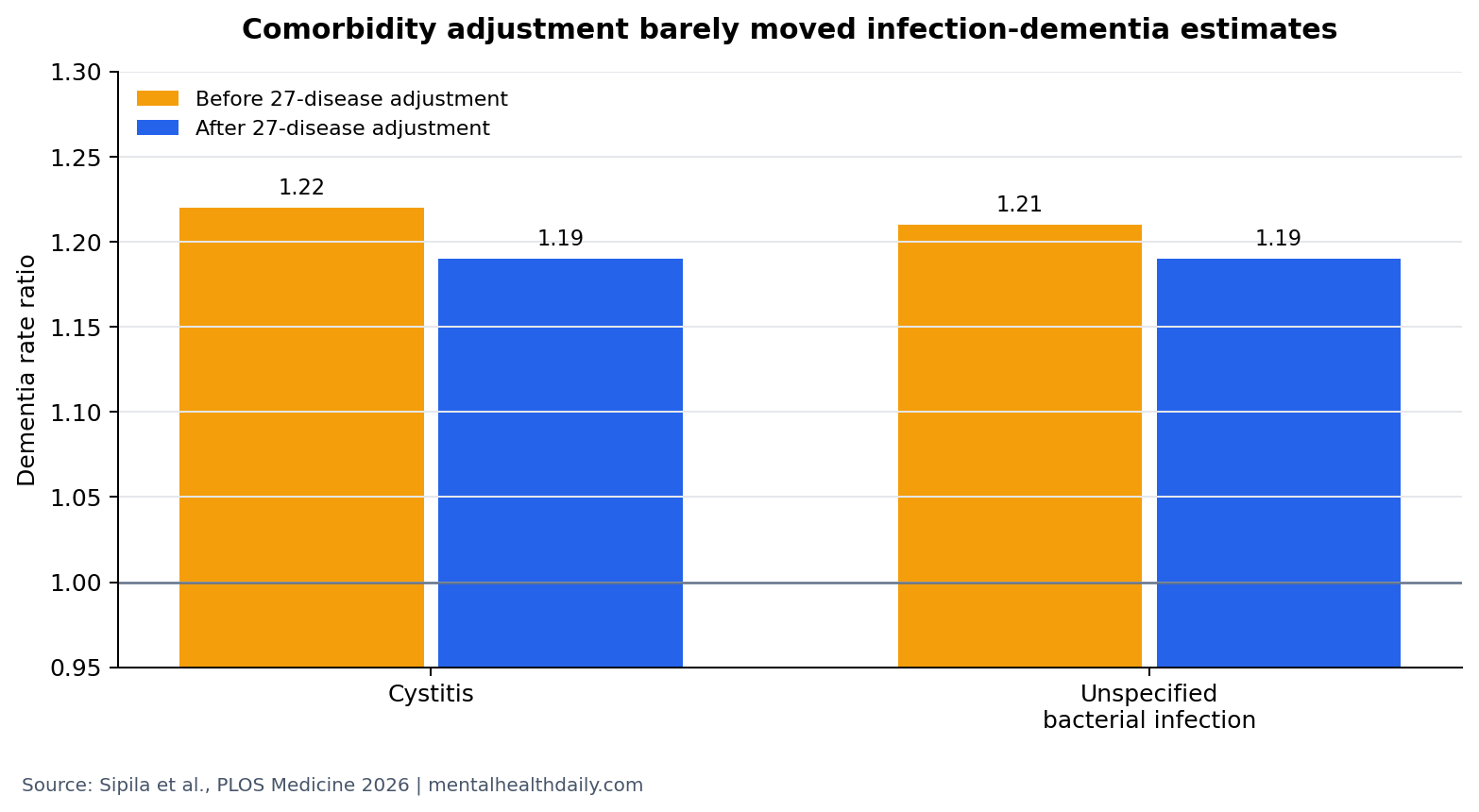
- Cystitis survived adjustment: the rate ratio changed from 1.22 before comorbidity adjustment to 1.19 after adjustment for the 27 noninfectious diseases.1
- Unspecified bacterial infection also persisted: the rate ratio changed from 1.21 to 1.19 after the same comorbidity adjustment.1
- The result is observational: a 1-year lag reduced reverse-causation risk, but registry data cannot measure every behavioral, psychosocial, or biological confounder.1
Severe infections in this study were hospital-treated infections, not ordinary mild colds or self-managed urinary symptoms. Comorbidity means other diagnosed illnesses that could raise dementia risk and also make severe infections more likely.
The paper’s value is not that it discovers infection-dementia associations from scratch. The stronger contribution is testing a specific alternative explanation: maybe infections only look predictive because they travel with other illnesses that are already linked to dementia.
62,555 Dementia Cases Were Matched to 312,772 Controls
Sipila et al. identified people aged 65 or older in Finland who were diagnosed with late-onset dementia between 2017 and 2020. Each dementia case was matched to dementia-free controls by year of birth, sex, and follow-up period, with adjustment for education, marital status, employment, and area of residence.1
The researchers then looked back 1-21 years before dementia diagnosis or control index date. They required a 1-year lag so diseases detected immediately before dementia diagnosis would not dominate the signal. That lag helps reduce reverse causation, where early dementia increases medical encounters or infection risk before diagnosis.
Robust disease screen: 29 hospital-treated disease categories met the study’s threshold for prior association with dementia. Only 2 were infections; the other 27 were mental, behavioral, digestive, endocrine, cardiometabolic, neurological, eye, injury, and other noninfectious disease categories.
The design matters because older adults often accumulate diseases in clusters. Diabetes, vascular disease, depression, delirium-prone hospitalizations, injuries, and infections can all travel together. A simple infection-only model can therefore exaggerate a causal interpretation if infection is merely tagging a broader frailty pattern.
Matched analysis helped control age and sex by design, while the regression models added socioeconomic and geographic covariates. That still leaves unmeasured confounding, but the paper directly tested whether diagnosed noninfectious disease burden explained the infection estimates.
Cystitis Stayed Linked to Dementia After the 27-Disease Adjustment
Cystitis means bladder inflammation, usually from urinary tract infection. Before adjustment for the 27 noninfectious comorbid dementia-related diseases, cystitis had a rate ratio of 1.22 (95% CI 1.17-1.27; p < 0.001). After adjustment, the rate ratio was 1.19 (95% CI 1.14-1.24; p < 0.001).1
A drop from 1.22 to 1.19 is small. It means the measured comorbidity burden explained little of the association. Rate ratio compares dementia incidence between exposed and unexposed groups; 1.19 means 19% higher rate in the infection-exposed group after the modeled adjustments.
Bacterial infection of an unspecified site followed the same pattern. Its rate ratio was 1.21 (95% CI 1.16-1.28) before comorbidity adjustment and 1.19 (95% CI 1.13-1.25) afterward.1
Confidence interval means the range of estimates compatible with the data under the model. The adjusted cystitis interval from 1.14 to 1.24 and the unspecified bacterial infection interval from 1.13 to 1.25 both stayed above 1.00, so the measured associations remained statistically clear after the comorbidity adjustment.
The effect size is modest, not dramatic. A 19% higher dementia rate at the population level can matter in public health because severe infections are common, but it is not strong enough to dominate individual prognosis. The better use is risk-context integration, especially after hospital-treated infections in older adults.
The Study Narrows Confounding, But Does Not Prove Causality
Prior infection-dementia studies have repeatedly raised a hard question: is infection a causal inflammatory hit, or is it a marker for frailty, diabetes, vascular disease, psychiatric illness, injury, medication exposure, or greater healthcare contact?
Sipila et al. directly tested part of that concern. Because 47% of dementia cases had at least 1 of the robustly associated prior diseases, the comorbidity burden was not theoretical. Yet the 2 infection categories remained associated with dementia after the noninfectious disease set was added to the model.
What remains unresolved: registry data cannot directly measure all inflammation biology, delirium episodes, infection severity within categories, medication exposures, cognitive reserve, social isolation, sleep disruption, alcohol use, smoking intensity, or care-seeking behavior. The result strengthens independence from coded comorbidity, not causality in the experimental sense.
There are several plausible pathways. Severe infection can trigger systemic inflammation, blood-brain barrier stress, delirium, vascular events, medication changes, immobility, sleep disruption, and prolonged functional decline. Delirium is an acute confusion state during illness or hospitalization and is itself associated with later cognitive decline. Registry codes may not capture every delirium episode, especially milder or short-lived ones.
Reverse causation can also remain even with a 1-year lag. Very early dementia may change hygiene, hydration, nutrition, medication adherence, or help-seeking before formal diagnosis. The paper reduces that concern but cannot abolish it.
Adjacent Studies Point in the Same Direction
Sipila et al. previously reported that hospital-treated infectious diseases were associated with later dementia in large multicohort data.2 The new Finnish study follows up by probing whether noninfectious comorbid disease explains the signal.
Muzambi et al. reviewed common bacterial infections and dementia or cognitive decline, finding that the association appears across multiple settings but remains vulnerable to confounding and reverse-causation concerns.3
Richmond-Rakerd et al. used a nationwide 30-year analysis and found hospital-treated infections associated with later dementia.4 Together, the pattern is consistent: severe infections can mark or contribute to long-term brain-health risk after the acute illness has resolved.
Clinical Implications Are Prevention-Focused, Not Panic-Focused
Useful implication: infection prevention, vaccination where appropriate, urinary-tract infection management, delirium prevention during hospitalization, and post-infection cognitive monitoring are plausible public-health priorities for older adults.
Overreach to avoid: telling every older adult with cystitis that dementia is likely. A 19% relative rate increase is population-level information. Individual risk still depends on age, baseline cognition, vascular health, genetics, infection severity, delirium, and many unmeasured factors.
Operational read: infection history should be one more signal in dementia-risk review. A severe urinary or bacterial infection in an older adult can prompt medication reconciliation, fall-risk review, sleep and hydration support, hearing and vision checks, depression screening, and cognitive follow-up after recovery. None of those steps require claiming that infection alone caused dementia.
For research, the next useful move is separating infection itself from hospitalization, delirium, inflammatory burden, antibiotic exposure, and post-acute functional decline. Those pieces may have different prevention targets even when they appear under one registry infection code.
Patient-level calibration: infection history should be interpreted alongside baseline cognition and recovery trajectory. A patient who returns to prior function after cystitis is different from a patient who has prolonged delirium, new falls, weight loss, sleep disruption, and loss of independence. The registry estimate averages across those very different clinical paths.
The study therefore supports better follow-up after severe infection. It does not support fatalism. A modest population-level association is most useful when it prompts prevention of delirium, vascular complications, recurrent infection, and functional decline.
For health systems, the actionable unit may be the transition out of hospital. Discharge plans that include hydration, mobility, sleep protection, medication review, and cognitive reassessment could reduce some downstream risk even if infection biology is only one part of the pathway.
Post-Infection Follow-Up Should Focus on Reversible Risk
The practical target is not a permanent dementia label after one hospitalization. A better follow-up frame is reversible risk: delirium, medication burden, dehydration, untreated pain, sensory loss, poor sleep, immobility, and vascular instability can all make cognition look worse after an acute infection. Some of those problems are modifiable, and some are missed when the clinical record treats discharge as the end of the episode.
That distinction also keeps the infection signal calibrated. A 19% adjusted increase is large enough to justify attention at the population level, but too small to make severe infection a standalone dementia predictor for one patient. The useful response is targeted reassessment in higher-risk older adults: ask whether thinking returned to baseline, whether delirium occurred, whether medications changed, and whether new functional decline appeared after the hospital stay.
Questions About Infections and Dementia Risk
Did comorbid illnesses explain the infection-dementia link?
Not in this analysis. Adjustment for 27 noninfectious dementia-related diseases barely changed the cystitis and unspecified bacterial infection estimates.
Does this apply to mild infections treated at home?
No. The exposure was hospital-treated infection. Mild community infections may have different risk patterns.
What should clinicians watch after severe infection?
Older patients may need delirium prevention, medication review, vascular-risk management, and cognitive follow-up after hospitalization. The study supports attention to infection history as part of dementia-risk context, not as a standalone prediction rule.
References
- Sipila PN, Korhonen K, Lindbohm JV, Kivimaki M, Martikainen P. The role of noninfectious comorbidities in the association between severe infections and risk of dementia in Finland. PLOS Medicine. 2026. doi:10.1371/journal.pmed.1004688
- Sipila PN, Heikkila N, Lindbohm JV, et al. Hospital-treated infectious diseases and the risk of dementia: a large, multicohort, observational study with a replication cohort. Lancet Infectious Diseases. 2021. doi:10.1016/s1473-3099(21)00144-4
- Muzambi R, Bhaskaran K, Brayne C, Davidson JA, Smeeth L, Warren-Gash C. Common bacterial infections and risk of dementia or cognitive decline: a systematic review. Journal of Alzheimer’s Disease. 2020. doi:10.3233/jad-200303
- Richmond-Rakerd LS, Iyer MT, D’Souza S, et al. Associations of hospital-treated infections with subsequent dementia: nationwide 30-year analysis. Nature Aging. 2024. doi:10.1038/s43587-024-00621-3