In a 2026 interview study involving 6 adults with long-term chronic pain in Quebec, participants said their deepest suffering came less from how much they hurt than from what pain did to their social lives: loneliness, judgment and the strain of trying to look normal.1
Research Highlights
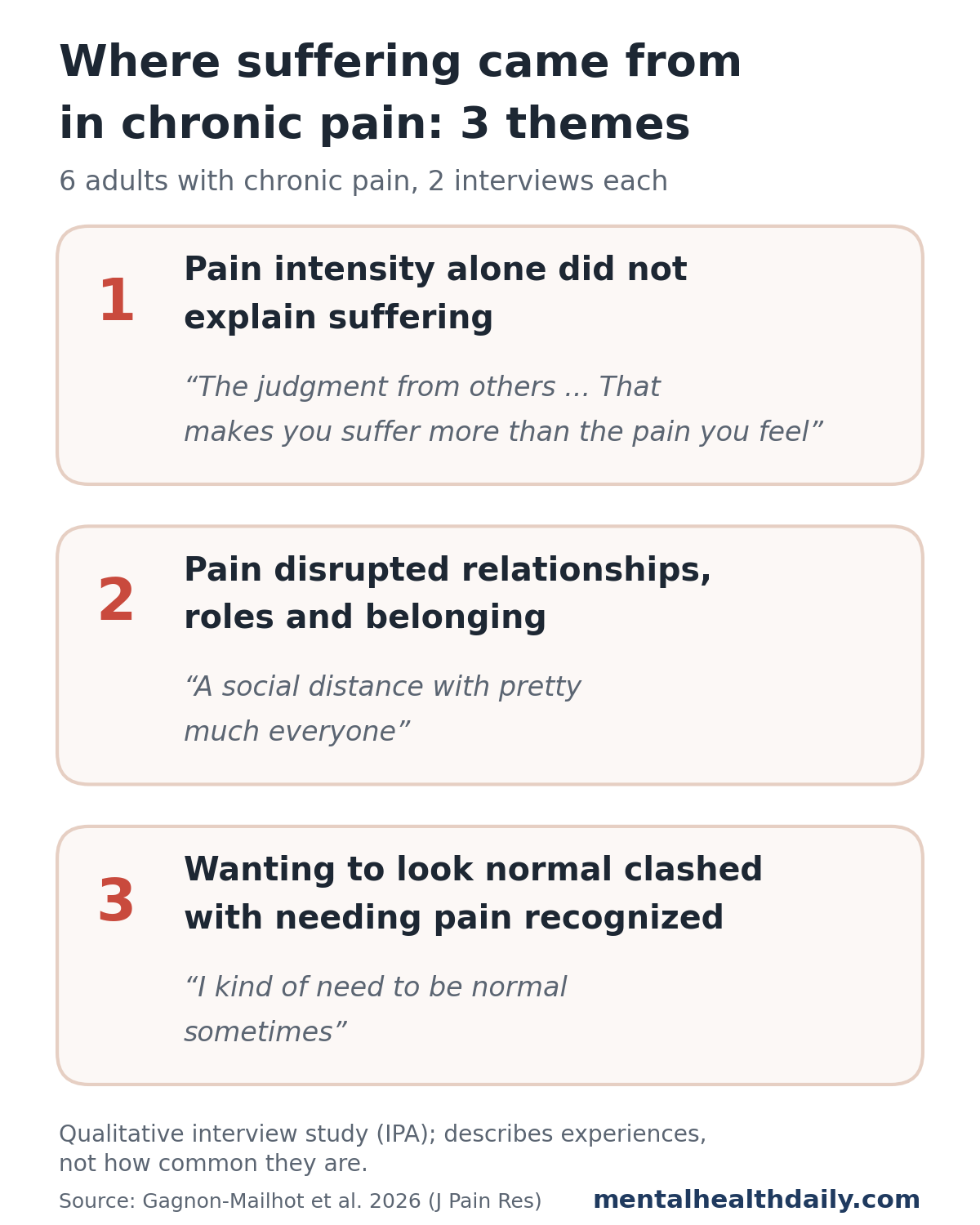
- Social losses, not pain intensity, defined suffering: all 6 participants linked their suffering to social experiences such as feeling judged, lonely, mistreated or less independent. One said the judgment of others “makes you suffer more than the pain you feel.”1
- Pain reshaped relationships and identity: participants described missing shared activities, being seen differently, losing parts of their personality and drifting into “a social distance with pretty much everyone.”1
- Caught between hiding pain and having it believed: people wanted to appear normal, yet also needed their mostly invisible pain to be recognized, and that tension added to their suffering.1
- Questions about stress turned into talk of suffering: when asked about stress, participants mostly described suffering or a path toward it. For one person, that path ran through losing control.1
- Small qualitative study: 6 people, 12 interviews. The results describe lived experience in depth but cannot show how common these experiences are.1
- Consistent with larger studies: a review of 60 qualitative studies described chronic pain as a struggle to prove legitimacy, and a survey of 1,455 patients with rheumatic diseases linked invalidation to worse mental health.2,3
How Researchers Interviewed 6 Adults With Chronic Pain
Mael Gagnon-Mailhot et al. at the Université de Montréal and McGill University recruited participants through the Quebec Chronic Pain Association, a support organization. Everyone had chronic non-cancer pain lasting more than 3 months and had experienced times when pain disrupted their life.1
- Participants: 6 adults, median age 45 (range 25 to 65); 2 women, 3 men and 1 non-binary person
- Pain history: 3 to 44 years, from lower-back or neck pain to pain almost everywhere in the body
- Pain interference: 5.0 to 8.3 on a 0-to-10 scale of how much pain got in the way of daily life over the past week
- Interviews: 2 per person, 12 in total (8 in French, 4 in English), lasting from 44 minutes to nearly 2 hours
The team used Interpretative Phenomenological Analysis (IPA), a qualitative method built to study how people make sense of a major life experience. Instead of testing a hypothesis, the researcher reads each person’s interviews in depth, interprets what the experience means to that person, and only then looks for patterns across people.1
IPA deliberately uses small samples, usually 6 to 10 interviews, because each account is studied closely. The first interviews were open-ended questions about pain, stress and suffering. The second round added prompts about feeling threatened or challenged and about available resources, because stress had come up only briefly the first time.1
The study focused on pain-related suffering, which the researchers describe as what happens when pain disrupts a person’s sense of self: the story they tell about who they are and how they move through the world day to day.1
Judgment and Loneliness Caused More Suffering Than Pain Intensity
The interview guides touched on social life only briefly. Social experiences still dominated how participants described suffering, which the researchers called an unexpected finding.1
Several people separated pain from suffering outright. “Physically I can tolerate,” one said; “I suffer from situations.” Another explained that on a day when everything hurt, they still would not call it suffering. That word was reserved for losing independence or for “how others look at me.”1
Loneliness: one participant named it directly: “The biggest source of suffering in my case was just the loneliness I felt.”1
A hostile setting: another recalled being offered morphine during a distressing episode, alone and surrounded by people screaming, and turning it down because the pain was not what needed attention. “Yes I was in pain but I was not suffering from my pain.”1
Pain intensity still counts, the researchers note. For some people, overwhelming bodily pain in the moment is the main source of suffering, and interview methods like this one tend to capture the slower damage to identity and life story instead.1
Chronic Pain Disrupted Relationships, Roles and Sense of Self
The second theme describes how suffering was lived day to day. Pain changed participants’ place among other people in several ways:1
- What they could do with others: a colleague texting daily, “are you coming?”, after the participant had already explained why they could not.
- Sharing a common world: “Maybe I won’t be able to enjoy it like everyone else. Feeling different.”
- How others saw them: people noticing the pain and then looking at them differently.
- Who they could be with others: a self-described prankster who loved teasing people found that part of himself was sometimes gone, and called that loss suffering.
- How they could present themselves: one participant was embarrassed at not being able to sit “in a respectable way” or speak with “the respected men.”
Over time, the world itself felt different. One participant described becoming “a completely different person” they did not like. The same person kept the foam tubes that made utensils usable at home, to avoid questions from people who “don’t understand.”1
The researchers tie this to the social nature of identity: people build their sense of who they are through relationships, so when pain cuts into those relationships, it also cuts into the self.1
Hiding Pain to Look Normal vs. Needing It Recognized
The third theme is a double bind. Participants wanted to fit in and not be defined by illness: “I kind of need to be normal sometimes.” They also needed others to understand what they were living with.1
Invisible pain made both needs harder to meet. Visible signs of pain undercut looking normal, but without them, the pain often went unrecognized:1
- Looking healthy: a participant in their 20s who used a cane said people looked at them oddly “because I look healthy, but I have all these problems.”
- Being overlooked: another felt people with invisible illness were “the great forgotten ones of society,” compared with the compassion people with cancer receive.
- Worrying about others’ judgment: a participant afraid of freezing up while crossing the street, with no cane to signal why, described anxious thoughts about what others would think that could spiral.
Even well-meaning people could miss the mark. “People really forget,” one participant said, adding that it hurt when others stopped seeing the pain, “even though I don’t necessarily want them to see it.”1
When Asked About Stress, Participants Described Suffering
The study set out to explore how pain and stress shape suffering. When asked about stress, though, participants mostly talked about suffering, or about stress as a route into it.1
- Loss of control: “Stress is very much related to control. Suffering is the loss of control.”
- Constant vigilance: always looking for solutions and managing emotions meant “you’re not living.”
- A threat that never ends: one participant compared living under the threat of pain to the sword of Damocles hanging overhead.
From this, the researchers suggest that in chronic pain, stress may be closely linked to suffering or felt as a form of it. They flag this as a hypothesis for future work.1
Larger Studies Link Pain Invalidation to Worse Health
The Quebec interviews are consistent with a sizable body of research on the social side of chronic pain.
Proving legitimacy: a 2013 review that combined 77 papers from 60 qualitative studies of chronic musculoskeletal pain described an ongoing struggle to affirm the self, explain the pain and prove it was real. Patients in those studies also struggled to find the right balance between hiding and showing pain, the same bind the Quebec participants described.2
Invalidation means having one’s symptoms discounted or misunderstood by others. Survey studies have linked it to health:
- Rheumatic diseases: in 1,455 patients with conditions such as fibromyalgia, rheumatoid arthritis and osteoarthritis, invalidation and lack of social support were each linked to worse mental health, and discounting by others was also linked to worse physical health.3
- Low back pain: among 92 patients with chronic low back pain, being discounted by others, especially by a partner, was linked to greater pain-related disability.4
Both were questionnaire studies of associations, so they cannot show that invalidation causes worse health. Together with the qualitative work, they still point the same way.
A push to measure social outcomes: in a 2022 paper in the journal Pain, Ashton-James et al. argued that pain research and care should track social outcomes alongside pain intensity, distress and disability, because those outcomes may matter as much or more to people with chronic pain.5
Limitations of This Chronic Pain Interview Study
- 6 participants: normal for IPA, but too few to say how often these experiences occur or how they differ by gender, ethnicity or income.
- Narrow sample: 5 of 6 were white, 4 had a university education and 4 worked full time.
- Recruited through a support organization: members may already have more support or validation than people outside such groups.
- Interview prompts: second-round questions about threat and loss may have nudged people toward negative experiences.
- No direct measure of intensity vs. suffering: the conclusion that pain intensity was not enough to explain suffering comes from participants’ own accounts.
- Crisis states not covered: people in an active mental health crisis were not included.
What This Means for People Living With Chronic Pain
Suffering can be about more than the pain score. A 0-to-10 rating captures intensity, but these accounts suggest it can miss the isolation, lost roles and judgment that people find hardest. Those losses are worth raising with a clinician.
Clinicians’ responses can ease or deepen suffering. The researchers suggest clinicians pay attention to how their own responses can invalidate or blame patients, since repeated experiences like that can lead people to absorb the stigma.1
Social support is a promising target that still needs testing. The researchers propose wider access to support groups and involving existing support networks as a first step. No treatment was tested in this study, so which social approaches work best is still unknown.1
References
- Gagnon-Mailhot M, Stilwell P, Côté CI, Wideman TH, Pagé MG. When the social foundations of the world are disrupted: an interpretative phenomenological analysis of suffering in pain and stress among individuals living with chronic pain. Journal of Pain Research. 2026;19:631772. doi:10.2147/JPR.S631772
- Toye F, Seers K, Allcock N, Briggs M, Carr E, Andrews J, Barker K. Patients’ experiences of chronic non-malignant musculoskeletal pain: a qualitative systematic review. British Journal of General Practice. 2013;63(617):e829–e841. doi:10.3399/bjgp13X675412
- Kool MB, van Middendorp H, Lumley MA, Bijlsma JWJ, Geenen R. Social support and invalidation by others contribute uniquely to the understanding of physical and mental health of patients with rheumatic diseases. Journal of Health Psychology. 2013;18(1):86–95. doi:10.1177/1359105312436438
- Wernicke S, de Witt Huberts J, Wippert PM. The pain of being misunderstood: invalidation of pain complaints in chronic low back pain patients. Journal of Health Psychology. 2017;22(2):135–147. doi:10.1177/1359105315596371
- Ashton-James CE, Anderson SR, Mackey SC, Darnall BD. Beyond pain, distress, and disability: the importance of social outcomes in pain management research and practice. Pain. 2022;163(3):e426–e431. doi:10.1097/j.pain.0000000000002404