A 2026 German-Austrian cohort analysis found that people with schizophrenia who were taking quetiapine scored modestly higher on demanding working-memory tests than sex- and age-matched patients who were not, with the largest gap at doses of 300 mg a day or less.1 Because patients were not randomized to quetiapine, this is an association; the advantage was already present at the first visit, and genetic markers tied to myelin repair did not explain it.
Research Highlights
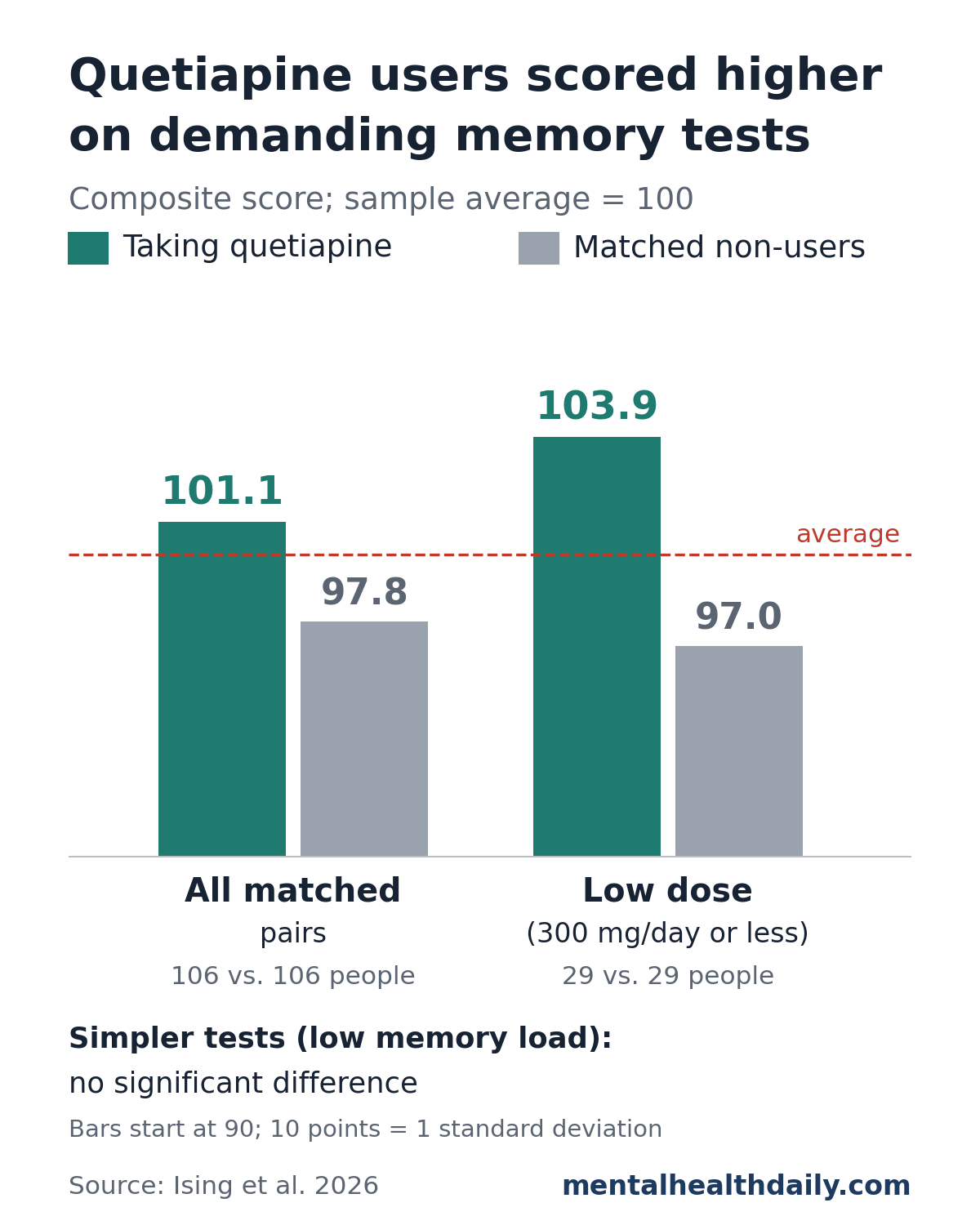
- Higher scores on harder memory tests: 106 quetiapine users averaged 101.1 on a high-working-memory composite vs. 97.8 for 106 matched non-users (sample average 100), a small-to-medium gap (p = 0.002).1
- No gap on simpler tests: on tasks that mostly measure speed and short-term recall, the 2 groups did not differ significantly (p = 0.18).1
- Low doses showed the largest gap: 29 people taking 300 mg a day or less averaged 103.9 vs. 97.0 for their matches, and higher doses tracked with lower scores.1
- Myelin-repair genetics did not explain the link: none of 36 polygenic scores for hippocampal volume, white matter, or brain-cell-specific risk changed the quetiapine association in 332 patients.1
- Randomized trials are less clear-cut: in CATIE, quetiapine’s 2-month cognitive gain (z = 0.18) did not differ from 4 other antipsychotics.3
Cognitive problems are one of the most disabling and least treatable parts of schizophrenia. People can have hallucinations and delusions well controlled and still struggle to hold a phone number in mind, follow multistep instructions, or learn new material at work. Antipsychotics mainly target psychosis, so any drug that also nudged cognition in the right direction would matter to patients.
Quetiapine (Seroquel) has been a recurring candidate. It is a second-generation antipsychotic — one of the newer antipsychotics that block serotonin receptors as well as dopamine receptors — with a relatively loose grip on dopamine D2 receptors. It also has a laboratory track record that most antipsychotics do not: in mice, it helps damaged myelin regrow.
Why Researchers Expected Quetiapine to Help Working Memory
Myelin is the fatty insulation wrapped around nerve fibers, laid down by support cells called oligodendrocytes. Well-insulated fibers carry signals quickly and in sync, which is especially important for tasks that require several brain regions to coordinate, such as juggling information in working memory.
Postmortem studies have found fewer oligodendrocytes in the hippocampus of people with schizophrenia, and the research group behind the 2026 study has proposed that disturbed oligodendrocyte maturation is one driver of the illness’s cognitive deficits.1
Quetiapine entered this picture through animal work. In a 2012 study by Zhang et al., mice were fed cuprizone, a chemical that strips myelin, for 12 weeks. Quetiapine given during the recovery period:5
- increased the number of mature oligodendrocytes in damaged areas,
- improved restoration of myelin, and
- improved the animals’ spatial working memory.
That chain — oligodendrocytes, myelin, working memory — is the remyelination hypothesis that Ising et al. set out to probe in patients. It led to 2 predictions: quetiapine users should do better specifically on tests with heavy working-memory demands, and people whose genes favor healthier white matter or oligodendrocytes should benefit more.
How the PsyCourse Quetiapine Comparison Worked
The data came from PsyCourse, a naturalistic study at 20 clinics in Germany and Austria that tested patients every 6 months. Doctors prescribed whatever they judged best; the researchers simply compared people who happened to be on quetiapine with people who were not.1
- Quetiapine group: 106 adults with schizophrenia spectrum disorder taking quetiapine at 2 visits 6 months apart, at an average of 543 mg a day.
- Comparison group: 106 patients not taking quetiapine, matched one-to-one on sex and age only. About 87% were on other second-generation antipsychotics.
- Typical patient: early 40s, about 13 to 15 years since diagnosis, moderately ill, with total antipsychotic doses similar in both groups.
- Genetic sample: for the gene analyses, the researchers added 60 people on quetiapine at 1 visit plus 60 matches, for 166 in each group.
The 2 groups did not differ significantly on symptoms, depression, daily functioning, illness duration, or education. Symptom scores on the PANSS, a standard 30-item psychosis rating scale, were somewhat lower in the quetiapine group (53.7 vs. 58.3), a gap that fell just short of significance (p = 0.069).1
The researchers sorted 6 cognitive tests into 2 bins:
- Low working-memory load: Trail Making Test A (connecting numbered dots in order) and Digit Span Forward (repeating digits back). These mainly test speed, attention, and brief storage.
- High working-memory load: Trail Making Test B (alternating numbers and letters), Digit Span Backward (repeating digits in reverse), the Digit Symbol Substitution Test (matching symbols to numbers against the clock), and a verbal list-learning test. Each requires holding information while manipulating or consolidating it.
Quetiapine Users Scored Higher on High-Working-Memory Tests Only
The pattern matched the first prediction. On the simpler tests, quetiapine users and non-users performed about the same. On the harder tests, quetiapine users scored better on each one when the 2 visits were considered, although Trail Making B only reached significance at the second visit.1
To summarize, the researchers combined the harder tests into a composite scaled so the sample average was 100 and a standard deviation (the typical spread of scores around the average) was 10 points:
- High-working-memory composite: 101.1 for quetiapine users vs. 97.8 for non-users, a 3.3-point gap (F = 9.42, p = 0.002).
- Low-working-memory composite: no significant difference (p = 0.18).
- Effect size: Cohen’s f = 0.21, which the researchers described as approaching a medium effect. In plain terms, a gap of roughly a third of a standard deviation.
Adding age, sex, education, illness duration, symptoms, functioning, use of older antipsychotics, and total antipsychotic dose as covariates left most results intact. The Digit Symbol test was the exception: its group difference weakened below significance across both visits (p = 0.104), but remained significant at visit 2 alone.1
Contrary to the researchers’ prediction, the advantage did not grow over time. Quetiapine users were already ahead at the first visit and stayed about the same distance ahead 6 months later.
If quetiapine were slowly rebuilding myelin, a widening gap might be expected. The researchers noted that most patients had probably started their current medication long before the first visit, so any gradual effect could have happened earlier, but the data cannot show that.
Lower Quetiapine Doses Were Linked to Better Scores
Within the quetiapine group, dose ran in the opposite direction from what a simple “more drug, more benefit” model would predict. Higher daily doses were associated with lower high-working-memory scores (Spearman rho = −0.23, p = 0.016).1
The 29 patients taking 300 mg a day or less averaged 103.9 on the composite vs. 97.0 for their matched partners, and the effect size rose to Cohen’s f = 0.46, which counts as large. Simpler tests again showed no difference.1
Two readings fit that result.
- A dose window: the mouse studies showing myelin protection used low doses, and heavy sedation at high doses could drag down performance on timed, effortful tasks.
- Selection: people on low-dose quetiapine may be less ill, or may be taking it partly for sleep or anxiety alongside another antipsychotic. Either would predict better cognition without the drug causing it.
The study cannot separate these, and 29 pairs is a small group. The low-dose result is a lead worth testing in a trial, not a dosing recommendation.
Myelin-Related Genes Did Not Explain the Quetiapine Link
The second prediction failed. Without brain scans for this sample, the researchers used polygenic scores — a single number summing many small genetic variants that, in other large studies, predict a trait such as hippocampal volume or white matter integrity. They tested 3 families of scores in the 332-person genetic sample:1
- Brain-volume proxies (19 scores): hippocampus and its subfields, amygdala, thalamus, striatum, and total brain volume.
- White-matter proxies (5 scores): genetic estimates of diffusion tensor imaging (DTI) measures, which use water movement in MRI to gauge how intact the brain’s wiring is.
- Cell-type schizophrenia risk (12 scores): genetic risk for schizophrenia restricted to genes most active in specific cells, including oligodendrocytes and their precursor cells.
In every model, quetiapine use still predicted higher composite scores, and no score changed that association; all interaction tests were nonsignificant. People with more favorable myelin-related genetics did not get more out of quetiapine.
One unexpected finding surfaced. Lower schizophrenia genetic risk concentrated in genes active in human oligodendrocytes was linked to better working-memory scores regardless of medication (β = −0.110, p = 0.043). The matching mouse-derived score showed nothing, and no correction was applied for the dozens of tests run, so this is a weak signal that oligodendrocyte biology may matter for cognition in schizophrenia, separate from quetiapine.1
The researchers’ own conclusion was direct: their findings do not provide evidence that polygenic estimates of hippocampal remyelination capacity influence the quetiapine–cognition association. Polygenic proxies are blunt instruments, built from general-population brain scans rather than schizophrenia samples, so a null here does not rule the mechanism out. It does mean the study offers no direct support for it.
How the Quetiapine Findings Compare With Randomized Trials
A consistent pattern across older reviews is that quetiapine often looks relatively good on cognition, though rarely decisively better than other second-generation antipsychotics.
Meta-analyses of trials: Woodward et al. pooled studies of 4 newer antipsychotics in 2005 and found a small overall cognitive advantage over older drugs (effect size 0.24), with between-drug differences in attention and verbal fluency.4 A 2021 network meta-analysis of 54 trials by Baldez et al. also found quetiapine among the more favorable drugs across several cognitive domains.6
Head-to-head randomized trial: in CATIE, a large US trial that randomly assigned people with chronic schizophrenia to 1 of 5 antipsychotics, cognition improved slightly on all of them after 2 months. Quetiapine’s composite gain (z = 0.18) sat between olanzapine (0.13) and risperidone (0.26), and no pair of drugs differed significantly — including the older drug perphenazine.3
Largest placebo-anchored network: Feber et al. analyzed 68 randomized trials involving 9,525 participants. No individual antipsychotic was clearly better than placebo on overall cognition; antipsychotics as a group showed small benefits, and haloperidol, fluphenazine, and clozapine ranked low.2
According to Ising et al.’s reading of that network, quetiapine outperformed haloperidol and clozapine but not other second-generation drugs, and the included quetiapine trials averaged about 500 mg a day, with only 5 of 13 allowing doses under 300 mg.1
Put together, the 2026 cohort result is directionally consistent with the older signal that quetiapine is among the less cognitively burdensome antipsychotics. Its matched comparison group was mostly on other second-generation drugs, which makes a roughly one-third standard deviation gap a little surprising given CATIE. The low-dose angle is the new wrinkle, and it is also the least tested.
Evidence Strength: What a Matched Cohort Can and Cannot Show
This is a naturalistic, observational comparison. It can show that quetiapine use was associated with better scores on demanding working-memory tests in a real clinical population. It cannot show that quetiapine caused those scores, or that myelin repair had anything to do with it.1
- Matching was thin: patients were paired only on sex and age. Why a clinician chose quetiapine — fewer motor side effects, better tolerability, a milder illness course, a patient’s preference — could relate to cognition in its own right.
- No treatment history: the researchers did not know when current treatment started or what patients took before, and the advantage was already present at the first visit.
- Small residual imbalances: non-users had nonsignificantly higher psychosis scores and more use of older antipsychotics (37% vs. 26%), both of which can weigh on test performance.
- Many uncorrected tests: dozens of genetic models were run without multiple-testing correction; the researchers labeled all findings preliminary and suggestive.
- Indirect biology: no MRI, myelin imaging, or tissue measures were collected, so the remyelination question was tested only through genetic proxies.
The researchers called for randomized trials with repeated brain imaging, including measures of hippocampal myelination, to test whether quetiapine changes cognition and myelin in the same people.
Questions About Quetiapine and Cognition in Schizophrenia
Does quetiapine improve memory in schizophrenia?
It has not been shown to cause improvement. In the 2026 cohort, quetiapine users scored modestly higher on demanding working-memory tests than matched non-users, but the groups were not randomized.1
In the CATIE randomized trial, quetiapine’s small cognitive gain was similar to that of the other antipsychotics tested.3
Should someone switch to quetiapine for cognitive problems?
This study is not a basis for switching. Antipsychotic choice depends on symptom control, relapse history, weight and metabolic risk, sedation, and past response. Among options, the stronger randomized evidence mainly says to avoid drugs that rank poorly on cognition, such as haloperidol, when cognition is a concern.2
Is a lower quetiapine dose better for thinking?
Lower doses were linked to better scores in 29 matched pairs, but dose was not assigned at random, and people on low doses may simply be less ill. Dose changes should be made with a prescriber, since underdosing an antipsychotic can raise relapse risk.1
Does quetiapine repair myelin in people?
That has been shown only in animals, such as cuprizone-treated mice.5 The 2026 human study found no sign that myelin-related genetics shaped the quetiapine–cognition link, and it did not measure myelin directly.1
How big is a 3-point difference on this composite?
About one-third of a standard deviation, a small-to-medium effect for a group average. The study did not measure whether it translated into better work, study, or daily functioning.1
References
- Effects of quetiapine on cognitive functioning in schizophrenia: evidence for the remyelination hypothesis? Ising M, et al. Eur Arch Psychiatry Clin Neurosci. 2026 (published online; accepted June 21, 2026). doi:10.1007/s00406-026-02309-8
- Antipsychotic drugs and cognitive function: a systematic review and network meta-analysis. Feber L, et al. JAMA Psychiatry. 2025;82(1):47-56. doi:10.1001/jamapsychiatry.2024.2890
- Neurocognitive effects of antipsychotic medications in patients with chronic schizophrenia in the CATIE Trial. Keefe RSE, et al. Arch Gen Psychiatry. 2007;64(6):633-647. doi:10.1001/archpsyc.64.6.633
- A meta-analysis of neuropsychological change to clozapine, olanzapine, quetiapine, and risperidone in schizophrenia. Woodward ND, et al. Int J Neuropsychopharmacol. 2005;8(3):457-472. doi:10.1017/S146114570500516X
- Quetiapine enhances oligodendrocyte regeneration and myelin repair after cuprizone-induced demyelination. Zhang Y, et al. Schizophr Res. 2012;138(1):8-17. doi:10.1016/j.schres.2012.04.006
- The effect of antipsychotics on the cognitive performance of individuals with psychotic disorders: network meta-analyses of randomized controlled trials. Baldez DP, et al. Neurosci Biobehav Rev. 2021;126:265-275. doi:10.1016/j.neubiorev.2021.03.028