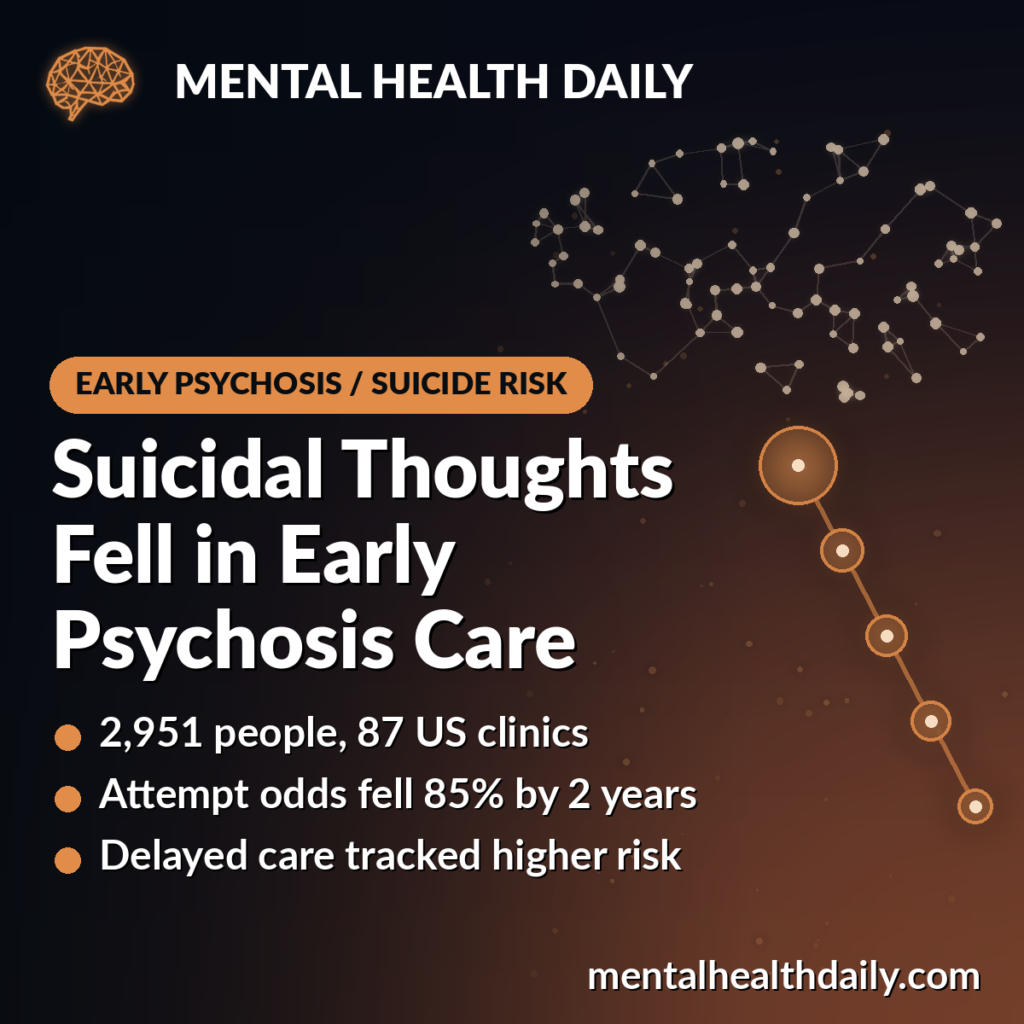
At entry to US specialty clinics, 34% of 2,951 young people with first-episode psychosis reported suicidal thoughts and 7% had attempted suicide in the previous 6 months. A 2026 Early Psychosis Intervention Network (EPINET) analysis found odds fell 76% for thoughts and 85% for attempts over 2 years of care.1 With no comparison group, the declines cannot be attributed to care alone.
Research Highlights
- Risk was high at the start: 34% of people entering care reported suicidal thoughts and 7% a suicide attempt in the previous 6 months.1
- Most of the drop came early: by 6 months, the odds of an attempt were 75% lower than at admission (odds ratio 0.25), and by 24 months 85% lower (0.15).1
- Delay to treatment tracked with risk: each extra year of untreated psychosis carried 11% higher odds of suicidal thoughts and 8% higher odds of an attempt.1
- Deaths still occurred: 6 participants (0.2%) died by suicide during follow-up, all of them men, even though women reported more suicidal thoughts.1
- Studies with comparison groups point the same way: a 2025 meta-analysis linked early-intervention programs to about one-third lower odds of suicide death and of suicide attempts.4
The first few years after psychosis begins are among the most dangerous for suicide. A person may be frightened by hallucinations or paranoid thoughts, may have just been hospitalized, and may be grasping what a diagnosis like schizophrenia could mean for school, work, and relationships. A large long-term cohort study found the suicide rate after first-episode psychosis was highest in the first year after presentation.6
The US answer to this period has been coordinated specialty care (CSC): a team-based program, usually lasting about 2 years, that combines medication management, psychotherapy, family education and support, case management, and help returning to school or work.1
Who Entered EPINET’s Early Psychosis Clinics
The Early Psychosis Intervention Network (EPINET), launched in 2019, links CSC programs into a national learning health system — a network in which routine clinical data are collected in the same format everywhere so programs can learn from their own outcomes. Every clinic uses a shared core assessment battery at admission and every 6 months.1
Tayfur et al. analyzed consecutive admissions from 2019 to 2024 in 87 community clinics across 15 states, which the researchers describe as the largest real-world, multisite US CSC cohort:1
- Age: average 21.5 years
- Sex: 65% male
- Background: 45% White, 37% Black, 20% Hispanic
- Diagnosis: 65% schizophrenia spectrum disorders
- Prior hospitalization: 71% had already been admitted to a psychiatric hospital before reaching CSC
A key clinical variable was duration of untreated psychosis (DUP) — the time between the first clear psychotic symptoms and entry into specialty care. Clinicians estimated it from patient and family reports and records. The median DUP was 6 months, and a quarter of participants had waited 16 months or longer.1
Suicidal Thoughts and Attempts Fell Most in the First 6 Months
At each visit, clinicians recorded yes or no for 2 questions: had the person had suicidal thoughts, and had they made a suicide attempt, since the last assessment (or, at admission, in the previous 6 months)?
Compared with admission, the adjusted odds of suicidal thoughts were 59% lower at 6 months (odds ratio 0.41) and about 76% lower at 24 months (0.24). For attempts, the odds were 75% lower at 6 months (0.25) and about 85% lower at 24 months (0.15). Every time point differed significantly from admission (p < 0.001).1
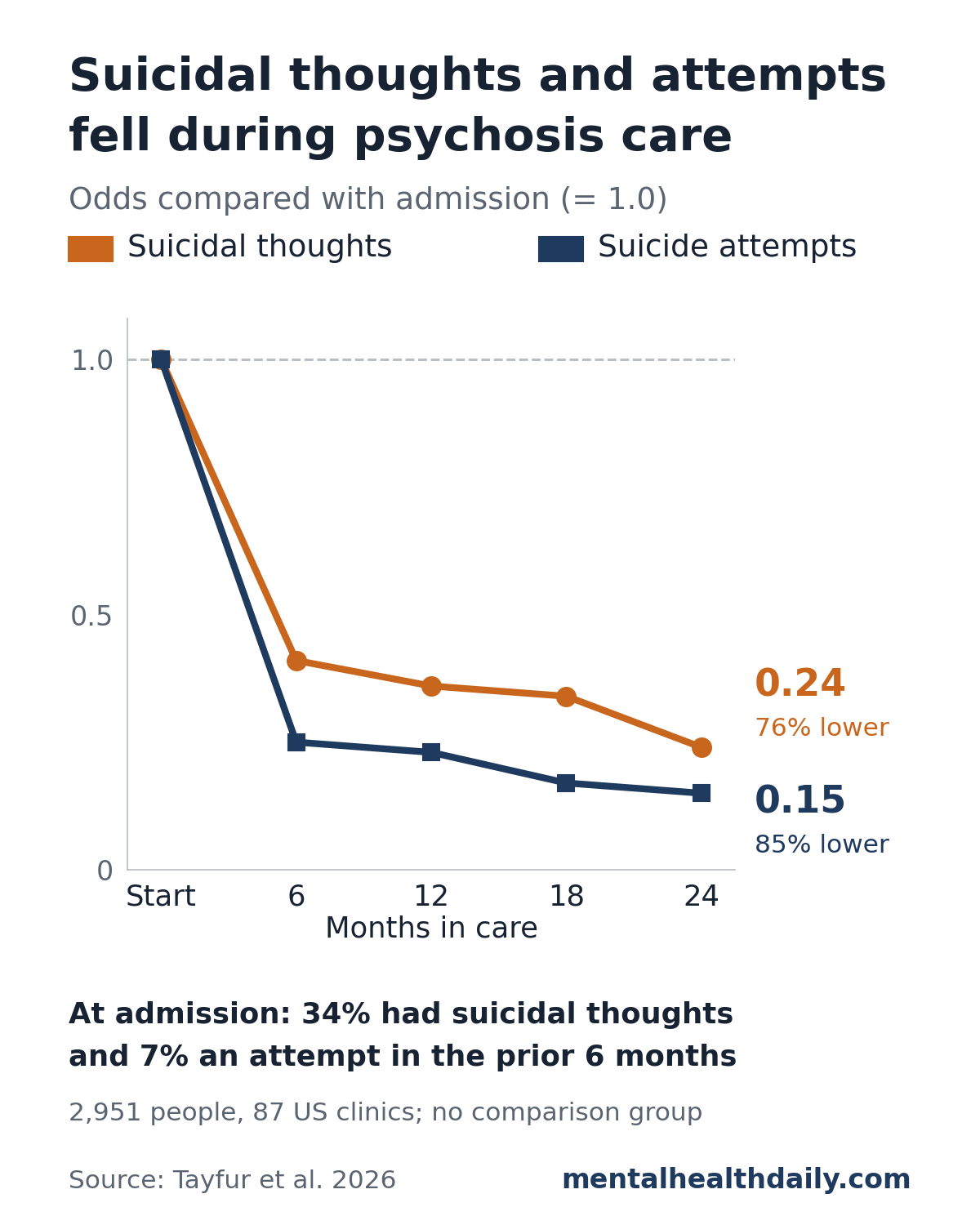
An odds ratio compares the odds of an outcome at one time with the odds at another. A value of 0.24 means the odds of reporting suicidal thoughts at 24 months were about a quarter of what they were at admission. The paper reports these adjusted odds rather than the share of people with suicidal thoughts at each later visit.
The shape of the curve is the most useful part. Most of the decline happened by the first 6-month check, then continued more slowly. Two other US CSC networks found the same pattern:
- Pennsylvania and Maryland: in 1,101 clients across 23 programs, Phalen et al. found that clinician-rated suicidality was at least 77% lower after the first 6 months, and self-reported suicidal thoughts were lower after 1 year.2
- New York State: in 1,298 OnTrackNY clients, Martínez-Alés et al. found 26.9% had suicidal thoughts at admission; 15.6% of all clients stopped being suicidal within 6 months, while 11.3% had persistent suicidal thoughts.3
Admission rates vary with how questions are asked. The Pennsylvania-Maryland network recorded clinician-rated suicidal thoughts in 52% of clients and attempts in 15% over the previous 6 months, well above EPINET’s 34% and 7%.1, 2 The direction of change over time, though, is consistent across all 3 networks.
Untreated Psychosis, Prior Hospitalization, and Youth Marked Higher Risk
The same adjusted models identified who stayed at higher risk across the 2 years.1
Longer untreated psychosis. Each additional year of DUP was associated with 11% higher odds of suicidal thoughts (odds ratio 1.11, 95% CI 1.07–1.15) and 8% higher odds of an attempt (1.08, 95% CI 1.01–1.15). That fits a 2025 systematic review cited by the researchers, which named long DUP and depressive symptoms as key risk factors for suicidal behavior in early psychosis.1
In the RAISE-ETP randomized trial of CSC at 34 US sites, people with a DUP under 74 weeks gained more in quality of life and symptom improvement from CSC than those who had waited longer.7
Prior psychiatric hospitalization. People hospitalized before entering CSC had 72% higher odds of an attempt (odds ratio 1.72) and about 4 times the rate of attempts during follow-up (incidence rate ratio 4.40, 95% CI 1.52–12.80). Hospitalization was not linked to suicidal thoughts; the researchers attributed the attempt signal to greater illness severity.1
A previous attempt. An attempt before admission was the strongest signal: those with one had about 7 times the rate of attempts during follow-up (incidence rate ratio 7.30, 95% CI 3.86–13.81).1
Younger age. Each additional year of age was associated with 4% lower odds of suicidal thoughts and 8% lower odds of an attempt.1
Sex. Men had 36% lower odds of suicidal thoughts than women (odds ratio 0.64) and about one-third the rate of attempts over follow-up (incidence rate ratio 0.33). Yet all 6 suicide deaths were men. That split matches broader evidence that women more often report suicidal thoughts and attempts while men more often die by suicide.1
Because the dataset had no information on the method or lethality of attempts, it cannot explain the gap.
Race and ethnicity. White participants had 73% higher odds of suicidal thoughts than Black participants, and non-Hispanic participants 50% higher odds than Hispanic participants; neither difference was significant for attempts.
OnTrackNY also linked suicidal thoughts at admission to White non-Hispanic, Asian, or Hispanic background, and linked persistent thoughts to Hispanic or White non-Hispanic background, which does not line up neatly with EPINET’s lower odds among Hispanic participants.3
Tayfur et al. noted that these gaps may partly reflect differences in how distress is reported and expressed, in pathways to care, or in whether patients and clinicians share a background, none of which the data could test.1
Why the Decline Cannot Be Credited to Specialty Care Alone
Everyone in EPINET received CSC, so there was no group to show what would have happened otherwise. The researchers stated plainly that the reductions “cannot be causally attributed to CSC.”1 Several features of the data could make the decline look larger than any treatment effect:
- Admission is often a crisis point. 71% had been hospitalized before reaching CSC, and many people enter care during or just after an acute episode. Some improvement would be expected as that episode settles, whatever the program.
- Higher-risk people were more likely to drop out. Those lost to follow-up had more suicidal thoughts at admission than those who stayed (38% vs. 32%, p < 0.01), although attempt rates did not differ (8% vs. 7%).1
- Measurement was brief. Outcomes came from single yes-or-no items in routine clinical records, not a standardized suicide assessment, and could vary across clinics.
- Depression was left out. Depressive symptoms, which predicted every suicidality measure in the Pennsylvania-Maryland network, were not included in the EPINET models because they were measured inconsistently.2
Comparison-group evidence fills part of the gap. Pooling studies that compared early-intervention programs with other care, Tahmazov et al. found about one-third lower odds of suicide death (adjusted odds ratio 0.66, 95% CI 0.49–0.88) and of suicide attempts (0.66, 95% CI 0.50–0.86), with little disagreement between studies.
Across those studies, 68 of 2,881 people in early-intervention programs died by suicide, compared with 218 of 8,356 in comparison care.4
In Hong Kong, Chan et al. followed patients for 12 years after a 2-year early-intervention program and compared them with patients who had received standard psychiatric care. Suicide deaths totaled 4.4% vs. 7.5%, with the difference concentrated in the first 3 years and no later catch-up.5
Taken together, the comparison-group evidence points to a real but more modest benefit of early-intervention services, likely closer to a one-third reduction in suicidal behavior than to the 76–85% drop in odds seen within EPINET. The EPINET curve probably combines whatever CSC contributes with the natural easing after an acute episode.
Six Deaths and Risk Beyond the 2-Year Window
Six participants (0.2%) died by suicide during follow-up. They averaged 25.4 years old, and 5 of the 6 had been hospitalized before entering CSC.1
That rate is lower than some earlier first-episode cohorts, but it is probably an undercount: deaths were identified from discharge records, and many EPINET discharges happen because programs simply lose contact with a person.1
The 2-year care window leaves later suicide risk unmeasured in EPINET. In an inception cohort of 2,723 people followed from their first episode of psychosis, Dutta et al. found that 1.9% died by suicide. The rate was highest in the first year, but the median time to suicide was 5.6 years.6
Risk remained almost 4 times the general-population rate a decade after first contact.6 Most CSC programs end after about 2 years, so the handoff to ordinary outpatient care is a period to plan for, not a finish line.
What the EPINET Findings Mean for Families and Clinicians
For a family watching someone go through a first psychotic episode, the most useful message is that suicidal thoughts are common at the start of treatment and, on average, ease in the months that follow.
- Earlier entry may help: longer untreated psychosis was linked to higher risk of suicidal thoughts and attempts, which adds to the case for faster referral into specialty care after the first psychotic symptoms.
- Some patients need closer monitoring: a previous attempt, a prior psychiatric hospitalization, and younger age identified people at higher risk of attempts throughout the 2 years.
- Improvement is not the end of risk: all 6 deaths occurred in a cohort whose overall suicidal thoughts were falling, and long-term cohort data show risk lasting well beyond 2 years.
If you or someone you know is thinking about suicide, call or text 988 in the US to reach the 988 Suicide & Crisis Lifeline, or contact local emergency services.
References
- Suicide-related outcomes in the Early Psychosis Intervention Network (EPINET) in the USA. Tayfur SN, et al. BJPsych Open. 2026;12:e244. doi:10.1192/bjo.2026.12103
- Suicidality among clients in a network of coordinated specialty care (CSC) programs for first-episode psychosis: rates, changes in rates, and their predictors. Phalen P, et al. Schizophr Res. 2024;274:150-157. doi:10.1016/j.schres.2024.07.054
- Incidence, prevalence, and trajectories of suicidal ideation among clients enrolled in early intervention services for first episode psychosis in New York State. Martínez-Alés G, et al. Schizophr Res. 2023;256:17. doi:10.1016/j.schres.2023.04.013
- Impact of early intervention for early psychosis on suicidal behavior: a meta-analysis. Tahmazov E, et al. Acta Psychiatr Scand. 2025;151:127-141. doi:10.1111/acps.13773
- Association of an early intervention service for psychosis with suicide rate among patients with first-episode schizophrenia-spectrum disorders. Chan SKW, et al. JAMA Psychiatry. 2018;75(5):458-464. doi:10.1001/jamapsychiatry.2018.0185
- Reassessing the long-term risk of suicide after a first episode of psychosis. Dutta R, et al. Arch Gen Psychiatry. 2010;67(12):1230-1237. doi:10.1001/archgenpsychiatry.2010.157
- Comprehensive versus usual community care for first-episode psychosis: 2-year outcomes from the NIMH RAISE Early Treatment Program. Kane JM, et al. Am J Psychiatry. 2016;173(4):362-372. doi:10.1176/appi.ajp.2015.15050632