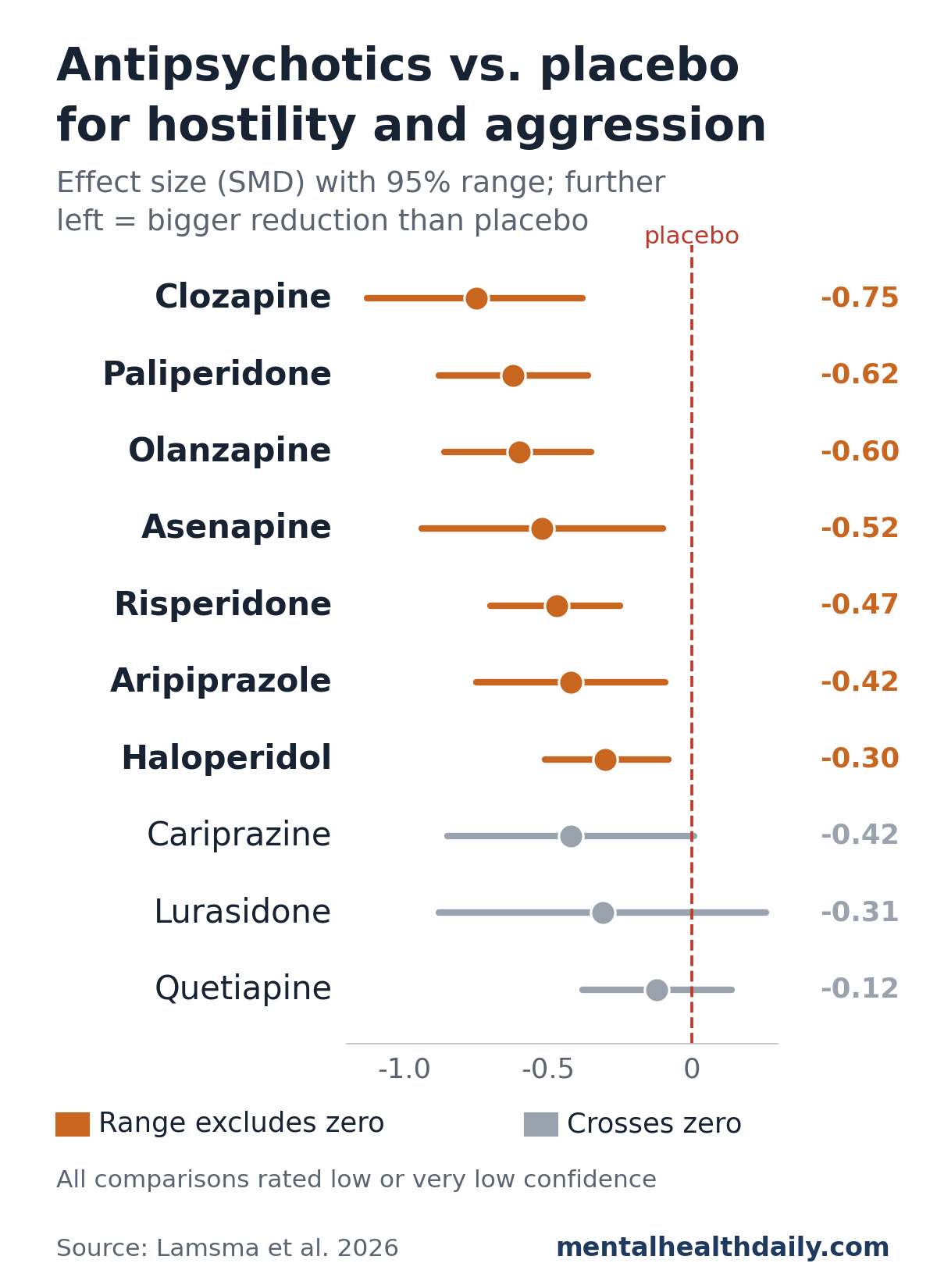
A 2026 analysis of 41 randomized studies involving 21,025 adults with schizophrenia found the largest estimated reductions in hostility and aggression for clozapine (standardized mean difference, or SMD, of −0.75), paliperidone (−0.62), and olanzapine (−0.60) vs. placebo.1 Confidence in every comparison was low or very low, the top 3 were not statistically separable, and most trials measured hostility scores rather than violent acts.
Research Highlights
- Clozapine had the largest estimated effect: an SMD of −0.75 vs. placebo (95% CI −1.13 to −0.38), a moderate-to-large reduction in hostility and aggression, followed closely by paliperidone and olanzapine.1
- 7 of 18 antipsychotics clearly beat placebo: clozapine, paliperidone, olanzapine, asenapine, risperidone, aripiprazole, and haloperidol.1
- Quetiapine did not: its effect (SMD −0.12) was indistinguishable from placebo, even though it is often prescribed for behavioral disturbance.1
- Evidence quality was the weak point: every comparison was rated low or very low confidence, and median follow-up was only 8 weeks.1
- Other evidence agrees on the direction: a trial in assaultive inpatients and a Swedish crime-register study also favored clozapine and olanzapine.2,6
Schizophrenia carries a higher risk of aggression. Lamsma et al. cite estimates that lifetime violence is about 5 times more common among affected people than in the general population, and it is often preceded by hostility: irritability, anger, and threats.1 Antipsychotics are the main medical tool for this, yet no earlier network meta-analysis had compared the individual drugs for this outcome.
How the Antipsychotic Aggression Network Meta-Analysis Worked
A network meta-analysis pools randomized trials that compare different pairs of treatments — drug A vs. placebo, drug B vs. drug A, drug C vs. placebo — and links them into one web of evidence.
That lets researchers estimate how drug B compares with drug C even when no trial tested them head-to-head. The cost is that those indirect estimates rest on an assumption: that the trials are similar enough to be chained together.
Lamsma et al., working at Oxford, Amsterdam, and Utrecht, searched 4 databases through April 2025 and included:1
- 41 studies drawn from 60 randomized trials, involving 21,025 adults (average age 38; 60% men)
- 18 antipsychotics plus placebo, each given as a single drug
- At least 48 hours of follow-up, to capture effects beyond emergency sedation (rapid tranquilization)
- Short trials, mostly: median follow-up of 8 weeks, with 80% of studies measuring outcomes between 4 and 14 weeks
Results are expressed as a standardized mean difference (SMD), which converts different rating scales into a common unit: the gap between groups measured in standard deviations. By common convention, an SMD around 0.2 is small, 0.5 moderate, and 0.8 large. Negative values here mean less hostility or aggression than placebo.
Clozapine, Paliperidone, and Olanzapine Showed the Largest Reductions
Compared with placebo, 7 antipsychotics produced reductions whose 95% confidence intervals (the range of plausible true values) stayed below zero:1
- Clozapine: −0.75 (−1.13 to −0.38)
- Paliperidone: −0.62 (−0.88 to −0.36)
- Olanzapine: −0.60 (−0.86 to −0.35)
- Asenapine, risperidone, aripiprazole, haloperidol: smaller effects, from −0.52 to −0.30
The remaining drugs had estimates that could not be distinguished from placebo. Some, such as cariprazine (−0.42) and lurasidone (−0.31), leaned in the right direction but had wide intervals that crossed zero. Others sat close to zero: quetiapine (−0.12), ziprasidone (−0.07), amisulpride (−0.07), and brexpiprazole (0.02).1
The clozapine estimate deserves a second look before anyone reads it as a clear win. It rests on only 124 people who received clozapine across the included trials, compared with 2,423 for olanzapine and 1,936 for paliperidone. That small base helps explain why its confidence interval is the widest among the top 3.
Head-to-Head Estimates Separated Some Drugs but Not the Top 3
A ranking by point estimate invites the assumption that clozapine beats olanzapine, which beats risperidone, and so on. The network’s drug-vs-drug estimates, which combine direct and indirect evidence, are more modest:1
- No clear winner at the top: clozapine vs. olanzapine differed by 0.15 SMD (−0.19 to 0.49), and paliperidone vs. olanzapine by 0.01 (−0.30 to 0.33). Neither gap was statistically significant.
- Clozapine outperformed haloperidol: by 0.46 SMD (0.12 to 0.79). Olanzapine also outperformed haloperidol, by 0.31 (0.08 to 0.53).
- Quetiapine trailed several drugs: clozapine (0.63), paliperidone (0.50), olanzapine (0.48), and risperidone (0.35) all had significantly larger effects than quetiapine.
The paliperidone result is the newest part of the picture. Its advantage over placebo was supported by direct trial evidence, but its comparisons with other antipsychotics relied mostly on indirect evidence. The researchers wrote that its apparent edge “requires confirmation in head-to-head trials.”1
Quetiapine is the result most likely to matter in everyday practice. Lamsma et al. note that it is widely prescribed for behavioral disturbance, yet in this network it did not differ significantly from placebo for hostility and aggression in schizophrenia.1 Individual patients may still benefit, but these trials give no reason to prefer it when aggression is the main concern.
Why Confidence in the Rankings Was Rated Low
The researchers graded every comparison with CINeMA (Confidence in Network Meta-Analysis), a framework that checks for biased trials, imprecise estimates, trials that disagree, and conflict between direct and indirect evidence. All comparisons came out low or very low.1 Several specific problems drove that rating:
- Hostility ratings, not violent acts: 35 of 41 studies measured hostility with a single item or subscale from a general psychosis rating scale, such as the PANSS (Positive and Negative Syndrome Scale). Only 4 used an aggression-specific scale, and 2 counted actual aggressive incidents. Improvement on these items may partly reflect overall symptom improvement.
- Trials not designed for this question: 34 studies (83%) had some concerns about bias and 6 (15%) were high risk, often because the aggression data came from after-the-fact (post hoc) analyses of larger trials or were affected by dropouts.
- Direct and indirect evidence disagreed: a formal test found significant inconsistency across the network (p = 0.018), and 8 specific comparisons were inconsistent, all involving amisulpride or olanzapine.
- Uneven patient mix: care setting, illness phase, treatment resistance, and baseline hostility varied across drug comparisons, which strains the assumption that trials can be chained together.
- Missing groups: first-episode and forensic patients were underrepresented, and people with substance use problems — a known risk factor for aggression — were often excluded.
Some things held up well. Trial-to-trial variation (heterogeneity) was moderate, with τ² = 0.09, and a funnel-plot test found no sign that small positive studies were inflating the results (p = 0.970). Removing studies with unusual baseline hostility, or those relying on hostility subscales, produced slightly larger effects rather than erasing them.1
Trials and Crime Registers Point in the Same Direction
A low-confidence network ranking becomes more believable when other kinds of evidence, with different weaknesses, land in the same place. For clozapine and olanzapine they largely do.
A trial in patients who had actually assaulted someone. Krakowski et al. randomized 110 physically assaultive inpatients with schizophrenia or schizoaffective disorder in state psychiatric facilities to clozapine, olanzapine, or haloperidol for 12 weeks.
Clozapine reduced aggressive behavior more than olanzapine, and olanzapine more than haloperidol, and the anti-aggressive effect appeared separate from the drugs’ antipsychotic and sedative actions.2 That is the same ordering as the 2026 network, in a sample selected for violence rather than for general psychosis.
An earlier pooled comparison of drug classes. In a 2018 meta-analysis of 18 randomized trials, Faay et al. found a small but significant advantage (effect size 0.26) for second-generation antipsychotics over older first-generation drugs on hostility, with high heterogeneity. Clozapine vs. first-generation drugs produced a larger effect of about 0.42, with low heterogeneity.3
A systematic review by Frogley et al. had earlier gathered the evidence for clozapine’s specific anti-aggressive effects, the basis for its established role in managing aggression.4
Real-world crime records. Fazel et al. followed 82,647 people in Sweden prescribed antipsychotics or mood stabilizers and compared each person with themselves across periods on and off medication. Violent crime was 45% lower during antipsychotic treatment periods (hazard ratio 0.55, 95% CI 0.47 to 0.64).5
A follow-up within-person study of 74,925 people by Sariaslan et al. found rates of arrests and convictions for crime 33% to 50% lower (relative risks 0.50 to 0.67) during antipsychotic periods, with clozapine, olanzapine, and risperidone linked to the strongest reductions.6
The register studies measure what the trials mostly missed — actual crimes over years — but they are observational, so people who take their medication may differ in other ways during those periods. The trials are randomized but short and mostly measure hostility ratings. Agreement between the 2 kinds of evidence is stronger than either alone.
Why Some Antipsychotics May Calm Aggression More
Much of the effect probably runs through psychosis itself. When paranoid delusions and hallucinations ease, so does the fear and suspicion that can drive aggression in schizophrenia. Lamsma et al. note that the drugs that led here also tend to rank well in network meta-analyses of overall schizophrenia symptoms.1
The researchers also proposed several drug-specific pathways, which remain hypotheses:1
- Serotonin 5-HT2A blockade, shared by clozapine, olanzapine, paliperidone, and risperidone, may improve impulse control.
- Mood-stabilizing and sedating effects of clozapine and olanzapine may add to the benefit.
- Dopamine D2 blockade alone looks insufficient: older first-generation drugs, which work mainly this way, showed modest effects.
- Akathisia — an intensely uncomfortable inner restlessness caused by some antipsychotics — can heighten agitation and irritability in some patients, working against the anti-aggressive effect.
What This Means for Choosing an Antipsychotic When Aggression Is a Concern
The clearest message is that antipsychotic treatment itself reduces hostility and aggression in schizophrenia, with moderate effects over weeks to months. Keeping someone on an effective antipsychotic is the foundation, which is consistent with the lower crime rates seen during treatment periods in the Swedish registers.1,5
Among individual drugs, the evidence leans toward clozapine, olanzapine, paliperidone, and risperidone, and away from quetiapine. The low-confidence comparisons do not support a strict ranking. Because the differences are uncertain, Lamsma et al. argue that side effects, tolerability, adherence, other health conditions, and patient preference should carry particular weight in the choice.1
Clozapine, for example, requires regular blood monitoring and is usually reserved for treatment-resistant schizophrenia, where its advantage is already established; olanzapine carries substantial weight-gain and metabolic risks.
For people who struggle to take daily pills, the researchers point out that long-acting injectable forms of paliperidone and risperidone can improve adherence, although this network had too few injectable studies to test whether the injectable forms work differently for aggression.1 They also suggest pairing medication with psychosocial approaches such as cognitive behavioral therapy, anger management, or social skills training.
The obvious gap is trials built for this question: randomized studies where aggressive behavior, measured with validated tools, is the primary outcome, followed long enough to show whether benefits last.
References
- Comparative efficacy of antipsychotics for reducing aggression in schizophrenia: systematic review and network meta-analysis. Lamsma J, Ostinelli EG, Cipriani A, Fazel S. Br J Psychiatry. 2026 (published online; accepted August 12, 2026). doi:10.1192/bjp.2026.10800
- Atypical antipsychotic agents in the treatment of violent patients with schizophrenia and schizoaffective disorder. Krakowski MI, et al. Arch Gen Psychiatry. 2006;63(6):622-629. doi:10.1001/archpsyc.63.6.622
- Efficacy of typical and atypical antipsychotic medication on hostility in patients with psychosis-spectrum disorders: a review and meta-analysis. Faay MDM, Czobor P, Sommer IEC. Neuropsychopharmacology. 2018;43:2340-2349. doi:10.1038/s41386-018-0161-2
- A systematic review of the evidence of clozapine’s anti-aggressive effects. Frogley C, et al. Int J Neuropsychopharmacol. 2012;15(9):1351-1371. doi:10.1017/s146114571100201x
- Antipsychotics, mood stabilisers, and risk of violent crime. Fazel S, et al. Lancet. 2014;384:1206-1214. doi:10.1016/s0140-6736(14)60379-2
- Associations between individual antipsychotics and the risk of arrests and convictions of violent and other crime: a nationwide within-individual study of 74 925 persons. Sariaslan A, et al. Psychol Med. 2022;52:3792-3800. doi:10.1017/s0033291721000556