A 2026 umbrella review of 16 systematic reviews covering 371 trials found strong medication evidence for tobacco and opioid use disorders, modest benefits for alcohol use disorder, and no approved drugs for stimulant or cannabis use disorders.1 Varenicline more than doubled smoking quit rates vs. placebo, methadone kept people in opioid treatment longer than buprenorphine, and the best alcohol drugs lowered relapse risk by about 7% to 17%.
Research Highlights
- Varenicline had the largest smoking-cessation effect: quit rates were 2.32 times those on placebo across 41 trials and 17,395 people, ahead of bupropion (1.64) and nicotine replacement (1.55).1
- Methadone kept more people in opioid treatment: buprenorphine had about 24% lower 6-month retention than methadone in 16 trials (RR 0.76), with a matching result in 21 observational studies of 155,111 people.13
- Alcohol medications helped modestly: acamprosate cut the risk of any return to drinking by 12% and oral naltrexone 50 mg cut return to heavy drinking by 19%; disulfiram showed no pooled benefit outside supervised settings.12
- Stimulants and cannabis have no approved drug: the only completed phase 3 trial with posted results, injectable naltrexone plus bupropion for methamphetamine use, produced response in 13.6% vs. 2.5% on placebo.18
- Evidence is lopsided: 223 trials support tobacco medications, 86 support alcohol medications, and 49 support opioid medications.1
Addiction is often treated as a problem of willpower or counseling alone, but dozens of drugs are approved somewhere in the world for treating substance use disorders, reversing overdose, or easing withdrawal. Some rest on hundreds of trials. Others rest on a handful of trials, and several major addictions have no approved medication at all.
Danovitch et al. set out to map that whole landscape at once. Their review, published in CNS Drugs, counted 41 approved medications (25 distinct molecules) across alcohol, opioid, tobacco, and sedative use disorders as of January 1, 2026.1
How the 2026 Umbrella Review of Addiction Medications Worked
An umbrella review is a review of reviews. Instead of pooling individual trials, researchers collect existing systematic reviews and meta-analyses, grade their quality, and summarize what the best ones found. It is a way to see an entire field in one pass, at the cost of inheriting whatever the underlying reviews got right or wrong.
- Search window: reviews published from 2016 through 2025 in PubMed, MEDLINE, and the Cochrane Library.
- Which drugs counted: medications approved by regulators on the World Health Organization’s list of trusted authorities (including the US, UK, EU, Japan, and Australia) or by the 10 most populous countries.
- Quality filter: reviews were graded with AMSTAR-2 and ROBIS, 2 standard checklists for how trustworthy a systematic review is. Of 24 reviews that reached full appraisal, 8 were dropped for high risk of bias or low quality, leaving 16.
- Pipeline check: the researchers also searched trial registries for completed phase 3 trials with posted results and found 4.
The researchers did not re-pool the data. Each medication was summarized using the most recent, highest-quality review available, and overlap between reviews (the same trial counted twice) was low: a corrected covered area of 0.34%, where anything under 5% counts as slight.1
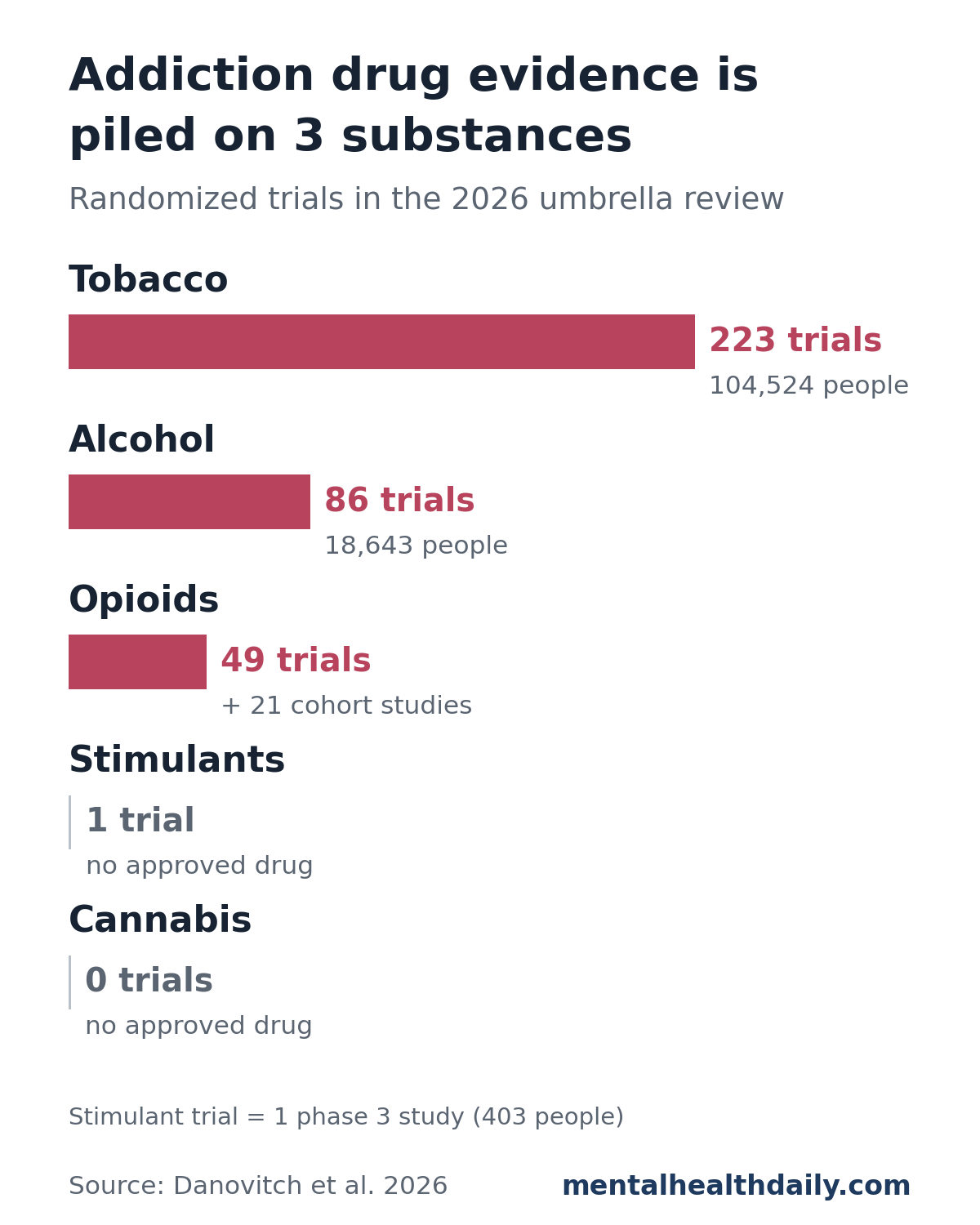
Trial counts are not effect sizes, but they show where confidence comes from. Tobacco medications rest on more than 100,000 randomized participants. The single stimulant trial had 403.
Varenicline Leads the Tobacco Use Disorder Evidence
Smoking-cessation drugs have the deepest and most consistent evidence of any addiction medications. Results are expressed as a risk ratio (RR): the chance of quitting on the drug divided by the chance of quitting on placebo, so an RR of 2 means twice as many people quit.1
- Varenicline: RR 2.32 (95% CI 2.15–2.51) across 41 trials and 17,395 people. Varenicline partly stimulates the nicotine receptors that drive craving while blocking nicotine from fully activating them.4
- Bupropion SR: RR 1.64 across 45 trials; compared directly with varenicline, it produced about 29% fewer quitters (RR 0.71).
- Nicotine replacement therapy (NRT): RR 1.55 across 133 trials and 64,640 people. Every form worked, from gum (1.49) and patch (1.64) to inhaler (1.90) and nasal spray (2.02), though the inhaler and spray estimates came from only 4 trials each.
- Cytisine: RR 1.30 across 4 trials. It is a plant-derived relative of varenicline and far cheaper in many countries.
These comparisons are partly indirect, because most trials tested one drug against placebo. The EAGLES trial closed that gap by randomizing 8,144 smokers to varenicline, bupropion, nicotine patch, or placebo. Varenicline beat placebo (OR 3.61), the patch (OR 1.68), and bupropion (OR 1.75), and it did not significantly increase moderate or severe psychiatric side effects, including in people with existing psychiatric disorders.5
Methadone vs. Buprenorphine for Opioid Use Disorder
Opioid use disorder has 2 main medication types that replace illicit opioids with a steady, longer-acting one. Methadone is a full opioid agonist, meaning it fully activates the mu-opioid receptor; buprenorphine is a partial agonist with a ceiling on its effect, which makes it safer in overdose and easier to prescribe outside specialized clinics.
Retention favored methadone. In the Degenhardt et al. meta-analysis, 6-month retention on buprenorphine was 24% lower than on methadone across 16 trials (RR 0.76, 95% CI 0.67–0.85) and 23% lower across 21 observational studies of 155,111 people (RR 0.77).3 Staying in treatment is a central outcome here, because leaving treatment is when death risk spikes.6
Illicit opioid use did not clearly differ. Urine-confirmed opioid use was not significantly different between the 2 drugs in a smaller Cochrane analysis (RR 0.81, 95% CI 0.57–1.17).1 Danovitch et al. described the tradeoff as methadone offering better retention and buprenorphine offering comparable or better suppression of use among those who stay.
Mortality data make the stakes concrete. A 2017 BMJ meta-analysis of 19 cohorts found all-cause death rates of 11.3 per 1,000 person-years during methadone treatment vs. 36.1 after leaving it, and 4.3 vs. 9.5 for buprenorphine, with the first 4 weeks after stopping especially dangerous.6
Long-Acting Injections and Naltrexone
- Long-acting injectable buprenorphine: in one 504-person trial, 41.3% to 42.7% of people were abstinent vs. 5.0% on placebo. In another trial, abstinence did not differ significantly from daily sublingual buprenorphine–naloxone (17.4% vs. 14.4%).1
- Naltrexone: this opioid blocker requires 7 to 10 opioid-free days before starting. The injectable and implant forms improved treatment retention (OR 1.86), while oral naltrexone did not (OR 1.52, not significant), largely because people stop taking the pills.1
- Naloxone for overdose: in 41 observational studies of community naloxone programs (74,114 people), survival after administration ranged from 92.4% when police gave it to 98.3% in drug treatment programs. These studies had no untreated comparison group, so they show high survival, not a precise lives-saved estimate.1
Alcohol Use Disorder Medications Show Smaller, Less Consistent Benefits
The alcohol evidence is where the review is most sobering. Effect sizes are smaller, there are fewer trials per drug, and reviews disagree more often than in the tobacco or opioid literature.1 Most numbers come from a 2023 JAMA meta-analysis by McPheeters et al.2
- Acamprosate: 12% lower risk of any return to drinking (RR 0.88, 20 trials, 6,380 people) and about 8 percentage points fewer drinking days. It did not lower the risk of a return to heavy drinking (RR 0.99). Acamprosate is thought to calm the glutamate overactivity that follows long-term drinking.
- Oral naltrexone 50 mg: the broadest profile, with 7% lower risk of any drinking (RR 0.93), 19% lower risk of heavy drinking (RR 0.81), fewer drinking days, and about half a drink less per drinking day. Naltrexone blocks opioid receptors that help make alcohol rewarding. The 100 mg dose added no benefit.
- Injectable naltrexone: about 2 fewer drinking days and 1 fewer heavy drinking day per month in 7 trials.
- Baclofen: 13% to 17% lower relapse risk across 2 reviews, with little effect on heavy drinking.
- Nalmefene: small but consistent reductions in total drinking, suited to cutting down rather than quitting.
- Disulfiram: no pooled benefit (RR 1.03, 3 trials). It works by making people sick if they drink, so it depends entirely on taking it; benefits appeared only in supervised settings.
In head-to-head trials, acamprosate and naltrexone did not differ significantly.2 Their placebo-controlled profiles point in different directions, though: acamprosate’s clearest benefit was keeping people from drinking at all, while naltrexone’s was keeping a slip from turning into heavy drinking. For someone whose goal is reducing heavy drinking, naltrexone has the stronger case.
No Approved Medication for Stimulant or Cannabis Use Disorder
The starkest finding is what is missing. No medication is approved anywhere in the review’s scope for cannabis, cocaine, methamphetamine or other stimulants, hallucinogens, inhalants, or caffeine.1
The single completed phase 3 stimulant trial was ADAPT-2, which tested injectable naltrexone every 3 weeks plus daily oral bupropion in 403 adults with methamphetamine use disorder.8
- Response rate: 13.6% on the combination vs. 2.5% on placebo, a difference of 11.1 percentage points (p < 0.001).1
- Number needed to treat: 9 people treated for 1 extra responder.
- Absolute scale: even on the combination, more than 8 in 10 people did not meet the response definition.
That result stands against a long list of failures. A 2019 Addiction meta-analysis of methamphetamine and amphetamine pharmacotherapy found that most tested drugs — antidepressants, anticonvulsants, aripiprazole, naltrexone alone, varenicline, and atomoxetine — showed no significant benefit, with only low-strength evidence for methylphenidate.7
Pipeline agents for alcohol use disorder were also thin: dutasteride, low-dose ondansetron, and zonisamide each had 1 phase 3 trial with favorable results. Ondansetron, tested in people with specific serotonin transporter gene variants, missed its primary endpoint in the full trial population; its benefit appeared in a prespecified heavy-drinking subgroup. Danovitch et al. called these single-trial results hypothesis-generating.1
GLP-1 receptor agonists such as semaglutide are in phase 2 and 3 trials across several substances, but none were approved for addiction as of 2026.1
Limits of This Addiction Medication Umbrella Review
- No common yardstick: tobacco results measure quitting, opioid results mostly measure retention, and alcohol results measure relapse or drinking days. The different outcomes prevent a valid numerical ranking of varenicline against methadone.
- A 10-year window: foundational trials of older drugs such as methadone and disulfiram mostly predate 2016 and appear only through later reviews.
- Missing is not the same as failed: 6 approved drugs, including heroin-assisted treatment and levomethadone, had no qualifying review. Danovitch et al. explicitly said this should not be read as evidence against them.
- Thin spots inside strong areas: injectable buprenorphine’s headline abstinence figures come largely from 1 trial, and the naltrexone retention estimate for opioid use disorder pooled injection and implant studies.
- The quality filter cuts both ways: AMSTAR-2 and ROBIS thresholds kept weak reviews out, but they also excluded emerging areas where no high-quality synthesis exists yet.
What the Addiction Medication Evidence Supports
For smoking: varenicline has the strongest single-drug evidence. Nicotine replacement in any form and bupropion are solid alternatives, and cytisine is a lower-cost option where it is available.
For opioid use disorder: methadone and buprenorphine are both effective and both lower death risk while people stay in treatment. Methadone holds people in care longer; buprenorphine is easier to access and safer in overdose. Naloxone should be on hand regardless.
For alcohol use disorder: medications help, but modestly. Naltrexone 50 mg has the broadest benefits, acamprosate helps most with staying abstinent, and disulfiram makes sense mainly when someone else supervises doses.
For stimulants and cannabis: there is no approved medication to prescribe, so treatment relies on non-drug approaches. The naltrexone–bupropion combination has 1 positive phase 3 trial for methamphetamine use but is not approved for it.
References
- Approved medications for substance use disorders: an umbrella review of systematic reviews and completed phase 3 randomized controlled trials. Danovitch I, et al. CNS Drugs. 2026 (published online; accepted August 21, 2026). doi:10.1007/s40263-026-01334-4
- Pharmacotherapy for alcohol use disorder: a systematic review and meta-analysis. McPheeters M, et al. JAMA. 2023;330(17):1653-1665. doi:10.1001/jama.2023.19761
- Buprenorphine versus methadone for the treatment of opioid dependence: a systematic review and meta-analysis of randomised and observational studies. Degenhardt L, et al. Lancet Psychiatry. 2023;10(6):386-402. doi:10.1016/s2215-0366(23)00095-0
- Nicotine receptor partial agonists for smoking cessation. Livingstone-Banks J, et al. Cochrane Database Syst Rev. 2023;5:CD006103. doi:10.1002/14651858.cd006103.pub8
- Neuropsychiatric safety and efficacy of varenicline, bupropion, and nicotine patch in smokers with and without psychiatric disorders (EAGLES): a double-blind, randomised, placebo-controlled clinical trial. Anthenelli RM, et al. Lancet. 2016;387(10037):2507-2520. doi:10.1016/s0140-6736(16)30272-0
- Mortality risk during and after opioid substitution treatment: systematic review and meta-analysis of cohort studies. Sordo L, et al. BMJ. 2017;357:j1550. doi:10.1136/bmj.j1550
- Pharmacotherapy for methamphetamine/amphetamine use disorder: a systematic review and meta-analysis. Chan B, et al. Addiction. 2019. doi:10.1111/add.14755
- Bupropion and naltrexone in methamphetamine use disorder. Trivedi MH, et al. N Engl J Med. 2021;384(2):140-153. doi:10.1056/nejmoa2020214