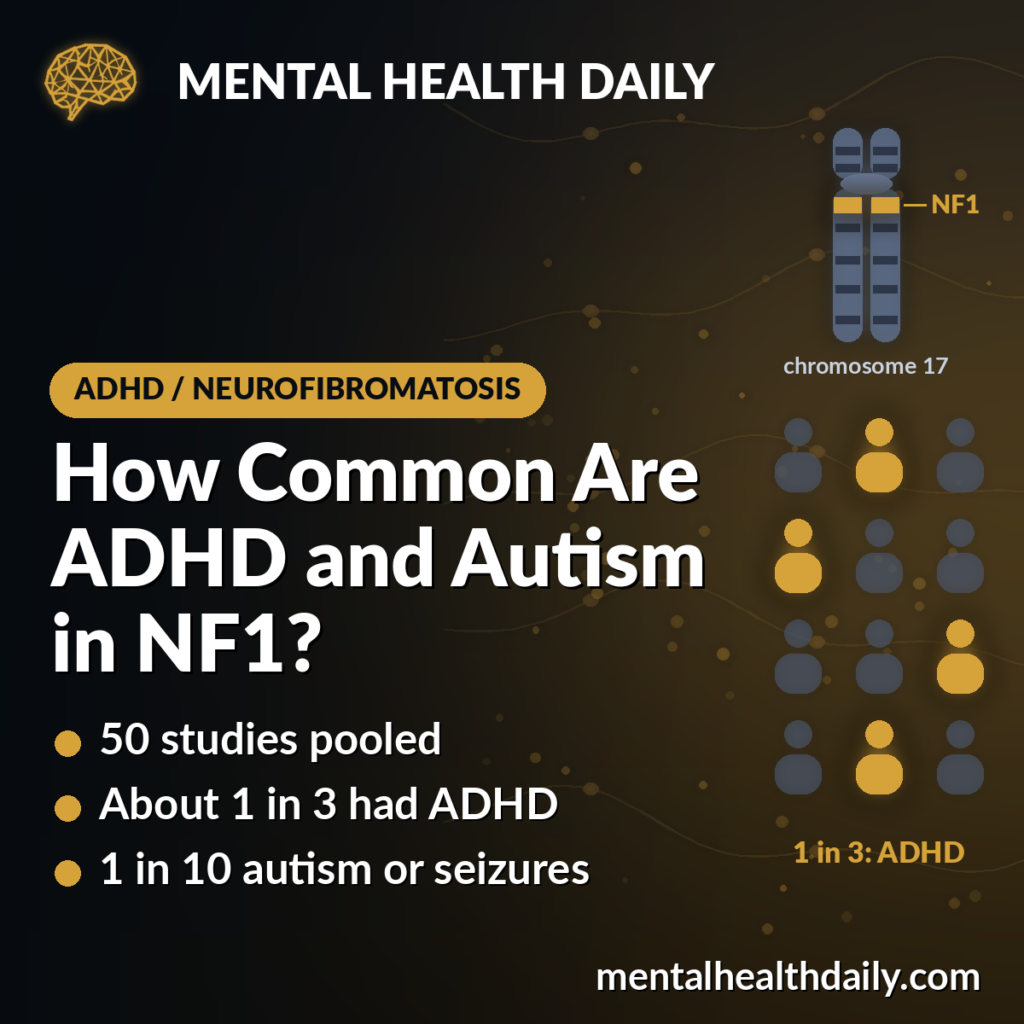
A 2026 meta-analysis of 50 studies estimated that about 1 in 3 people with neurofibromatosis type 1 (NF1) have ADHD (33%), and that roughly 1 in 10 have autism (11%), seizures (11%), depression (13%), or anxiety (12%).1 Every one of those figures sits well above typical population rates, but the individual studies disagreed so widely that the exact percentages are best read as rough centers of a very broad range.
Research Highlights
- ADHD was the most common condition: pooled prevalence 33% (95% CI 26% to 40%) across 29 studies, vs. a general-population estimate of about 3.4% in children and teens.1
- Autism, seizures, and intellectual disability clustered around 1 in 10: autism 11%, seizures 11%, epilepsy 9%, and intellectual disability 8%.1
- Mood and anxiety problems were common too: depression 13% and anxiety 12%; depression estimates varied between studies more than any other outcome.1
- Large NF1 deletions carried more intellectual disability: 41% in people missing the whole NF1 gene region, though that figure rests on only 2 studies.1
- A new study could land almost anywhere: the range expected for ADHD in a future comparable cohort ran from 2% to 73%.1
What NF1 Is and Why It Reaches the Brain
Neurofibromatosis type 1 (NF1) is a genetic condition that affects roughly 1 in 2,500 to 3,000 babies. It is best known for coffee-colored skin spots and benign tumors that grow along nerves, called neurofibromas. It is autosomal dominant: a single altered copy of the NF1 gene is enough to cause it.1
The NF1 gene makes a protein called neurofibromin, which acts as a brake on RAS/MAPK signaling — a chain of chemical relays that tells cells when to grow and divide. When neurofibromin is low, that pathway runs hot. In the body, this drives tumor growth. In the developing brain, researchers link it to changes in:1
- Neuroplasticity: how connections between neurons strengthen or weaken with learning.
- Myelination: the insulation that speeds signals along nerve fibers.
- Excitatory-inhibitory balance: the ratio of “go” to “stop” signaling in brain circuits, which is thought to shape attention and seizure risk.
Neuropsychiatric problems account for most of the non-tumor burden of NF1, yet published estimates of how common they are have ranged from a few percent to more than half of patients, depending on the study.1
ADHD, Autism, Seizures, and Mood Problems in NF1: The Pooled Estimates
Moreno-Charco et al. searched 3 large medical databases through April 2026 and found 50 observational studies from the Americas, Europe, Asia, and Oceania. The studies ranged from 24 to 8,579 participants, with average ages from 4.5 to 43.3 years. Reviewers rated 43 of the 50 studies (86%) as high quality on a standard checklist for prevalence research.1
Prevalence is simply the share of a group that has a condition. A meta-analysis pools prevalence from many studies into 1 estimate. This one used a random-effects model, which assumes each study is measuring a somewhat different true rate (because samples and methods differ) and estimates the average of those rates rather than a single fixed value.
The pooled estimates for people with NF1 in general were:1
- ADHD: 33% (95% CI 26% to 40%; 29 studies)
- Depression: 13% (3% to 23%; 11 studies)
- Anxiety: 12% (5% to 20%; 10 studies)
- Autism spectrum disorder: 11% (7% to 14%; 17 studies)
- Any seizures: 11% (8% to 14%; 13 studies)
- Epilepsy (recurring unprovoked seizures): 9% (6% to 11%; 16 studies)
- Intellectual disability: 8% (6% to 11%; 17 studies), mostly defined as an IQ below 70
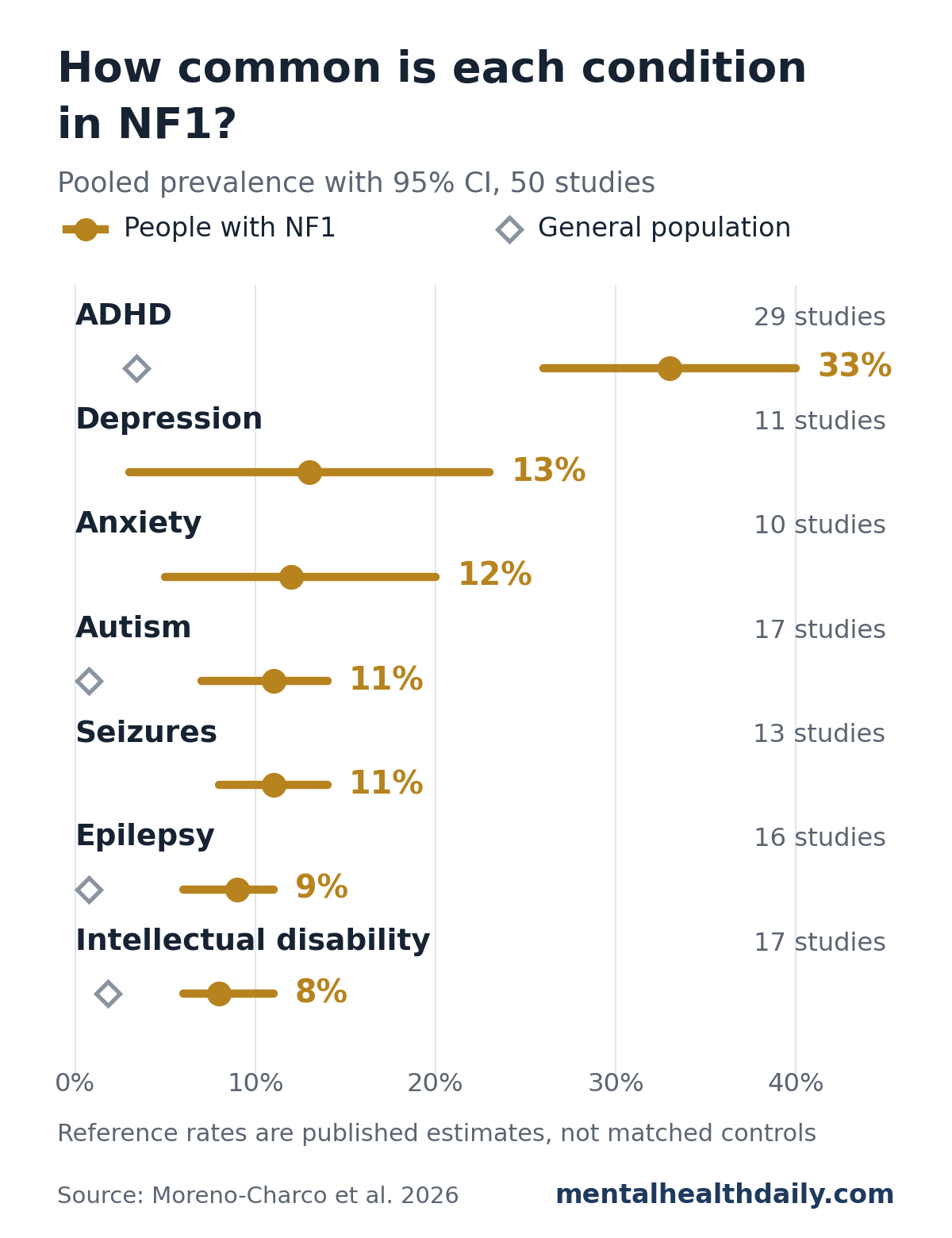
Comparison with the general population: the researchers set their results beside published reference rates of about 3.4% for ADHD in children and teens, 0.76% for autism, 1.8% for intellectual disability in children, and 0.64% to 0.76% for epilepsy. On those numbers, ADHD looks roughly 10 times more common in NF1, and autism and epilepsy more than 10 times more common.1
Those multiples are approximate. The meta-analysis pooled only people with NF1, with no matched comparison group, so the gap is context rather than a formally measured relative risk.
Why NF1 Studies Reported ADHD Anywhere From 3% to 72%
Individual studies put ADHD in NF1 anywhere from 3% to 72%, and depression from 1% to 55%. The narrow-looking 95% confidence intervals above describe how precisely the average was estimated. They do not describe how much individual studies disagreed. For that, the researchers reported 2 other measures:1
- I² (I-squared): the share of variation between studies that reflects real differences rather than chance. Above 75% counts as considerable. I² was 97% for ADHD, 99% for depression, 96% for anxiety, 92% for autism, 91% for epilepsy, and 80% for intellectual disability.
- Prediction interval: the range where the result of a new, similar study would be expected to fall. It ran from 2% to 73% for ADHD and from 0% to 63% for depression, but was tighter for intellectual disability (2% to 19%), seizures (3% to 22%), and epilepsy (1% to 21%).
Much of that spread traces to how each study found its cases:
- Registries and medical records: tended to give lower rates of ADHD, autism, and anxiety, because they only capture people who were referred, diagnosed, and coded.
- Screening questionnaires: tended to give higher depression rates. The highest single estimate, 55%, came from an adult sample scored with a depression symptom scale rather than a diagnostic interview.
- Specialist referral centers: concentrated more severe cases. A Paris tertiary-center sample reported intellectual disability in 23%, in part because it included children with brain tumors and epilepsy.
Small-study effects: smaller studies reported higher rates than larger ones for ADHD, autism, anxiety, seizures, and epilepsy. When the researchers ran a statistical adjustment (trim-and-fill) as a sensitivity check, the ADHD estimate fell to 27% and autism to 7%. They treated these as checks on robustness, not corrected answers, and removing any single study did not materially change the pooled results.1
Autism in NF1: Why Estimates Range From 11% to 25%
Autism shows the measurement problem most clearly, because 3 well-known NF1 studies land at and well above the pooled 11%:
- Unselected Dutch cohort: Eijk et al. assessed an unselected group of 128 children with NF1 (not chosen because of autism concerns), using both a clinician observation (ADOS) and questionnaires. Clinical autism was present in 10.9%, almost exactly the pooled figure.3
- International screening consortium: Morris et al. pooled 531 children from NF1 clinics in 4 countries. About 13% scored in the clinical autism range on a screening scale, and another 26% had milder, subclinical traits. Symptoms were spread along a continuum rather than splitting into “autistic” and “not autistic” groups.4
- Population-based UK study: Garg et al. used a 2-stage design with gold-standard diagnostic assessments and estimated autism in 24.9% of children with NF1 (95% CI 13.1% to 42.1%), with a further 20.8% showing a broader autism phenotype.2
Together these point to autism traits being common in NF1, with the rate of full diagnoses depending on how hard clinicians look. The 2026 review noted that some low estimates came from record-based studies without active case-finding, while social difficulties in NF1 can also be written off as part of ADHD or of NF1 itself.1
NF1 Microdeletions: More Intellectual Disability, Uncertain ADHD Signal
Most people with NF1 carry a small change within the NF1 gene itself. A smaller group carries an NF1 microdeletion — a missing stretch of chromosome 17 that removes the whole NF1 gene along with its neighbors, up to 14 working genes in total. Losing that many genes at once is thought to hit cognition disproportionately.1
Only 2 studies in the meta-analysis were limited to microdeletion carriers, with 57 and 29 participants:1
- Intellectual disability: 41% (95% CI 29% to 52%), about 5 times the 8% seen in NF1 overall. The 2 studies agreed closely (42% and 38%).
- ADHD: 45% (95% CI 25% to 65%), from estimates of 55% and 33%. That interval overlaps the 26% to 40% interval for NF1 overall.
The intellectual disability gap has a plausible explanation: the extra deleted genes include ones tied to synaptic plasticity and neurodevelopment, such as OMG and RNF135. For ADHD and autism, the researchers were explicit that the data cannot show whether microdeletions add risk beyond the NF1 gene itself; with so few studies, a higher rate was neither confirmed nor ruled out.1
Seizures and Epilepsy in NF1: About 1 in 10
The pooled seizure (11%) and epilepsy (9%) estimates line up with an earlier meta-analysis by Wu et al., which pooled 14 studies and 4,946 patients and found a seizure prevalence of 8.1% (95% CI 5.9% to 10.3%). Because the confidence intervals overlap, the 2 reviews are statistically compatible.1,5
Wu et al. also looked at outcomes, which prevalence alone cannot capture:5
- Seizure control: 68.5% of people with NF1 and seizures became seizure-free.
- Harder cases: seizures linked to cortical malformations or hippocampal sclerosis (scarring in a memory region of the temporal lobe) had poorer outcomes.
That fits the 2026 review’s point that NF1 epilepsy has 2 broad sources: an overexcitable brain from the RAS/MAPK changes themselves, and visible structural problems such as brain tumors or malformations.1
Depression and Anxiety in NF1 Rose With the Share of Women
Depression and anxiety estimates were the least stable in the meta-analysis, ranging from 1% to 55% for depression and 2% to 38% for anxiety across studies. One pattern did emerge: samples with more women reported more depression. Each 1-point increase in the percentage of female participants was linked to about a 1.1-point higher depression prevalence (p = 0.018), consistent with the sex gap seen in the general population.1
A Danish register study by Kenborg et al. supplies what the meta-analysis lacked: a matched comparison group. Researchers followed 905 people with NF1 and 7,614 population comparisons matched on sex and birth year, using hospital psychiatric diagnoses:6
- Childhood: both sexes with NF1 had higher rates of ADHD, autism, and intellectual disability.
- Early adulthood: women with NF1 also had higher rates of unipolar depression, other emotional and behavioral disorders, and severe stress and adjustment disorders.
- No excess: rates of psychosis, schizophrenia, bipolar disorder, and substance use disorders were similar to the comparison group.
That profile suggests NF1 mainly raises risk for neurodevelopmental conditions and, later, mood and stress-related problems, rather than across all psychiatric disorders.
What the Numbers Mean for NF1 Screening
The meta-analysis reinforces an existing recommendation rather than creating a new one. The American Academy of Pediatrics’ health supervision guidance for children with NF1 already calls for periodic monitoring as new features emerge with age, including school and learning difficulties.7 For families and clinicians, the pooled estimates suggest:
- ADHD deserves routine attention: with about 1 in 3 affected on average, attention and hyperactivity checks belong in regular NF1 care rather than waiting for a school crisis.
- Autism assessment should look past ADHD: social difficulties in a child with NF1 and ADHD may reflect autism traits that go undiagnosed when only records or brief screens are used.
- Mood screening should continue into adulthood: depression and anxiety risk appears to persist, especially in young women with NF1.
- Microdeletion carriers need closer developmental follow-up: roughly 4 in 10 had intellectual disability in the 2 available studies.
What this meta-analysis cannot answer: prevalence alone does not identify the best screening tool, the right screening interval, whether screening is cost-effective, or whether earlier treatment improves outcomes. The researchers flagged each of these as needing dedicated studies.1
Evidence Strength of the 2026 NF1 Prevalence Estimates
The design supports a firm qualitative conclusion — neurodevelopmental, mood, and seizure disorders are clearly more common in NF1 than in the general population — while leaving the exact percentages soft. Key limits:1
- No matched controls: comparisons with the general population rely on outside estimates from different ages, eras, and diagnostic methods.
- Mixed diagnostic methods: interviews, rating scales, parent reports, and registries were pooled together even though they measure somewhat different things.
- Changing definitions: the studies span about 3 decades, during which diagnostic criteria for autism, ADHD, and intellectual disability changed.
- Thin microdeletion data: 2 studies with 86 people in total.
- Possible overlap: some participants may appear in more than 1 study drawn from the same registries or consortia.
For an individual child or adult with NF1, the useful message is not a precise percentage. ADHD is common enough to check for routinely, and autism, seizures, intellectual disability, depression, and anxiety are each common enough to keep on the monitoring list.
References
- Prevalence of neuropsychiatric and seizure disorders in neurofibromatosis type 1: a systematic review and meta-analysis. Moreno-Charco E, et al. J Neurol. 2026;273:603. doi:10.1007/s00415-026-14143-y
- Neurofibromatosis type 1 and autism spectrum disorder. Garg S, et al. Pediatrics. 2013;132(6):e1642-e1648. doi:10.1542/peds.2013-1868
- Autism spectrum disorder in an unselected cohort of children with neurofibromatosis type 1 (NF1). Eijk S, et al. J Autism Dev Disord. 2018;48:2278-2285. doi:10.1007/s10803-018-3478-0
- Disease burden and symptom structure of autism in neurofibromatosis type 1: a study of the International NF1-ASD Consortium Team (INFACT). Morris SM, et al. JAMA Psychiatry. 2016;73(12):1276-1284. doi:10.1001/jamapsychiatry.2016.2600
- Prevalence, clinical characteristics and outcomes of seizures in neurofibromatosis type 1: a systematic review and single arm meta-analysis. Wu F, et al. Epilepsy Res. 2024;208:107476. doi:10.1016/j.eplepsyres.2024.107476
- Psychiatric disorders in individuals with neurofibromatosis 1 in Denmark: a nationwide register-based cohort study. Kenborg L, et al. Am J Med Genet A. 2021;185(12):3706-3716. doi:10.1002/ajmg.a.62436
- Health supervision for children with neurofibromatosis type 1. Miller DT, et al. Pediatrics. 2019;143(5):e20190660. doi:10.1542/peds.2019-0660