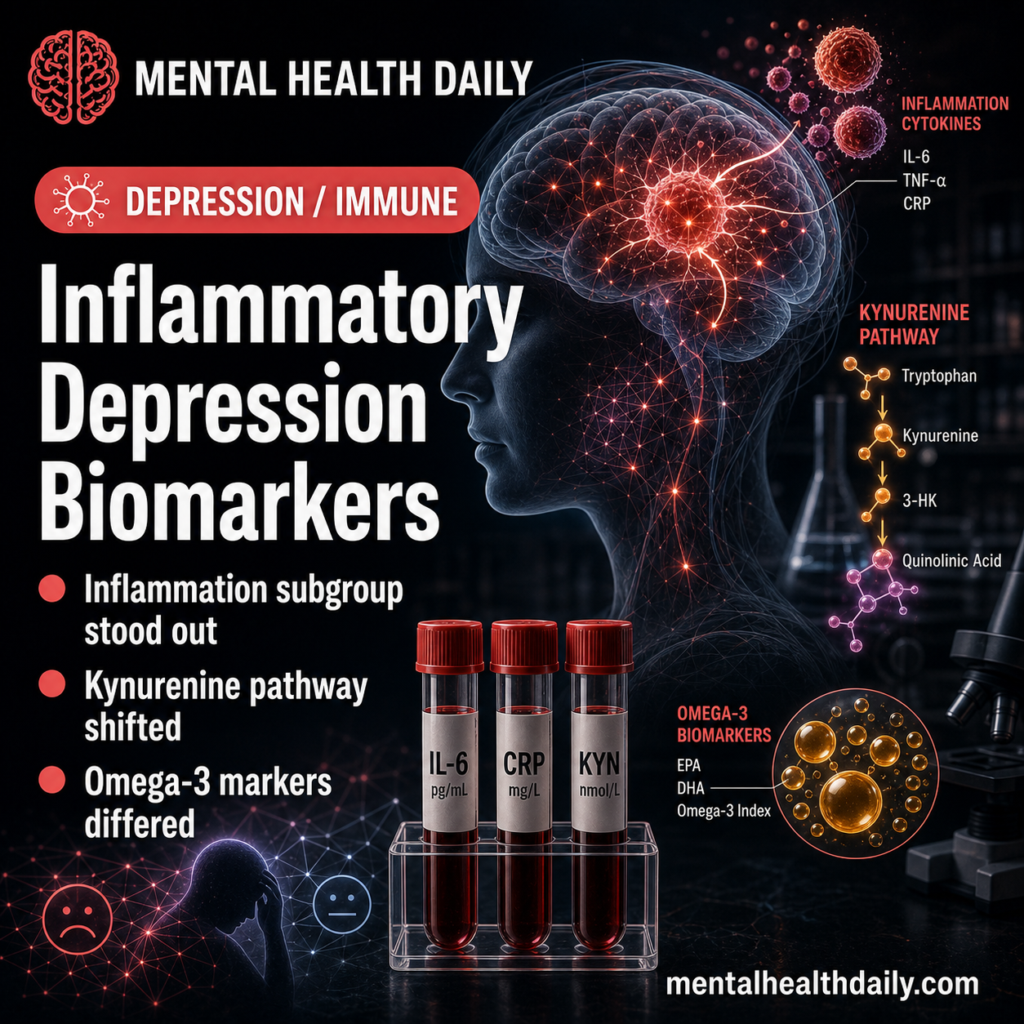
A 2026 biomarker study found kynurenine-pathway activation in inflammatory major depressive disorder (MDD), but not across all depression cases. Compared with non-inflammatory MDD and healthy controls, the inflammatory subgroup had higher pathway metabolites, and omega-3 treatment reduced several of them over 8 weeks.1
Research Highlights
- Inflammatory depression showed kynurenine activation: people with MDD and high-sensitivity C-reactive protein (hs-CRP) ≥1 mg/L had higher quinolinic acid, 3-hydroxykynurenine, and kynurenine than non-inflammatory MDD and healthy controls.1
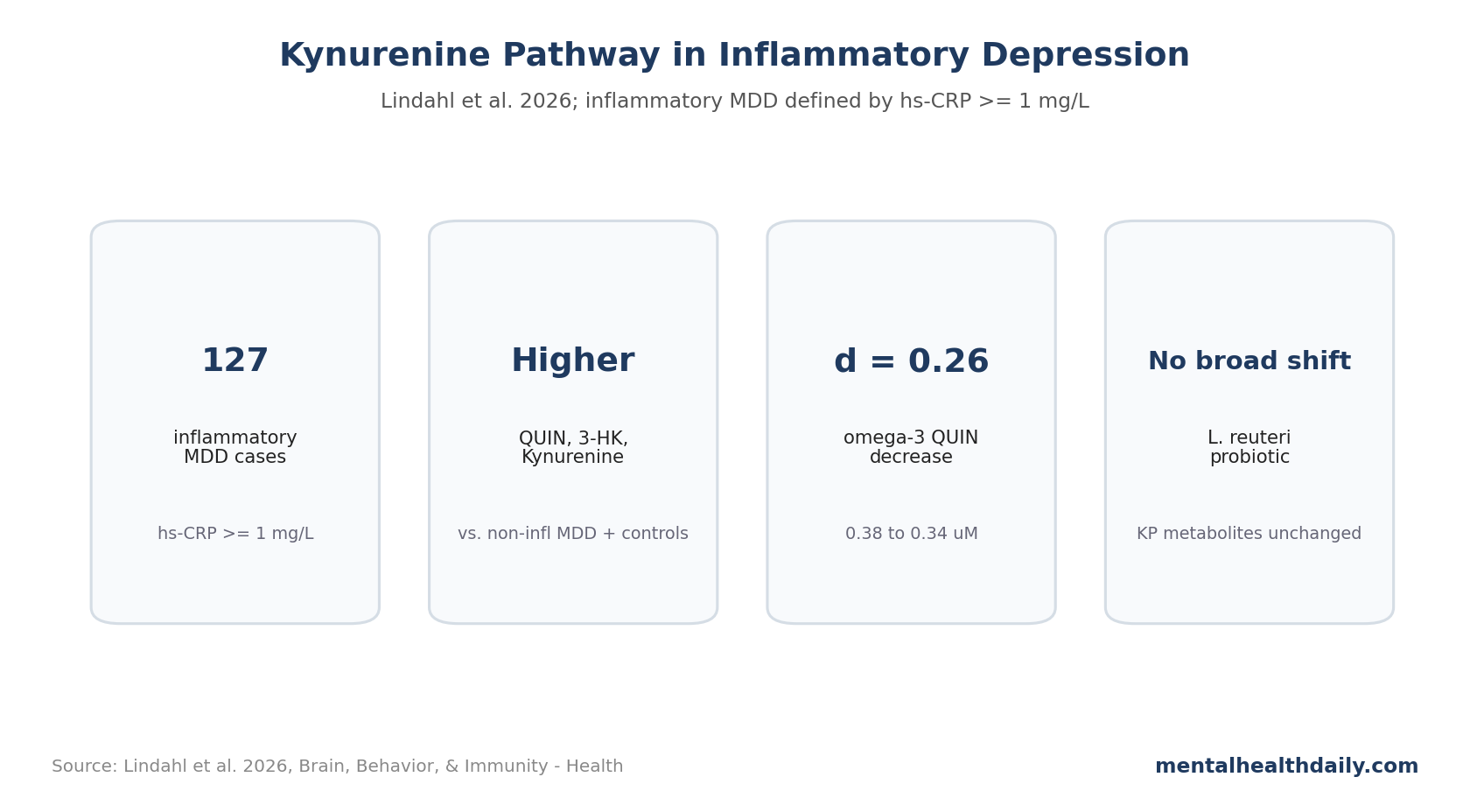
- The sample was biomarker-rich: baseline kynurenine-pathway data were available for 250 people: 127 inflammatory MDD, 43 non-inflammatory MDD, and 80 healthy controls.1
- Omega-3 shifted several metabolites: in patients receiving omega-3 polyunsaturated fatty acids, quinolinic acid, kynurenic acid, and 3-hydroxykynurenine decreased over 8 weeks.1
- Probiotic effects were not parallel: Lactobacillus reuteri did not significantly change kynurenine-pathway metabolites beyond a nicotinamide decrease also seen in controls or placebo groups.1
- The result supports stratification: depression biology may be easier to detect when patients are separated by inflammatory status such as hs-CRP ≥1 mg/L instead of pooled into one broad MDD group.
Kynurenine is part of tryptophan metabolism. Tryptophan can feed serotonin synthesis, but it can also enter the kynurenine pathway, producing metabolites that interact with immune signaling, oxidative stress, glutamate signaling, nicotinamide adenine dinucleotide (NAD+) biology, and brain function.
The important point is not that every person with depression has the same “kynurenine problem.” The data argue almost the opposite: the pathway signal became visible when MDD was split by inflammatory status.
250 People Were Stratified by hs-CRP Inflammation Status
Lindahl et al. combined participants from omega-3 and probiotic depression studies. At baseline, kynurenine-pathway data were available for 170 people with MDD and 80 healthy controls.1
The MDD group was divided by high-sensitivity C-reactive protein (hs-CRP), a blood marker of low-grade systemic inflammation:
- Inflammatory MDD: 127 patients with hs-CRP ≥1 mg/L.
- Non-inflammatory MDD: 43 patients with hs-CRP <1 mg/L.
- Healthy controls: 80 participants without MDD.
The researchers also ran a sensitivity analysis using hs-CRP ≥3 mg/L. With that stricter threshold, inflammatory depression still showed robustly elevated quinolinic acid and 3-hydroxykynurenine, though some other biomarker differences weakened.
Hs-CRP thresholds are not magic cut points. A result that survives at a stricter threshold for key metabolites is more persuasive than one that appears only at a permissive cutoff.
QUIN, 3-HK, and Kynurenine Were Higher in Inflammatory MDD
The baseline comparison was the core result. Compared with both healthy controls and non-inflammatory MDD, the inflammatory depression group had significantly higher quinolinic acid (QUIN), 3-hydroxykynurenine (3-HK), and kynurenine (Kyn).1
These metabolites are not interchangeable:
- Quinolinic acid: often discussed as a neuroactive metabolite that can interact with N-methyl-D-aspartate (NMDA) glutamate receptors.
- 3-hydroxykynurenine: linked to oxidative stress biology and immune pathway activation.
- Kynurenine: an upstream pathway metabolite that can feed several downstream branches.
- Kynurenic acid: a metabolite with NMDA-antagonist properties, but also possible cognitive relevance depending on context.
The biomarker pattern points to pathway activation in an inflammatory subgroup, not a universal depression signature. That distinction helps explain why older studies of kynurenine metabolites in depression have often looked inconsistent.
The non-inflammatory MDD group had lower kynurenic acid than both controls and inflammatory MDD, and lower tryptophan than controls. No significant group differences were found for nicotinamide or picolinic acid.
Subtype signal: the contrast keeps the result from becoming a generic inflammation story. If systemic inflammation merely marked worse overall health, every kynurenine-pathway marker might be expected to rise together.
Instead, the pattern was more selective: inflammatory MDD separated most clearly on QUIN, 3-HK, and kynurenine, while non-inflammatory MDD carried its own lower kynurenic-acid and tryptophan pattern.
Research use: the finding gives future trials a sharper target: enroll or stratify patients by inflammatory status, then test whether pathway-shifting interventions change both metabolites and symptoms.
Without that stratification, a real subgroup signal can be diluted by patients whose depression biology is being driven by sleep disruption, trauma load, endocrine disease, medication effects, pain, or other non-kynurenine mechanisms.
Omega-3 Reduced QUIN, Kynurenic Acid, and 3-HK Over 8 Weeks
97 patients received omega-3 polyunsaturated fatty acids (n-3 PUFAs). In that group, several metabolites decreased significantly over 8 weeks:
- Quinolinic acid: 0.38 to 0.34 μM, Cohen's d = 0.26, p = 0.017.
- Kynurenic acid: 0.053 to 0.049 μM, Cohen's d = 0.30, p = 0.006.
- 3-hydroxykynurenine: 0.027 to 0.025 μM, Cohen's d = 0.26, p = 0.016.
- Kynurenine: 2.17 to 2.11 μM, p = 0.060.
The changes were small, but biologically coherent. Omega-3 treatment did not produce a dramatic collapse of the pathway; it modestly shifted several metabolites in the expected direction.
Clinical-response signals were more exploratory. Higher baseline kynurenic acid, kynurenine, and 3-HK correlated with greater improvement in Hamilton Depression Rating Scale scores, each around rho 0.21-0.22. Omega-3 responders had higher baseline QUIN, kynurenic acid, kynurenine, and 3-HK than non-responders.1
Those correlations did not all survive the strongest multiple-comparison framing, so they should be read as hypothesis-generating. Still, they fit a precision-treatment idea: omega-3 may be more biologically relevant when inflammatory and kynurenine-pathway signals are present.
Practical interpretation: the omega-3 data are stronger as a mechanism signal than as a stand-alone treatment recommendation. A small metabolite shift over 8 weeks does not prove that omega-3 meaningfully treats inflammatory depression by itself. It does, however, support testing omega-3 as one component of a biomarker-guided strategy, especially in patients whose depression overlaps with elevated hs-CRP, metabolic inflammation, fatigue, and anhedonia.
Probiotic Supplementation Did Not Reproduce the Same Pathway Shift
The probiotic arm used Lactobacillus reuteri. In that group, nicotinamide decreased, but a similar nicotinamide decrease also appeared in controls with repeated sampling and in MDD patients receiving placebo.1
No other kynurenine-pathway metabolites changed significantly with L. reuteri, placebo, or repeated sampling in healthy controls. That makes the probiotic result much less compelling than the omega-3 result for this specific pathway.
This is a useful negative finding. Gut-brain and probiotic discussions often drift into generic “microbiome helps mood” language. Here, the measured pathway did not show a broad probiotic-linked shift.
Probiotics may still affect depression, inflammation, or tryptophan metabolism in other contexts. This specific L. reuteri study, in this inflammatory-depression sample, did not move the measured kynurenine markers the way omega-3 did.
Kynurenine Biology Fits the Inflammation-Depression Subtype
The kynurenine pathway is attractive in depression research because it links immune activation to neuroactive metabolites. Inflammatory cytokines can shift tryptophan metabolism toward kynurenine, and downstream metabolites can interact with glutamate signaling, oxidative stress, and energy metabolism.2
That pathway could connect several depression features:
- Anhedonia: reduced ability to feel pleasure may track inflammation and reward-circuit changes in some patients.
- Fatigue: immune and metabolic signals can affect energy, sleepiness, and effort allocation.
- Cognition: glutamate and kynurenic-acid signaling may affect attention and memory.
- Treatment response: anti-inflammatory or metabolism-shifting interventions may work better in biomarker-defined subgroups.
The field has repeatedly struggled when all MDD is analyzed as one biological condition. MDD is a syndrome, not a single disease mechanism. Some patients have inflammatory signatures; others do not.
The subtype split is more informative than any single metabolite. It says the pathway may be present where inflammation is present, which is more plausible than claiming kynurenine metabolites define depression as a whole.
Clinically, a single kynurenine lab value is too narrow for treatment decisions.
More plausible panel: depressive phenotype, hs-CRP, body mass index, metabolic health, sleep, fatigue, anhedonia, medication history, and perhaps pathway metabolites in research settings. One marker rarely carries enough information by itself.
The omega-3 findings should be read with the same calibration. Omega-3 supplementation is not a substitute for standard depression care, and the metabolite changes were modest. But the data make a biologically sensible prediction: if omega-3 helps a subset of MDD patients, that subset may be enriched for inflammatory and kynurenine-pathway abnormalities rather than randomly distributed across all depression.
Limitations of This Kynurenine Depression Study
- Exploratory response analyses: several treatment-response correlations used unadjusted p-values and should not be overread.
- Inflammation threshold choice: hs-CRP ≥1 mg/L is defensible, but different thresholds produce different subgroup sizes.
- BMI confounding: inflammatory depression had the highest mean body mass index, and adiposity can influence CRP and metabolism.
- Peripheral biomarkers: blood kynurenine metabolites do not perfectly map onto brain concentrations or cellular source.
- Intervention heterogeneity: omega-3, probiotic, placebo, and repeated-control sampling came from related but not identical study contexts.
Questions About Inflammatory Depression and Kynurenine
Does every person with depression have high kynurenine metabolites?
No. The signal appeared in inflammatory MDD, not in the whole depression group as a single undifferentiated category.
Should hs-CRP be checked before omega-3 for depression?
The study supports that idea as a research strategy, but it does not establish a clinical prescribing rule by itself.
Were omega-3 effects large?
No. Metabolite changes were modest, with Cohen's d around 0.26-0.30 for significant changes. The value is more mechanistic than dramatic.
How should the 2026 kynurenine findings change the research question?
Inflammation-stratified depression research is more informative than treating MDD as biologically uniform. Kynurenine metabolites may help identify and understand an inflammatory subtype, but they are not ready as standalone diagnostic tests.
References
- Kynurenine pathway metabolites are increased in inflammatory depression. Lindahl J, et al. Brain, Behavior, & Immunity – Health. 2026;53:101221. doi:10.1016/j.bbih.2026.101221
- The kynurenine pathway: a finger in every pie. Savitz J. Molecular Psychiatry. 2020;25:131-147. doi:10.1038/s41380-019-0414-4
- Omega-3 fatty acids for inflamed depression: a match/mismatch study. Suneson K, et al. Brain, Behavior, and Immunity. 2024;118:192-201. doi:10.1016/j.bbi.2024.02.029
- Inflammation as a predictive biomarker for response to omega-3 fatty acids in major depressive disorder. Rapaport MH, et al. Molecular Psychiatry. 2016;21:71-79. doi:10.1038/mp.2015.22
- Plasma kynurenine levels are elevated in suicide attempters with major depressive disorder. Sublette ME, et al. Brain, Behavior, and Immunity. 2011;25:1272-1278. doi:10.1016/j.bbi.2011.05.002