A 2026 PLOS Biology study using 256-electrode EEG and 1,024 NREM2 awakenings found that immersive dreaming predicted deeper subjective sleep, beta = 0.277, while reflective thought predicted shallower subjective sleep, beta = −0.195.1 Deep-feeling sleep can include immersive conscious experience.
Research Highlights
- Immersion predicted depth: Perceptual immersion in NREM2 dreams was positively associated with subjective sleep depth, beta = 0.277, CI 0.208 to 0.346, p < 0.00001.1
- Reflective thought predicted shallower sleep: Thought-like mentation had beta = −0.195, CI −0.287 to −0.102, p = 0.00004.1
- The dataset was dense: Researchers analyzed 196 overnight high-density EEG recordings from 44 healthy adults and collected 1,024 NREM2 awakenings.1
- Report types separated: The awakenings included 432 conscious-experience reports, 364 white-dream reports, and 228 no-conscious-experience reports.1
- Sleepiness was a different dimension: Subjective sleepiness did not follow the same pattern as sleep depth; the 2 ratings diverged across the night.1
NREM2 sleep is a non-rapid-eye-movement sleep stage that makes up a large share of ordinary sleep and sits between lighter NREM1 sleep and deeper slow-wave NREM3 sleep. It is not usually treated as the dream-rich stage, but people can still report mental experience when awakened from it.
Subjective sleep depth means how deep sleep felt to the sleeper after awakening. That is different from physiological sleep depth, which is usually inferred from EEG frequency patterns, arousal threshold, slow waves, or sleep-stage scoring.
1,024 NREM2 Awakenings Tested Sleep Depth Directly
Michalak et al. studied 44 healthy adults across 196 overnight recordings with 256-electrode EEG. Participants were repeatedly awakened from NREM2 sleep and asked about prior mental activity, perceived sleep depth, and sleepiness. The design produced 1,024 awakenings with subjective reports.1
Reports were divided into 3 broad groups. Participants described conscious experiences with recalled content in 432 awakenings. They described conscious experiences without recall of content, often called white dreams, in 364 awakenings. They reported no conscious experience in 228 awakenings.
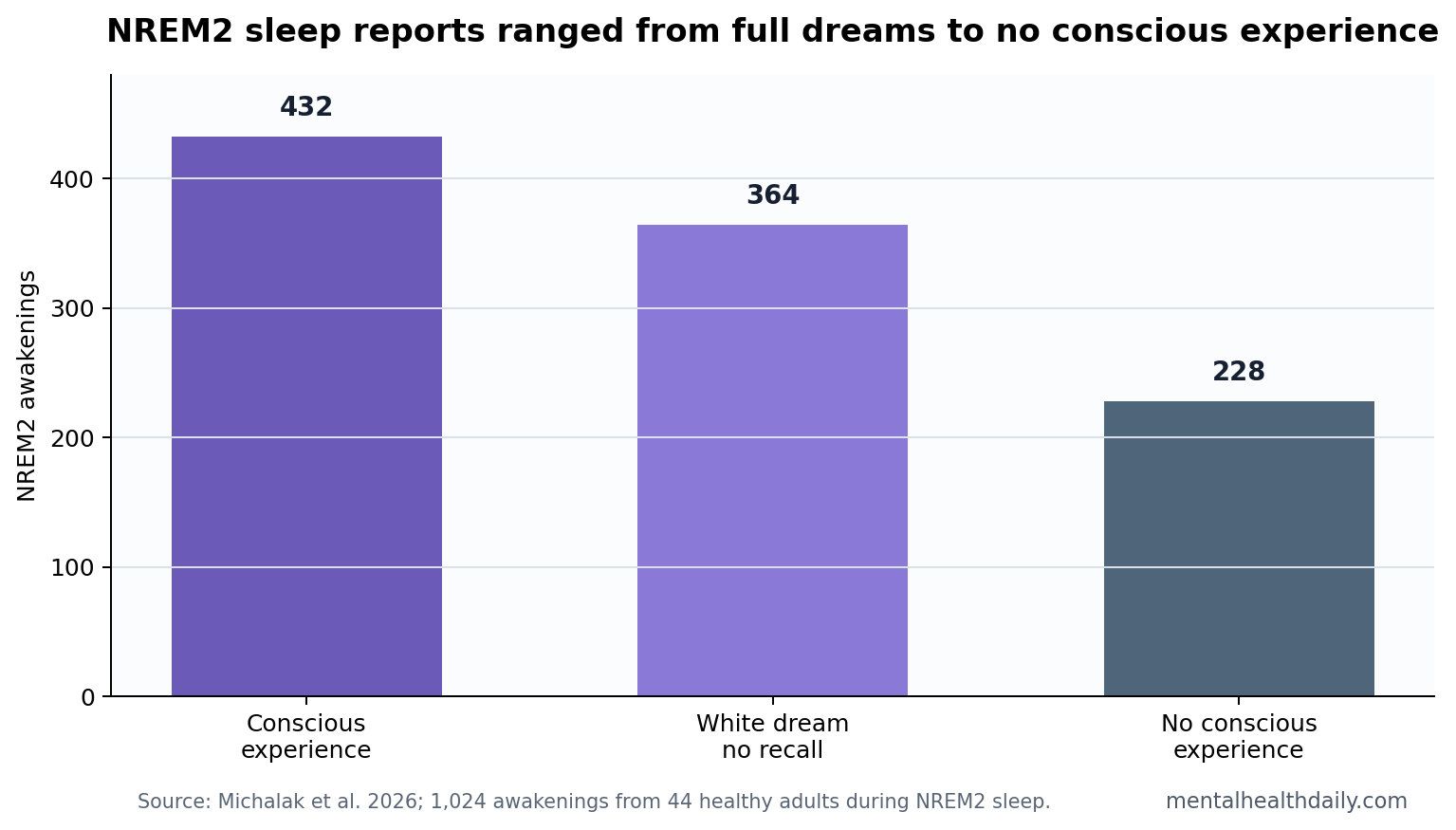
White dreams are reports where a person has the impression that something was experienced during sleep but cannot recall specific content. This category matters because absence of recall is not the same as absence of consciousness.
Immersive Dreams Felt Deep, Minimal Presence Felt Shallow
The strongest result came from the quality of experience. The researchers used principal component analysis to reduce dream ratings into 2 dimensions. Perceptual immersion captured vividness, sensory richness, duration, emotional intensity, bizarreness, and REM-like dream quality. Reflective thought captured more abstract, thinking-like mentation.
Perceptual immersion predicted deeper subjective sleep, beta = 0.277, CI 0.208 to 0.346, p < 0.00001. Reflective thought predicted shallower subjective sleep, beta = −0.195, CI −0.287 to −0.102, p = 0.00004.1
That pattern explains why the simple “dreaming means light sleep” rule fails. Vivid, immersive dreaming can feel deep. Minimal conscious presence, by contrast, produced the lowest depth ratings. Complete unconsciousness also felt deep, but it was not the only route to deep-feeling sleep.
EEG Activation Did Not Map Cleanly Onto Sleep Depth
High-density EEG records scalp electrical activity from many electrodes at once, allowing researchers to map frequency patterns across the head rather than relying on a small electrode set. In this study, higher gamma activity and a higher gamma-to-delta ratio generally aligned with lighter perceived sleep, but conscious experience changed that mapping.
When participants reported dreaming, wake-like cortical activation appeared less disruptive to subjective sleep depth. The paper described this as an attenuation of the usual inverse relationship between high-frequency activity and deep-feeling sleep.1
Nir et al. previously showed that dream reports can be predicted by local EEG patterns in a posterior cortical hot zone rather than by sleep stage alone.2 Siclari et al. extended that NREM point with high-density EEG work showing that NREM dreaming depends on local sleep dynamics, not a global on/off consciousness switch.3
Sleep Depth and Sleepiness Moved Apart Overnight
Subjective sleep depth increased as the night progressed, beta = 0.127, CI 0.103 to 0.151, p < 0.00001. Subjective sleepiness followed a different trajectory: the interaction between time and measure showed that sleepiness increased less steeply than perceived sleep depth, beta = −0.166, CI −0.277 to −0.056, p = 0.00325.1
This is counterintuitive because physiological sleep pressure usually declines overnight. A sleeper would be expected to feel lighter as the homeostatic need for sleep dissipates. Instead, perceived sleep depth rose alongside increasingly immersive dream experience.
Clinical implication: complaints about “light sleep” may not map one-to-one onto stage scoring or sleep duration. Dream quality, awakenings, sleep inertia, and memory for mentation may shape whether sleep felt restorative.
Sleep Perception Is Not the Same as Sleep Architecture
Sleep architecture is the objective distribution of sleep stages across the night: NREM1, NREM2, NREM3, and REM sleep. It is useful, but it does not fully explain what sleep felt like to the person who woke up. Michalak et al. measured that gap directly by pairing EEG-defined NREM2 awakenings with immediate subjective reports.
The result helps explain why 2 people with similar sleep-stage summaries can report different sleep quality. One sleeper may wake from NREM2 with immersive dream experience and rate the sleep as deep. Another may wake from NREM2 with a vague sense of presence, fragmented thought, or partial awareness and rate the sleep as shallow.
Measurement consequence: subjective sleep quality should not be reduced to total sleep time or one stage percentage. A complete sleep-perception model needs at least 3 layers: objective physiology, timing of awakenings, and the conscious or near-conscious experience immediately before awakening.
This helps explain why sleep trackers can feel wrong even when their stage estimates are directionally reasonable. A device can estimate movement, heart rate, breathing, or EEG-like signals, but it usually cannot know whether the sleeper woke from immersive dreaming, thought-like mentation, minimal presence, or true unconsciousness. The subjective report can therefore diverge from the score.
Insomnia relevance: insomnia often involves a mismatch between objective sleep and perceived sleep. The Michalak study did not test insomnia, but it gives a plausible mechanism for that mismatch: the content and form of near-awakening experience may shape whether sleep feels deep, fragmented, or absent.
The serial-awakening method is unusually strong for this question because it reduces memory delay. Morning dream recall can miss earlier mentation or rewrite it through later sleep and waking interpretation. Asking immediately after NREM2 awakenings gives a closer read on the experience that actually preceded the sleep-depth rating.
That immediacy also creates the main tradeoff. Repeated awakenings produce better reports but make sleep less natural. The result is therefore best read as a controlled map of sleep perception, not as a perfect copy of an uninterrupted night.
Sleep-depth language should therefore be used carefully. A person saying “I slept lightly” may be describing stage structure, frequent awakenings, low arousal threshold, unpleasant thought-like mentation, or a memory of being partly aware. Those are overlapping but separable problems. The 2026 data make the last 2 possibilities harder to ignore.
Research direction: the next useful step pairs objective sleep measurement with richer immediate reports in people who complain that they sleep poorly despite adequate measured sleep, especially after repeated brief awakenings and morning recall gaps.
Why the Result Does Not Prove Dreaming Improves Sleep
The study is correlational. It can show that immersive NREM2 dreaming was associated with deeper perceived sleep, but it cannot prove that dreams caused better sleep quality. Serial awakenings also fragment sleep by design, and repeated questioning can alter later sleep perception.
Windt et al. argued that minimal conscious experience can exist without full narrative content.4 That concept helps interpret the lowest-depth category in Michalak et al.: a vague sense of presence may be neither restful unconsciousness nor immersive dreaming, leaving sleep feeling shallow.
Best inference: subjective sleep depth is partly constructed. The brain’s electrical state matters, but so does the form of conscious experience occurring inside that state.
Measurement caution: this does not make subjective reports unreliable. It means they measure a different layer of sleep. Polysomnography can classify stage and arousal, while an immediate awakening report can capture whether the person experienced immersion, thought-like content, vague presence, or nothing remembered. Treating those sources as competitors misses the point; the useful question is how they combine.
For insomnia and sleep-quality research, that combination is the practical target. A person can have adequate NREM2 time but still remember shallow, fragmented, or semi-aware experience. Conversely, immersive mentation can make sleep feel deeper even when conventional sleep pressure is falling across the night.
Questions About NREM2 Dreaming and Sleep Depth
Does this mean dreams make sleep deeper?
Not proven. The study shows that immersive dreaming was linked to deeper perceived sleep. Causality would require experiments that change dream immersion or sensory input while measuring sleep perception.
Is NREM2 dreaming the same as REM dreaming?
No. REM dreams are often more vivid and narrative, but NREM2 can still contain conscious experience. This paper showed that some NREM2 experiences were immersive enough to shape perceived sleep depth.
Could this explain insomnia?
Possibly in part, but the study used healthy adults. Insomnia research would need to test whether thought-like, less immersive mentation makes sleep feel shallow even when objective sleep is present.
References
- Michalak J, et al. Immersive NREM2 dreaming preserves subjective sleep depth against declining sleep pressure. PLOS Biology. 2026;24:e3003683. doi:10.1371/journal.pbio.3003683
- Nir Y, et al. The neural correlates of dreaming. Nature Neuroscience. 2017. doi:10.1038/nn.4545
- Siclari F, Bernardi G, Cataldi J, Tononi G. Dreaming in NREM sleep: a high-density EEG study of slow waves and spindles. Journal of Neuroscience. 2018;38:9175-9185. doi:10.1523/jneurosci.0855-18.2018
- Windt JM, Nielsen T, Thompson E. Does consciousness disappear in dreamless sleep? Trends in Cognitive Sciences. 2016;20:871-882. doi:10.1016/j.tics.2016.09.006