
Adults with physical disabilities who were kinder to themselves and more psychologically flexible reported fewer symptoms of depression, according to a 2026 US survey. Shame was also less closely linked to depression in people who scored high on either trait.1
Research Highlights
- Shame went with more depression: among 207 adults with physical disabilities, shame was the strongest predictor of depressive symptoms (β = .55, p < .001).1
- Self-compassion and flexibility went with less: both were linked to fewer depressive symptoms beyond what shame explained — self-compassion (β = −.25, p < .001) and psychological flexibility (β = −.16, p = .003).1
- A weaker shame-depression link at high levels: the link between shame and depression was roughly 40% weaker in people high in either trait than in people low in it.1
- A one-time survey: everything was measured once, by self-report, so the study shows links rather than cause and effect.1
- Consistent with broader research: a meta-analysis found a large inverse link between self-compassion and mental health symptoms (r = −0.54).4
Why Shame Is a Focus for Depression in Physical Disability
Mental distress is far more common among adults with disabilities. In a 2018 CDC survey, 32.9% of US adults with any disability reported frequent mental distress (14 or more bad mental health days a month), compared with 7.2% of adults without a disability.2
That 4.6-fold gap covers all disability types, including cognitive ones. Adults with only a mobility disability reported frequent distress 2.4 times as often as adults without a disability, and those with both mobility and cognitive disabilities 8.8 times as often.2
Michael Christopher et al. point to shame as one pathway. Repeated staring, awkward offers of help, inaccessible spaces and outright discrimination can send the message that a person is “other.” Over time, that outside stigma can turn inward as a sense of being defective or unwanted.1
Shame tends to drive withdrawal and isolation. Those reactions ease social threat in the short run but deepen loneliness and distress over time.1
What Psychological Flexibility and Self-Compassion Mean
The researchers tested 2 traits that shape how a person relates to painful thoughts and feelings:
- Psychological flexibility: the ability to notice hard thoughts and feelings without getting stuck in them or avoiding them, and to keep acting on what matters to you. A thought like “I’m a burden” is treated as a passing mental event rather than a fact. It is the core skill built in acceptance and commitment therapy (ACT), a talk therapy that combines acceptance and mindfulness skills with values-based action.
- Self-compassion: treating yourself with the same kindness you would offer a friend during pain or failure. It has 3 parts: self-kindness instead of harsh self-judgment, seeing suffering as part of being human, and noticing painful feelings without being swept away by them.
Shame involves harsh self-criticism. Self-compassion works in the opposite direction, which is why researchers expected it to soften shame’s link to depression.1
How the Disability and Depression Survey Was Done
- Participants: 207 US adults, aged 18 to 71 (average 44), who self-identified as having a physical disability
- Recruitment: a Qualtrics online survey panel in June 2022
- Sample: 44% women, 40% men, 14% nonbinary and 3% transgender; about half White, with 18% Black and 18% multiracial respondents
- Measures: standard questionnaires for shame, depressive symptoms (the depression scale of the DASS-21), psychological flexibility and self-compassion
Researchers used regression models to see whether flexibility and self-compassion predicted depression once shame was accounted for. They then tested whether the strength of the shame-depression link changed with each trait.
Age, gender, relationship status, race and ethnicity did not predict depression in early checks (all p > .20), so they were left out of the main models.1
Self-Compassion and Flexibility Were Linked to Fewer Depressive Symptoms
Shame was strongly linked to depression (β = .55, p < .001), uniquely accounting for about 37% of the variation in depressive symptoms.1
Even with shame in the model, both traits were linked to lower depression scores:
- Self-compassion: β = −.25 (p < .001), uniquely explaining about 8% of the variation
- Psychological flexibility: β = −.16 (p = .003), uniquely explaining about 4%
A standardized beta (β) shows how much depression scores shift, in standard units, when a predictor rises by 1 standard unit and the other predictors stay the same. Negative values mean higher levels of the trait went with lower depression.
Shame Was Less Tightly Linked to Depression at High Levels of Each Trait
The second question was whether flexibility and self-compassion changed how closely shame tracked depression. Both did, with small interaction effects (each added about 2% of explained variation).1
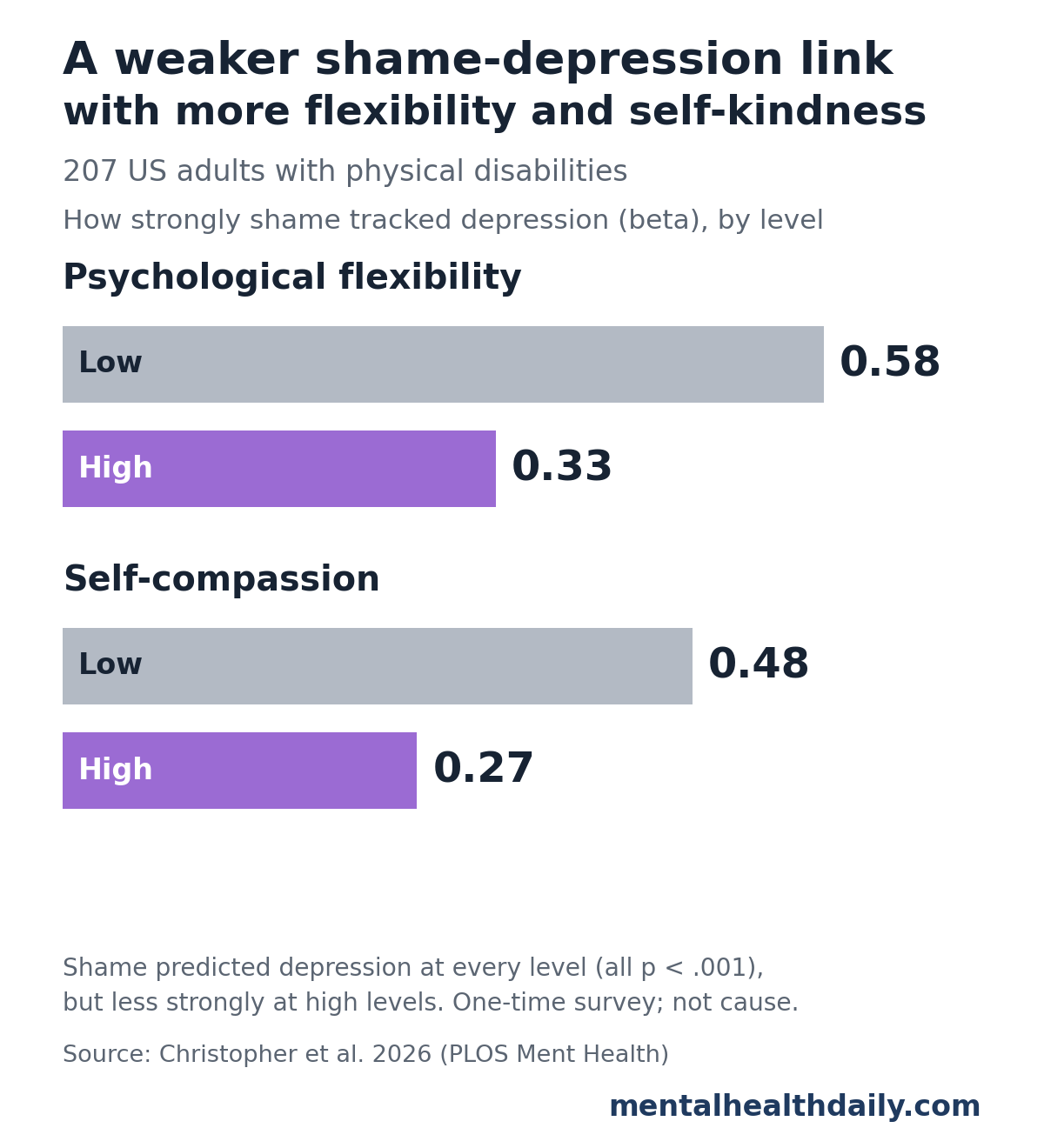
- Psychological flexibility: the shame-depression link was β = .58 at low flexibility and β = .33 at high flexibility.
- Self-compassion: the link was β = .48 at low self-compassion and β = .27 at high self-compassion.
Shame still predicted depression at every level (all p < .001). The link was just looser in people high in either trait.
The researchers interpret this as a difference in how people relate to shame. Shame describes what someone feels, while flexibility and self-compassion shape what they do with that feeling: get pulled into self-criticism and withdrawal, or meet it with understanding and keep moving toward what matters.1
Other Studies on Self-Compassion, Flexibility and Mental Health
The pattern is consistent with earlier work in several directions:
- Disability and self-stigma: in a Polish study of 238 people with disabilities, deep-rooted negative beliefs about the self explained 39% of the variation in self-stigma. Psychological flexibility added 2% more and partly accounted for the link between those beliefs and self-stigma.3
- Self-compassion and symptoms: a 2012 meta-analysis found a large inverse link between self-compassion and mental health symptoms such as depression, anxiety and stress (r = −0.54).4
- Therapy trials: a meta-analysis of 22 randomized trials found that therapies that build self-compassion, including compassion-focused therapy, mindfulness-based cognitive therapy and ACT, improved depressive symptoms (g = 0.40) compared with control conditions. They did not clearly beat other active treatments.5
Those trials were not limited to people with physical disabilities. Whether building these skills lowers depression in this group specifically has not yet been tested in a trial.
Limitations of This Physical Disability Survey
- Cross-sectional design: all measures were taken once, so the study cannot show that self-compassion or flexibility reduce depression. Depression could also make it harder to be kind to oneself or stay flexible.
- Self-report only: shame, depression and both traits came from questionnaires, which share the same reporting biases.
- Disability details missing: the type, severity and duration of each person’s disability were not recorded, and disability was self-identified.
- Online panel sample: people who take paid online surveys may differ from adults with physical disabilities who do not.
- Small interactions: the moderation effects were statistically clear but small, each adding about 2% of explained variation.
Could Self-Compassion Training Help With Disability-Related Shame?
Not yet tested in this group. The researchers suggest that mindfulness-based programs and ACT, which build flexibility and self-compassion, could help adults with physical disabilities. They call for long-term studies to confirm that changing these traits changes how shame relates to depression over time.1
Shame often starts outside the person. Much of it grows from stigma, staring and inaccessible spaces. Skills like self-compassion work on the response to those experiences, while accessibility and inclusion work on the cause.
Depression deserves direct care. Anyone with ongoing low mood, loss of interest or hopelessness should talk with a doctor or mental health professional. In the US, the 988 Suicide & Crisis Lifeline is available by call or text at 988.
References
- Christopher M, Kahle X, Pham K. Psychological flexibility and self-compassion buffer the impact of shame on depression among adults with physical disabilities. PLOS Mental Health. 2026;3(9):e0000707. doi:10.1371/journal.pmen.0000707
- Cree RA, Okoro CA, Zack MM, Carbone E. Frequent mental distress among adults, by disability status, disability type, and selected characteristics — United States, 2018. MMWR Morbidity and Mortality Weekly Report. 2020;69(36):1238–1243. doi:10.15585/mmwr.mm6936a2
- Pyszkowska A, Stojek MM. Early maladaptive schemas and self-stigma in people with physical disabilities: the role of self-compassion and psychological flexibility. International Journal of Environmental Research and Public Health. 2022;19(17):10854. doi:10.3390/ijerph191710854
- MacBeth A, Gumley A. Exploring compassion: a meta-analysis of the association between self-compassion and psychopathology. Clinical Psychology Review. 2012;32(6):545–552. doi:10.1016/j.cpr.2012.06.003
- Wilson AC, Mackintosh K, Power K, Chan SWY. Effectiveness of self-compassion related therapies: a systematic review and meta-analysis. Mindfulness. 2019;10(6):979–995. doi:10.1007/s12671-018-1037-6