Older South Koreans with cognitive impairment had higher depression scores when their care came mainly from public caregivers or a mixed group of helpers rather than their adult children. A 2026 analysis of national survey data on 537 adults aged 65 and older found the link after adjusting for health, daily function and income.1
Research Highlights
- Higher depression scores with public and mixed care: compared with child-centered care, public-centered care was linked to scores about 0.9 points higher (β = 0.09, p = 0.041) and mixed care to scores about 1.3 points higher (β = 0.14, p = 0.002) on a 15-point scale.1
- 5 kinds of care networks: child-centered (175 people), mixed (121), spouse-centered (101), public-centered (97) and friends-and-neighbors-centered (43).1
- Spouse, child and friend networks looked alike: depression scores did not differ clearly among the 3 networks built around family or friends.1
- Older, sicker and poorer people relied more on outside help: people in mixed networks were the oldest and most dependent in daily tasks, and 60% of the public-care group were in the poorest income fifth.1
- Consistent with Dutch research: a 30-year study of older adults in the Netherlands also linked formal care networks to more depressive symptoms, partly through loneliness.3
Who Was in the Korean Care Network Study
Hwang et al. at Seoul National University used the 2023 National Survey of Older Koreans, a nationally representative survey based on face-to-face interviews. Out of 10,078 respondents, they selected 537 who met 2 conditions:1
- Cognitive impairment: a score below 24 out of 30 on the Korean Mini-Mental State Examination, a standard screening test of memory and thinking
- Needing help: they received assistance from someone with activities of daily living such as dressing, bathing, eating or using the toilet
Sample: average age 82, 74% women, about half living alone, and nearly half with no formal schooling. Most (71%) scored 16 to 23 on the cognitive test, the mildest of the 3 ranges the researchers used.1
Depression measure: the 15-item Short Form Geriatric Depression Scale, a yes/no questionnaire about mood over the past week. Scores run from 0 to 15, and the group averaged 6.6.1
How Latent Class Analysis Sorted the 5 Care Networks
Most research on caregiving looks at a single primary caregiver. This study looked at everyone who helped. The researchers sorted each person’s helpers into 6 kinds:1
- A spouse
- Adult children (or their spouses)
- Extended family, such as grandchildren or siblings
- Distant relatives, friends or neighbors
- Privately paid caregivers
- Public caregivers, mainly through Korea’s Long-Term Care Insurance and government home-care services
Latent class analysis is a statistical method that looks for hidden groups of people who share similar answer patterns. Here, it sorted participants by which combination of helpers they had, without the researchers deciding the groups in advance.
The researchers tested 2 to 6 groups. A 5-group solution fit best and sorted people clearly:1
- Child-centered (33%): every member got help from adult children; few used public services.
- Mixed (23%): help from public caregivers, friends or neighbors and children together, with some paid help.
- Spouse-centered (19%): care came almost entirely from a husband or wife.
- Public-centered (18%): nearly all care came from public caregivers, with little family or friend involvement.
- Friends-and-neighbors-centered (8%): mostly help from distant relatives, friends or neighbors.
Child-centered care was the most common pattern, which fits South Korea’s strong tradition of adult children caring for aging parents. In Western studies, including those from the US and the Netherlands, mixed or publicly supported networks tend to be more common.1
Public and Mixed Care Networks Had Higher Depression Scores
Before any adjustment, average depression scores were 5.9 in child-centered care, 6.0 in spouse-centered care and 6.1 in friends-and-neighbors care. They were 7.3 in public-centered care and 7.9 in mixed care.1
The researchers then adjusted for age, gender, education, living arrangement, household income, number of chronic diseases, cognitive score, dependence in daily activities and how adequate people felt their care was. The gap narrowed but held:1
- Public-centered vs. child-centered: 0.90 points higher (95% CI 0.04 to 1.76; p = 0.041)
- Mixed vs. child-centered: 1.33 points higher (95% CI 0.48 to 2.18; p = 0.002)
- Spouse-centered and friends-and-neighbors-centered: no clear difference from child-centered care
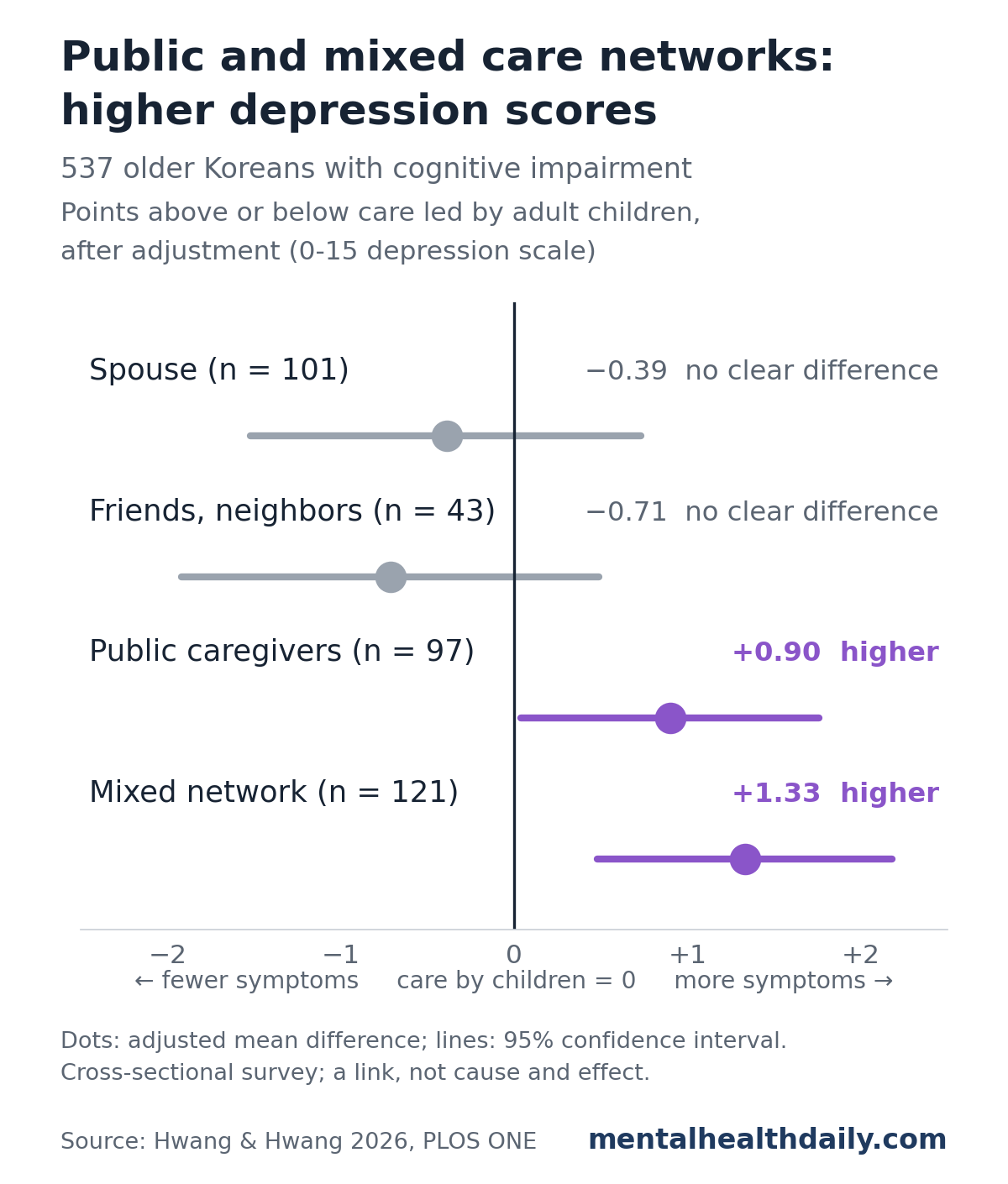
Public and mixed networks also scored higher than spouse-centered and friends-and-neighbors networks in pairwise comparisons. Public and mixed networks did not differ from each other.1
Effect size: a difference of about 1 point on a 15-point scale is small for any one person. Care network type added 2.7% to the share of variation in depression scores the model explained, on top of the other factors.1
Several other factors had stronger links to depression. More chronic diseases and more dependence in daily tasks went with higher scores, while feeling that one’s care was adequate went with lower scores.1
Why Public and Mixed Care Groups May Have Been More Depressed
The groups started out different. Comparing their profiles helps explain why they ended up with different care arrangements in the first place:1
- Public-centered group: 74% lived alone and 60% were in the lowest income fifth, the highest shares of any group.
- Mixed group: the oldest (average 84.5) with the most chronic diseases and the greatest need for help with daily tasks.
- Spouse-centered group: the youngest (average 78), with the fewest chronic diseases and the smallest share in the lowest income fifth.
The researchers offered 2 explanations for the links that remained after adjustment:1
- Mixed networks often form under strain. Under a long-standing model of care, older adults turn first to close family, then to more distant ties and formal services when family help runs short. A mixed network may signal heavier, more complex care needs. Several helpers can also make it harder to keep care consistent for someone with cognitive decline.
- Public care alone may leave emotional needs unmet. Formal services suit practical tasks, while family and friends usually supply much of the companionship and emotional support. People who depend mostly on public services may get less of that.
Neither explanation was measured directly in this survey.
Other Research Links Care Network Type to Mood
Depression is common in people with cognitive decline. A meta-analysis of 20 studies covering 5,897 people with dementia found depressive symptoms in 38% of those with mild dementia, 41% with moderate dementia and 37% with severe dementia.2
The Korean result is consistent with Dutch findings. Swinkels et al. followed 4,837 older adults in the Longitudinal Aging Study Amsterdam from 1992 to 2022. People who relied mainly on formal care had more depressive symptoms than those cared for by a partner, other informal helpers or privately paid help, and loneliness and care sufficiency partly explained the gap.3
A 2025 US study also used latent class analysis, focusing on family and unpaid helpers of people with dementia. People with dementia in small “siloed” networks, where little care was shared among helpers, slept worse than those in networks where helpers shared tasks.4
Limitations of This Care Network and Depression Study
- Cross-sectional design: care and mood were measured at the same time, so the study shows a link, not cause and effect.
- Reverse direction is plausible: people who were already depressed, sicker or short on family support may have been more likely to end up with public or mixed care. The researchers name this possibility directly.
- Missing details: the survey did not record how close caregivers lived, how often they visited, relationship quality, caregiver burden or how stable care arrangements were.
- Screening score, not diagnosis: cognitive impairment was defined by a test score below 24, not a clinical dementia diagnosis.
- One country: results reflect South Korea’s family care norms and public long-term care system.
What This Means for Families and Care Teams
Public home care fills real gaps. Public caregivers were serving people who were poorer, more often living alone and getting little family help. The study does not show that public care itself worsens mood.
Watch mood when the network changes. The researchers suggest that nurses and care teams look at the whole care network, not only the main caregiver, and check for depression when public services become the main source of care or when many helpers are involved.1
Keep family and friends in the picture. When formal services take over practical tasks, regular visits and calls from family, friends or neighbors may help fill the emotional gap. In mixed networks, clear roles and good communication among helpers can make care more consistent.1
Signs of depression in someone with memory problems, such as withdrawal, loss of interest or persistent sadness, are worth raising with their doctor.
References
- Hwang M, Hwang Y. Care network types and depression among people with cognitive impairment: A latent class analysis. PLOS ONE. 2026;21(9):e0357737. doi:10.1371/journal.pone.0357737
- Leung DKY, Chan WC, Spector A, Wong GHY. Prevalence of depression, anxiety, and apathy symptoms across dementia stages: a systematic review and meta-analysis. International Journal of Geriatric Psychiatry. 2021;36(9):1330–1344. doi:10.1002/gps.5556
- Swinkels JC, Abbing J, Broese van Groenou MI. Why is the composition of older adults’ care network associated with psychological wellbeing: an application of the self-determination theory. Aging & Mental Health. 2025;29(1):121–129. doi:10.1080/13607863.2024.2373405
- Leggett AN, Haldar S, Tsuker S, Lai W, Nemmers N, Choi H, et al. Who’s on your team? Classifying dementia caregiving networks and associations with the well-being of caregivers and care recipients with dementia. Journals of Gerontology: Series B. 2025;80(6):gbaf040. doi:10.1093/geronb/gbaf040