A single-arm Hwa-byung digital therapeutic pilot found good app engagement and large pre-post symptom changes, but the absence of a control group keeps the result in feasibility territory. The ACT-based Hwa-free app improved Hwa-byung symptoms, depression, state anger, psychological flexibility, and quality-of-life scores over 4 weeks, with some gains maintained at 8 weeks.1
Research Highlights
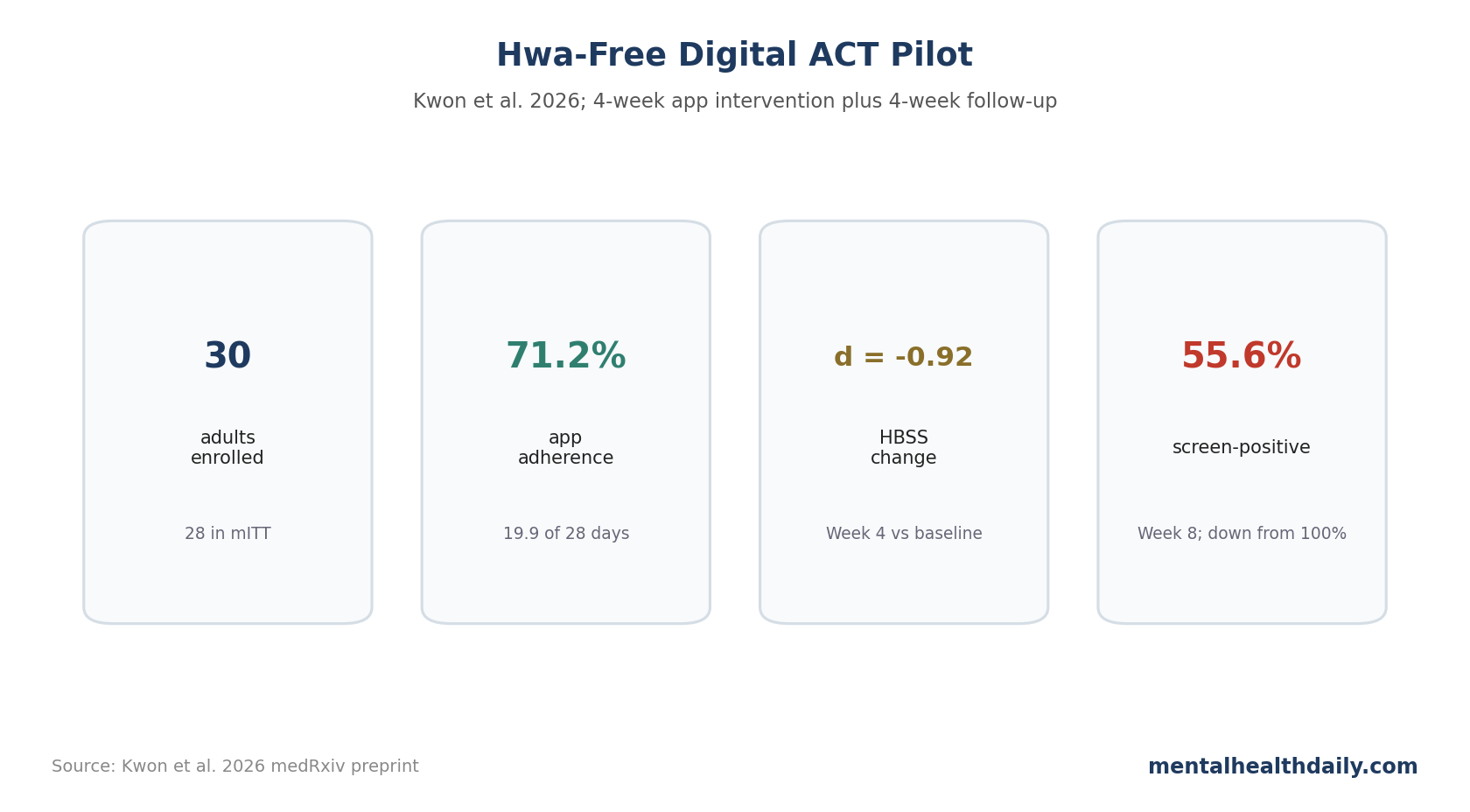
- 30 adults were enrolled: 45 people were screened, 30 entered the study, and 28 made up the modified intention-to-treat analysis population.1
- App engagement was workable: mean use was 19.9 of 28 days, or 71.2% adherence, with no intervention-related adverse events reported.1
- Hwa-byung symptoms decreased: Hwa-byung Symptom Scale scores changed by Δ = −9.8, Cohen’s d = −0.92, p < 0.001 at Week 4.1
- Depression and anger also improved: Beck Depression Inventory-II changed by Δ = −13.3 and state anger by Δ = −7.8, both with large within-person effect sizes.1
- Control-group evidence is still missing: the 4-week signal in 28 analyzed adults supports a randomized controlled trial, not a claim that the app itself caused all symptom change.
Hwa-byung is a Korean cultural concept of distress involving suppressed anger, somatic heat or pressure sensations, resentment, and a sense of injustice. Acceptance and commitment therapy (ACT) targets experiential avoidance, which fits the clinical idea that chronic anger suppression can keep symptoms locked in place.2
This pilot tested feasibility and user experience before a larger trial. That sequence is necessary because digital therapeutics often look promising in small single-arm studies, then lose force when compared with attention controls, therapist contact, or usual care.
Hwa-Free Delivered 4 Weeks of ACT-Based App Content
Kwon et al. tested Hwa-free, a smartphone app with weekly psychoeducational videos, daily diaphragmatic breathing, relaxation therapy, meditation, 3-line journaling, and Hwa-byung self-assessment.1
- Sample: 30 enrolled adults, 86.7% female, median age 55.5 years.
- Intervention dose: 28 days of app access, then a 4-week app-free observation period.
- Primary outcome: user experience at Week 4, not clinical efficacy.
- Clinical scales: Hwa-byung symptoms, depression, anxiety, anger expression, psychological flexibility, quality of life, and heart rate variability.
The baseline symptom level was high. Mean Hwa-byung Symptom Scale (HBSS) was 46.93, Beck Depression Inventory-II (BDI-II) was 38.37, and state anger was 28.47.1
HBSS, Depression, and State Anger Had Large Pre-Post Changes
By Week 4, 11 of 18 clinical scales reached statistical significance after false-discovery correction. The largest changes were BDI-II, state anger, and HBSS.1
- BDI-II: Δ = −13.3, 95% CI −17.9 to −8.6, Cohen’s d = −1.11, p < 0.001.
- State anger: Δ = −7.8, 95% CI −11.0 to −4.7, d = −0.96, p < 0.001.
- HBSS: Δ = −9.8, 95% CI −14.0 to −5.7, d = −0.92, p < 0.001.
- Psychological flexibility: Acceptance and Action Questionnaire-II changed by Δ = −7.0, d = −0.78.
Those are large within-person changes. The calibration is that within-person change in a single-arm study mixes treatment effect with regression to the mean, expectancy, therapist/research contact, and natural symptom fluctuation.
User Experience Was Strong Except Breathing Sensor Friction
User experience was broadly favorable. Positive response rates exceeded 80% for multiple video-content items, Hwa-byung self-assessment, meditation therapy, and in-app guidance.1
The most specific usability problem was the breathing module. Breath-count accuracy had only 41.4% positive responses, and placing the phone on the abdomen had 48.3% positive responses. Among participants who did not use the app daily, 42.9% cited insufficient reminders and 23.8% cited burdensome or long content.
Breathing-sensor friction is product-level safety data: the core psychological content looked acceptable, but sensor-based breathing needs refinement before a larger trial.
Psychological Flexibility Is the Mechanism To Test Next
The ACT mechanism signal was coherent. Improvement in AAQ-II, a measure of experiential avoidance and psychological flexibility, correlated with improvement in HBSS; the exploratory mediation model reported an indirect effect of −3.02, 95% CI −6.42 to −0.40.1
That does not prove mediation. Mediation in a single-arm pre-post pilot is vulnerable to shared measurement timing and unmeasured common causes. It does, however, identify the right target for the next trial: does improving psychological flexibility explain Hwa-byung symptom reduction better than nonspecific app contact?
Digital ACT trials in other conditions, including chronic pain, suggest that app-supported ACT can improve psychological flexibility and emotional symptoms, but effects depend heavily on engagement, guidance, and comparator choice.4
RCT Design Should Separate App Content From Contact and Expectancy
The next trial needs a comparator that can separate ACT content from nonspecific study attention. A wait-list control would answer a basic question, but an active control would be more informative.
Useful comparator options include psychoeducation without ACT skills, symptom monitoring without therapeutic modules, or a structurally similar wellness app that controls for reminders, research contact, and expectation of benefit. Each comparator answers a different question.
The trial should also predefine what counts as clinically meaningful Hwa-byung improvement. The pilot used a 30% HBSS decrease as an exploratory responder threshold, which works for description, but the field needs a validated minimal clinically meaningful difference.
- Control condition: credible digital education or supportive app contact, not waitlist alone.
- Mechanism: psychological flexibility, anger suppression, somatic distress, and depressive symptoms measured as separate pathways.
- Safety: worsening depression, suicidal thoughts, anger escalation, and family conflict monitored explicitly.
Adherence should be measured by module and by days opened. Watching a video, writing a journal entry, practicing diaphragmatic breathing, and completing a meditation are different therapeutic doses. If one module drives improvement, the app can be simplified.
The sensor layer deserves special scrutiny. If the breathing module frustrates users, it may reduce adherence even if breathing practice itself is helpful. A simpler breathing timer could outperform an inaccurate sensor interface.
Hwa-Byung Requires Cultural Specificity Without Treating Culture as Static
Hwa-byung is often described as a Korean culture-bound syndrome, but that phrase can make the condition sound frozen in an older cultural moment. Kwon et al. note that Hwa-byung remains present in modern Korean culture, including younger generations.
Digital therapy may be especially relevant when stigma, geography, cost, and specialist availability limit care. A phone app cannot replace culturally competent therapy, but it can lower the first barrier to practicing acceptance, breathing, reflection, and symptom tracking.
The app also needs to avoid reducing Hwa-byung to generic anger. The syndrome includes suppressed anger, somatic sensations, resentment, injustice, anxiety, depressive symptoms, and culturally shaped family or social context.
ACT is plausible because it trains distance from anger, bodily alarm, and suppression loops, but plausibility is not enough. The intervention has to show that it changes the lived symptom cluster alongside any improvement in a transdiagnostic flexibility score.
App-Free Follow-Up Is a Useful Design Feature
The 4-week app-free period is one of the better design choices in the pilot. If symptoms only improve while a person is actively using modules, the app may function as temporary regulation. If improvement persists after access stops, skills may be consolidating.
In this pilot, the HB screening-positive rate kept falling through Week 8, and AAQ-II continued to improve from Week 4 to Week 8. That pattern is compatible with skill internalization, though it still needs a control group to rule out delayed nonspecific improvement.
Safety Monitoring Should Include Depression and Anger Escalation
Even if the app looked safe in this small pilot, a larger trial should monitor worsening depression, suicidality, anger escalation, family conflict, and somatic panic-like symptoms. A self-guided app can surface painful material without a therapist present.
The safest digital therapeutic model may include stepped support: app-only for low-risk users, clinician messaging for moderate symptoms, and rapid referral for severe depression, suicidal thoughts, psychosis, bipolar instability, or interpersonal violence risk.
Clinical Adoption Should Wait for Active-Comparator Data
The app may eventually become useful, but routine clinical adoption should wait for active-comparator evidence. A pilot can show that people will use the intervention and that symptoms move in the expected direction; it cannot show whether Hwa-free beats credible digital education, therapist-guided self-help, or usual care.
That standard protects patients and developers. If the active ingredient is ACT practice, the trial will show it. If the main driver is reminders, journaling, social contact, or expectancy, the product can be redesigned around what actually helps.
Useful endpoint: the next study should track anger suppression, somatic heat symptoms, depression, and functioning as separate outcomes.
Those domains may move differently, especially if ACT changes avoidance before somatic distress fully settles.
Questions About Hwa-Byung Digital Therapy
Is Hwa-free proven to treat Hwa-byung?
No. The pilot supports feasibility, acceptability, and a plausible symptom signal. A randomized controlled trial with an active comparator is needed for efficacy.
Why use ACT for Hwa-byung?
ACT targets experiential avoidance: the habit of fighting, suppressing, or escaping unwanted internal states. That maps reasonably well onto Hwa-byung models centered on suppressed anger and somatic distress.
Was the app safe?
Adverse events were infrequent and unrelated to the intervention in this small pilot. Larger trials still need structured safety monitoring, especially for severe depression, suicidality, or unstable psychiatric illness.
References
- Digital Therapeutic for Hwa-byung Based on Acceptance and Commitment Therapy: A Pilot Feasibility Trial. Kwon et al. doi:10.64898/2026.04.19.26351203
- Acceptance and Commitment Therapy: A Transdiagnostic Behavioral Intervention for Mental Health and Medical Conditions. Dindo et al. doi:10.1007/s13311-017-0521-3
- Factors Influencing Adherence to mHealth Apps for Prevention or Management of Noncommunicable Diseases. Jakob et al. doi:10.2196/35371
- ACTsmart: Guided Smartphone-Delivered Acceptance and Commitment Therapy for Chronic Pain. Gentili et al. doi:10.1093/pm/pnaa382