PTSD symptom scores fell by about half among 94 US servicemembers who completed a 4-week program of EEG-guided magnetic brain stimulation, according to a 2026 chart review. The program had no control group, so the study cannot show how much of that drop came from the treatment itself.1
Research Highlights
- PTSD scores dropped 48%: average PTSD Checklist (PCL-5) scores went from 35.9 to 18.8 over 20 sessions of alpha-rTMS in 91 completers with full data.1
- Depression scores dropped 52%: average PHQ-9 scores went from 12.5 to 6.0 in 89 completers, and most of the change on both scales came in the first 2 weeks.1
- Most high scorers fell below the cutoff: 36 of 48 people (75%) who started at or above the probable-PTSD cutoff ended below it.1
- Side effects were mild: fatigue, headache and nausea or dizziness were the main complaints, and no serious adverse events were recorded.1
- No control group: there was no sham (placebo) stimulation group, no formal PTSD diagnosis, and no follow-up after week 4. Sham-controlled trials of standard rTMS for PTSD have produced mixed results.1,2,3
What Alpha-rTMS Is and How It Is Supposed to Work
Repetitive transcranial magnetic stimulation (rTMS) uses a magnetic coil held against the scalp to send rapid pulses into the brain. The pulses induce small electrical currents in the outer layer of the cortex, which can raise or lower activity in the targeted area over a course of daily sessions. It is an established treatment for depression.2
Standard rTMS uses a fixed pulse rate, often 10 pulses per second (10 Hz), aimed at the prefrontal cortex. Alpha-rTMS instead sets the pulse rate to each person’s own alpha rhythm, the 8–13 Hz brain wave that dominates an EEG recording when someone is awake and resting with eyes closed. The commercial version used here is called MeRT (Magnetic EEG/EKG-guided Resonance Therapy).1
The idea behind it, as the researchers describe it:1
- PTSD and brain networks: PTSD has been linked to disruption in the default mode network, a set of brain regions active during self-focused thought and memory.
- Weaker alpha rhythm: some EEG studies report reduced alpha power in key hubs of that network in people with PTSD.
- Matching the rhythm: stimulating at a person’s own alpha frequency is meant to nudge that rhythm, and the networks linked to it, back toward a healthier pattern.
That rationale is plausible but largely untested. Alpha-rTMS for PTSD has so far been studied mostly in open-label reports like this one.
How the Operation Synchrony Chart Review Worked
Alexander Balbir et al. reviewed the records of servicemembers in Operation Synchrony, a wellness program funded by the Wounded Warrior Project and run at 3 outpatient clinics in Southern California between 2021 and 2023.1
- Who took part: self-referred active-duty and retired servicemembers who had served since September 11, 2001, and reported PTSD symptoms. A formal PTSD diagnosis was not required.
- Who was analyzed: 94 people who finished the program (77 men, 17 women; average age 39). Another 10 who withdrew or stopped early were left out.
- Treatment: 20 sessions of about 30 minutes, 5 days a week for 4 weeks. Stimulation was set to each person’s alpha frequency (average 10.9 Hz), delivered at the front-center of the forehead at 80% of the strength needed to make a hand muscle twitch.
- Measures: self-report questionnaires and a 10-minute EEG at the start, week 2 and week 4.
The PCL-5 is a 20-item PTSD symptom checklist scored from 0 to 80; the researchers used 33 or higher to flag probable PTSD. The PHQ-9 measures depression from 0 to 27. The team also tracked concussion symptoms and resilience, the ability to bounce back from stress, on the Brief Resilience Scale.1
PTSD and Depression Scores Roughly Halved in 4 Weeks
Average scores improved on every scale between the first session and the last:1
- PTSD (PCL-5, 91 people): 35.9 to 18.8, a 48% drop. On the usual effect-size scale, the change was large (Cohen’s d = 0.99).
- Depression (PHQ-9, 89 people): 12.5 to 6.0, a 52% drop.
- Concussion symptoms (88 people): 26.8 to 14.5, a 46% drop.
- Resilience (87 people): 3.0 to 3.4 on a 1–5 scale, a 13% rise. The paper’s abstract describes this as a decrease, but its own results table shows resilience went up.
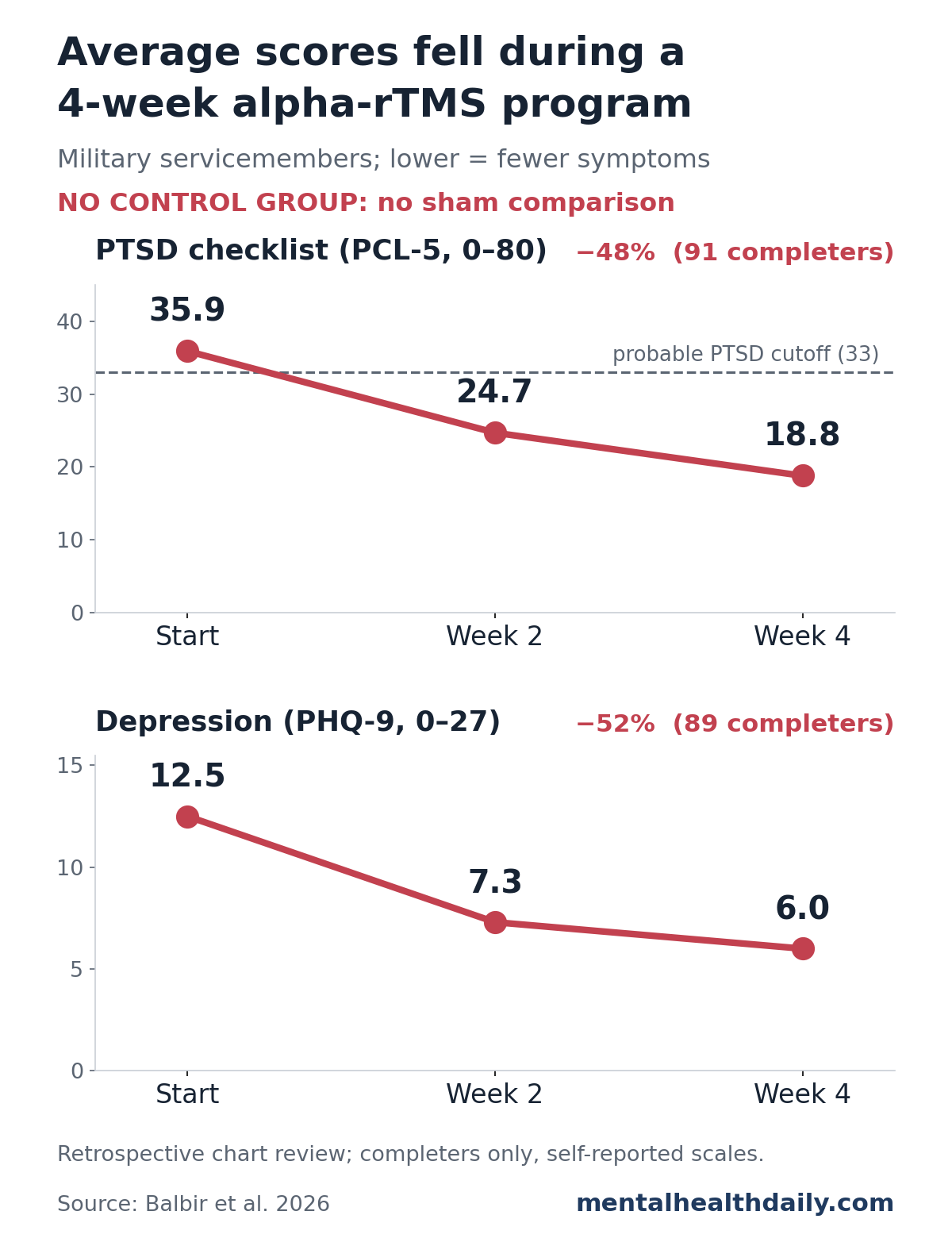
Among the 48 people who started at or above the probable-PTSD cutoff, 23 had dropped below it by week 2 and 36 (75%) by week 4. Of 36 people who started with at least moderately severe depressive symptoms (PHQ-9 of 15 or more), 28 (78%) ended below that level.1
The 10 people who did not finish were similar to completers in age, gender and starting scores, and most left for personal reasons such as moving or scheduling.1
Side Effects Were Mild and Short-Lived
Staff recorded side effects at every session. Complaints reported more than once during the program:1
- Fatigue: 23 people (24%)
- Headache: 12 people (13%)
- Nausea or dizziness: 5 people (5%)
Most occurred in the first 2 weeks and all had resolved by the end of treatment. No serious adverse events were recorded. People with seizure history, pacemakers or metal in the head were screened out, as is standard for TMS.1
Why the Missing Control Group Matters
Symptom scores can improve between a first and last visit even when a treatment does nothing specific. Without a sham group, several other explanations remain open, and the researchers acknowledge this:1
- Placebo and expectation: 20 visits to a clinic, daily attention from staff and a high-tech treatment can lift symptoms on their own.
- Regression to the mean: people often seek help when symptoms peak, and scores tend to drift down from a peak regardless of treatment.
- Other care: charts did not record medications or therapy, so changes in other treatment could account for part of the improvement.
- Completers only: the 10 people who did not finish were excluded from the results.
- Self-referral and self-report: participants chose the program, no one confirmed a PTSD diagnosis, and every outcome was a questionnaire the participant filled out.
- No follow-up: results end at week 4, so it is unknown whether the gains lasted.
Conflicts of interest: the paper reports no conflicts. The authors work at eTMS Florida and the Brain Treatment Center of San Diego, clinics that deliver this kind of stimulation.1
How This Compares With Sham-Controlled rTMS Trials for PTSD
Sham-controlled trials give the clearest test, and for standard rTMS in PTSD the results are mixed:
- Cochrane review (2024): across 13 randomized trials with 577 participants, active rTMS probably made little to no difference to PTSD severity right after treatment compared with sham, based on moderate-certainty evidence from 3 trials. Results varied widely between studies, and serious side effects were rare.2
- Network meta-analysis (2021): across 10 trials with 421 participants, low- and high-frequency rTMS aimed at the right side of the prefrontal cortex beat sham. Several other protocols, including deep TMS of the medial prefrontal cortex and theta-burst stimulation, did not.3
Neither review reported results for alpha-guided stimulation. Earlier alpha-rTMS reports in the military are also uncontrolled chart reviews; one in 2024 found that PCL-5 scores fell 37% among active-duty special operations service members after about 30 sessions.4
The researchers note that MeRT received FDA clearance for PTSD in 2026 based on a blinded, sham-controlled randomized trial. That trial is separate from this chart review, and its results are the better guide to how much alpha-rTMS adds beyond placebo.1
What This Means for Veterans Considering Alpha-rTMS
Promising, with real limits. Servicemembers who finished the program reported large drops in PTSD and depression symptoms and tolerated the stimulation well. This design cannot tell how much of that improvement came from alpha-rTMS itself.
Ask about the controlled evidence. Anyone weighing MeRT or other forms of rTMS can ask a clinic what sham-controlled results support the specific protocol, how long benefits last and what it costs. Trauma-focused psychotherapies such as cognitive processing therapy and prolonged exposure remain the best-supported first-line treatments.
Better trials are coming. The researchers call for sham-controlled trials in people with a confirmed PTSD diagnosis, with 3- and 6-month follow-up, and say such studies are underway.1
References
- Balbir A, Prowse K, Kim J. A retrospective chart review of PTSD symptoms in military servicemembers participating in an individually guided neuromodulation (alpha-rTMS) wellness program. Neuropsychiatric Disease and Treatment. 2026;22:612731. doi:10.2147/NDT.S612731
- Brown R, Cherian K, Jones K, Wickham R, Gomez R, Sahlem G. Repetitive transcranial magnetic stimulation for post-traumatic stress disorder in adults. Cochrane Database of Systematic Reviews. 2024;(8):CD015040. doi:10.1002/14651858.CD015040.pub2
- McGirr A, Devoe DJ, Raedler A, Debert CT, Ismail Z, Berlim MT. Repetitive transcranial magnetic stimulation for the treatment of post-traumatic stress disorder: a systematic review and network meta-analysis. Canadian Journal of Psychiatry. 2021;66(9):763. doi:10.1177/0706743720982432
- Bailar-Heath M, Burke R, Thomas D, Morrow CD. A retrospective chart review to assess the impact of alpha-guided transcranial magnetic stimulation on symptoms of PTSD and depression in active-duty special operations service members. Frontiers in Psychiatry. 2024;15:1354763. doi:10.3389/fpsyt.2024.1354763