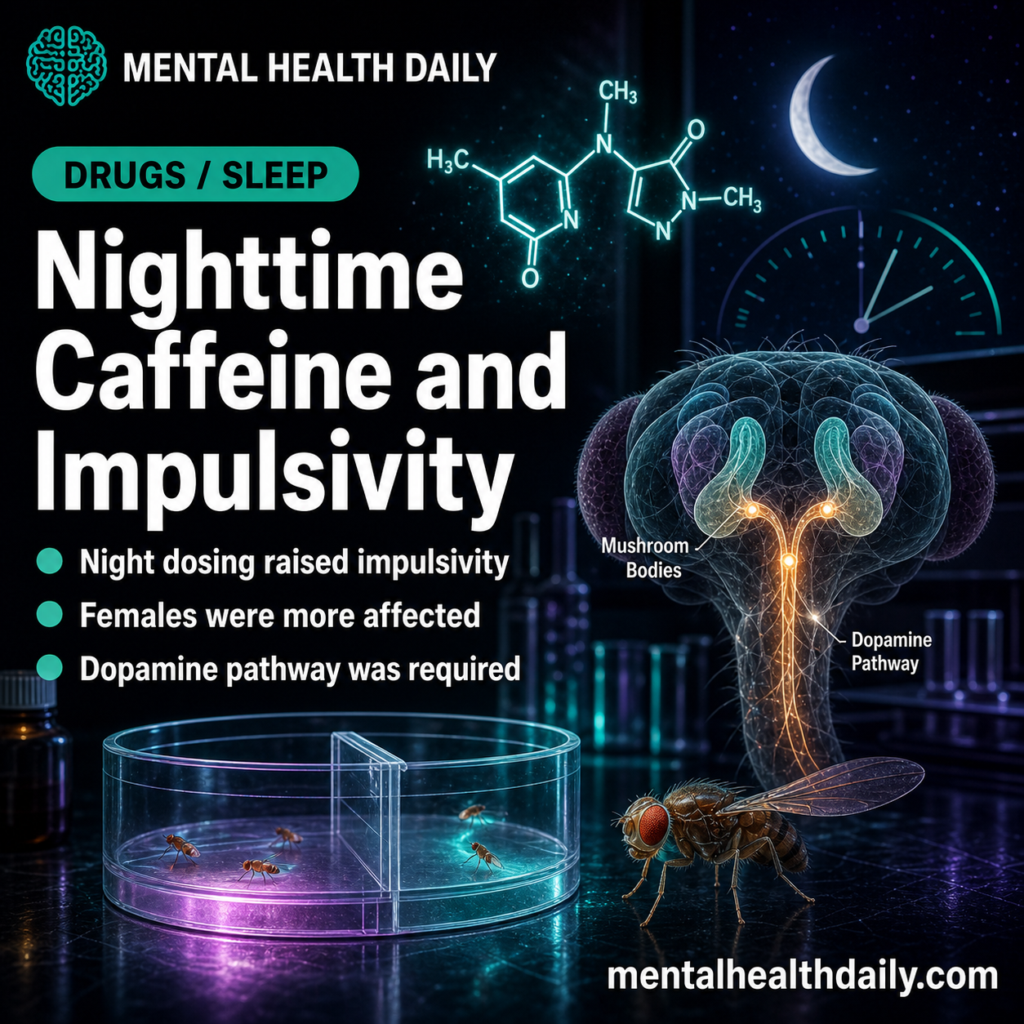
A 2025 iScience study found that nighttime caffeine increased motor impulsivity in Drosophila, with dose-dependent loss-of-inhibition events across n = 30-32 flies per behavioral condition and stronger effects in female flies than male flies.1 The result does not prove that an evening coffee makes humans reckless, but it sharpens a neglected point: caffeine’s alertness benefit may come with time-of-day-specific inhibitory-control costs.
Research Highlights
- Night caffeine raised impulsivity: Caffeine-fed flies showed dose-dependent loss-of-inhibition events, with n = 30-32 per behavioral condition.1
- Females were more sensitive: Female and male flies both responded, but female flies showed a more pronounced behavioral effect across doses.1
- Internal caffeine tracked dose: Female caffeine levels rose with dose (F4,14 = 443.97, p < 0.0001), as did male levels (F4,14 = 229.09, p < 0.0001).1
- Sleep loss did not explain it: Walking speed was unchanged, and artificial sleep deprivation did not reproduce the same inhibitory-control deficit.1
- Dopamine was required: Reduced dopamine synthesis, PAM neuron silencing, dopamine-transporter manipulation, and dDA1/Dop1R1 receptor targeting all pointed to a dopamine-dependent pathway.1
Motor impulsivity means acting when a movement should be withheld. In the fly go/no-go assay, normal flies suppress movement during strong airflow or predator-like sound; impaired inhibition appears as rapid movement above 60 mm/s, scored as a loss-of-inhibition event.
Dopamine is a neurotransmitter involved in arousal, reinforcement, movement, and action selection. Caffeine is not a dopamine drug in the same way as amphetamine, but the Saldes et al. data show that dopamine signaling was necessary for this nighttime behavioral effect.
Nighttime Exposure, Not Caffeine Alone, Drove the Impulsivity Signal
Saldes et al. fed flies caffeine-containing food overnight at 1, 5, 7.5, or 10 mg/mL and then tested inhibitory control. Caffeine-fed flies showed dose-dependent increases in loss-of-inhibition events, while caffeine-free flies showed strong movement suppression.1
The time-of-day point is central. Daytime caffeine did not impair inhibitory control in the same way. That makes the study more interesting than a generic “caffeine is stimulating” result. The behavioral cost appeared when caffeine was given during the biological night.
Sleep Loss and Hyperactivity Were Not Enough to Explain the Result
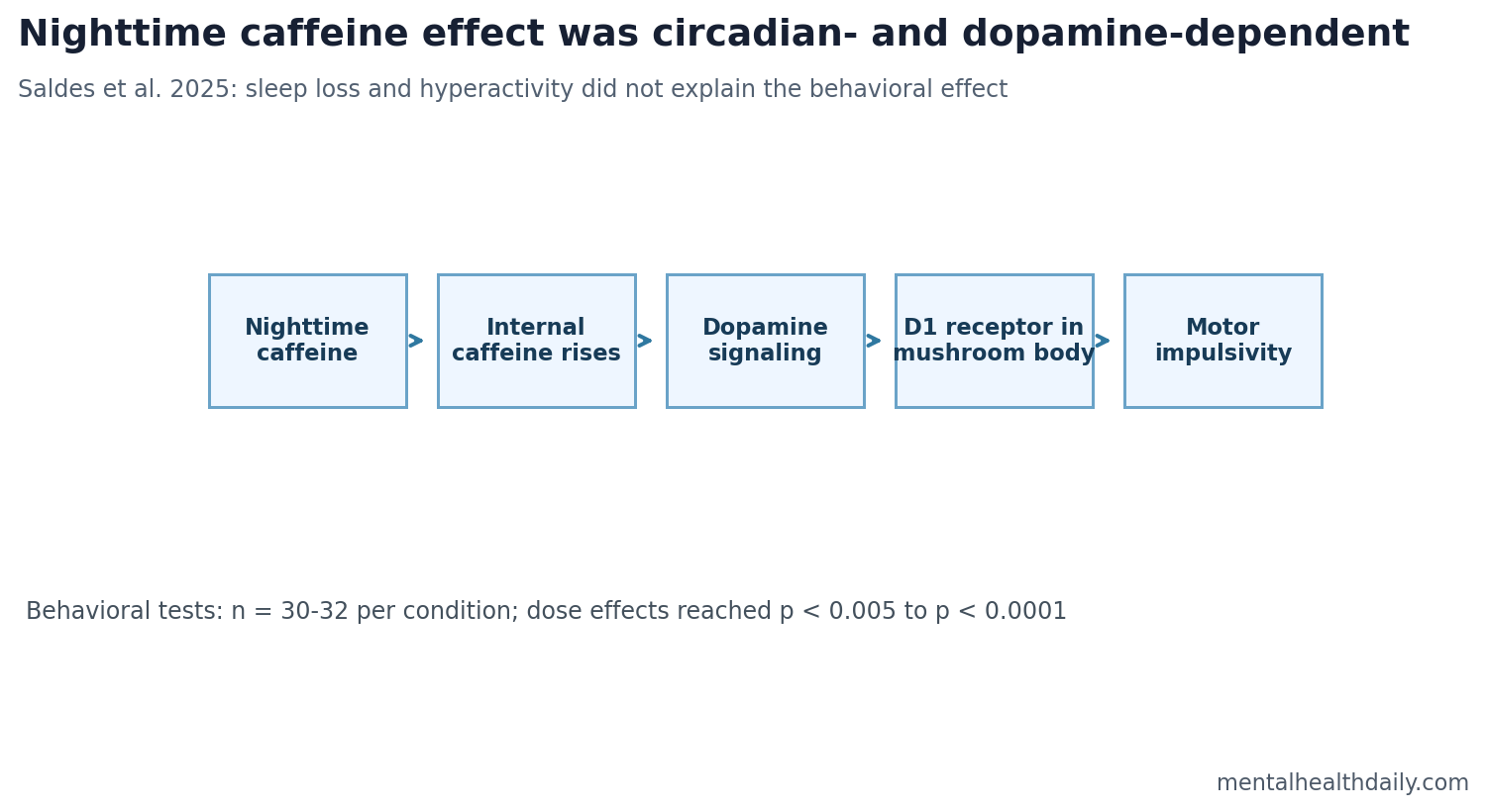
A simple explanation would be that caffeine made flies hyperactive or sleep-deprived, and restless flies failed the task. Saldes et al. tested that idea directly. Walking speed was unchanged, and artificial sleep deprivation using light or mechanical stimulation did not create the same deficit.1
Inhibitory-control interpretation: the result looked less like general overactivity and more like a failure to suppress an inappropriate action under an adverse cue. That distinction matters for translation because human night-shift caffeine is often justified by vigilance, while errors in high-risk work can involve action inhibition as much as alertness.
Dopamine D1 Signaling in Mushroom-Body Lobes Was the Mechanism
Mushroom bodies are insect brain structures involved in learning, memory, and flexible behavior. They are not human prefrontal cortex, but they provide a genetically tractable circuit for testing how neuromodulators change action control.
Reducing dopamine synthesis attenuated the caffeine-induced impulsivity signal. Silencing protocerebral anterior medial dopaminergic neurons also changed the effect, and dopamine-transporter manipulations could attenuate or worsen impulsivity. Targeted experiments identified the dopamine D1 receptor dDA1/Dop1R1 in mushroom-body alpha/beta and gamma lobes as essential, with gamma-lobe neurons showing heightened sensitivity.1
That mechanistic specificity is the paper’s strength. The study maps the behavior onto a dopamine pathway that can be manipulated, which makes the caffeine result more informative than a behavioral observation alone.
Human Night-Work Evidence Points to a Benefit-Cost Tradeoff
Human caffeine evidence is not one-directional. Kamimori et al. found that caffeine improved reaction time, vigilance, and logical reasoning during extended restricted-sleep conditions.2 That is why shift workers, military personnel, trainees, and clinicians use caffeine at night.
Burke et al. showed that evening caffeine can delay the human circadian clock.3 Circadian timing is therefore not a passive background variable; caffeine can act on the system that tells the brain what biological time it is.
Nall et al. showed in Drosophila that caffeine promotes wakefulness through dopamine signaling.4 Saldes et al. extend that model from wakefulness into inhibitory control. In plain English: the same broad arousal system that helps an organism stay awake may also make action suppression more fragile at the wrong biological time.
What This Fly Study Can and Cannot Support
Supported: nighttime caffeine can impair a fly inhibitory-control task through a circadian- and dopamine-dependent mechanism. The result was not explained by simple hyperactivity or experimentally induced sleep loss.
Not supported: human dose thresholds, workplace safety rules, or a claim that any nighttime caffeine intake causes dangerous human impulsivity. Drosophila behavior is useful for circuit discovery, not direct clinical advice.
Most useful human question: does caffeine taken during circadian night improve vigilance while worsening specific forms of response inhibition, motor precision, or risk-prone action in some people? A trial could test that directly with time-of-day, dose, sex, sleep debt, and task domain separated.
Shift-Work Translation Needs More Than Reaction-Time Tests
Many caffeine studies use reaction time, vigilance lapses, subjective sleepiness, or simple attention as the main performance outcomes. Those outcomes are important, but they do not cover the whole safety problem. A worker can be awake and fast while still being worse at withholding a response, checking an impulse, or avoiding a premature movement.
Task mismatch: an emergency clinician, pilot, machine operator, driver, or military worker may need both alertness and restraint. Caffeine could improve one side of that equation while leaving another side unchanged or worse. The fly data cannot quantify that human tradeoff, but it identifies the kind of tradeoff human studies should test.
Sex differences also deserve direct testing. Female flies were more sensitive in the Saldes et al. experiments, but that does not automatically map onto human female caffeine response. Hormonal state, body size, metabolism, sleep debt, oral contraceptives, pregnancy, CYP1A2 genetics, anxiety sensitivity, and habitual caffeine use could all change response in people.
Human translation would need a within-person design, because the same worker can look different at 10 a.m., 2 a.m., after 4 hours of sleep, or after several consecutive night shifts. Without separating biological night from ordinary sleep loss, caffeine can be blamed for errors that came from the schedule itself.
That design should also compare task domains: vigilance, reaction time, response inhibition, manual precision, and risky choice can move in different directions.
Dose timing: human studies should report clock time, circadian phase, recent sleep, habitual caffeine use, and the gap between caffeine and the task. A 100 mg dose before a night shift, a 200 mg dose at 3 a.m., and repeated dosing across a rotating schedule are different exposures. Lumping them together would blur the same timing issue that made the fly result interesting.
Studies should also separate caffeine’s direct performance effect from its delayed sleep effect. A dose may help a task tonight and still worsen tomorrow’s performance by delaying sleep onset or reducing sleep depth. That two-step pathway is especially relevant for workers who use caffeine repeatedly across consecutive nights.
Human Advice Should Stay Boring and Specific
For ordinary readers, the conservative advice is not to panic about coffee. It is to stop treating caffeine as a frictionless alertness tool. Night dosing close to sleep can delay circadian timing, worsen sleep, raise anxiety or jitteriness in sensitive people, and potentially affect action control in ways that standard wakefulness measures miss.
Better self-experiment: track dose, timing, sleep onset, nighttime awakenings, next-day irritability, mistakes, and whether caffeine was taken to compensate for an already-bad sleep schedule. A pattern of late caffeine followed by poor sleep and more errors is more actionable than a generic rule about coffee being good or bad.
Occupational studies should also separate caffeine from the reason caffeine was needed. A person taking caffeine at 2 a.m. may already be sleep-deprived, stressed, under bright light, eating at circadian night, and working against a rotating schedule. If a study does not model those conditions, caffeine can look cleaner or dirtier than it really is.
Calibrated bottom line: caffeine is still useful, but timing changes the risk profile. Nighttime use deserves the same domain-specific testing that clinicians already expect for sedatives, stimulants, and shift-work countermeasures.
Until those data exist, late caffeine should be planned, not automatic, especially before precision work.
Questions About Nighttime Caffeine and Impulsivity
Does this mean people should never drink caffeine at night?
No. The study is in flies. For humans, the realistic message is tradeoff-aware use: caffeine may improve alertness, but timing, dose, sleep debt, anxiety sensitivity, and task type can change the net effect.
Why use flies for a caffeine question?
Flies allow direct genetic manipulation of dopamine neurons and receptors. That makes them useful for finding mechanisms that would be hard to isolate in humans.
What kind of human task would be most relevant?
Night-shift studies should include response inhibition, driving simulation, manual precision, go/no-go errors, impulsive choice tasks, reaction time, and wakefulness.
How should night-shift caffeine users read this fly study?
Caffeine at night should be treated as a performance drug with domain-specific effects. It can help vigilance while potentially worsening other control systems in susceptible contexts.
References
- Saldes EB, Sabandal PR, Han KA. Nighttime caffeine intake increases motor impulsivity. iScience. 2025. doi:10.1016/j.isci.2025.113197
- Kamimori GH, McLellan TM, Tate CM, Voss DM, Niro P, Lieberman HR. Caffeine improves reaction time, vigilance and logical reasoning during extended periods with restricted opportunities for sleep. Psychopharmacology. 2015. doi:10.1007/s00213-014-3834-5
- Burke TM, Markwald RR, McHill AW, et al. Effects of caffeine on the human circadian clock in vivo and in vitro. Science Translational Medicine. 2015. doi:10.1126/scitranslmed.aac5125
- Nall AH, Shakhmantsir I, Cichewicz K, Birman S, Hirsh J, Sehgal A. Caffeine promotes wakefulness via dopamine signaling in Drosophila. Scientific Reports. 2016. doi:10.1038/srep20938