hit counter

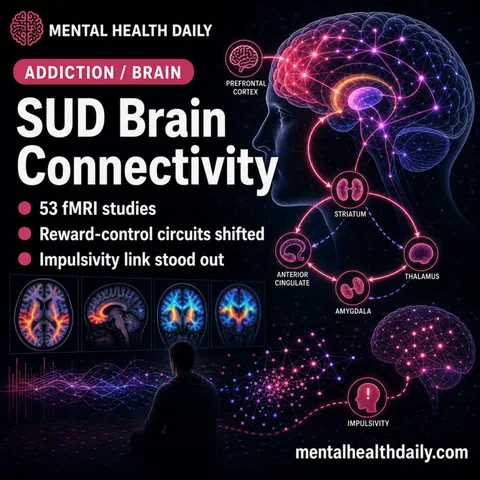
Substance Use Disorder Brain Connectivity in 53 Studies

MHD featured image for substance use disorder, resting-state fMRI, reward circuitry, and brain connectivity meta-analysis.

A 53-study resting-state functional magnetic resonance imaging (fMRI) meta-analysis found substance use disorder (SUD) linked to altered connectivity across prefrontal, striatal, thalamic, cingulate, and amygdala circuits. The most clinically relevant finding was an impulsivity correlation, not a diagnostic brain signature. Research Highlights Meta-analysis scale was meaningful: Zhang et al. pooled 53 whole-brain resting-state functional magnetic …

Read more

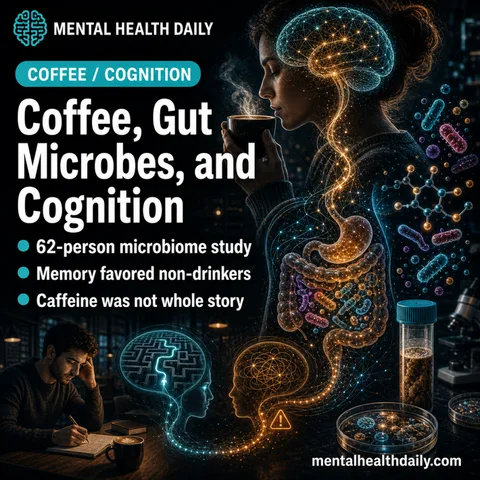
Coffee, Gut Microbes, Memory, and Impulsivity in 62 Adults

Stylized illustration of a coffee cup overlaid with gut bacteria silhouettes and brain neurons with neurotransmitter symbols, representing the gut-brain axis effects of habitual coffee intake.

Coffee is widely framed as cognitively friendly, but a 2026 prospective study from Boscaini et al. published in Nature Communications used shotgun metagenomics, metabolomics, and cognitive testing in 62 healthy adults to show that coffee drinkers and non-coffee drinkers differ on the gut microbiome, key neurotransmitter-related metabolites, and behavioral measures — with coffee drinkers showing …

Read more

Nighttime Caffeine Increased Impulsivity Through Dopamine in Fly Study

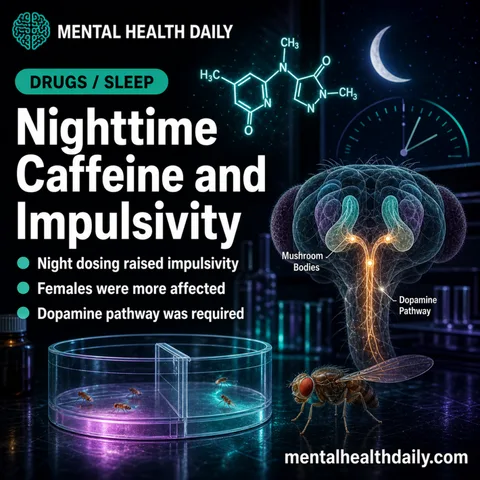
MHD featured image for nighttime caffeine, dopamine, and impulsive motor behavior.

A 2025 iScience study found that nighttime caffeine increased motor impulsivity in Drosophila, with dose-dependent loss-of-inhibition events across n = 30-32 flies per behavioral condition and stronger effects in female flies than male flies.1 The result does not prove that an evening coffee makes humans reckless, but it sharpens a neglected point: caffeine’s alertness benefit …

Read more

Early Antidepressants Linked to Bipolar Impulsivity During Euthymia

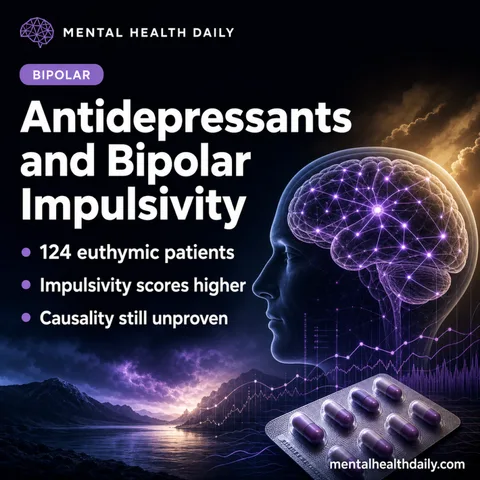
MHD featured image for early antidepressant exposure and impulsivity in bipolar disorder.

A 124-person study of euthymic bipolar disorder found that patients with early systematic antidepressant treatment history had higher negative affect, attentional impulsivity, non-planning impulsivity, and total BIS-11A impulsivity scores than matched patients without that history.1 The association is clinically cautionary, but the cross-sectional design cannot separate antidepressant effects from delayed bipolar diagnosis or more severe …

Read more

Ebselen Failed to Reduce Impulsivity in 130 Healthy Adults

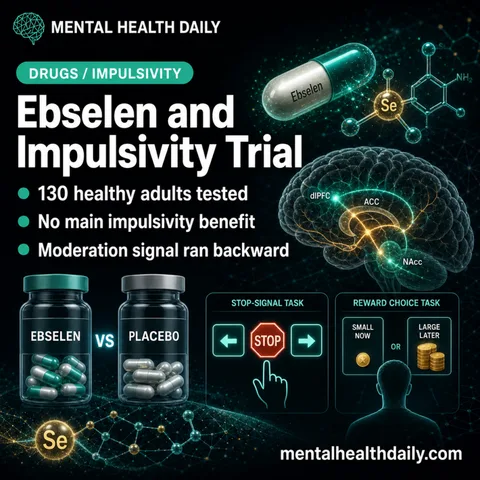
MHD featured image for ebselen and impulsivity placebo trial.

A double-blind placebo-controlled trial found no evidence that ebselen reduced impulsivity in 130 healthy adults: 66 received ebselen, 64 received placebo, and the 1,800 mg 2-day regimen did not improve motor impulsivity, reflection impulsivity, or delay discounting.1 The more interesting calibration is that several trait-impulsivity interactions ran opposite the secondary prediction, weakening the idea that …

Read more

Anterior Cingulate Sulcus Asymmetry Linked to Lower Delay Discounting

MHD featured image for anterior cingulate sulcus asymmetry and delay discounting.

A 2026 Human Connectome Project MRI study linked asymmetric anterior cingulate cortex sulcal pattern to lower delay discounting in 390 healthy young adults: asymmetric ACC morphology predicted a higher delay-discounting area under the curve, meaning delayed rewards lost less value.1 The finding is not a diagnostic scan for impulsivity, but it puts an early-formed cortical-folding …

Read more

5-Week Mindfulness Training Effects on Brain Structure & Behavior: Caudate Volume Reduction & Less Impulsivity (2024 Study)

Mindfulness training is more than a meditative practice; it’s a transformative journey that reshapes our brain, improves our mental faculties, and alters how we respond to emotions and impulses. Recent research has shed light on how this ancient practice can lead to significant changes in the brain’s structure, particularly in the caudate nucleus, and influence …

Read more